Those of you who regularly read my weekly commentary know that I attend conferences and other industry events. (So far this year, I’ve been to two conferences, one four-day seminar and various luncheons and I have even more upcoming events on my calendar.) The presentations are generally informative, but it’s the personal interaction that’s the big draw for me. I’ve made numerous connections over the years, many I never would have made had I simply stayed in my office. Those connections aren’t just with speakers, either; many have been with other attendees.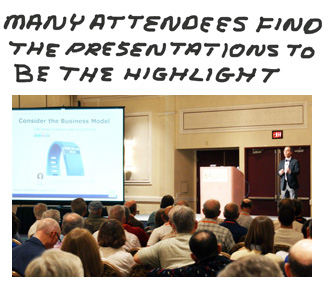
I bring this up because I want to talk to you about our forthcoming AAII Investor Conference. It’s a great opportunity to learn from some of the smartest people in the industry. Not only will you get to attend their presentations, but there will also be time for questions and answers afterward. In addition, you’ll have ample time to meet your fellow individual investors between sessions, at the luncheon and during the two breakfasts.
Of course, the highlight will be the speakers themselves. We’re excited to have behavioral finance expert Meir Statman as our opening ceremony speaker and market strategist Bruce Johnstone as our luncheon keynote speaker. Many of the most popular speakers from past AAII Investor Conferences are returning, including Morningstar’s Christine Benz, Hulbert Financial Digest founder Mark Hulbert, CFRA’s Sam Stovall and AFAM Capital’s John Buckingham. We'll also have new speakers too, including Cambria’s Mebane Faber, Charles Schwab’s Jeffery Kleintop and The Wall Street Journal’s Spencer Jakab.
In addition, you’ll get to hear from my fellow current and former colleagues. Senior financial analyst Wayne Thorp will discuss how to replicate our Shadow Stock methodology with your own portfolio. Computerized Investing editor Jaclyn McClellan will show you how to analyze dividend-paying stocks, including what traits to look for. Former AAII Journal editor (and my predecessor) Maria Crawford Scott will review the best methods for taking retirement withdrawals. As for myself, I’ll unveil the new value- and momentum-oriented stock strategy I’ve been working on.
For more program details, click here.
As you can see, there will be a lot of great information given out over the course of three days. In fact, once you are there, the hardest decision you will have will be choosing which of the concurrent presentations to sit in on. Though you’ll inevitably find yourself skipping one presentation to see another, the good news is that we’ll be recording all of the sessions so you can hear what you’ve missed. (Audio and presentation slides will be made available to you for free.)
This year’s conference will be held at the Loews Royal Pacific Resort in Orlando, Florida. It’s a nice property and is just a short walk from Universal Orlando. If you have children or grandchildren who are fans of Harry Potter, they’ll love the amusement park. Plus, for those of you living in northern states, it’s Florida in November!
Our conferences regularly sell out, so if you’re considering going, register now. Late fees will soon become effective.
I hope to see you there.

- Overcoming Common Behavioral Errors – Meir Statman provided guidance for avoiding the frequent behavioral mistakes many investors make.
- Finding the Right Withdrawal Rate: One Key to Portfolio Sustainability – Maria Crawford Scott gave a comprehensive overview of how to figure out the right withdrawal rate in this 2012 AAII Journal article.
- The Four Groups of ETFs – Think you know ETFs? You should read this interview with Elisabeth Kashner of research firm FactSet to learn even more.
- Analyst Target Prices Influence Merger Completion Rates – Mergers are more likely to be completed when the acquisition price is above analysts’ target prices.
The earnings calendar lists seven S&P 500 member companies as being scheduled to report. They are Best Buy Co. Inc. (BBY) and H&R Block Inc. (HRB) on Tuesday; Analog Devices Inc. (ADI) and Brown-Forman Corp. (BF.B) on Wednesday; and Campbell Soup Co. (CPB), Cooper Companies Inc. (COO) and Dollar General Corp. (DG) on Thursday.
The week’s first economic report will be July international trade in goods, released on Monday. Tuesday will feature the June Case-Shiller home price index (HPI) and the Conference Board’s August consumer confidence survey. On Wednesday, the August ADP national employment report and the first estimate of second-quarter gross domestic product (GDP) will be released. July personal income and spending, the August Chicago Purchasing Managers’ Index (PMI) and July pending home sales will be released on Thursday. Ending the week, August motor vehicle sales, August employment data—including the unemployment rate and the change in nonfarm payrolls, the August Purchasing Managers’ Manufacturing Index (PMI), the Institute for Supply Management’s August manufacturing index, July construction spending and the University of Michigan’s final August consumer sentiment survey will be released on Friday.
The Treasury Department will auction $26 billion of two-year notes and $34 billion of five-year notes on Monday and $28 billion of seven-year notes on Tuesday.
- Inherited IRA Rules for Spouses, Heirs and Trusts
- Avoid the Top 10 Mistakes Made With Beneficiary Designations
- What the Evolving Robo Advisory Industry Offers
The latest AAII Sentiment Survey shows pessimism among individual investors being at its fifth highest level of the year. The jump in pessimism occurred as optimism dropped.
Bullish sentiment, expectations that stock prices will rise over the next six months, plunged 6.1 percentage points to 28.1%. Optimism was last lower on May 31, 2017 (26.9%). This is the 26th consecutive week and the 31st time out of the last 32 weeks that bullish sentiment is below its historical average of 38.5%.
Neutral sentiment, expectations that stock prices will stay essentially unchanged over the next six months, rose by a modest 0.6 percentage points to 33.6%. The rise keeps neutral sentiment above its historical average of 31.0% for the 17th consecutive week and the 22nd time out of the last 23 weeks.
Bearish sentiment, expectations that stock prices will fall over the next six months, surged 5.5 percentage points to 38.3%. Pessimism was last higher on April 19, 2017 (38.7%). This is the fourth consecutive week with a bearish sentiment reading above the historical average of 30.5%.
Recent weakness in the major indexes along with concerns about high valuations are combining to dampen the short-term outlook for stocks among many individual investors. Bearish sentiment has been climbing throughout this month.
Optimism is below 30% for the first time in six weeks. At its current level, bullish sentiment is right at the border between the range of typical readings and unusually low readings.
While this year’s record highs for the major indexes continue to encourage some individual investors, many others have expressed concern about the possibility of a pullback and/or the prevailing level of valuations. The Trump administration remains at the forefront of many investors’ minds and it is having a significant impact on sentiment. Other factors playing roles are valuations, earnings and interest rates/monetary policy.
This week’s special question asked AAII members how second-quarter earnings have influenced their outlook for stock prices. Just under 38% of respondents said that the earnings reports have had a positive impact, or at least led them to be less negative. Approximately one-third of respondents (32%) described their outlook as not being altered by corporate profits. Some of these respondents said Washington politics are having a bigger impact than earnings. Slightly more than 22% of respondents have a more negative view of stocks following second-quarter earnings season. A perception of valuations being too high and/or the pace of earnings growth being unsustainable were the primary reasons why.
Here is a sampling of the responses:
- “Good earnings reports are a positive sign.”
- “They prompted me to revise the decline I expect to a smaller magnitude.”
- “Stock prices are higher than they should be based on earnings.”
- “Second-quarter earnings have been better than I expected, but I’m concerned that the third quarter may not be as good.”
- “Earnings are not influencing my outlook as much as Washington D.C. turmoil and uncertainty.”
Historical averages:
- Bullish: 38.5%
- Neutral: 31.0%
- Bearish: 30.5%

Bullish: 28.1%, down 6.1 points
Neutral: 33.6%, up 0.6 points
Bearish: 38.3%, up 5.5 points
Bullish: 38.5%
Neutral: 31.0%
Bearish: 30.5%
Local Chapter Meetings

August 17, 2017 The New Bubble: Bitcoin and Other Cryptocurrencies
August 10, 2017 Value Investing Is Not Dead
August 3, 2017 Successful Investing Requires Coping With Some Discomfort
July 27, 2017 Volatility Is Extraordinarily Low