My Decision to Stick With an Intermediate-Term Corporate
Bond Fund
Bond Fund
Thursday, November 2, 2017

A small change in our 403(b) plan combined with the start of the best six months for stock prices prompted me to revisit my choice of bond funds. The change to our workplace retirement plan made Vanguard’s Admiral share class of funds available to us. These funds carry a lower expense ratio than the investor share class. (We were previously barred from owning this class of fund’s shares regardless of what our account balances were.)
I’ll get to my allocation and the reason for looking at my portfolio momentarily, but I want to first address why I own bond funds and why I specifically opted for an intermediate-term corporate bond fund.
A bond fund provides a psychological buffer by reducing a portfolio’s volatility relative to what an all-equity portfolio would have. Allocating to fixed income also provides a reserve I can tap into during turbulent periods for stocks. Should stock prices fall low enough, I can use the bond allocation to rebalance my portfolio by buying stocks when they are cheap.
Intermediate-term bonds split the risk of what will or won’t happen to interest rates in the future. Should rates rise significantly, intermediate-term bonds will hurt less than long-term bonds will. Should interest rates turn out to be lower than expected, intermediate-term bonds will provide more yield than short-term bonds will. Since I don’t know what the future interest rate environment will actually be, I’d rather not put real money on what would be a guess.
The other factor to be considered when choosing what type of bond fund to hold is credit risk. Credit risk is the extra chance of default that is incurred by not investing in Treasury bonds. The greater the perceived risk of default, the higher the yield investors are going to require as compensation for risk of the bond issuer not paying its debt obligations. Currently, the credit spreads—the difference in yields between Treasury bonds and similarly rated corporate (or other) bonds—are unusually low. When spreads widen again (and I have no idea when this will happen), corporate bonds will be hurt. So, by holding corporate bonds instead of similarly dated Treasury bonds, I’m currently incurring this risk.
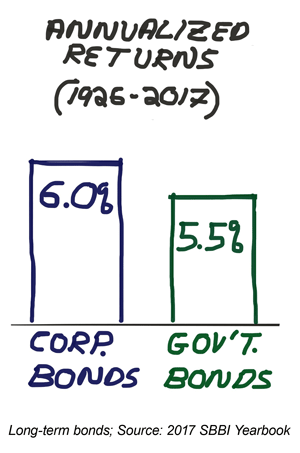
To revisit my decision to accept this risk, I reanalyzed the historical data on long-term government and corporate bonds. Though admittedly not purely an apples-to-apples comparison, the Ibbotson SBBI Yearbook’s 91 years of data allow me to look across a variety of business and interest rate environments. The data shows a return advantage to corporate bonds (6.0% annualized versus 5.5% for government bonds) with long-term corporate bonds realizing higher annual returns during 55 out of the last 91 years. Furthermore, long-term corporate bond funds have experienced about 15% less volatility on an annualized basis.
As far as the timing of why I looked at my portfolio recently, it has to do with my portfolio schedule. I check my portfolio at the end of April and the end of October to see if any rebalancing is needed. Since the end of World War II, the S&P 500 has risen by 8.3% between November and April according to Sam Stovall at CFRA Research. In contrast, the large-cap index has returned just 1.4% between May and October. (The Stock Trader’s Almanac has similar data showing the existence of the best and worst six-month periods.) If my portfolio allocations are off target by more than five percentage points, I rebalance.
My target allocation is an equal weighting of five funds (20% per fund). The five funds are Vanguard S&P 500 (VFIAX), Vanguard FTSE All-World ex-US Small-Cap (VFSVX), Vanguard Intermediate-Term Investment-Grade (VFIDX), Vanguard REIT (VGSLX) and Vanguard Small-Cap Value (VSIAX). Each fund has the same target allocation of 20%. All but the all-world small-cap fund are admiral share class funds. When I checked my account a few days ago, no rebalancing was required. I haven’t done the detailed math, but I suspect monthly contributions to the account are helping to widen the frequency between when rebalancing would be needed versus the same allocation with no ongoing contributions.

- Corporate Bond Analysis: What to Consider – This 2011 AAII Journal article explains how a corporation’s characteristics affect how risky investors view its bonds to be.
- Using Seasonal and Cyclical Stock Market Patterns – Additional details on the best six months and other seasonality factors associated with stock market returns.
- Model Shadow Stock Portfolio: Special Update and Rule Changes – The momentum and holding period rules are being updated. Plus, starting in 2018, commentary will be provided six times a year.
- Discontinuing the Model Fund Portfolio, but Keeping the Level3 Passive Portfolio – The Model Fund Portfolio is ending after 14 years. Updates to the Level3 Passive Portfolio will be included with the Model Shadow Stock Portfolio commentary.
Expect to see earnings reports from any mid- and smaller-sized companies. In addition to them, 48 S&P 500 companies are on the calendar including Dow Jones industrial average component Walt Disney Co. (DIS). Disney will report on Thursday.
The week’s first economic report will be the September JOLTS report from the Labor Department, released on Tuesday. The University of Michigan’s preliminary November Consumer Sentiment Survey will be released on Friday.
Only one Federal Reserve official will make a public appearance: New York president William Dudley will speak on Monday.
The Treasury Department will auction $24 billion of three-year notes on Tuesday, $23 billion of 10-year notes on Wednesday and $15 billion of 30-year bonds on Thursday.
AAII Sentiment Survey
The week’s first economic report will be the September JOLTS report from the Labor Department, released on Tuesday. The University of Michigan’s preliminary November Consumer Sentiment Survey will be released on Friday.
Only one Federal Reserve official will make a public appearance: New York president William Dudley will speak on Monday.
The Treasury Department will auction $24 billion of three-year notes on Tuesday, $23 billion of 10-year notes on Wednesday and $15 billion of 30-year bonds on Thursday.
Optimism among individual investors about the short-term direction of stock prices rose to its second-highest level of the year in the latest AAII Sentiment Survey. The rise occurred as both neutral and bearish sentiment fell.
Bullish sentiment, expectations that stock prices will rise over the next six months, jumped 5.4 percentage points to 45.1%. Optimism was last higher on January 4, 2017 (46.2%). The increase puts optimism above its historical average of 38.5% for the fifth time in eight weeks.
Neutral sentiment, expectations that stock prices will stay essentially unchanged over the next six months, declined 1.0 percentage points to 26.4%. The pullback puts neutral sentiment at its lowest level since March 8, 2017 (23.5%). The historical average is 31.0%.
Bearish sentiment, expectations that stock prices will fall over the next six months, fell 4.5 percentage points to 28.6%. Pessimism has now been below its long-term historical average of 30.5% for six out of the past eight weeks.
At their current levels, all three sentiment indicators are well within their typical historical ranges. We are continuing to see an overall improvement in optimism, however. Five of this year’s eight above-average readings for bullish sentiment have occurred after Labor Day.
Political drama in Washington remains at the forefront of many individual investors’ minds. (Many have previously expressed skepticism about the prospects of tax reform actually being passed.) Opinions about stocks are mixed, with many individual investors viewing stocks as being a bit or too overpriced. Other individual investors are encouraged by the growth in earnings and the market’s upward momentum. In the background are concerns about the lack of volatility and the possibility of a forthcoming correction.
This week’s special question asked AAII members what their comfort level was with the current valuation level of stocks. More than two out of five respondents (42%) said they were uncomfortable. Many of these respondents described valuations as being “high,” though some of these respondents clarified their views by calling valuations “a little” or “a bit” too high. Slightly more than 26% of respondents described themselves as being comfortable with the current level of valuations. Several of these respondents pointed toward earnings growth as supporting current prices. Nearly 13% expressed a more mixed opinion, saying valuations are varying by stock, valuations could be sustained if earnings growth continues and/or interest rates remain low or that stock prices could continue to climb even with the current level of valuations.
Here is a sampling of the responses

Bullish: 45.1%, up 5.4 points
Neutral: 26.4%, down 1.0 points
Bearish: 28.6%, down 4.5 points
Bullish: 38.5%
Neutral: 31.0%
Bearish: 30.5%
Take the Sentiment Survey.Bullish sentiment, expectations that stock prices will rise over the next six months, jumped 5.4 percentage points to 45.1%. Optimism was last higher on January 4, 2017 (46.2%). The increase puts optimism above its historical average of 38.5% for the fifth time in eight weeks.
Neutral sentiment, expectations that stock prices will stay essentially unchanged over the next six months, declined 1.0 percentage points to 26.4%. The pullback puts neutral sentiment at its lowest level since March 8, 2017 (23.5%). The historical average is 31.0%.
Bearish sentiment, expectations that stock prices will fall over the next six months, fell 4.5 percentage points to 28.6%. Pessimism has now been below its long-term historical average of 30.5% for six out of the past eight weeks.
At their current levels, all three sentiment indicators are well within their typical historical ranges. We are continuing to see an overall improvement in optimism, however. Five of this year’s eight above-average readings for bullish sentiment have occurred after Labor Day.
Political drama in Washington remains at the forefront of many individual investors’ minds. (Many have previously expressed skepticism about the prospects of tax reform actually being passed.) Opinions about stocks are mixed, with many individual investors viewing stocks as being a bit or too overpriced. Other individual investors are encouraged by the growth in earnings and the market’s upward momentum. In the background are concerns about the lack of volatility and the possibility of a forthcoming correction.
This week’s special question asked AAII members what their comfort level was with the current valuation level of stocks. More than two out of five respondents (42%) said they were uncomfortable. Many of these respondents described valuations as being “high,” though some of these respondents clarified their views by calling valuations “a little” or “a bit” too high. Slightly more than 26% of respondents described themselves as being comfortable with the current level of valuations. Several of these respondents pointed toward earnings growth as supporting current prices. Nearly 13% expressed a more mixed opinion, saying valuations are varying by stock, valuations could be sustained if earnings growth continues and/or interest rates remain low or that stock prices could continue to climb even with the current level of valuations.
Here is a sampling of the responses
- “My comfort level is low. Valuations are too high.”
- “I am generally comfortable with valuations because of low interest rates, an improving economy and improving profitability.”
- “Valuations seem a bit too high. I wouldn’t be surprised to see a market correction.”
- “Slightly uncomfortable, but bearable. I expect interest rates to stay reasonably low and company earnings to slowly increase.”
- “They are likely a bit high, but appear to be all over the map.”
This week’s Sentiment Survey results:
Bullish: 45.1%, up 5.4 points
Neutral: 26.4%, down 1.0 points
Bearish: 28.6%, down 4.5 points
Historical averages:
Bullish: 38.5%
Neutral: 31.0%
Bearish: 30.5%
AAII Asset Allocation Survey
Last month, cash allocations among individual investors fell to their lowest level since the summer. The October AAII Asset Allocation Survey also shows a rebound in fixed-income allocations and a decline in equity allocations.
Stock and stock fund allocations declined 0.7 percentage points to 68.0%. Equity allocations were last higher in June 2017 (68.8%). October was the 55th consecutive month that equity allocations were above their historical average of 60.5%.
Bond and bond fund allocations rebounded by 1.8 percentage points to 16.9%. The historical average is 16.0%.
Cash allocations fell 1.0 percentage points to 15.1%. Cash allocations were last lower in July 2017 (14.5%). October was the 71st consecutive month that cash allocations were below their historical average of 23.5%.
This is the first time since February and March 2015 that equity allocations have equaled or exceeded 68.0% in consecutive months. Fixed-income allocations have been above their historical average three times and below their historical average three times over the past six months. The range for fixed-income allocations over this period of time has been from 15.0% (June) to 17.7% (July).
Optimism about the short-term direction of the stock market hovered around its historical average through October in our weekly Sentiment Survey. Yields on the benchmark 10-year Treasury continued to rise (albeit modestly) last month. Differences in which AAII members take the survey from month to month can also influence the results.
Last month’s special question asked AAII members how the Federal Reserve’s decision to unwind its balance sheet is affecting their expectations for interest rates. Nearly 70% anticipate interest rates will rise, though the majority of these respondents believe the rise will be slow and gradual. An additional 20% of respondents think the unwinding of the Fed’s balance sheet will either have gradual or no impact.
Here’s a sampling of the responses:
Stock and stock fund allocations declined 0.7 percentage points to 68.0%. Equity allocations were last higher in June 2017 (68.8%). October was the 55th consecutive month that equity allocations were above their historical average of 60.5%.
Bond and bond fund allocations rebounded by 1.8 percentage points to 16.9%. The historical average is 16.0%.
Cash allocations fell 1.0 percentage points to 15.1%. Cash allocations were last lower in July 2017 (14.5%). October was the 71st consecutive month that cash allocations were below their historical average of 23.5%.
This is the first time since February and March 2015 that equity allocations have equaled or exceeded 68.0% in consecutive months. Fixed-income allocations have been above their historical average three times and below their historical average three times over the past six months. The range for fixed-income allocations over this period of time has been from 15.0% (June) to 17.7% (July).
Optimism about the short-term direction of the stock market hovered around its historical average through October in our weekly Sentiment Survey. Yields on the benchmark 10-year Treasury continued to rise (albeit modestly) last month. Differences in which AAII members take the survey from month to month can also influence the results.
Last month’s special question asked AAII members how the Federal Reserve’s decision to unwind its balance sheet is affecting their expectations for interest rates. Nearly 70% anticipate interest rates will rise, though the majority of these respondents believe the rise will be slow and gradual. An additional 20% of respondents think the unwinding of the Fed’s balance sheet will either have gradual or no impact.
Here’s a sampling of the responses:
- “I expect interest rates to gradually and moderately increase over the next few years.”
- “I’m expecting them to gradually rise.”
- “None. A wise decision to unwind as long as it is done on a gradual basis.”
- “[Interest rates] should rise. Although easy money from foreign governments should keep them from rising too quickly.”
- “Interest rates will rise at a slow, but steady rate and will not cause significant market disruptions.”
October AAII Asset Allocation Survey results:
- Stocks and stock funds: 68.0%, down 0.7 percentage points
- Bonds and bond funds: 16.9%, up 1.8 percentage points
- Cash: 15.1%, down 1.0 percentage points
October AAII Asset Allocation Details:
- Stocks: 30.8%, up 0.5 percentage points
- Stock funds: 37.3%, down 1.2 percentage points
- Bonds: 3.0%, up 0.4 percentage points
- Bond funds: 13.8%, up 1.3 percentage points
Take the Asset Allocation Survey.
Local Chapter Meetings
AAII Local Chapter Meetings offer you a variety of presentations from expert speakers who will give you their view on the world of investing. A bonus of attending a Chapter Meeting near you is the opportunity to meet other AAII members who share your interest and enthusiasm for investing. You can even share the Chapter experience with your family and friends by inviting them to attend Chapter Meetings with you!

Archives
October 26, 2017 Portfolio Optimization Isn’t Necessarily Worth the Effort
October 19, 2017 Lessons From Black Monday
October 12, 2017 Bill Bengen Discusses His Retirement Withdrawal Strategy
October 5, 2017 What Investments Do You Need?
October 26, 2017 Portfolio Optimization Isn’t Necessarily Worth the Effort
October 19, 2017 Lessons From Black Monday
October 12, 2017 Bill Bengen Discusses His Retirement Withdrawal Strategy
October 5, 2017 What Investments Do You Need?