Even with last weekend’s government shutdown, no agreed-upon budget and yet another debt ceiling increase needed, the major U.S. indexes continued to set record highs. While Mr. Market’s ongoing calm mood may seem paradoxical given what’s happening inside of the Beltway, one study suggests it is normal for volatility to be low.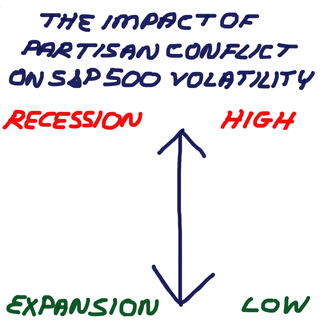
The study’s authors (Rangan Gupta et. al) analyzed the S&P 500 index’s volatility in relation to partisan conflict over the period of January 1981, through April 2017. Partisan conflict was measured by tabulating the number of headlines referring to political disagreement among U.S. politicians. The headlines were pulled from The Washington Post, The New York Times, the Los Angeles Times, the Chicago Tribune, and The Wall Street Journal. Volatility was measured using a statistical analysis of fluctuations in the S&P 500’s returns.
Gupta and his co-authors found the negative impact of partisan conflict on relative volatility “is more pronounced when the former increases from an initial value moderately below or above the median, with [the S&P 500’s volatility] being lower than its normal state.” One reason why this would be the case is the inverse impact that higher partisan conflict has on economic policy uncertainty. The more politicians disagree with each other, the less likely they are to push through legislation affecting the economy. The study’s authors further suggest that partisan conflict “at least causes market agents to perceive a possible reduction in economic policy uncertainty, and, hence, a fall in market volatility.”
The state of the economy also plays a role. Conflict during expansions reduces relative volatility. During expansions, investors perceive that partisan conflict will not lead to a change in economic policy. Alternatively, a forthcoming paper cited in this study raises the possibility of uncertainty about economic policy being lower during expansions. During recessions, partisan conflict can increase volatility particularly if the level of conflict is quite high. The study’s authors theorize the “increased partisan conflict, especially if it is quite high, is likely to result in a policy change and volatility tends to rise, as a result of increased policy uncertainty.”
There are, of course, other factors at play right now. The economy has continued to expand here in the U.S. Many other countries are also experiencing stronger growth. At the same time, the credit markets remain tame even with the recent upward move in Treasury yields. Monetary policy is still accommodative in many countries.
As far as Washington D.C. is concerned, what frustrates us personally doesn’t always necessarily impact the stock market. Yes, there is a long list of problems that our elected officials need to address, but their inability to reach compromises or otherwise be productive shouldn’t in itself give you reason to stay out of the market. I realize that it can be hard to set aside your frustrations with our collective elected officials (I’m not happy with them either), but the market factors political risk, or at least the current expectations of it, into asset prices.
The market also prices in expected monetary policy. I mention this because Jerome “Jay” Powell was confirmed by the Senate to be the next Fed chair on Tuesday. Powell expects to continue the current course of modest rate hikes and unwinding the Fed’s balance sheet. Though monetary policy is in a tightening cycle, the current actions are being viewed more as an unwinding of stimulus than a hard push on the economy’s brakes. The well-telegraphed moves have so far been well received. Plus, the expectation of Powell not representing a significant departure from what current Chair Janet Yellen might have done had she been given another term is likely contributing to the stock market's ongoing low level of the volatility.

- Follow the Fed, but Be Smart About It – Whether the monetary policy is loosening or tightening influences the returns realized by stocks.
- Managing Your Portfolio in Difficult Markets – The long-term lessons given in this 2012 AAII Journal article also apply to those of you who are letting your political frustrations filter through to your portfolio decisions.
- Polar Opposite: MAGNET Complex Goes From Bottom to Top in 2017 – Most of the AAII stock screening strategies realized gains last year, with 25 besting the S&P 500, as Wayne Thorp discusses in our annual review.
- For Mutual Funds, Competition Doesn’t Mean Lower Fees – Domestic equity funds operating in more competitive market segments charge more than funds operating in less competitive segments.
It’s going to be a busy week for earnings with 123 members of the S&P 500 scheduled to report. Included in this group are 10 Dow components: Pfizer Inc. (PFE) and McDonald’s Corp. (MCD) on Tuesday; Microsoft Corp. (MSFT) and Boeing Co. (BA) on Wednesday; DowDuPont Inc. (DWDP), Visa Inc. (V) and Apple Inc. (AAPL) on Thursday; and Merck & Co. Inc. (MRK), Chevron Corp. (CVX) and Exxon Mobil Corp. (XOM) on Friday.
The Federal Open Market Committee will hold a two-day meeting starting on Tuesday. It will be the last meeting with Janet Yellen serving as the chair. The meeting statement will be released on Wednesday around 2:00 p.m. ET. No change in rates is expected.
The week’s first economic report will be December personal income and spending, released on Monday. The November Case-Shiller home price index and the Conference Board’s January consumer confidence survey will be released on Tuesday. Wednesday will feature the January ADP employment report, January Chicago purchasing managers’ index (PMI) and the December pending home sales index. January motor vehicle sales, preliminary fourth-quarter productivity, the January PMI manufacturing index, the ISM’s January manufacturing index and December construction spending will be released on Thursday. On Friday, January jobs data—including the changes in nonfarm payrolls and the unemployment rate—plus the University of Michigan’s final January consumer sentiment survey and December factory orders will be released.
San Francisco president John Williams, who will speak on Friday, is the only Federal Reserve official scheduled to make a public appearance.
- How Much Should You Have in Equities Until Retirement?
- Should You Maintain an Allocation to Bonds When Current Rates Are Low?
- A Do-It-Yourself Approach to Target Date Retirement Investing
Optimism among individual investors fell back into its typical historical range for the first time since mid-December. At the same time, both neutral and bearish sentiment rebounded in the latest AAII Sentiment Survey.
Bullish sentiment, expectations that stock prices will rise over the next six months, fell 8.7 percentage points to 45.5%. Optimism was last lower on December 14, 2017 (45.0%). Even with the decline, bullish sentiment remains above its historical average of 38.5% for the seventh consecutive week.
Neutral sentiment, expectations that stock prices will stay essentially unchanged over the next six months, jumped 6.0 percentage points to 30.5%. Neutral sentiment was last higher on November 30, 2017 (32.4%). Even with the rise, neutral sentiment remains below its historical average of 31.0% for the eighth consecutive week.
Bearish sentiment, expectations that stock prices will fall over the next six months, rebounded by 2.6 percentage points to 24.0%. Nonetheless, pessimism remains below its historical average of 30.5% for the seventh consecutive week.
Levels of optimism between 28.1% and 48.6% are considered to be typical. Prior to this week’s reading, bullish sentiment had been at an unusually high level for five consecutive weeks. Such readings have historically been followed by lower-than-average returns for the S&P 500 index over the preceding six- and 12-month periods.
Some individual investors are encouraged by the record highs for the major indexes, the tax cuts and/or the Federal Reserve’s decision to continue raising interest rates at a gradual pace. Other individual investors are concerned about the possibility of a pullback or a more severe drop occurring. Even many investors who are optimistic about the overall direction of stocks expect a return of volatility this year. Also affecting investor sentiment are earnings growth, economic growth, valuations and the lack of volatility. Washington politics remain at the forefront of many individual investors’ minds.
This week’s special question asked AAII members for their opinion about the overall level of optimism (from both individual and institutional investors) being reflected by the market so far this year. Responses were split primarily into two groups. Nearly 49% think optimism is currently too high. Some of these respondents think the market is reflecting euphoria or irrational exuberance or has gotten ahead of itself. Conversely, 39% of respondents think the level of optimism is justified or is otherwise warranted. Several of these respondents pointed to the tax cuts, the changes in the regulatory environment or economic growth.
Here is a sampling of the responses:
- “Everyone is bullish and optimistic about the coming year, but I will quietly prepare for the cliff.”
- “Businesses and individual investors are positive about economic growth in the short to intermediate term (one to two years).”
- “I feel the guys who were on the sidelines are jumping in now and driving the market to new highs.”
- “I think it’s warranted by corporate tax reform and the general improvement in the economy.”
- “I think things are way too exuberant.”
- “I believe optimism is too high and yet I’m optimistic!”

Bullish: 45.5%, down 8.7 points
Neutral: 30.5%, up 6.0 points
Bearish: 24%, up 2.6 points
Bullish: 38.5%
Neutral: 31.0%
Bearish: 30.5%
Local Chapter Meetings

January 18, 2018 Comparing the 2018 Melt Up to the 1999 Bubble
January 11, 2018 Two Ways to Build and Preserve Wealth
January 4, 2018 Quality Can Help Put the Odds in Your Favor
December 28, 2017 19 Investing Resolutions for 2018