Performance chasing is common in investing. Not investing based on momentum strategies per se, but choosing funds, money managers and newsletters based on recent performance. Institutional investors (pensions, endowments, etc.) are as guilty as individual investors when it comes to looking for the hot hand.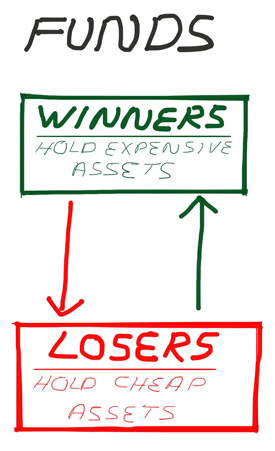
Such behavior often leads to worse outcomes than better ones. While some funds and managers should be walked away from—if there is going to be average performance, then there has to be below-average performance too—not all should be fired based on recent performance. Some underperformers should actually be hired (purchased).
Rob Arnott and two of his colleagues at Research Affiliates made the argument for doing so in a paper appropriately titled, “The Folly of Hiring Winners and Firing Losers.” The authors looked at over 3,300 funds. They found that, in certain instances, chasing worse aggregate performance can be a profitable strategy. The key is to seek funds whose style is out of favor, thereby causing them to hold undervalued assets. Likewise, leave funds whose styles have been very much in favor, thereby causing them to hold overvalued assets. It is a buy low, sell high approach.
A simple strategy of shifting to managers whose performance lagged over the past one-, three- or five-year periods led to higher returns if the losers were held for the same period in the future. (For example, buy the funds with the worst one-year performance and hold them for the following one-year period.) This is based on aggregate results. Even the paper’s authors acknowledge that the strategy cannot be used to differentiate between managers.
Looking at return relative to the market can help a bit. Favor funds whose returns lagged the market over those whose returns beat the market after fees have been adjusted for. (Be wary of funds with high expense ratios.)
You should also consider returns relative to a fund’s peers. If small-cap value is out of favor, then all true small-cap value approaches will be out of favor too. Some funds, however, will do better than others. In this case, you want to choose the best of the losers. “Unlike in the case of the simple return or the return relative to the market, we do not find mean reversion in performance once we control for manager peer-group performance,” observed the paper’s authors. In layman’s terms, the better fund managers hold their edge relative to their subpar peers.
If this all sounds a bit counterintuitive, step back and consider the bigger picture. A fund’s returns are determined by three things: the market environment, the approach followed and the skill of the manager. Manager skill can be assessed by comparing a fund’s performance to its peers. The other two aspects are beyond a manager’s control. This said, many funds follow a specific style such as value, growth, etc. These so-called "factors" and their performance relative to the broader market have a big influence on a specific fund's returns and can explain why the “losers” can beat the “winners” going forward. Again, from the authors:
“When a factor performs poorly it drags down the fund’s return, which contributes to cheap valuations that lead to future superior performance. It also works the other way around: stellar performance of a factor will boost the fund’s return, pushing its valuations higher until they are very expensive, and setting the fund up for future disappointing performance.”
Of course, some factors can remain in favor for a period of several years. This is where valuation comes into play. Look at the valuations of the fund’s holdings. If they’re expensive, the fund could be at greater risk for disappointing future performance. If they’re cheap, the fund could be set for a rebound.

- The Truth About Top-Performing Mutual Fund Managers – Top-performing mutual funds underperform their benchmarks at some point, but investors are usually rewarded for sticking with them.
- How to Measure the Skills of Your Fund Manager – The statistical measure R-squared, included in our Mutual Fund Guide, can reveal whether a fund manager is truly following a differentiated strategy.
- Retirement Planning Strategies Following the 2017 Tax Act – The lower tax rates and higher standard deductions make taking advantage of Roth IRAs more attractive now.
- “Sell in May” Has Weakened as a Strategy – The relative underperformance of stocks starting in May has become less severe because the so-called January effect has weakened.
As a reminder, the U.S. stock exchanges will be closed tomorrow in observance of Good Friday. Our office will be closed as well. On behalf of everyone at AAII, I wish a happy Easter to those of you observing the holiday. For those of you observing Passover, I wish you a happy Pesach as well as luck in finding the afikoman.
Only four S&P 500 companies will report earnings next week: Acuity Brands Inc. (AYI), CarMax Inc. (KMX), Monsanto Co. (MON) and Lennar Corp. (LEN) on Wednesday.
The week’s first economic reports will be the March Purchasing Managers’ Manufacturing Index (PMI), the Institute for Supply Management’s (ISM) March manufacturing index and February construction spending, released on Monday. Tuesday will feature March motor vehicle sales. The March ADP employment report, February factory orders and the ISM’s March non-manufacturing index will be released on Wednesday. February international trade will be released on Thursday. March jobs data—including the change in nonfarm payrolls and the unemployment rate—will be released on Friday.
Two Federal Reserve officials will make public appearances: Minneapolis president Neel Kashkari on Monday and Tuesday, and Cleveland president Loretta Mester on Wednesday.
- The Top Mutual Funds Over Five Years: Tech Takeover
- Tax Guide Update: The Tax Cuts and Jobs Act and 2018 Taxes
- Why a New Allocation Approach Is Needed
The percentage of individual investors who are pessimistic about the short-term direction of stock prices is at its highest level in nearly seven months. The latest AAII Sentiment Survey also shows declines in both bullish and neutral sentiment.
Bullish sentiment, expectations that stock prices will rise over the next six months, declined 1.3 percentage points to 31.9%. The decline keeps optimism below its historical average of 38.5% for the sixth time in eight weeks.
Neutral sentiment, expectations that stock prices will stay essentially unchanged over the next six months, fell 5.5 percentage points to 32.7%. Though at a five-week low, neutral sentiment remains above its historical average of 31.0% for a sixth consecutive week.
Bearish sentiment, expectations that stock prices will fall over the next six months, jumped 6.8 percentage points to 35.3%. Pessimism was last higher on September 7, 2017. The rise puts bearish sentiment above its historical average of 30.5% for just the second time in the last 16 weeks.
After falling to its second-lowest level of the year two weeks ago, pessimism has rebounded by a cumulative 14.0 percentage points. Over the same two-week period, the S&P 500 index has lost 5.3% of its value.
Many individual investors are anticipating continued volatility and/or think the current political backdrop could have a further impact on the stock market. Trade policy is influencing some individual investors’ sentiment, but not all. While many individual investors either approve of the recent interest rate hike or don’t expect it to affect the stock market, some are concerned about the impact that rising rates will have as the responses to this week’s special question indicate. Also influencing sentiment are valuations, tax cuts, earnings and economic growth.
This week’s special question asked AAII members for their thoughts about the Federal Open Market Committee’s (FOMC) recent decision to raise interest rates. Slightly more than half of all respondents (51%) approved of the increase. Many of these respondents thought it was necessary. An additional 15% of respondents described the increase as being expected and/or already priced into the market, while 11% thought that it was about time rates were raised again or otherwise viewed the hike as being overdue. Slightly less than 12% of respondents either disapproved of the hike or expressed concern about it potentially doing more harm than good.
Here is a sampling of the responses:
- “Everyone anticipated it, so I don’t think it will have a significant impact.”
- “I think rates will be raised, but at a rather slow pace. This will provide a good environment for the stock market.”
- “I am concerned they will raise rates too quickly and that will lead to a recession.”
- “If they continue to raise rates gradually and no more than three times in 2018, we should be okay.”
- “I’ll be glad to earn a little more interest on my cash.”
- “Long predicted and needed as the economy strengthens.”

Bullish: 31.9%, down 1.3 points
Neutral: 32.7%, down 5.5 points
Bearish: 35.3%, up 6.8 points
Bullish: 38.5%
Neutral: 31.0%
Bearish: 30.5%
Local Chapter Meetings

March 22, 2018 The Different Types of Risk
March 15, 2018 Risk Tolerances Change With Both Age and the Market
March 8, 2018 Tariffs and the Market Environment
March 1, 2018 Warren Buffett on Market Volatility, Risk and More