

Related

Financial Statements
These 16 ratios enable investors to compare the fiscal strength, profitability and efficiency of two or more companies.
by Joe Lan | September 2012

In the previous installments of AAII’s Financial Statement Analysis series, I discussed the three most commonly used financial statements—the income statement, balance sheet and cash flow statement.
In this installment of the series, I take an in-depth look at the most commonly used financial ratios. Click here for a downloadable spreadsheet that automatically calculates these ratios using financial statement inputs that you provide. Click here for detailed explanations on creating the ratios for Stock Investor Pro users.
Over the years, investors and analysts have developed numerous analytical tools, concepts and techniques to compare the relative strengths and weaknesses of companies. These tools, concepts and techniques form the basis of fundamental analysis.
Ratio analysis is a tool that was developed to perform quantitative analysis on numbers found on financial statements. Ratios help link the three financial statements together and offer figures that are comparable between companies and across industries and sectors. Ratio analysis is one of the most widely used fundamental analysis techniques.
However, financial ratios vary across different industries and sectors and comparisons between completely different types of companies are often not valid. In addition, it is important to analyze trends in company ratios instead of solely emphasizing a single period’s figures.
What is a ratio? It’s a mathematical expression relating one number to another, often providing a relative comparison. Financial ratios are no different—they form a basis of comparison between figures found on financial statements. As with all types of fundamental analysis, it is often most useful to compare the financial ratios of a firm to those of other companies.
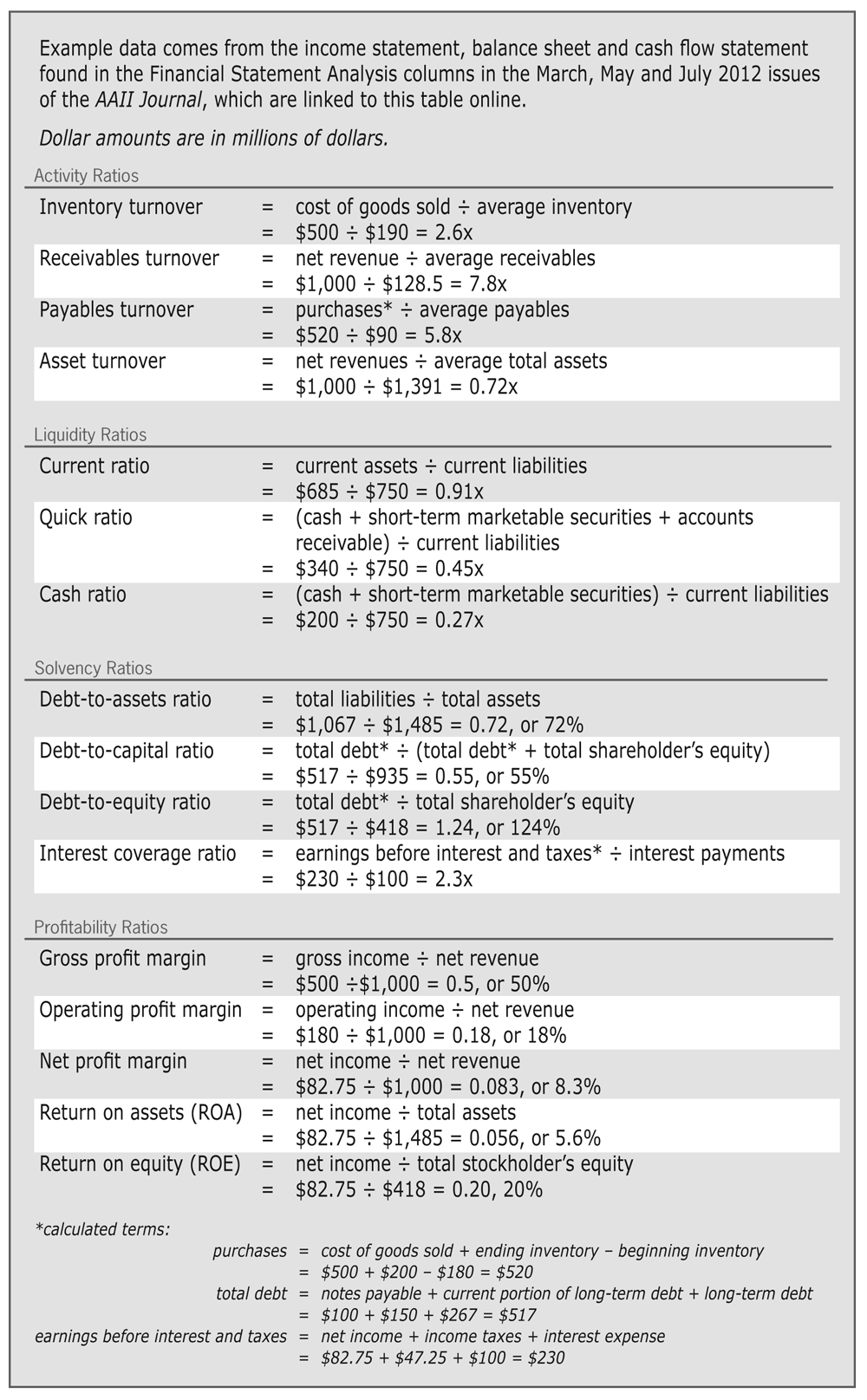
Financial ratios fall into several categories. For the purpose of this analysis, the commonly used ratios are grouped into four categories: activity, liquidity, solvency and profitability. Also, for the sake of consistency, the data in the financial statements created for the prior installments of the Financial Statement Analysis series will be used to illustrate the ratios. Table 1 shows the formulas with examples for each of the ratios discussed.
Activity ratios are used to measure how efficiently a company utilizes its assets. The ratios provide investors with an idea of the overall operational performance of a firm.
As you can see from Table 1, the activity ratios are “turnover” ratios that relate an income statement line item to a balance sheet line item. As explained in my previous articles, the income statement measures performance over a specified period, whereas the balance sheet presents data as of one point in time. To make the items comparable for use in activity ratios, an average figure is calculated for the balance sheet data using the beginning and ending reported numbers for the period (quarter or year).
The activity ratios measure the rate at which the company is turning over its assets or liabilities. In other words, they present how many times per year inventory is replenished or receivables are collected.
Inventory turnover is calculated by dividing cost of goods sold by average inventory. A higher turnover than the industry average means that inventory is sold at a faster rate, signaling inventory management effectiveness. Additionally, a high inventory turnover rate means less company resources are tied up in inventory. However, there are usually two sides to the story of any ratio. An unusually high inventory turnover rate can be a sign that a company’s inventory is too lean, and the firm may be unable to keep up with any increased demand. Furthermore, inventory turnover is very industry-specific. In an industry where inventory gets stale quickly, you should seek out companies with high inventory turnover.
In our example in Table 1, the inventory turnover ratio of 2.6x means that inventory was “turned over” or replenished 2.6 times during a period of one year. (This equates to inventory being turned over once every 140 days, or 365 days ÷ 2.6.) The inventory figure used, $190 million, is calculated using a beginning inventory of $180 million on December 31, 2010, and an ending inventory of $200 million on December 31, 2011. The $190 million represents the average inventory held during 2011, the time period when $500 million was generated in cost of goods sold.
Going forward, a decrease in inventory or an increase in cost of goods sold will increase the ratio, signaling improved inventory efficiency (selling the same amount of goods while holding less inventory or selling more goods while holding the same amount of inventory).
The receivables turnover ratio is calculated by dividing net revenue by average receivables. This ratio is a measure of how quickly and efficiently a company collects on its outstanding bills. The receivables turnover indicates how many times per period the company collects and turns into cash its customers’ accounts receivable.
In Table 1, the receivables turnover is 7.8x, signaling that, on average, receivables were fully collected 7.8 times during the period or once every 47 days (365 ÷ 7.8).
Once again, a high turnover compared to that of peers means that cash is collected more quickly for use in the company, but be sure to analyze the turnover ratio in relation to the firm’s competitors. A very high receivables turnover ratio can also mean that a company’s credit policy is too stringent, causing the firm to miss out on sales opportunities. Alternatively, a low or declining turnover can signal that customers are struggling to pay their bills.
Payables turnover measures how quickly a company pays off the money owed to suppliers. The ratio is calculated by dividing purchases (on credit) by average payables.
Our payables turnover of 5.8x suggests that, on average, the firm used and paid off the credit extended 5.8 times during the period or once every 63 days (365 days ÷ 5.8). The payables turnover increases as more purchases are made or as a company decreases its accounts payable.
A high number compared to the industry average indicates that the firm is paying off creditors quickly, and vice versa. An unusually high ratio may suggest that a firm is not utilizing the credit extended to them, or it could be the result of the company taking advantage of early payment discounts. A low payables turnover ratio could indicate that a company is having trouble paying off its bills or that it is taking advantage of lenient supplier credit policies.
Be sure to analyze trends in the payables turnover ratio, as a change in a single period can be caused by timing issues such as the firm acquiring additional inventory for a large purchase or to gear up for a high sales season. Also understand that industry norms can vary dramatically.
Asset turnover measures how efficiently a company uses its total assets to generate revenues. The formula to calculate this ratio is simply net revenues divided by average total assets. Our asset turnover ratio of 0.72x indicates that the firm generates $0.72 of revenue for every $1 of assets that the company owns.
A low asset turnover ratio may mean that the firm is inefficient in its use of its assets or that it is operating in a capital-intensive environment. Additionally, it may point to a strategic choice by management to use a more capital-intensive (as opposed to a more labor-intensive) approach.
Liquidity ratios are some of the most widely used ratios, perhaps next to profitability ratios. They are especially important to creditors. These ratios measure a firm’s ability to meet its short-term obligations.
The level of liquidity needed varies from industry to industry. Certain industries are more cash-intensive than others. For example, grocery stores will need more cash to buy inventory constantly than software firms, so the liquidity ratios of companies in these two industries are not comparable to each other. It is also important to note a company’s trend in liquidity ratios over time.
The current ratio measures a company’s current assets against its current liabilities. The current ratio indicates if the company can pay off its short-term liabilities in an emergency by liquidating its current assets. Current assets are found at the top of the balance sheet and include line items such as cash and cash equivalents, accounts receivable and inventory, among others.
A low current ratio indicates that a firm may have a hard time paying their current liabilities in the short run and deserves further investigation. A current ratio under 1.00x, for example, means that even if the company liquidates all of its current assets, it would still be unable to cover its current liabilities. In our example, the firm is operating with a very low current ratio of 0.91x. It indicates that if the firm liquidated all of its current assets at the recorded value, it would only be able to cover 91% of its current liabilities.
A high ratio indicates a high level of liquidity and less chance of a cash squeeze. A current ratio that is too high, however, may indicate that the company is carrying too much inventory, allowing accounts receivables to balloon with lax payment collection standards or simply holding too much in cash. Although these issues will not typically lead to insolvency, they will inevitably hurt the company’s bottom line.
The quick ratio is a liquidity ratio that is more stringent than the current ratio. This ratio compares the cash, short-term marketable securities and accounts receivable to current liabilities. The thought behind the quick ratio is that certain line items, such as prepaid expenses, have already been paid out for future use and cannot be quickly and easily converted back to cash for liquidity purposes. In our example, the quick ratio of 0.45x indicates that the company can only cover 45% of current liabilities by using all cash-on-hand, liquidating short-term marketable securities and monetizing accounts receivable.
The major line item excluded in the quick ratio is inventory, which can make up a large portion of current assets but may not easily be converted to cash. During times of stress, high inventories across all companies in the industry may make selling inventory difficult. In addition, if company stockpiles are overly specialized or nearly obsolete, they may be worth significantly less to a potential buyer. Consider Apple Inc. (AAPL), for example, which is known to use specialized parts for its products. If the company needed to quickly liquidate inventory, the stockpiles it is carrying may be worth a great deal less than the inventory figure it carries on its accounting books.
The most conservative liquidity ratio is the cash ratio, which is calculated as simply cash and short-term marketable securities divided by current liabilities. Cash and short-term marketable securities represent the most liquid assets of a firm. Short-term marketable securities include short-term highly liquid assets such as publicly traded stocks, bonds and options held for less than one year. During normal market conditions, these securities can easily be liquidated on an exchange. The cash ratio in Table 1 is 0.27x, which suggests that the firm can only cover 27% of its current liabilities with its cash and short-term marketable securities.
Although this ratio is generally considered the most conservative and very reliable, it is possible that even short-term marketable securities can experience a significant drop in prices during market crises.
Solvency ratios measure a company’s ability to meet its longer-term obligations. Analysis of solvency ratios provides insight on a company’s capital structure as well as the level of financial leverage a firm is using.
Some solvency ratios allow investors to see whether a firm has adequate cash flows to consistently pay interest payments and other fixed charges. If a company does not have enough cash flows, the firm is most likely overburdened with debt and bondholders may force the company into default.
The debt-to-assets ratio is the most basic solvency ratio, measuring the percentage of a company’s total assets that is financed by debt. The ratio is calculated by dividing total liabilities by total assets. A high number means the firm is using a larger amount of financial leverage, which increases its financial risk in the form of fixed interest payments. In our example in Table 1, total liabilities accounts for 72% of total assets.
The debt-to-capital ratio is very similar, measuring the amount of a company’s total capital (liabilities plus equity) that is provided by debt (interesting bearing notes and short- and long-term debt). Once again, a high ratio means high financial leverage and risk. Although financial leverage creates additional financial risk by increased fixed interest payments, the main benefit to using debt is that it does not dilute ownership. In theory, earnings are split among fewer owners, creating higher earnings per share. However, the increased financial risk of higher leverage may hold the company to stricter debt covenants. These covenants could restrict the company’s growth opportunities and ability to pay or raise dividends.
The debt-to-equity ratio measures the amount of debt capital a firm uses compared to the amount of equity capital it uses. A ratio of 1.00x indicates that the firm uses the same amount of debt as equity and means that creditors have claim to all assets, leaving nothing for shareholders in the event of a theoretical liquidation.
For our example, total debt used in the numerator includes short- and long-term interest-bearing debt. This ratio can also be calculated using only long-term debt in the numerator.
The interest coverage ratio, also known as times interest earned, measures a company’s cash flows generated compared to its interest payments. The ratio is calculated by dividing EBIT (earnings before interest and taxes) by interest payments.
In the example used in Table 1, the interest coverage ratio of 2.3x indicates that the firm’s earnings before interest and taxes are 2.3 times its interest obligations for the period. The higher the figure, the less chance a company has of failing to meet its debt repayment obligations. A high figure means that a company is generating strong earnings compared to its interest obligations.
With interest coverage ratios, it’s important to analyze them during good and lean years. Most companies will show solid interest coverage during strong economic cycles, but interest coverage may deteriorate quickly during economic downturns.
Profitability ratios are arguably the most widely used ratios in investment analysis. These ratios include the ubiquitous “margin” ratios, such as gross, operating and net profit margins. These ratios measure the firm’s ability to earn an adequate return. When analyzing a company’s margins, it is always prudent to compare them against those of the industry and its close competitors.
Margins will vary among industries. Companies operating in industries where products are mostly “commodities” (products easily replicated by other firms) will typically have low margins. Industries that offer unique products with high barriers to entry generally have high margins. In addition, companies may hold key competitive advantages leading to increased margins.
Gross profit margin is simply gross income (revenue less cost of goods sold) divided by net revenue. The ratio reflects pricing decisions and product costs. The 50% gross margin for the company in our example shows that 50% of revenues generated by the firm are used to pay for the cost of goods sold.
For most firms, gross profit margin will suffer as competition increases. If a company has a higher gross profit margin than is typical of its industry, it likely holds a competitive advantage in quality, perception or branding, enabling the firm to charge more for its products. Alternatively, the firm may also hold a competitive advantage in product costs due to efficient production techniques or economies of scale. Keep in mind that if a company is a first mover and has high enough margins, competitors will look for ways to enter the marketplace, which typically forces margins downward.
Operating profit margin is calculated by dividing operating income (gross income less operating expenses) by net revenue. The operating margin in Table 1 is 18%, which suggests that for every $1 of revenues generated, $0.18 is left after deducting cost of goods sold and operational expenses. Operating expenses include costs such as administrative overhead and other costs that cannot be attributed to single product units.
Operating margin examines the relationship between sales and management-controlled costs. Increasing operating margin is generally seen as a good sign, but investors should simply be looking for strong, consistent operating margins.
Net profit margin compares a company’s net income to its net revenue. This ratio is calculated by dividing net income, or a company’s bottom line, by net revenue. It measures a firm’s ability to translate sales into earnings for shareholders. Once again, investors should look for companies with strong and consistent net profit margins.
In our example, the net profit margin of 8.3% suggests that for every $1 of revenue generated by the firm, $0.083 is created for the shareholders.
Two other profitability ratios are also widely used—return on assets (ROA) and return on equity (ROE).
Return on assets is calculated as net income divided by total assets. It is a measure of how efficiently a firm utilizes its assets. A high ratio means that the company is able to efficiently generate earnings using its assets. As a variation, some analysts like to calculate return on assets from pretax and pre-interest earnings using EBIT divided by total assets.
While return on assets measures net income, which is return to equity holders, against total assets, which can be financed by debt and equity, return on equity measures net income less preferred dividends against total stockholder’s equity. This ratio measures the level of income attributed to shareholders against the investment that shareholders put into the firm. It takes into account the amount of debt, or financial leverage, a firm uses. Financial leverage magnifies the impact of earnings on ROE in both good and bad years. If there are large discrepancies between the return on assets and return on equity, the firm may be incorporating a large amount of debt. In that case, it is prudent to closely examine the liquidity and solvency ratios.
The firm in our example in Table 1 has an ROA of 5.6%, indicating that for every $1 of company assets, the firm is generating $0.056 in net income. The ROE in our example of 20% suggests that for every $1 in shareholder’s equity, the firm is generating $0.20 in net income.
Ratio analysis is a form of fundamental analysis that links together the three financial statements commonly produced by corporations. Ratios provide useful figures that are comparable across industries and sectors. Using financial ratios, investors can develop a feel for a company’s attractiveness based on its competitive position, financial strength and profitability.
Creating the ratios discussed in this article for use in Stock Investor Pro allows you to quickly pull them up for any company in the database. This overview shows you how to create the ratios to access them through Stock Investor Pro views.
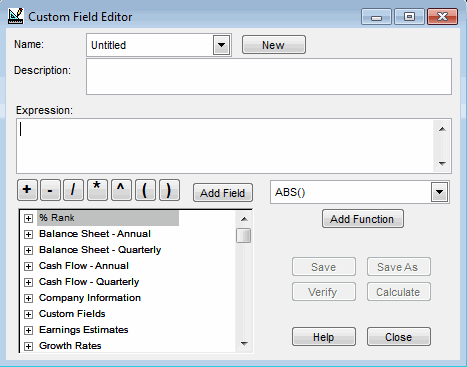
Start by opening the Custom Field Editor by going to go Tools and selecting Custom Field Editor, by pressing Alt-C, or by clicking on the Custom Field Editor icon in the toolbar. The Custom Field Editor is where all the ratios are created.
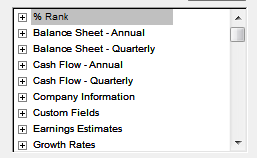
To create each of the ratios, the ratio formula must be entered into the expression box. For instance, when creating inventory turnover ratio, which is calculated by taking cost of goods sold and dividing by average inventory, first click in the expression box and select cost of goods sold from the field picker box. Cost of goods sold is an income statement item, so it is found by expanding the Income Statement – Annual category. To expand any category, click on the plus sign next to category in the field picker window. In our example, we select Cost of Goods Sold Y1, which provides the cost of goods sold figure for the most recently completed fiscal year. After selecting cost of goods sold, click Add Field and the data point will appear in the expression box. Next, press the division symbol and it will also appear in the expression box. The denominator of the inventory turnover equation is average inventory, which requires the average of the beginning and ending inventories for the period. In order to properly enter the denominator, start by inputting two open parentheses by pressing the open parentheses button twice. Expand the Income Statement – Annual category, select Inventory Y1 and press Add Field. Once again, the data field will appear in the expression box.
Next, click on the addition symbol and confirm that it appeared in the expression box. Select Inventory Y2 (the inventory figure at the end of the fiscal year two years ago) and click on Add Field. After checking to see that the data field appeared in the expression box, click on the end parentheses sign. Next, select the divisor sign again and then click on the end parenthesis sign one more time. The denominator of the expression should look like this: ([Inventory Y1] + [Inventory Y2]) / 2). The denominator adds the ending inventory one and two fiscal years ago and then divides by two, which is the average inventory during that period. The entire expression should now be complete and look like this: [Cost of goods sold 12m] / (([Inventory Y1] + [Inventory Y2]) / 2).
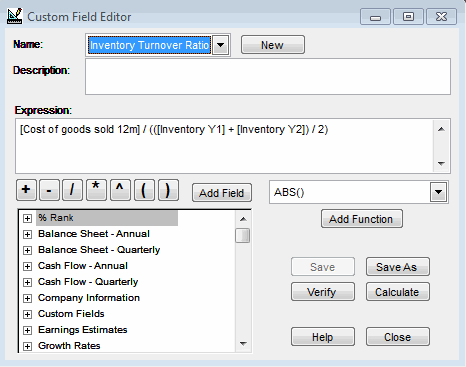
You can also simply type this expression in. Please note that it must be typed into the expression box exactly as it shows up here or the function will not work properly. After finishing the inventory turnover expression, click on Verify. The program notifies you if the expression is valid or invalid. If the expression is valid, you can save and name it by clicking on the Save As button. If the expression is invalid, it means you did not enter in the expression correctly. In our example, we named the expression Inventory Turnover Ratio.
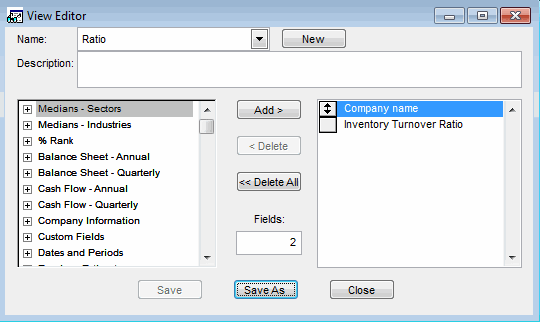
The remaining ratios are created in the same manner. If you know the ratio formula, you can easily create them in Stock Investor Pro. The difficulty lies in knowing which category each of the data fields resides in. For help finding each data point, refer to the Help menu, which includes all the data fields offered in the program. A summary is provided for each data point along with their categories.
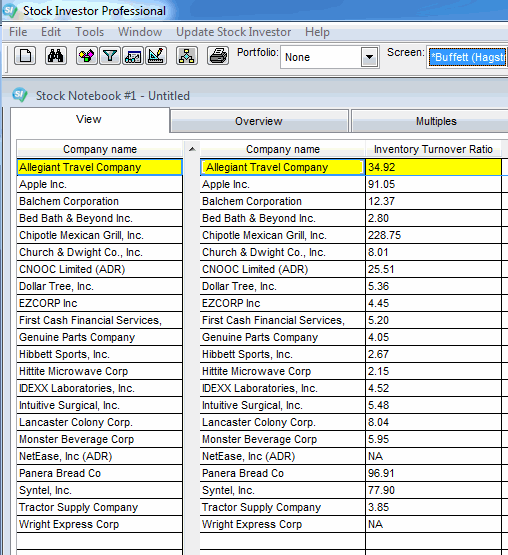
After creating your ratios, the program allows you to create a view to access the ratios quickly and easily. To create a view, open the View Editor by clicking on View Editor from the Tools pulldown menu. The newly created custom fields are all stored in the Custom Fields category. Expand this category and select the ratios you want to be included in your view and press Add, then select Save and name your view. In our example, we include the Company Name and Inventory Turnover Ratio. After creating your view, pull it up by selecting it from the View pulldown menu. As you can see, I selected the Buffett (Hagstrom) screen and the newly created Ratio View. I am shown the companies passing the Buffett (Hagstrom) screen and the Inventory ratio of each company.
—Joe Lan
Introduction to Financial Statement Analysis, January 2012
The Income Statement: From Net Revenue to Net Income, March 2012
The Balance Sheet: Assets, Debts and Equity, May 2012
The Cash Flow Statement: Tracing the Sources and Uses of Cash, July 2012
Financial Statements

Financial Statements

Steven Sears from IA posted over 13 years ago:
Thomas Dean from ON posted over 13 years ago:
Joe Lan from IL posted over 13 years ago:
Doug from Ithaca, NY posted over 13 years ago:
Raj from NJ posted over 13 years ago:
Gerrie Griffin from IL posted over 13 years ago:
Alex from CA posted over 13 years ago:
Doug Dudley from AZ posted over 13 years ago:
Nord from California posted over 12 years ago:
Ron from Ohio posted over 12 years ago:
Paul Courchene from NH posted over 10 years ago:
A. Smith from OH posted over 10 years ago:
Donald Levy from NY posted over 8 years ago:
You need to log in as a registered AAII user before commenting.
Log InCreate an account