


- When the stock market starts to disappoint, it helps to have a historical perspective. The three column excerpts included here provide a flashback to the volatile years of 2008 and 2009.
- Investors who cannot afford to lose money should not bet on market direction. Rather, they should focus on their asset allocation, cash flow needs and investing time horizon.
- When a market bottom appears to have been reached, as was the case in March 2009, investors who previously increased their cash positions out of fear should re-enter slowly, selecting the best stocks to own for the long term.
History has a way of putting things in perspective. Looking back over time, the stock market has been a very good investment, outperforming other asset classes over 20-, 30- and 40-year periods. Those are the types of long horizons that define our journey toward retirement security.
During the journey, down periods challenge the steadfastness of even the most knowledgeable and resolute investors.
For example, if you had invested in the stock market some 20 years ago, when I started writing my weekly column in September 1998, you would have lived through two bear markets.
If you had hung on for the ride through 2017, your investment in an S&P 500 index fund would be worth far more (7.2% average annual return) than a no-thrills bank account (1.6% average annual return).
If you factor inflation into the picture, your bank account would have left you with a negative return.
[Editor’s note: Jason’s column, “Retirement Planning and Investing,” appears in The (Stamford, Connecticut) Advocate and is syndicated by King Features.]
When markets start to disappoint, as they will from time to time, it helps to have a historical perspective.
Let me take you back to three columns I wrote in 2008 and 2009.
In a Volatile Market
The first column, originally published in January 2008, shown in the first box below, offered guidelines for navigating through a highly volatile stock market.
“What’s Your Guess: Up or Down?”
Originally published January 27, 2008
The stock market is taking us all on a wild ride, leaving us upended and breathless. It is no different from the fierce Kingda Ka, the tallest roller coaster on Earth. Kingda Ka reaches speeds of 128 miles per hour, rises 45 stories and plunges 418 feet. At one point, riders defy gravity and enter weightlessness as they swoop down a valley and up a 129-foot camel hump.
That’s what the market felt like last Wednesday (January 23, 2008) when it gapped down at the open only to rebound by the end of the day in a breathless rebound reminiscent of internet bubble days.
The Dow fell almost 300 points on Wednesday (January 23, 2008), then turned around, recovered the points it had just lost, and added an additional 300 points to close at 12,270—up 2.5% from the previous day.
Some might believe that Wednesday’s action signaled a “capitulation,” a major reversal in the downward trend that we’ve been experiencing in the stock market. That may indeed be the case, but we won’t know for a while.
[Note: There were several other “false” capitulation days in October 2008 in what had become a unique financial crisis, with the market nadir in March 2009.]
Here are some guidelines.
Investors
If you cannot afford to lose money, don’t make bets on market direction. No news, tips, software programs, newsletters or programs you learn about through an advertisement or infomercial will consistently give you the signals you need to be safely on the right side of the market with your trades. Be especially wary of the programs advertised on TV that promise that even a 12-year-old can apply their system to make huge profits in the market.
Placing bets is not investing. It’s speculating—something the average person cannot afford to do.
Speculators
What about people who can afford to place bets on market direction?
If you believe the market is going up, you can buy an ETF (exchange-traded fund) that mimics an index such as the S&P 500 or is leveraged to amplify the move. For example, a double-leveraged ETF can give you a 4% return on a day the market goes up 2%.
If you believe the market is due for a drop, you can buy an inverse ETF that makes money when the market goes down. There are a number of bear market mutual funds that accomplish the same result. That is, you win if the market goes down.
Before the advent of bear mutual funds and inverse ETFs, you had to short stocks, sell calls or buy puts to achieve a profit in a declining market.
Reacting to Big Market Moves
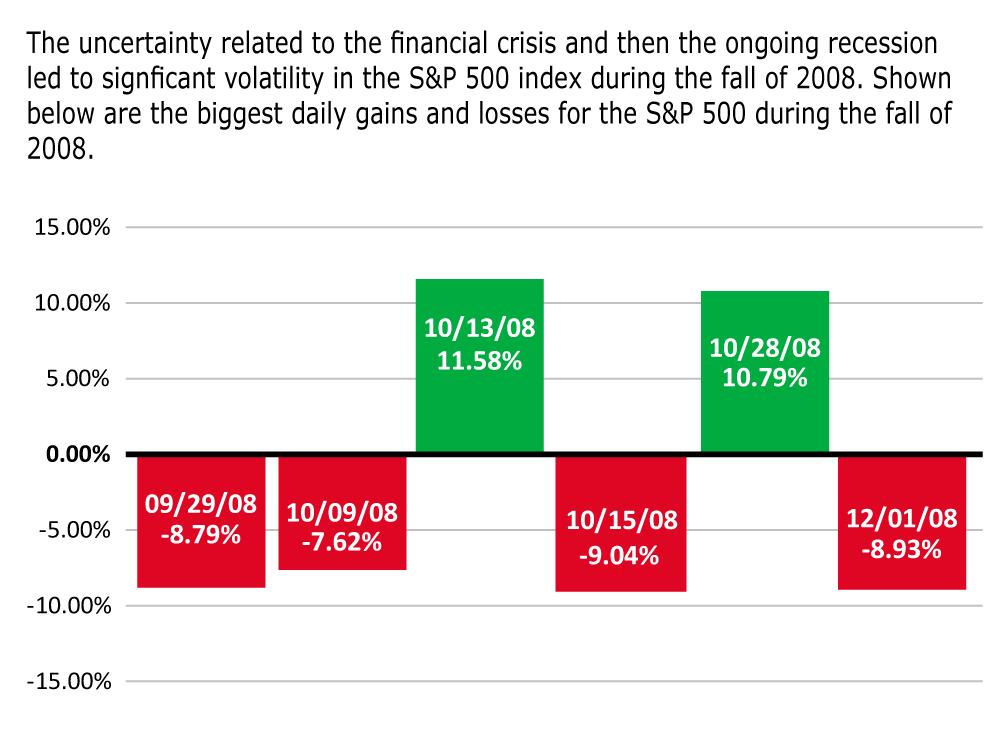
In the fall of 2008, the S&P 500 index experienced massive daily losses and gains.
First the losses:
-
September 29, 2008, down 8.79%;
-
October 9, 2008, down 7.62%;
-
October 15, 2008, down 9.04%;
- December 1, 2008, down 8.93%.
Big gains occurred on:
- October 13, 2008, up 11.58% and
- October 28, 2008, up 10.79%.
These big market moves are illustrated in Figure 1.
When I wrote the next column in October 2008, six months before the market bottomed, investors were thinking of jumping ship. That time frame raised these important questions: How do you know when a market is at a top or a bottom? Should you stay the course, or liquidate everything?
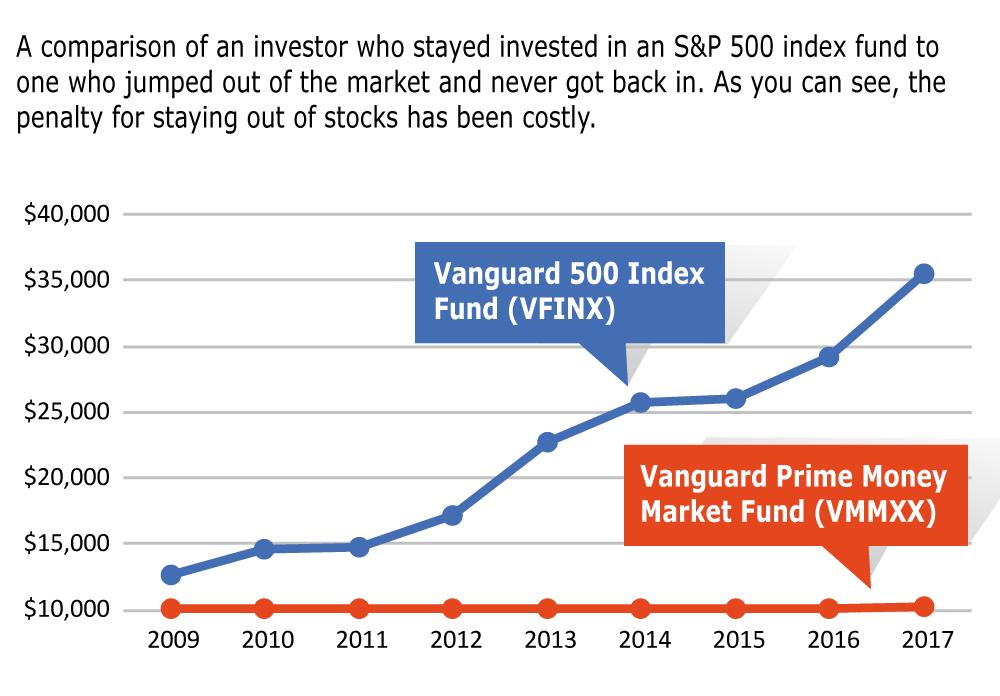
With hindsight or without it, the one thing an investor should never do is panic. An investor who cashed out of stocks at the end of October 2008 and stayed in cash through 2017 would have underperformed the stock market by vast amounts. How much? By about 235%. [The S&P 500 returned about 235% (cumulative) compared to less than 1% (cumulative) for a bank account.] Figure 2 provides a visual performance comparison of an investor who stayed in the market to one who jumped out in 2009.
The column below, written in October 2008, addresses the steps to consider taking during a bear market.
“Now Is No Time to Abandon the Investment Ship”
Originally published October 12, 2008
These are troubled times in the financial markets, to say the least. The markets are in turmoil, and there is no place to hide.
If you are tempted to abandon ship, don’t. There is no need to.
Today is not tomorrow. These bad market periods will come to an end. In earlier times like these, many steady investors made a fortune when others were panicking.
Since we don’t know when the market will find a bottom, the question is what you should do when nothing seems certain.
Open those brokerage statements you received in the mail a few days ago. Don’t worry about the dollar amount: The general direction of the market is down, and your account value should reflect that decline. Unless you have been hedging, going short or keeping it all in cash, your account will be lower than it was last month, last quarter and last year, and it will be lower still if you check your current values.
Focus instead on the asset allocation. How much do you have committed to stocks, bonds and cash?
Do the same thing with your 401(k) statements.
If there are any general rules that apply across the board, this is one of them: People investing for income need to have higher allocations in bonds and dividend-paying stocks than do people investing for growth.
If you depend on income from your portfolio, now is the time to review your sources of bond interest and stock and mutual fund dividends.
Address any changes that have occurred recently that will affect your cash flow. For example, Bank of America announced a few days ago (October 2008) that it would cut its dividend because of “recessionary conditions.” Have any of your dividends been cut?
Sit down with your spouse to review your cash flow: How much money comes into the household every month, and what is the source of that income? How much goes out, and where does it go? Whether you are working or retired, this will help you be ready for emergencies should any arise. It’s always good to be prepared.
Now consider your timeline.
The younger you are, the higher your stock allocations can be on the theory that you will find yourself in better market periods sooner or later. Young 401(k) participants, for example, can put most or all of their 401(k) regular payroll deductions to work in the stock market even today—prices are substantially lower now—and if those prices continue to decline, so much the better for these investors. If the 401(k) has a match, that’s even more desirable.
If you have a solid financial adviser on your side, that’s reassuring; this is a most difficult time to be going it alone. However, if your adviser is not reaching out to help you, put it on your to-do list to look for another one.
One day in the near future, we will have a trading day that has tremendous volume with a downward move followed by a large upswing; this generally is called a capitulation day. Expect the character of the market to change after that.
After the Market Has Bottomed
Now let’s jump to the end of March 2009, when I recounted a presentation I gave to an audience of retirees. Some were seeing a market bottom and, indeed, that was a correct call in hindsight. However, we were still seeing dividend cuts underway in companies that were conserving cash.
“When Is It Right to Re-enter the Market?”
Originally published March 29, 2009
Last Tuesday (March 24, 2009), I spoke with a group of 50 or so retirees at the learning and retirement program at Sacred Heart University’s Stamford, Connecticut, campus.
What was on everyone’s mind? “When do we get back into the market?”
What a difference a few weeks makes.
This is a decidedly different posture from what I’ve encountered over the last few months as I’ve been addressing groups of retirees about how to protect themselves in this turbulent market.
Of course, keep in mind that we had just experienced Monday’s (March 23, 2009) 7% surge in the S&P 500 after Treasury Secretary Timothy Geithner announced details of the administration’s plan to deal with banks’ toxic assets.
Monday’s upswing was the biggest one-day jump since last October (2008). Some of the major bank stocks ended up almost 20% higher that day.
In fact, so far, the month of March (2009) has been the first positive month we’ve seen since December 2008. After so many dramatically declining months, it’s a relief to see what some are calling a bottom.
Year-to-date through February (2009), the S&P 500 index had declined over 18%, with financials declining 40%. Extend that measuring period out three weeks through Monday, March 23 (2009), and the year-to-date numbers look far better, with the S&P 500 index down only about 8% and the financials down only 23%.
Looking back to the beginning of 2007, the S&P 500 had fallen by almost 50% until returns this month started reversing some of those losses ever so slightly.
When we see positive moves in the market, especially dramatic ones such as the ones we saw on Monday, the tendency is to rush back into stocks for fear of being left out in the cold.
We’ve seen these kinds of market swings before. Should this one be any different? More important, should the average investor care?
The answer lies in how you define yourself.
If you are an active trader, you’ve got a perfect market environment to make money on the upside by going long and on the downside by going short. That is something you can do easily (but very cautiously) by using long and short ETFs.
In contrast, if you invest for a goal such as retirement, it’s best to ignore the impulse to jump in feet first, especially if you moved all of your money out of stocks and into Federal Deposit Insurance Corporation (FDIC)–insured bank accounts, as many of the retirees I was addressing had done.
Caution is the watchword for today (March 2009). We still don’t know what the future will hold considering the need to work out the banking, credit, mortgage and other recessionary problems, not to mention that substantially increased government spending programs, if not curtailed, will lead to an unhappy future of high inflation.
Dividends, the lifeblood of income investors, no doubt will be cut further as we go into 2009. Standard & Poor’s Index Services expects that the dividends on the S&P 500 will decline by more than 13% in 2009; that would be the worst annual decline since 1942, when dividends fell almost 17%. This is not an unlikely result considering that growth slows in economic recessions and companies can conserve cash by cutting expenditures, with one such outlay being the dividends paid to shareholders.
Of course, some companies actually may be increasing dividends, but according to Howard Silverblatt, senior index analyst at S&P, “unless companies believe that their financial future will improve, their need to conserve cash will outweigh their desire to pay dividends.”
Given the environment and the unknowns before us all, a conservative investor would do well to put together a good buy list of seasoned dividend-paying stocks that could be expected to survive the rough waters ahead.
A good starting point is S&P Dividend Aristocrats, a list of solid dividend-paying stocks that you can access for free online at https://us.spindices.com. These are companies that paid dividends for 25 consecutive years, companies you’ll recognize, such as McDonald’s, PepsiCo, Procter & Gamble and Walmart.
See Table 1 for the current list of Dividend Aristocrats.
Caution: Because this list is assembled on the basis of calendar year measures, it also contains stocks that decreased their dividends already this year (March 2009). If those dividends are not increased before the end of the year, those companies will drop off the list. An example is General Electric, whose dividend was reduced last month by almost 70% from 31 cents to 10 cents a share (a savings for the company of $9 billion a year).
[Update: General Electric (GE) was removed from the Dividend Aristocrats list at the end of 2009; GE reduced its dividend in 2017 by 50%.]
This is a starting point for further research, of course, not a list of recommended stocks.
Thus, the answer to the question posed is to foreswear emotion. Know yourself. If you have the stomach to trade, now is the time. If you are an investor, don’t rush into buying anything because of market moves. Use your time carefully to pick the best stocks to own for the long haul and buy only when you are ready, entering the market slowly over time.
[Note: At the end of 2009, S&P 500 dividends actually declined by 21%, surpassing the decline in 1942. By the end of 2016, S&P dividends had risen to more than twice the level they were at at the end of 2009.]
|
Table 1. Dividend Aristrocrats These S&P 500 member companies have raised their dividends for a minimum of 25 consecutive years. |
|||
| Company (Ticker) | Yield (%) | Company (Ticker) | Yield (%) |
|---|---|---|---|
| 3M Co. (MMM) | 2.5 | Illinois Tool Works Inc. (ITW) | 2.0 |
| A. O. Smith Corp. (AOS) | 1.1 | Johnson & Johnson (JNJ) | 2.6 |
| Abbott Laboratories (ABT) | 1.9 | Kimberly Clark Corp. (KMB) | 3.8 |
| AbbVie Inc. (ABBV) | 4.2 | Leggett & Platt, Inc. (LEG) | 3.2 |
| AFLAC Incorporated (AFL) | 2.3 | Lowe’s Companies, Inc. (LOW) | 1.9 |
| Air Products & Chemicals (APD) | 2.7 | McCormick & Company (MKC) | 2.0 |
| Archer Daniels Midland Co. (ADM) | 3.0 | McDonald’s Corp. (MCD) | 2.5 |
| AT&T Inc. (T) | 5.7 | Medtronic PLC (MDT) | 2.3 |
| Automatic Data Processing (ADP) | 2.4 | Nucor Corp. (NUE) | 2.5 |
| Becton Dickinson and Co. (BDX) | 1.3 | Pentair PLC (PNR) | 2.0 |
| Brown-Forman Corp. (BF.B) | 1.1 | PepsiCo, Inc. (PEP) | 2.9 |
| Cardinal Health Inc. (CAH) | 3.1 | PPG Industries, Inc. (PPG) | 1.6 |
| Chevron Corp. (CVX) | 3.7 | Praxair, Inc. (PX) | 2.3 |
| Cincinnati Financial Corp. (CINF) | 2.9 | Procter & Gamble Co. (PG) | 3.7 |
| Cintas Corp. (CTAS) | 1.0 | Roper Technologies Inc. (ROP) | 0.6 |
| Clorox Co. (CLX) | 3.1 | S&P Global Inc. (SPGI) | 1.0 |
| Colgate-Palmolive Co. (CL) | 2.3 | Sherwin-Williams Co. (SHW) | 0.9 |
| Consolidated Edison, Inc. (ED) | 3.7 | Stanley Black & Decker (SWK) | 1.7 |
| Dover Corp. (DOV) | 2.0 | SYSCO Corp. (SYY) | 2.4 |
| Ecolab Inc. (ECL) | 1.2 | T. Rowe Price Group Inc. (TROW) | 2.6 |
| Emerson Electric Co. (EMR) | 2.8 | Target Corp. (TGT) | 3.5 |
| Exxon Mobil Corp. (XOM) | 4.0 | The Coca-Cola Co. (KO) | 3.5 |
| Federal Realty Investment (FRT) | 3.5 | VF Corp. (VFC) | 2.4 |
| Franklin Resources, Inc. (BEN) | 2.8 | W W Grainger Inc. (GWW) | 1.8 |
| General Dynamics Corp. (GD) | 1.7 | Walgreens Boots Alliance (WBA) | 2.5 |
| Genuine Parts Company (GPC) | 3.2 | Walmart Inc. (WMT) | 2.4 |
| Hormel Foods Corp. (HRL) | 2.1 | ||
| Sources: ProShares S&P 500 Dividend Aristrocrats ETF (NOBL) and Stock Investor Pro/Thomson Reuters; Data as of April 13, 2018. | |||
Sound Decision-Making
Making good investment decisions is not something we know inherently or intuitively. When dealing with retirement security in particular, more than a casual acquaintance with investing is required. Sound decision-making needs to be based on cash flow management in good markets and bad. It also demands an appreciation of the effect of inflation with the passage of time, and the integration of estate, financial and tax planning.
Notwithstanding the apparent complexities, the future can and will be sound and secure for investors who embrace this basic principle: Bull markets are followed by bear markets, and bear markets are followed by bull markets. That may seem trite, but the point is that no market is bound heavenward at all times. Historical perspective will give you a foundation to build your investment decisions on, especially if you have a long investment horizon. Achieving retirement security is a long-term enterprise.

Related

Stock Strategies
Dividends Are Still Valuable
Related

Portfolio Strategies
Nirav Patel from IL posted over 8 years ago:
Bill Renaud from Texas posted over 7 years ago:
You need to log in as a registered AAII user before commenting.
Log InCreate an account