

Related

Portfolio Strategies
U.S. government STRIPS provide guaranteed income and, since they are purchased at steep discounts, will appreciate by the time of death.
by Robert Muksian | April 2013
Last year, I wrote an article that shared ideas on how not to outlive, with virtual certainty, one’s money (“A Pseudo-Life Annuity: Guaranteed Annual Income for 35 Years,” AAII Journal, June 2012).
Specifically, I demonstrated how an individual investor with a $1 million portfolio on March 19, 2012, could have invested the money to have virtually a 100% probability of both not outliving his or her money and leaving a legacy for heirs at death.
Though the data showed that income for the investor would be assured throughout retirement, a question that was left unanswered is, “Is there a downside to the beneficiaries when the individual dies and the remaining bonds must be sold prior to maturity?” That is, will there be a loss of original principal? In this article, I will answer that question.
As I wrote last year, an investor could assure income in retirement by purchasing U.S. government STRIPS (zero-coupon bonds) in a tax-deferred account with a specified amount that mature each year for 30 years and five additional bonds that mature in year 30 for years 31 through 35. STRIPS are bonds whose corpus, or principal, has been separated from the coupon payments. An investor could create his or her own pseudo-annuity by using STRIPS laddered for 30 years—meaning bonds with different maturity dates are purchased—to provide 35 years of fixed maturity values.
Since STRIPS do not make interest payments like traditional bonds do, they are sold at a discounted price and increase in price as they near maturity. This occurs because the only cash flow paid will be the face value of the bond paid at maturity. Given this certain amount of cash flow, we can calculate the return of the security if it is held to maturity. Furthermore, a STRIPS’ duration, or sensitivity to interest rate changes, equals the number of years to its maturity.
The yield to maturity depends on the discount rate on the date of purchase; it is the cash flow expected to be received relative to the price paid for the bond. For purposes of this analysis, the rates of March 19, 2012, were used. Based on a $1 million fund, three possibilities were included.
The first plan was to purchase $40,000 of STRIPS maturing each year for the next 30 years and an additional $200,000 of STRIPS maturing in year 30 for years 31 through 35. The purchase cost of this plan would have been $855,770 with $144,230 remaining that could have been invested in equities to help mitigate the effects of inflation or to withdraw required minimum distributions. For inflation, only $54,263 in any account would be necessary to increase the annual income by 3% per year with an investment rate of return of zero (0%).
A second plan, presented in an online appendix to my original article at AAII.com, would be to maximize the annual income at $46,700 by utilizing the entire $1 million to purchase $46,700 of STRIPS that would mature each year for the next 30 years and purchase an additional $233,500 that would mature in year 30, leaving only $889 after the purchase.
A third alternative, also presented in the appendix, was to incorporate a 3% annual increase in the maturing bonds. This approach would require a reduced first-year income of $30,600 but with a 30th year income of $72,200 (the $40,000 level would have been reached in year 10). Further, $361,000 of bonds will have matured at year 30 for years 31 through 35, leaving $775 after the purchase.
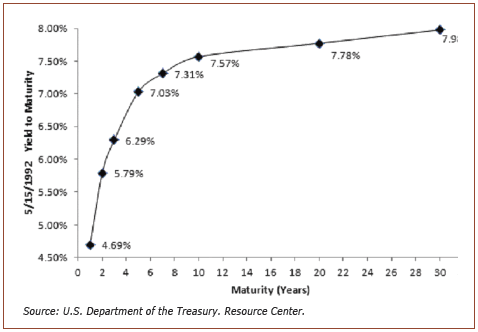
The analysis in this article shows the effect on the original principal if males and females who followed these approaches died during the year of their respective life expectancies. Using the 2010 Social Security Administration life tables, the average man, age 66 in 2012, will live 15.8 years into retirement to age 82 and the average woman, age 66 in 2012, will live 18.4 years into retirement to age 84. If death occurs to either a male or female during the 29th year instead, the effect on the original principal is also shown. Since death “will” occur in the 16th, 19th or 29th year, there will be a short first year in the year of death unless it occurs on the maturity date of the bond for that year, and this reality is ignored. Rather, the assumption is that a full first year is available for the sale of bonds. Secondly, the discount rates and yields to maturity are far into the future and assumptions for those must be made. I make two assumptions:
Because at the time of death the durations to maturity have diminished (the bond is worth more because the time period before cash is paid has shortened) and a bond that was purchased at a relatively deep discount 15 or 20 years earlier may have to be sold at a relatively shallow discount, the results could be skewed. The use of an earlier range of yields serves to remove this bias.
The present value, $P, of a bond is the price on the date of purchase with a maturity value of $M in t years at a yield of y. Since the yield on U.S. government bonds is compounded semiannually, the present value is calculated as:
P = M ÷ [1 + (y ÷ 2)]2t
As an example, the present value of $40,000 in bonds maturing in five years at a forward yield of 1.33% would be calculated as:
P = $40,000 ÷ [1 + (0.0133 ÷ 2)]10
P = $37,434.76
The result is rounded up to $37,435 in the tables.
Using a starting date of 2012 and assuming the age-66 male survives only to his life expectancy of 15.8 years, death will occur in 2027. Table 1 shows that for a portfolio paying $40,000 in annual income, the original principal for the remaining maturities of $760,000 was $319,783. The numbers assume some of the bonds held over the 15.8-year period have matured and the cash has been withdrawn from the portfolio. The remaining STRIPS have yet to mature and therefore trade at a discount to their eventual value at maturity.
| Original | Present | Present | Forward | ||||
| Principal | Value | Value | Yields | ||||
| Based on | Based on | Approx | Based on | for | |||
| 3/19/2012 | Maturity | 3/19/2012 | 3/19/2012 | 5/15/1992 | 5/15/1992 | Principal | |
| Maturity | YTM | Value | YTM | YTM | YTM | YTM | Recovery |
| Date | (%) | ($) | ($) | ($) | (%) | ($) | (%) |
| 5/15/2028 | 0.19 | 40,000 | 23,084 | 39,924 | 4.7 | 38,184 | 63.27 |
| 5/15/2029 | 0.42 | 40,000 | 22,199 | 39,666 | 4.95 | 36,273 | 31.72 |
| 5/15/1930 | 0.67 | 40,000 | 21,317 | 39,205 | 5.2 | 34,291 | 22.12 |
| 5/15/1931 | 1.04 | 40,000 | 20,417 | 38,374 | 5.45 | 32,259 | 17.54 |
| 5/15/1932 | 1.33 | 40,000 | 19,576 | 37,435 | 5.7 | 30,201 | 14.81 |
| 5/15/1933 | 1.61 | 40,000 | 18,777 | 36,331 | 5.95 | 28,137 | 13.01 |
| 5/15/1934 | 1.89 | 40,000 | 18,019 | 35,065 | 6.2 | 26,088 | 11.72 |
| 5/15/1935 | 2.17 | 40,000 | 17,313 | 33,657 | 6.45 | 24,071 | 10.75 |
| 5/15/1936 | 2.38 | 40,000 | 16,658 | 32,328 | 6.7 | 22,104 | 9.97 |
| 5/15/1937 | 2.56 | 40,000 | 16,006 | 31,016 | 6.95 | 20,200 | 9.37 |
| 5/15/1938 | 2.75 | 40,000 | 15,354 | 29,620 | 7.2 | 18,372 | 8.9 |
| 5/15/1939 | 2.93 | 40,000 | 14,763 | 28,214 | 7.45 | 16,629 | 8.48 |
| 5/15/1940 | 3.11 | 40,000 | 14,231 | 26,781 | 7.7 | 14,979 | 8.11 |
| 5/15/1941 | 3.26 | 40,000 | 13,678 | 25,436 | 7.95 | 13,429 | 7.81 |
| 5/15/1941 | 3.26 | 200,000 | 68,392 | 127,179 | 7.95 | 67,146 | 7.81 |
| Totals | 760,000 | 319,783 | 600,231 | 422,363 | |||
| Cumulative Gain | 188% | 132% |
Based on the replicated 2012 yield curve, the present value (principal) of those bonds at the time of death is $600,231, which is a significant upside to the original principal. It represents a 188% increase of the principal over the 15 years to death. This gain is due to the fact that the bonds had been purchased at relatively deep discounts due to durations of 15 or more years and are now being sold at shorter durations. Also, it is not unreasonable to assume that future yields may be higher than the 2012 yields. Using the May 15, 1992, yields shows the present value of the bonds at the time of death would be $422,363, which is a cumulative gain of 132% over the original principal—again, a significant upside.
| Original | Present | Present | Forward | ||||
| Principal | Value | Value | Yields | ||||
| Based on | Based on | Approx | Based on | for | |||
| 3/19/2012 | Maturity | 3/19/2012 | 3/19/2012 | 5/15/1992 | 5/15/1992 | Principal | |
| Maturity | YTM | Value | YTM | YTM | YTM | YTM | Recovery |
| Date | (%) | ($) | ($) | ($) | (%) | ($) | (%) |
| 5/15/1931 | 0.19 | 40,000 | 20,417 | 39,251 | 4.7 | 38,184 | 79.94 |
| 5/15/1932 | 0.42 | 40,000 | 19,576 | 39,666 | 4.95 | 36,273 | 39.12 |
| 5/15/1933 | 0.67 | 40,000 | 18,777 | 39,205 | 5.2 | 34,291 | 26.87 |
| 5/15/1934 | 1.04 | 40,000 | 18,019 | 38,374 | 5.45 | 32,259 | 20.96 |
| 5/15/1935 | 1.33 | 40,000 | 17,313 | 37,435 | 5.7 | 30,201 | 17.47 |
| 5/15/1936 | 1.61 | 40,000 | 16,658 | 36,331 | 5.95 | 28,137 | 15.15 |
| 5/15/1937 | 1.89 | 40,000 | 16,006 | 35,065 | 6.2 | 26,088 | 13.52 |
| 5/15/1938 | 2.17 | 40,000 | 15,354 | 33,657 | 6.45 | 24,071 | 12.33 |
| 5/15/1939 | 2.38 | 40,000 | 14,763 | 32,328 | 6.7 | 22,104 | 11.39 |
| 5/15/1940 | 2.56 | 40,000 | 14,231 | 31,016 | 6.95 | 20,200 | 10.61 |
| 5/15/1941 | 2.75 | 40,000 | 13,678 | 29,620 | 7.2 | 18,372 | 10 |
| 5/15/1941 | 2.75 | 200,000 | 68,392 | 145,235 | 7.2 | 91,858 | 10 |
| Totals |
640,000
|
253,183
|
537,183
|
|
402,038
|
||
| Cumulative Gain |
|
|
212%
|
|
159%
|
Alternative values at the death of the male are shown in Tables 3 and 4 here.
Using a starting date of 2012 and assuming the age-66 female will survive only to her life expectancy of 18.4 years, death will occur in 2030.
Table 2 shows that for $40,000 in annual income, the original principal for the remaining maturities of $640,000 was $253,183. Based on the replicated 2012 yield curve, the present value of those bonds at the time of death is $537,183, which is a significant upside to the original principal. It represents a 212% increase in the principal over the 18 years to death. This gain is due to the fact that the bonds had been purchased at relatively deep discounts due to durations of 18 or more years and are now being sold at shorter durations. Using the May 15, 1992, yields show the present value of the bonds at the time of death to be $402,038, which is a cumulative gain of 159% over the original principal—again, a significant upside.
Alternative values at the death of the female are shown in Tables 5 and 6 here.
For either the male or female, if death occurs in the 29th year, the decision to sell or wait a year could depend on the loss, relative to the maturity values, that would be incurred by selling. Using an annual income option of $40,000, if the one-year yield is the same as the original yield, the loss from the respective maturity value of $240,000 by not waiting one year would be negligible: $455. However, if the one-year yield replicates the May 15, 1992, value of 4.7%, the loss will be $11,329. (Bond prices and yields are inverted, so the rise in yields would hurt the value of the bonds.) For this situation, it might be wiser for the beneficiary to wait. The cumulative gain on the original principal would be 292% for the 2012 yield curve and 179% for the 1992 yield curve. Values at death occuring in year 29 are shown in Table 7 here.
The right-most column in the tables shows what the yield curve would have to be at the time of death in order for there to be loss of original principal. These values are calculated by solving for y, and then expressing in percent form, as follows:
y = 2 × [(M ÷ P)1/2t – 1] × 100
For year 5 after death, the yield for breakeven becomes:
y = 2 × [($40,000 ÷ $19,576)1/10 – 1] × 100
y = 14.81%
These yields generate a breakeven, vis-à-vis the “long-ago” principal. Any yield that is greater than those in that column will return a loss. The yield ranges for the male from approximately 63% for year one to 8% for year 14 and for the female the yield ranges from 80% to 10%.
The original strategy for the financial plan in retirement was to utilize a given amount of money to generate 35 years of guaranteed annual income with no loss of principal by purchasing U.S. government 30-year STRIPS (zero-coupon bonds). Since this type of bond is appropriate only in a qualified tax-deferred account, a spousal beneficiary could continue to receive the annual maturities, or sell the bonds prior to maturity. A non-spousal beneficiary would be required by law to sell the bonds prior to maturity.
Because the bonds with long-term durations would have been purchased at relatively deep discounts and would be sold at death with shorter durations and relatively shallow discounts, the present values at the time of death far exceed the original principals and, rather than a downside, the strategy always has an upside. Therefore, to the question “Is there downside?,” the answer is no.
Portfolio Strategies
Sebastian Lasher from VA posted over 13 years ago:
Sebastian Lasher from VA posted over 13 years ago:
Joseph Schunk from CA posted over 13 years ago:
Donald Brown from Virginia posted over 13 years ago:
Monk Monk from Texas posted over 13 years ago:
Steven Spainhower from MT posted over 12 years ago:
Charles Rotblut from IL posted over 12 years ago:
Hildy Richelson from PA posted over 12 years ago:
Robert Wainer from MA posted over 9 years ago:
You need to log in as a registered AAII user before commenting.
Log InCreate an account