


Related

Financial Planning

Charles Rotblut leads a class in AAII's new Essential Investing Video Course. Go to https://www.aaii.com/ves for more information and to subscribe.
William “Bill” Sharpe is the STANCO 25 Professor of Finance, Emeritus, at Stanford University, recipient of the 1990 Nobel Prize in Economic Sciences and a co-founder of Financial Engines Inc. He also authors the Retirement Income Scenarios blog (RetirementIncome
Scenarios.blogspot.com). In this excerpt of our conversation at the CFA Institute Conference this past May, we discuss portfolio allocation and retirement withdrawal strategies.
—Charles Rotblut
Charles Rotblut (CR): I’d like to discuss allocation, starting with rebalancing. A lot of people either psychologically have a problem doing it or just won’t do it. What are your thoughts?
William Sharpe (WS): I think, by and large, people probably shouldn’t do it. In particular, rebalancing by selling winners and buying losers. Basically, if you’re going to sell your winners and buy your losers, then you have to trade with someone. And that person has to take the other side of the trades. If you’re smart doing that, then the other person must be dumb to trade with you. So the questions are: Why is that a good thing to do, and what’s the matter with the other person for trading with you?
We can’t all rebalance, because rebalancing to pre-selected proportions means selling relative winners and buying relative losers. Since we can’t all do that, the question is: If this is the obvious thing to do, with whom are you going to trade? Who is it? And why should the other person trade with you? In an efficient, sensible or informed market, such rebalancing will not be a good strategy.
I would like to see a very-low-cost index fund that buys proportionate shares of all the traded stocks and bonds in the world. Unfortunately, there are none at present. It would be good if there were one or more used by a great many investors as their main investment vehicle. While such a fund is not available, you can construct one from existing index funds, but then you have to monitor the current world values of the components—for example, the value of all the U.S. bonds for the U.S. bond index fund, the value of all the non-U.S. bonds for that fund and the value of all the world stocks for that fund. I’ve talked to my friends in the index fund business, and thus far nobody seems to be interested in producing that. It is a huge hole and individual investors could really use such a fund.
CR: You’re talking about all securities in the fund?
WS: All traded bonds and stocks in the world. What a great default investment that would be if it were really low cost. To my knowledge, it doesn’t exist.
CR: Do you think it’s just because of the cost or the difficulties?
WS: I don’t know. It’s hard to get anybody to produce a low-cost index fund, because you can’t make a great deal of money because it’s low cost. Now, many people have home bias and conclude that it is enough to buy a U.S. bond fund and a U.S., or possibly a world, stock fund. But there may still be gains from diversifying your bonds globally as well.
CR: What about adaptive allocation? I know you’ve written about the subject.
WS: Here is a simple way to think about this. Assume that at the moment stock values are 60% of the total value of bonds and stocks, that bond values are 40% and that you just want to have the risk and return of the average investor. Then you should invest 60% in stocks, 40% in bonds. And now, let’s say, stocks go up and bonds go down, so the market values are now 70%/30%. If you want to continue to be the average investor, you should have 70%/30% proportions. But when you look at your portfolio values, you are likely to find that they are already close to 70%/30%. And you didn’t have to do anything. This won’t be exactly the case due to new security issues and things of that sort, so you might have make some minor adjustments, probably when reinvesting dividends and bond payments. But the trades will be small. The idea is to have a policy that indicates what proportions you want when the market proportions are, say 60%/40%, and then keep your relative risk constant as market values change (Figure 1). The formula that I suggest for adaptive asset allocation works from this basic policy and indicates the proportions that you should have as market proportions change.
In the simplest case where you just want to take the risk of the average investor, the formula just says that your policy should be to hold the same proportions as the market. If you want to have a policy of being more risky than the average investor, then you have to look at the formula. But it’s a very easy formula.
CR: What about adjusting as you get older?
WS: That’s a different issue. The strongest argument, I believe, for taking less risk in your portfolio during your working years as you get older is to think about your total portfolio, which includes your human capital; that is, the present value of your future savings and your financial capital—your portfolio. If you want to keep the risk of this total portfolio constant, and if you think your human capital is relatively low in risk—for example, bond-like—
then when you’re young that overall portfolio is mostly human capital with very little financial capital.
If you want an overall portfolio of moderate risk, you would need to put your financial capital mostly in stocks when you are young. But when you’re near retirement, most of your assets will be in financial capital, and then you might want to have your financial portfolio invested in both bonds and stocks. I think that’s the strongest argument for a glide path in which you reduce the proportion in stocks in your financial portfolio as you get older. Of course, once you’re retired, you have no human capital. So any argument for post-retirement glide paths would have to rest on some other argument.
CR: So your thought is, as you get older: Don’t rebalance your portfolio relative to the market, rebalance it versus age but then get to an end point at 65 or 70?
WS: Not quite. I would prefer to state any rebalancing in terms of risk relative to the market. It could be very simple. You might start off with a portfolio, say, 1.5 times as risky as the market of bonds and stocks, and then want the risk to be equal to the market portfolio of bonds and stocks. You would use the adaptive formula until you retire, and then decide year-by-year how risky you want the portion for each year.
There’s very little settled theory or application of theory indicating what you ought to do after you retire. That’s the area that I’m most interested in now, as are a lot of other people. There are many questions to be addressed, and we don’t have as much of a handle on them as I wish we did. There is work to be done both in the industry and the academy.
CR: In terms of factoring in market risk, how should the individual investor determine their baseline risk?
WS: It’s very hard. In principle, you do some sort of analysis to answer questions, such as the question: “If I take this much risk, what is the range of things that might happen to me, and if I take less, what is the range?” Of course, there will be trade-offs. You can have less risk about, say, your income 10 years from now, but the center of the range will be lower, because risk and return go together as long as you focus on broadly diversified portfolios.
It’s not that there’s a right and a wrong solution for everyone. You have to ask what’s right for you given your particular circumstances. And the whole issue of mortality adds to the complexity of the problem. I don’t have any simple answers that apply to everyone other than the recommendation to keep your costs low. That’s a win-win proposition.
CR: Should an investor get a second opinion if he’s not sure what seems reasonable, especially since it seems there is an element of subjectivity?
WS: This is an area of great importance. And it’s going to be more important every year, given demographics. The financial industry, broadly construed, is producing many products: insurance policies, investment products, combinations of the two and many other alternatives. There are many products and there are going to be more. It’s an area in great ferment. I wish I could say that those who are thinking deeply about these problems have simple solutions that work for everyone, but they don’t.
CR: Since we’re talking about retirement, what are your thoughts on the 4% rule for spending? [Editor’s note: The 4% rule says an investor should withdrawal 4% of his portfolio balance during the first year of retirement. Each year after, the withdrawal amount should be increased in accordance with the rate of inflation.]
WS: I’ve written about the 4% rules with co-authors. I would argue that the simplest way to think about it is this: What you spend should depend on how much you have and how long you’re going to need it. Now, the 4% rule starts off, more or less, taking both aspects into account. Say, for example, you have $1 million dollars and you are 67. You look at the mortality tables, see how long you might need income and determine that it might be reasonable to spend $40,000. The next year, the 4% rule totally ignores what you have. If your portfolio has fallen 30%, it ignores that fact. If it has risen 50%, it ignores that. No matter what has happened, it calls for you to spend $40,000 plus inflation, every year, until you die or run out of money.
This seems strange. Shouldn’t you be taking a look at how much money you have? If you’ve lost 30%, 40% or 50% of your portfolio, shouldn’t you cut your spending—unless you’ve developed a terminal illness? If your portfolio has doubled in size, shouldn’t you think of spending a little more? The 4% rule doesn’t do any of these things, which doesn’t seem very sensible.
CR: I know you’ve also talked about the required minimum distribution (RMD) rules for traditional IRAs, 401(k) plans and similar retirement accounts, and that obviously has some problems in itself. Do you think investors should have a band of spending that they should adjust?
WS: The RMD strategy does take into account at least how much you have year by year, which seems sensible. The particular percentages may not be the very best, but you can alter them if desired.
More generally, an RMD approach is a particular case of a general procedure that I call a proportional spending strategy, with predetermined proportions of your wealth to be spent in each year. I’ve written about a Fidelity product that provides another example: The percentages to be spent are determined in advance. In the Fidelity product, the portfolio proportions follow a glide path. In software that I have developed, it is possible to analyze policies of this sort with any desired glide path. You can find more at RetirementIncomeScenarios.blogspot.com.
There is an argument against glide paths in retirement, since they subject retirement income to risk associated with the sequence of returns in addition to the risk resulting from cumulative returns. But this is a complex issue, and the added risk may be warranted in some cases. I would have to know quite a bit about your preferences to categorically recommend against a glide path investment strategy.
I am comfortable saying that there is almost certainly a strategy that would be preferable for any investor to the 4% rule. But I doubt that the best strategy for most investors is a spending rule such as one followed by many university endowments, which typically call for spending X% of the average value of the portfolio over, say, the last five years. Such approaches involve proportional spending rules based on moving averages of prior wealth. For whom might this be a good approach?
Academics like to approach such questions by characterizing investor preferences using some sort of utility function and considering alternative ranges of incomes that could be produced with portfolios. The goal would be to find the best opportunity set given investor preferences. The problem that this is very hard to do in this complicated multi-period setting, even if you knew exactly when everyone would die. And when you add uncertainty about mortality, it gets even harder. You can use actuarial tables for the probabilities, but it is still a very difficult problem to solve. This makes it fun for an academic, but makes it really hard to say anything absolutely definitive that will apply in general.
CR: For an investor going through retirement who hasn’t worked in finance, should there at least be bumpers in terms of spending?
WS: Probably the first thing to do is to ask this: If I were going to buy fixed annuities—preferably real (inflation-adjusted)—what would I choose? That’s a somewhat easier problem for an individual to think about. Maybe you should try to get the answer to that question, and then you can start considering whether instead of fully annuitizing, you might invest in Treasury inflation-protected securities (TIPS) or 10-year bonds and then annuitize or perhaps purchase a deferred annuity now.
This might be a useful way to begin to approach the problem. It would get everyone thinking about longevity in a setting where there isn’t risk to deal with other than mortality risk. That’s hard enough to think about. But it could get you started. Then you could go on to consider the possibility of risky investment strategies.
Zvi Bodie (of Boston University) might say to start with that problem. Then go on to consider whether you might want to only annuitize some portion of your money (or none, since Social Security provides a real annuity in any event) and think about ways to invest and spend the rest. That could be a good place to start, but there are still many other options to consider.
Happily, a great many smart people are working on the problem, so we should have a better understanding of alternative approaches as time goes by.
The second excerpt of our conversation appeared in the October 2014 AAII Journal. In it, we discussed the Sharpe ratio and the advice he has for individual investors.
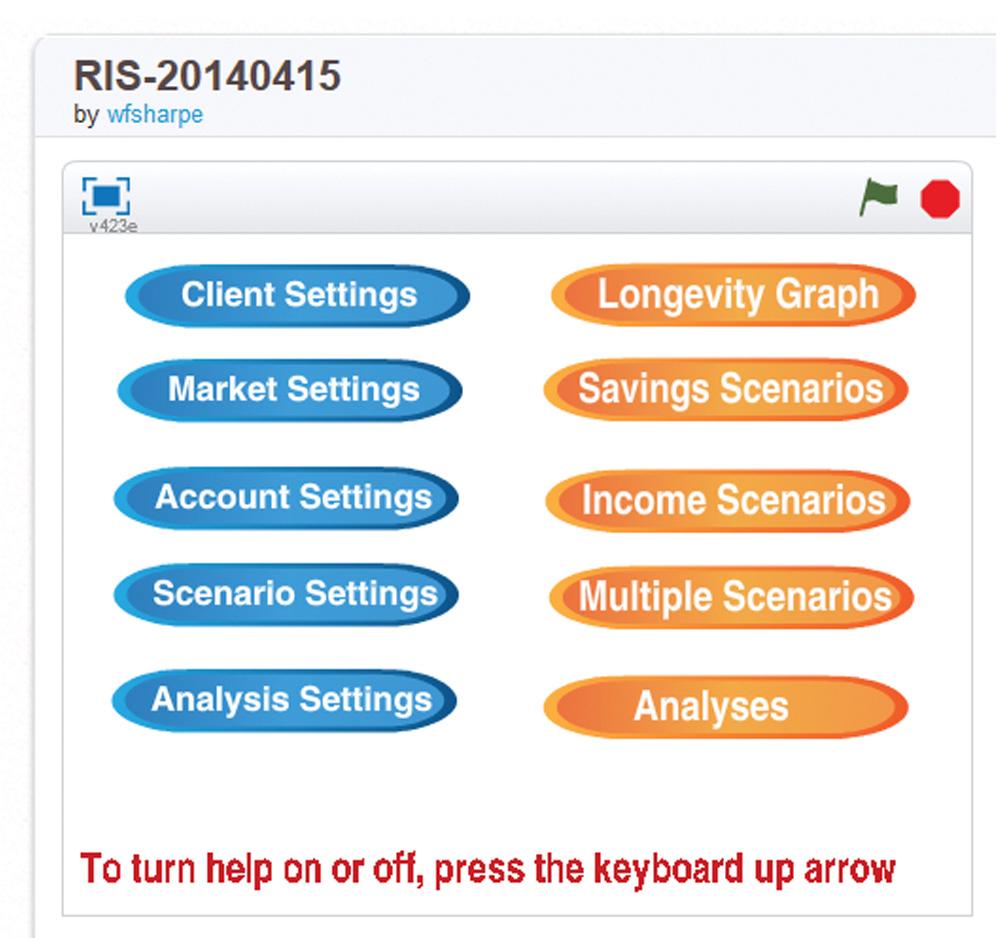
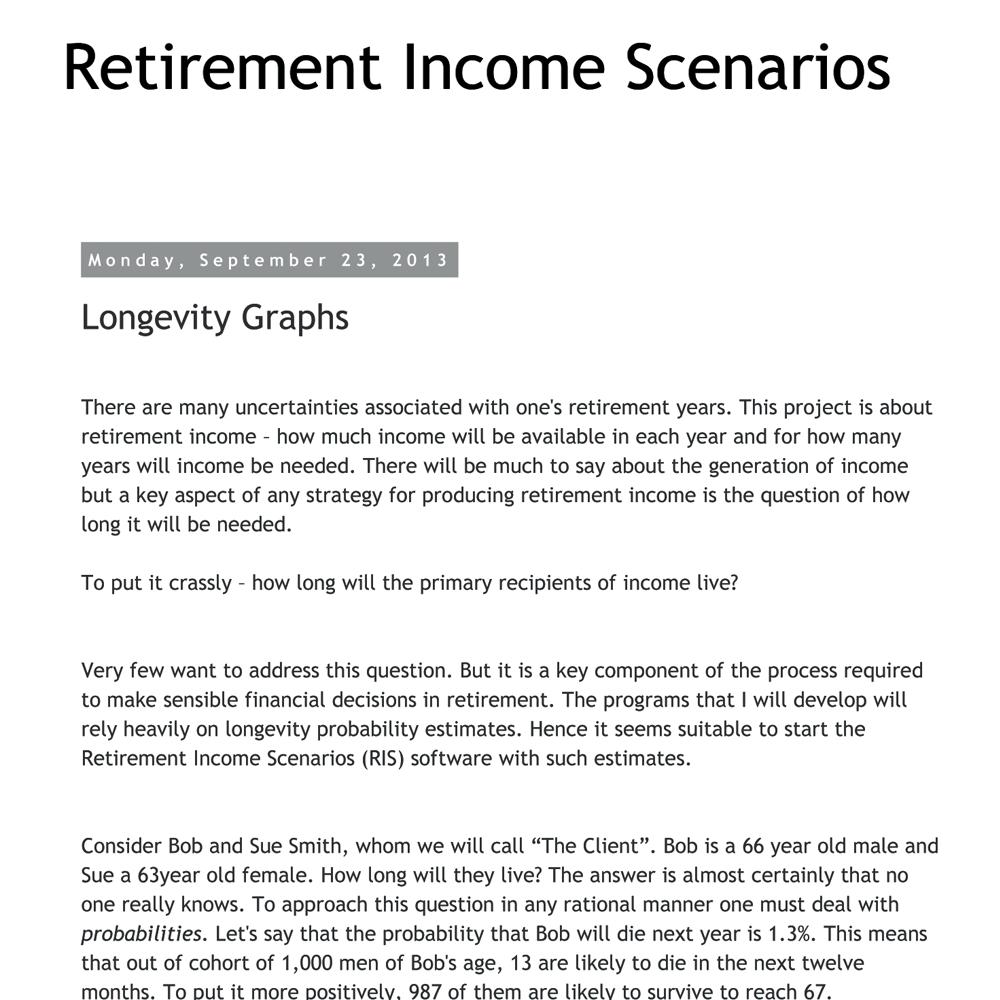
The blog, at RetirementIncomeScenarios.blogspot.com, is devoted to discussions of issues surrounding the provision of income for a person or couple during their retirement years. Much of the analysis is conducted by forecasting a number of possible future scenarios, then analyzing the properties of chosen strategies in producing retirement income across the scenarios (Figure 2).
This employs the method of Monte Carlo simulation (a form of analysis that considers many scenarios) with an underlying set of assumptions about the behavior of capital market and macro-economic variables as well as an assumed basis for valuation of possible future cash flows. A user-friendly and freely accessible software program is also provided to enable readers to experiment with and analyze alternative strategies (Figure 3).
Financial Planning

Portfolio Strategies
Growth Investing
JC from MA posted over 11 years ago:
Jon from MA posted over 11 years ago:
Werner Emmerich from PA posted over 11 years ago:
David D. from CO posted over 11 years ago:
Stephen Stanton from PA posted over 11 years ago:
Harold Jacobson from California posted over 11 years ago:
Michael Muhle from TX posted over 11 years ago:
Dave Gilmer from WA posted over 11 years ago:
Vaidy Bala from AB posted over 11 years ago:
You need to log in as a registered AAII user before commenting.
Log InCreate an account