

The investment ideas of the some of the greatest investors on the planet today are wrong most of the time, and yet they still make a lot of money.
How can this be? How can the world’s best investors get it wrong and still make millions?
That was the question I faced several years ago when I became rather obsessed with trying to understand how one professional investor who worked for me was able to deliver outstanding returns when only one in three of his ideas made money. I simply had to know what his secret was that meant he could be so good (at making money) despite being so bad (his investment ideas generally failed). I burned with curiosity, and this fire from within led me to analyze every investment, every trade he did. The outcome of this investigation was that I uncovered that he was able to make a lot of money because of a few key habits of execution that he religiously stuck to when he found himself in either losing or winning situations. In a nutshell, I discovered that when his idea lost money he would turn into either a “Hunter” or an “Assassin.” If he were winning, he would become a “Connoisseur.”
Having made this discovery, a new question surfaced: Is this finding true for all the successful investors who worked for me? Basically, was their success due to how they executed their ideas rather than their ideas being successful overall? To find out, I analyzed the investments of 45 investors I oversaw between 2006 and 2013, each of whom I had entrusted with managing between $20 million and $150 million dollars with strict instructions that they were only allowed to invest in their 10 best ideas to make money. After analyzing 30,874 trades that these professionals made during the study period, I discovered that the successful ones all adopted the same habits of execution. The secret sauce behind their success had been revealed.
Moreover, I discovered that the chance of a great idea making money was a lousy 49%. Think about this the next time some investment titan on TV shares his “top investment tip.” Despite such ideas often being the result of hundreds of hours of research by some of the smartest people on the planet, the chance of making money in these ideas is worse than tossing a coin and betting on heads. If success in property is about “location, location, location,” I came to understand success in the stock market came down to “execution, execution, execution” of great ideas. Or, as attributed to the great inventor Thomas Edison, “Vision without execution is hallucination.”
The key to success depends upon the action an investor takes when they find themselves in a losing, or a winning, situation. Adopt the habits of the successful investors and you too can find yourself being wrong more often than you are right and still making money.
I’m Losing. What Should I Do?
My findings suggest the odds are that an investor’s great idea will lose money. As such, before you invest a cent into an investment idea, it is imperative to have a plan of action as to what you will do if you find yourself in a losing position.
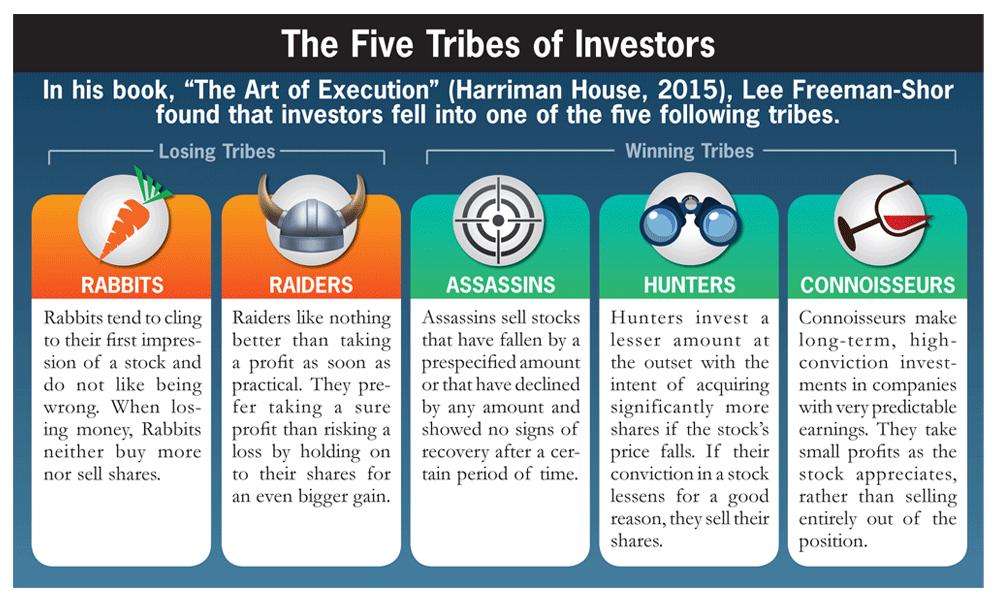
When losing, the successful investors I worked with planned to become either Assassins or Hunters. [Assassins sold losing investments that fell by a certain percentage or that declined by any amount and showed no signs of recovery after a certain period of time. Hunters invested a lesser amount at the outset and with a plan of buying significantly more shares if the price fell. Hunters were also unafraid to sell if it became clear that they had made a mistake.] The bad investors didn’t have a plan and consequently turned into Rabbits. [When losing money, Rabbits neither bought more shares nor sold their holdings. Once forming an initial perception, Rabbits were achingly slow to change their opinion of a stock.] Which tribe will you become a member of?
If you want to be successful, you have to “materially adapt” when you are losing money. In reality, this either means cutting your losses and taking the hit before you have lost too much money (aka being an Assassin). Or, it means backing up the truck and investing a lot more money into an idea (aka, being a Hunter). Clearly, if you want to be a Hunter you need to be careful not to deploy too much of your capital in an idea on day one because you have to be prepared to invest significantly more money into the idea when you are losing. This is a key difference from the ordinary dollar cost averaging approach. It also means that buying a few more shares doesn’t cut the mustard. The key habit you are trying to embrace is that of materially adapting when you are losing.
Before you invest in an idea, you have to have a predefined plan of action that will govern your actions after the initial investment, and you have to have the discipline to stick to it. Not having a plan, or doing nothing (aka the Rabbits) or too little is a character trait of a loser.
The problem with doing nothing is that it opens up the possibility of losing big. That is, you dig a hole so deep that you cannot get out of it (aka being a Rabbit). My findings showed that of the 131 ideas that lost more than 40% when they were sold, not one would have bounced back to help the investor break even despite 21 of these going on to produce returns of over 100%.
I’m Winning. What Should I Do?
As with losing, you need to have a predefined plan of action with respect to what you are going to do when you find yourself having made a paper profit. In this scenario, however, you will be given a choice of joining one of two tribes: the Connoisseurs or the Raiders. Your aim is to be a Connoisseur. Raiders have a habit of taking profits too early rather than letting their winners run. [Raiders take profits as soon as practical. Connoisseurs make high-conviction investments, hold onto them for a long time and take small profits along the way.]
My findings show that two-thirds of the time investors will bank their profits when they have made up to 20%. While it may feel good, snatching at profits is a character trait (a habit) of a loser. In fact, I discovered that 61% of investments that were sold for a profit of less than 20% kept going up. Had the investor stayed invested, they would have made more money. Worse still, big winners were to be found among those.
To be successful, you have to have one or two big winners—not least because Sod’s law [Murphy’s law in the U.S.] holds that you will have one or two big losers. If your approach is to keep taking small profits, you will never have a big winner. I have yet to come across a successful investor whose success was achieved without the presence of one or two big winners. The way a Connoisseur ensures he wins big is that he slowly nibbles away at the growing pie of profits. He knows that to eat it in one sitting will give him more problems than merely an upset stomach. As hedge fund manager Stanley Druckenmiller once said, “[The] way to build long-term returns is through preservation of capital and home runs.”
Summary
In conclusion, I have found that all successful investors who have worked for me have common habits that explain their success and ultimately mean they can be wrong most of the time and still make money.
I have seen the enemy. It is made up of Rabbits and Raiders. If you spot someone from one of these tribes when you invest then know you might face an unhappy ending.
Ensure you invest with the Hunters, the Assassins and the Connoisseurs. Over time, these tribes will look after you, keep you safe, and ensure you prosper.

Related

Financial Planning
Behavioral Errors Hurt Your Returns
Related

Portfolio Strategies
The Good Investor Rule: Focus on How Not to Lose Money
Discussion
FREE REPORT

Get your free copy of our special
report analyzing the tech stocks
most likely to outperform the
market.
John Duguid from NJ posted over 10 years ago:
Stanley Hahn from CA posted over 10 years ago:
Martin Huber from CH posted over 10 years ago:
John Wilson from Alberta posted over 10 years ago:
Martin Huber from CH posted over 10 years ago:
David Levine from NC posted over 10 years ago:
Roger Mckinney from OK posted over 10 years ago:
David Fields from TX posted over 10 years ago:
Eric Long from AL posted over 10 years ago:
RICHARD V from CA posted over 2 years ago:
You need to log in as a registered AAII user before commenting.
Log InCreate an account