

Related
Feature
Dow Theory relies on both the Dow Jones industrial average and the Dow Jones transportation average to determine whether a true market trend exists.

Every day we hear about the Dow rising or falling, but we may not stop to think who Dow was, what the Dow averages are all about and what the implications might be.
I’ll start with who Charles Dow was and then how his theory, which has served so well for over 100 years, can still be used in the 21st century as a guide to timing the stock market and making money from it.
Charles Henry Dow was born in November 1851 on a farm in Sterling, Connecticut. At the early age of 18, he began his career as a reporter and developed an early interest in business. Subsequently, he and his friend Edward Jones formed Dow Jones & Company in 1882. They published the handwritten Customer’s Afternoon Letter, precursor of The Wall Street Journal, with Dow as its first editor. It was not until May 26, 1896, that the Dow Jones industrial average was born with 12 “smokestack” companies. A year later, a separate average began to keep track of the railroad stocks, which were the primary transportation mode of the day. Both averages have been expanded over time, with 30 stocks now in the industrial average, and the rail average (renamed the transportation average) expanded to include airline, air freight, delivery service, marine transport and trucking companies.
Dow saw the stock market and his idea, yet to be named by others as the “Dow Theory,” as a barometer of business activity. He recognized that if the stocks in his averages were going up, that pointed to future business being good, and vice versa. On January 31, 1901, Charles Dow compared the stock market to the tides of the ocean when he wrote in The Wall Street Journal: “A person watching the tide coming in and who wishes to know the exact spot which marks the high tide, sets a stick in the sand at the points reached by the incoming waves until the stick reaches a position where the waves do not come up to it, and finally recede enough to show that the tide has turned. This method holds good in watching and determining the flood tide of the stock market.”
If you think of the Dow Jones industrial average as being the measure of the tide on one part of the beach and the Dow Jones transportation average as the measure on another part of the beach, and you use both to determine that the tide is indeed coming in or going out all along the seashore, you will understand what Dow was getting at: Confirmation by both averages is an integral part of the Dow Theory.
The amazing thing about Dow’s theory was that it was developed with only five years’ worth of data on the two averages from which to form the basis. Unfortunately, Charles Dow had little time to write about and expound on his theory. He never wrote down a complete description of his theory, never dedicated a complete editorial to it, never gave it a name and, most unfortunately, never wrote a book. By 1902, Dow was in failing health and sold the company. He died shortly thereafter, on December 4, 1902. Most of what we know of the theory came from a series of editorials in The Wall Street Journal written by Dow’s successor as editor, William Peter Hamilton, during the period from 1902 until his death in 1929. Hamilton did write a book about Dow’s theory, “The Stock Market Barometer,” in 1922 (reprinted in 1998 by John Wiley & Sons).
The most organized and thorough description of the Dow Theory as we knew it in the early 20th century came from the book of that name, written by Robert Rhea in 1932. Rhea, who was bedridden, had the time and inclination to analyze the 35 years of data available to him to further refine the work of Dow and Hamilton into what I consider the definitive work on the original Dow Theory. The book was reissued in 1993 by Fraser Publishing Company. Portions are reprinted here with permission.
Robert Rhea, after many years of studying the writings of both Dow and Hamilton, set out a “few hypotheses,” which he said must be accepted “without reservation whatsoever” if one is to use the theory successfully in order to know when to buy and sell and to make money in the stock market. They are:
There are three movements of the averages, all of which may be in progress at one and the same time.
The first, and most important, is the primary trend: The broad upward or downward movements known as bull or bear markets, which may be of several years duration. The correct determination of the direction of this movement is the most important factor in successful speculation. There is no known method of forecasting the extent or duration of a primary movement. The primary trend, once in place, is assumed to continue in place until definitely proven otherwise. This is an offshoot of Isaac Newton’s law, which states a body in motion tends to stay in motion unless compelled to change its state.
A primary bear market is a long downward movement interrupted by important rallies. There are three principal phases of a bear market: The first represents the abandonment of the hopes upon which stocks were purchased at inflated prices; the second reflects selling due to decreased business and earnings; and the third is caused by distress selling of sound securities, regardless of their value, by those who must find a cash market for at least a portion of their assets.
These phases go from complacency to concern and, finally, to capitulation. “Capitulation” was a term never used by Dow, Hamilton or Rhea, but it was alluded to by the description of the third phase of a bear market, and the further statement: “After a market has drastically declined…and then goes into a semi-panic collapse, it is wise to cover short positions and even perhaps make commitments for long accounts.” In my interpretation of the Dow Theory for the 21st century, I do indeed use capitulation as the time to start buying.
A primary bull market is a broad upward movement, interrupted by secondary reactions, and averaging longer than two years. There are three phases of a bull period: The first is represented by reviving confidence in the future of business, the second is the response of stock prices to known improvement in corporate earnings, and the third is the period when speculation is rampant and inflation is apparent—a period when stocks are advanced on hopes and expectations.
While the primary trend has not been specifically defined, my own research shows that a bull market primary trend will have advanced in excess of 19% on the Dow Jones averages and the S&P 500 index. A bear market primary trend will have declined in excess of 16% on both. These percentages are reciprocal numbers, unlike the traditionally used +20% and –20%, but there are more important reasons to use them, which space does not allow me to expand upon.
The second, and most deceptive, movement is the secondary reaction: This is an important decline in a primary bull market or a rally in a primary bear market. For the purpose of this discussion, a secondary reaction is considered to be an important decline in a bull market or advance in a bear market, usually lasting from three weeks to as many months, during which interval the price movement generally retraces from 33% to 66% of the primary price change since the termination of the last preceding secondary reaction. These reactions are frequently erroneously assumed to represent a change of the primary trend, because obviously the first stage of a bull market must always coincide with a movement which might have proved to have been merely a secondary reaction in a bear market; the contra being true after the peak has been attained in a bull market. The time frame of “usually lasting from three weeks to as many months” has been taken by many Dow theorists as being cast in stone. Actually, at one time (January 4, 1902), Dow himself wrote, “The secondary movement covers a period ranging from 10 days to 60 days,” and that is the definition I use. A review of the Dow Theory signals implies that a secondary trend will usually extend at least 4% on both the industrials and transportation averages, and usually one or both will exceed 7%, but these figures are not written into the theory. What is precisely defined is the extent of the “return move,” the pullback after a bounce up from a bear market bottom or the bounce after a pullback from a bull market top, and that it shall exceed 3% on either of the averages.
After a secondary reaction, the primary trend is reaffirmed when both the industrials and transports return to extend that trend, but confirmation need not occur on the same day. In a bull market, such a move to new highs is often described as being “in the clear” and is sometimes labeled as a new buy signal, which is incorrect. The buy signal dates to the original signal; this move merely affirms that signal.
The third, and usually unimportant, movement is the daily fluctuation. Inferences drawn from one day’s movement of the averages are almost certain to be misleading and are of little value.
The movements of both the railroad and industrial stock averages should always be considered together. The movement of one price average must be confirmed by the other before reliable inferences may be drawn. Conclusions based upon the movement of one average, unconfirmed by the other, are almost certain to prove misleading.
A common complaint is that the railroads (transports) are of inconsequential importance these days, which makes the theory ‘out of date.’ I would remind the reader that the transportation average is actually made up of 20 stocks representing at least six transportation-related industries. The stocks in the average deliver raw materials and components to industry and then distribute the manufactured products to the world. Therefore, their business fortunes are still intertwined.
There is a modern-day misconception that says both the industrial and transports must make new all-time highs for a bull market to be in force. But a bear market changes to a bull market at the low point, not after it gets to a higher point than the last bull market. Granted, the new bull market is not immediately determinable at that low point, but after a time it can be seen as having been the start.
The levels at which I consider that a market attains bull- or bear-market status are +19% and –16% as mentioned previously. I use those levels as a ‘stop-point’ for completing the Dow Theory for 21st century signals, in case they were not completed prior to those thresholds being attained.
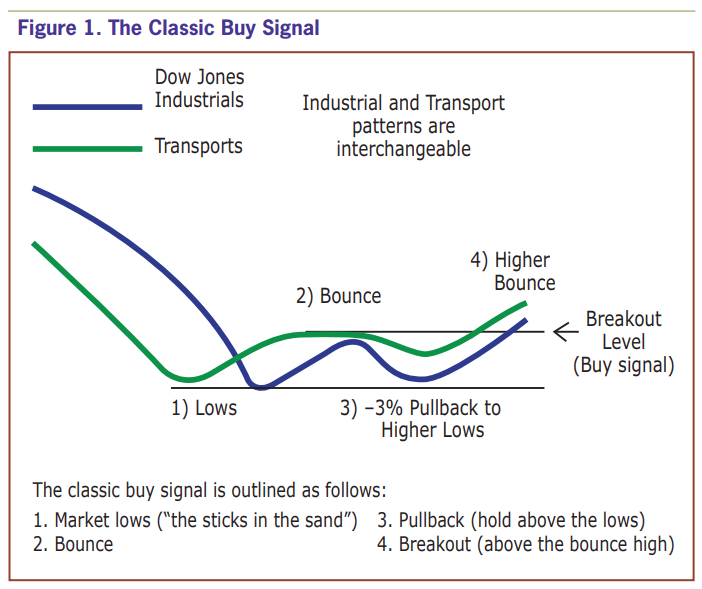
The classic buy signal is developed as follows: After the low point of a primary downtrend in a bear market is established (point 1 in Figure 1), a secondary uptrend bounce will occur (point 2). After that, a pullback (point 3) on one of the averages must exceed 3%, according to Robert Rhea. That setback must, ideally, hold above the prior lows on both the industrial and the transportation averages. Finally, a breakout above the previous rally high (point 4) by both averages constitutes a buy signal for the developing bull market.
Figure 1 represents how the Dow Jones industrial average and the transportation averages might look.
More than one bounce can occur within the confines of the bounce highs and the lows. A common variation is when one of the averages makes newer lows but then rejoins the other in making newer highs.
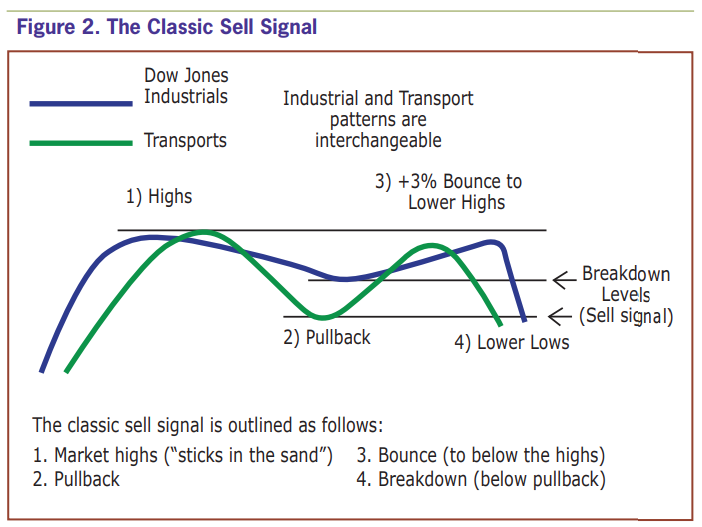
The classic sell signal is determined in much the same way, but opposite to a buy signal. When a bull market tops and sets back, with a subsequent rally that goes back up (again, over 3%) but falls short of reaching the previous high and then penetrates the recent lows on the next decline as measured by both the industrial and transportation averages, a sell signal is generated, indicating a bear market.
Figure 2 illustrates a classic sell signal.
Historically, the traditional Dow Theory has outperformed a buy-and-hold approach by 1% to 2% a year, a seemingly small percentage until one considers the compounding effect over a number of years, where the difference is substantial.
Improvements to the Dow Theory for the 21st century would appear to increase that advantage going forward.
Feature
Jim Braun from CA posted over 13 years ago:
Dave Kent from CO posted over 13 years ago:
Werner Emmerich from PA posted over 13 years ago:
Philip Faccenda from NJ posted over 13 years ago:
David Disick from NY posted over 13 years ago:
David Heffelfinger from PA posted over 13 years ago:
Fernando Robles from FL posted over 13 years ago:
Jack Schannep from AZ posted over 13 years ago:
Edward Mueller from IL posted over 13 years ago:
Charles Rotblut from IL posted over 13 years ago:
John from IL posted over 13 years ago:
Jim from CT posted over 11 years ago:
You need to log in as a registered AAII user before commenting.
Log InCreate an account