


There has never been another period in history more demanding of investor efforts, nor as rewarding of investor diligence, as today’s. The current environment poses a broad range of uncertainties. Investors are now confronted by strong contrasts between conventional wisdom and unconventional insight. For example, conventional wisdom points to historical average returns for long-term investors, but unconventional insights from history tell a different story.
“Long-Term” Returns
The well-known and most-respected long-term average statistic from the stock market is the one provided in the annual compendium published by Morningstar “Ibbotson Stocks, Bonds, Bills, and Inflation Classic Yearbook.” Consultants, financial analysts, advisers and investors seeking a benchmark for long-term stock market returns reach for this annually revised testament of historical financial market data. [Editor’s note: This book can be found at many public libraries.]
The number that everyone seeks in the book is the long-term average return from the stock market, which is near 10%. Conventional wisdom believes that any number representing more than 80 years of history must be a valid indication for the next decade or two. Everyone knows that the stock market has ups and downs, yet 80 years is certainly enough time to produce a valid measure for the average condition, right? Well, actually not.
The three components of stock market returns are dividend yield, earnings growth, and the change in the price-earnings ratio; any other elements will fall within one of these three components. The discussion of the historical data in the Ibbotson yearbook provides the details for all three components and the insights needed to fully appreciate the “Average” (capitalized to acknowledge its aura as a presumed market truism).
The Ibbotson yearbook is updated annually to include another year’s data in the long-term series. To reduce the distortions from any single set of data, Figure 1 reflects the average of multiple series for greater consistency. From each of the three yearbooks preceding 2010, the long-term total return from the stock market is near 10%. The components vary slightly across the three publications, yet the total return is fairly consistent. Earnings growth contributed between 4.1% and 5.3% toward the total return, dividend yield provided between 4.3% and 4.4%, and changes in the price-earnings ratio added 0.6% to 1.3%. Simplifying the ranges, the average values are 4.7%, 4.4%, and 0.9%, for a total of 10%.
According to the trite expression, however, the devil is in the details.
Most noteworthy, the series begins in 1926. This is critically important because the series starts during a period when the market’s price-earnings ratio was fairly low. Ibbotson’s price-earnings ratio for 1926 is 10.2. Since the level of the price-earnings ratio is such a major driver of stock market returns, the starting level of the price-earnings ratio for this most recognized series is an under-appreciated footnote. If the series had started with a price-earnings ratio closer to the average for the recent decade of nearly 25 (or even at recent levels near 20), then the accepted historical average return would be closer to 7%!
When assessing the contributions of the components to the long-term average, it is worth noting that a starting price-earnings ratio near 20 results in a dividend yield closer to 2.5%. [Editor’s note: Valuations and yields are inversely related when the dividend is unchanged. A stock’s yield is calculated by dividing the four-quarter dividend by the share price.] The level of the price-earnings ratio is a major driver of the dividend yield investors receive. When the price-earnings ratio is near 10, the dividend yield is twice as high as it is when the price-earnings ratio is 20. That element alone strikes almost 2% from the long-term average return.
Further, the long-term average includes a near doubling of the price-earnings ratio. From current levels, virtually everyone accepts that a doubling in valuation is unlikely, and many are concerned that the market’s price-earnings ratio may decline from current levels. For this assessment, assume that the price-earnings ratio remains unchanged at currently high levels. [Editor’s note: This article was written prior to this summer’s correction.] By excluding the effect of an increase in the price-earnings ratio, the long-term average return is reduced by another 1%.
Taken together, the two issues of dividend yield and price-earnings ratio change explain the difference between a long-term average return of 10% and one of 7%. Had Ibbotson started the long-term series years earlier or later, when the price-earnings ratio was closer to 20, all of us would carry quite different expectations for long-term returns.
Therefore the long-term return of almost 10% represents the return for an investor who enters the market when the price-earnings ratio is 10.2, stays for more than 80 years when the inflation rate averages just over 3% (to boost nominal earnings growth), and exits after inflation subsides and the market price-earnings ratio has just about doubled from where it started.
Just like the favorite shirt or outfit you own that you hope to keep long enough for it to come back into style, the long-term average return of 10% will be a relic in the back of the closet for any period that does not start from a low price-earnings ratio. When starting from a relatively high price-earnings ratio, two of the stock market return components cannot contribute as much as they did from 1926.
Decades, Not Centuries
Some people will identify with the long-term view; others will be curious to see the effect that these factors have on their own investment horizons. Ten years is generally considered long enough to smooth the yearly ups and downs in the market. Many people expect that the cumulative return over 10-year periods will begin to concentrate near the long-term average return of 10%.
There have been 102 rolling 10-year periods since 1900, covering more than a century of stock market history. Of course, very few, if any, 10-year periods will have total returns (including dividends) of exactly 10%. Yet, many investors and advisers either implicitly or explicitly assume that stock market returns for this decade will be inside the 8%–12% range. This is especially true considering that the assumption by many investors for overall investment portfolio returns is 8% or more.
Consider that the expectation for returns from a portfolio includes a blending of assumptions, combining relatively higher stock market returns with much lower bond investment returns and, for some investors, returns from alternative investments. For the blended portfolio to generate overall returns of 8% after expenses, stocks may need to return 12% or more to offset bond returns that are likely to be less than half that. Alternatively, some investors are concentrating their portfolios more heavily in stocks because of the low bond yields.
Nonetheless, many investors assume that stock market returns over this decade will be inside the range of 8% to 12%. As Figure 2 reflects, the annualized total return from the stock market over rolling 10-year periods has been inside the 8% to 12% range less than one-quarter of the time!
Just over one-third of the time (35%), annualized 10-year returns exceeded 12%. The remainder of the 10-year periods, 43%, delivered annualized returns that were less than 8%.
In Figure 2, the columns list the respective 10-year periods. The periods are not random; rather, they run in series that reflect the fluctuating trend in the price-earnings ratio as driven by the inflation rate. In the rightmost column, reflecting periods with returns in excess of 12%, are all periods when the price-earnings ratio started at less than 15. For the leftmost column, with returns below 8%, the starting price-earnings ratio was generally above 15. With the price-earnings ratio currently near 20, an argument could be made that the next 10-year period ultimately will find its place in the left column.
Driver, Take Me To…
There are two major drivers of stock market returns. The first is the growth rate in earnings. The second is the overall level of valuation in the stock market, as measured by the price-earnings ratio. The price-earnings ratio has two significant effects: The price-earnings ratio drives dividend yield (higher valuations make cash dividends reflect lower-yield percentages), and higher price-earnings ratios are vulnerable to decline just as low price-earnings ratios offer the opportunity of multiplied returns from rising valuations.
Although corporate profits ride a wild business cycle, ultimately high and low margins return to normal. As a result, the long-term growth rate of earnings is similar to that of revenues, since profit margins are determined by dividing profits by revenues. Further, aggregate revenue growth reflects economic growth. Therefore, earnings growth is driven by economic growth.
One of the major uncertainties for the future is economic growth, and thus earnings growth. It is an uncertainty that weighs heavily on the stock market.
The second major uncertainty relates to the second major driver of stock market returns: changes in the price-earnings ratio of the overall stock market. The most significant driver of market price-earnings ratio over time is the level and trend in the inflation rate. High inflation brings high interest rates and lower price-earnings ratios. Deflation brings declining earnings in nominal (non-inflation adjusted) terms and thus lower price-earnings ratios. Conversely, high price-earnings ratios are driven by low and stable inflation, reflecting positive financial conditions and greater certainty. But today’s relatively low inflation confronts the tightly bound tectonic plates of deflation and inflation, which could suddenly surge in either direction. Economic growth and inflation are also items where the conventional confronts the unconventional.
Pause for a moment to take a pop quiz; let’s use it to reveal a few insights.
Over the past century in the United States, real economic growth before inflation has averaged near 3% per year. Over the decades of the 1970s, 1980s and 1990s, the compounded average annual growth rate was 3.2%, 3.0% and 3.2%, respectively. So during the decade of the 2000s (2000–2009), when consumers were loading up their credit cards, homeowners were said to be using home equity like an ATM, unemployment averaged 5.5% and fell below 4% at times, and debt was being added to debt, what was the compounded economic annual growth rate before inflation rounded to the nearest percent?
A) 4%
B) 3%
C) 2%
For many, the first choice, 4%, is the most logical response. It reflects the perception that much of the consumption and leverage of the 2000s artificially accelerated economic growth. People who choose 4% expect that the factors present in the 2000s boosted economic growth above the historical and recent average growth rates.
Following such a strong period of economic growth, most people answering “A” expect a period of below-average growth over this decade to make up for the excesses of the prior decade. They expect that periods during which growth was fueled by debt will be followed by offsetting moderation as the vestiges of leverage and excess consumption are addressed.
The second choice, 3%, is the contrarian response. It reflects a belief that the last 10 years were not different from the previous decades. Though some of the factors in play in the 2000s may have impacted economic growth, people who choose 3% either don’t believe that those factors had much effect, or presume that there may have been similarly unique factors during prior decades. Nonetheless, economic growth of 3% has endured for more than 100 years and has been very consistent in recent decades. Some people in this group believe that 3% is likely for this decade, while others have begun to adopt the notion of a “new normal” of slowing growth due to recent trends in demographics, government policy, taxes, etc.
The third choice, 2%, is the correct response, despite being the one least often selected. Many investors are surprised that the decade of the 2000s experienced compounded annual growth of only 1.8%. Some economists say that it was a decade sandwiched by two recessions, while others blame it on the severe recession of 2008 and the related financial crisis. Yet excluding the recession of 2008 from the decade, the growth rate for the first eight years of the 2000s was still only 2.6%. Further, cumulative economic growth throughout the decade of the 2000s did not exceed 2.7%. It would have required an unusual surge—near 4.5% annually—in the final two years for the full decade to reach the historical average annual growth rate of near 3%.
This sets the stage for a dilemma. Will this decade restore the long-term average by growing at 4%, thereby defying the predominant belief in a slow-growth decade? Was the prior decade an anomaly, with future economic growth simply returning again to its long-term trend of 3%? Did something change 10 years ago, and has economic growth downshifted to a level near 2%? Or as some might contend, could the rate be even lower due to the economic, financial, and/or policy headwinds in front of us? All three scenarios are plausible, which makes economic growth a major uncertainty. The answer to the dilemma has very significant implications for stock market returns over the next decade and longer.
Projected Inflation
But the pop quiz isn’t over: What’s your outlook for inflation? Figure 3 presents a picture of the inflation rate for more than a century.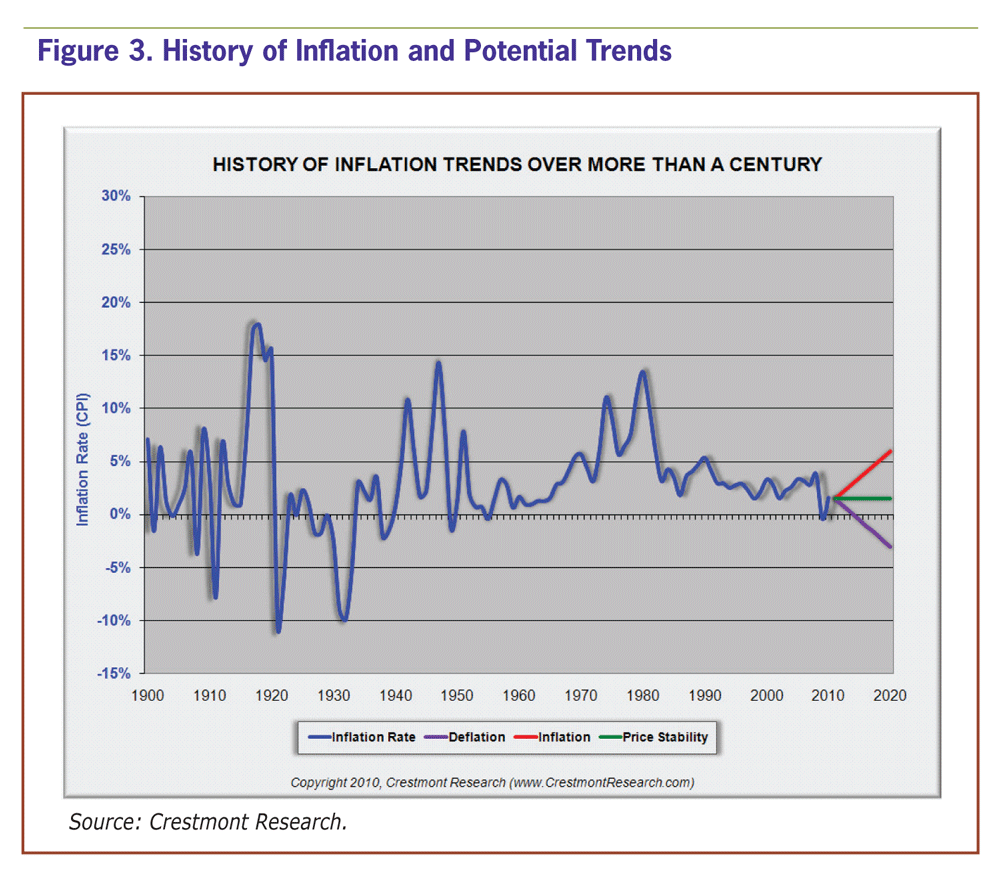
The roller-coaster ride reflects an undulating cycle that does not ride a consistent wave of time. There’s no right answer for this question either … at least not for another 10 years. But there are three plausible scenarios. Does your outlook include a trend of deflation (the purple line in the graph), the calm of price stability (the green line), or a trend of rising inflation (the red line)? If the answer is not clear—and it is not for most people—then certainly you now appreciate the second major uncertainty: What will the rate of inflation be in the future?
Implications
Based upon current levels of valuation, an argument could be made that the stock market is likely to deliver modest or minimal returns. Nonetheless, investors should not avoid stocks. They should diversify their portfolios and enhance returns from stock market investments.
To hedge inflation risk in portfolios, investors can complement diversification with TIPS (Treasury Inflation-Protected Securities), inflation-sensitive commodity investments, and defensive stocks that offer higher dividend yields. To address deflation risk, investors will find that zero-coupon Treasury bonds provide near-guaranteed returns if held to maturity, yet in an environment with significant deflation those bonds can double or triple in value in the near term. If inflation remains under control, investors can sell call options on stock portfolios to enhance returns while still participating in capital gains.
These are among the many ways that investors can realize higher returns when the stock market treads through periods of below-average returns. Using a boating analogy, investors should pull out the oars and actively row their portfolios toward success, while waiting for the next long-term bull market to more passively sail portfolios into the sunset.
Discussion
FREE REPORT

H from NC posted over 15 years ago:
Edward from PA posted over 15 years ago:
David from MI posted over 15 years ago:
James from OH posted over 15 years ago:
Lance from NC posted over 15 years ago:
Dave from WA posted over 15 years ago:
George Pettiford from IL posted over 13 years ago:
David Van Knapp from NY posted over 11 years ago:
Paul Grim from NY posted over 9 years ago:
You need to log in as a registered AAII user before commenting.
Log InCreate an account