


Related

Hot Links
The type, size and timing of an order to buy or sell a security impacts if, when and at what price your transaction gets filled.
Charles Rotblut leads a class in AAII's new Essential Investing Video Course. Go to https://www.aaii.com/ves for more information and to subscribe.
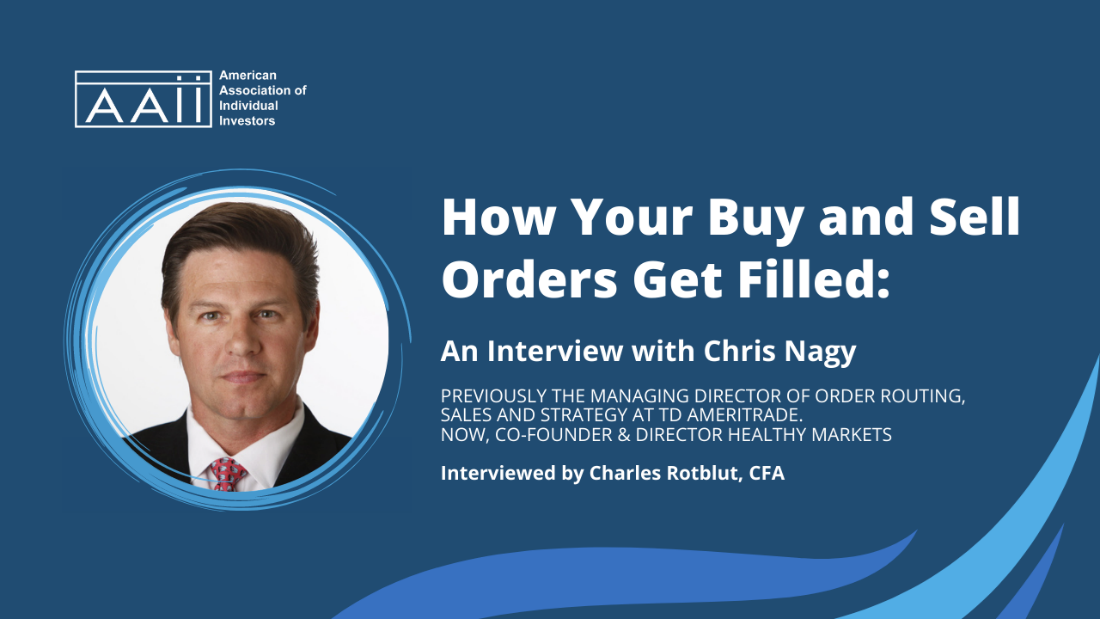
AAII’s lead editor, Charles Rotblut, CFA, had the unique experience of chatting with Christopher “Chris” Nagy, at the time the managing director of order routing, sales and strategy at TD Ameritrade, about how buy and sell orders get filled and executed.
In this candid interview, Rotblut speaks to him about the process that occurs at the brokerage firm after an investor places a stock trade.
Charles Rotblut (CR): Let’s start with the basics. An investor logs on to TD Ameritrade’s website to place a stock order, and they click “buy” or they click “sell.” What happens from that point to the time they see the trade confirmation on their screen?
Chris Nagy (CN): Most investors, and in fact a lot of people in the financial markets, believe that stocks either trade on the New York Stock Exchange or the NASDAQ Stock Market. The reality is far different from that fiction. Today there are over 40 different dark places—or 40 different execution venues—in the marketplace where trades can and do occur, and prices between those venues are changing very quickly.
What typically happens first when a client enters a trade is that, within a manner of milliseconds, there are a whole lot of checks that go on (do you have the cash in your account, and so on). Then the routing technology that we utilize actually scans the entire marketplace in a matter of microseconds to help determine the best venue to send that security to, taking into consideration the amount of the order. You’ve got a bid price (that’s the price you can sell at), you’ve got an offer price (that’s the price you can buy at), and the difference between the two is called the spread; quite typically in today’s markets, that spread is as little as a penny. So markets have tightened. But the consequence of that is that, many times, the size of an offer does not meet the needs of the entire order.
To give you an example, say you want to buy 1,000 shares of XYZ stock, and the offer price is $20.00 per share. When you see that, you might be misled into thinking you can purchase your whole order at $20.00 per share. However, when you look at a real-time quotation, there are only 100 shares offered at that price. So circling back on our routing technology, we look at a lot of the factors: If there are 100 shares available on one exchange, are there 900 shares available on another exchange, and how can we ascertain that? We look at market makers and specialists—people who are actually providing liquidity to ensure that fair and orderly markets exist in our marketplace—to see if they can offset some of the size considerations of that order. Once all that happens, the order execution comes back. Typically that process happens in well under a second. In fact, typically it’s about half a second for an order to be turned around today.
CR: Could you briefly touch on exactly what market makers and specialists do, especially given all the electronic trading that’s now occurring?
CN: Today the role of a market maker is really in many ways to help individual investors get the liquidity they’re seeking on their price. So let’s go back to the example: You want to buy shares of XYZ and the offer price is $20.00 per share. Many times, a market maker will be able to step up and sell that stock to you at a slightly better price. So instead of receiving your execution [your trade fulfillment] at $20.00 per share, you actually receive it at a slightly better price, $19.99 per share.
The reason a market maker would be willing to step up and provide price improvement for the order is that this person is committing capital in the markets throughout the day and they’re taking advantage of minute variations in stock price fluctuations as they do so. By purchasing that stock, they’re able to effectively garner liquidity that helps them offset long and short positions that they have, which helps maintain order in the marketplace. Their role really helps provide a lot of consistency in the marketplace. Without liquidity being added into the marketplace—and in stocks that are not actively traded a lot of times—you can have wild price swings and sharp, severe price movements. So the role of a market maker and a specialist is: one, to help ensure that, when someone wants to buy or sell a stock, there are enough shares available; but two, to help mitigate the overall price swings in the marketplace. It’s a very important role in the liquidity process and in how stocks trade in our markets today.
A market order indicates you want the immediate execution of an order for a stated number of shares at the next available price without any other restrictions. This means your order will seek execution once it is received by the market (as long as the security is trading).
When and why you might consider using a market order:
Source: TD Ameritrade.
CR: What about limit order books? Are they still being used, and could you provide a brief explanation of what they are?
CN: There are essentially two basic types of orders in the marketplace today. You’ve got a market order, which says, “I want to buy a stock at the best prevailing market price available,” and then you have a limit order, which says, “I want to buy a stock, and here is the price that I am willing to pay for it.” Again, let’s go back to XYZ stock. If the stock is bid for at $19.99 per share and offered for at $20.00 per share, and you put in a limit order to buy at $19.99 per share, you actually step in line behind other people who have their orders in already—maybe even some specialists and market makers who are also looking to buy and sell stock at those prices—to purchase that stock at $19.99 per share. The difference between today’s markets and the markets of the past is that, because there are so many different limit order books—I mentioned that there are over 40 different venues where you are able to trade stocks today—many times you can see the stock trade at your limit price, but you don’t know exactly where that trade took place and on which exchange it took place. This is because of all the different exchanges that are out there and the competition that is out there. So that is why limit orders are important: There are times when, even though a stock may be trading at your desired price, you may not get the execution at that price right away. Patience is kind of a virtue in that regard.
CR: Is it any different if we’re talking about a large stock that is frequently traded on the exchanges, like ExxonMobil  (XOM), versus a stock that maybe has a market capitalization of $100 million and is trading 50,000 shares a day?
CN: If you take a look at a stock like Exxon (XOM) or Citigroup (C), you’ll notice that the spread—the difference between bid price and offer price—quite typically will be less than a penny. In fact many times trades, because of price improvement and other factors, will occur at what’s called sub-penny increments. As you go down to stocks with lower capitalization and thus lower trading interests—fewer people may want to own these stocks, and fewer people trade these stocks—you tend to find that these stocks many times have spreads of five cents, 10 cents, even 25 cents. As a result, you can have a whole different experience when you’re placing a limit order on those particular stocks.
Consider a very liquid security, where the bid price shows 100 shares bidding-for, which means you can sell 100 shares at the current bid price. At 25 cents higher there’s an offer price for 100 shares. You as a buyer really like this stock, so you decide to put in a limit order, maybe even splitting the bid offer: for example if it’s bid for $20.00 per share and offered at $20.25 per share, you decide you want to buy this stock at $20.12 per share. If you want to buy 5,000 shares, you’ve basically just increased the overall size of the marketplace, and that signals there’s almost more liquidity available. Your order itself could send the stock higher, because somebody sees a very big buyer in the market. So it’s really important to understand the size of those bid and offer prices in relation to the size of the limit order that you’re placing with the overall liquidity of the stock.
A limit order indicates the highest price you are willing to pay for a security, or the lowest price you are willing to accept to sell a security. Your order will be executed at your designated price or better. This helps protect your order from sudden volatility, but it also means you will only buy or sell the security if it reaches the price you’re seeking.
When and why you might consider using a limit order:
Source: TD Ameritrade.
CR: I assume that for order size information, investors just need to look at the website when they place a quote. Most brokers will list the bid size, correct?
CN: That’s correct. There are a couple different quotes in the marketplace. Typically, when you see a quotation at a site like Yahoo! Finance or Google, that’s what’s called last-sale information—it shows you only the last trade that occurred (delayed by up to 20 minutes during market hours). In very liquid stocks, you could have as many as 5,000 or 10,000 trades in a single second in today’s market, believe it or not.
The next step in quotes is what’s called the level I quotation, and the level I quotation shows the real-time bid price and offer price and shows the size. Typically you now find a level I quote when you log in to your account at your electronic broker’s and pull up a stock quotation. A level II quote gives you a little bit bigger of a picture into the marketplace, showing not only the best price available (level I), but also the second, third, fourth, and so on, best prices available at the different exchanges on the marketplace. It gives you a better idea of how much liquidity is out there.
Now, keep in mind, I mentioned that 5,000-share orders can have an impact on moving prices of a stock. Conversely, not everyone and not all intentions to buy and sell (or liquidity, as we refer to it) are displayed in the marketplace. So sometimes, somebody wants to buy stock, but they’re only showing that they want to buy 100 shares, when in reality they might have a lot more stock to buy behind that. So while level II can give you a good indication, it’s not absolute with regard to the available stock at that particular price.
Stop orders can help you to limit your potential loss in an investment or to lock in profits. By setting an activation price below the market, if you are selling, you may be able to limit a potential loss should the stock price fall.
A stop order becomes a market order once the activation (or stop) price you specified has been reached or surpassed. Stop market orders for purchases require you to enter an activation price above the current ask (offer) price. Sellers must enter an activation price below the current bid price.
A stop-limit order allows you enter two prices—an activation (or stop) price as well as a limit price. The activation and limit prices can be the same or you can choose a different limit price. A stop-limit order becomes a limit order once the activation price has been reached or surpassed. When placing a stop-limit order, buyers must enter an activation price above the ask price and sellers must enter an activation price below the current bid price.
When and why you might consider using a stop order:
Source: TD Ameritrade.
CR: Going back to the stock with the 25-cent spread: If somebody were looking at a stock with a wide spread, and they wanted to buy the stock, should they place an order at the upper end of the spread? Conversely, if they’re selling, should they be willing to accept the lowest price, or is there a strategy where they can maybe try to save some costs and place their order somewhere in the middle of the spread? And if so, are they risking not having the order filled at all?
CN: Every one of those strategies applies. The most important kind of warning sign that’s out there is when you see a stock with a wide spread. You want to draw caution to such a stock. You say, “Okay, this stock has a wider spread. I know in today’s markets, stocks can trade with a penny spread, and this particular stock has a 25-cent spread. Let me back up a bit and analyze what’s going on here and see exactly what kind of liquidity is out there.” And then understand that you might have to have some patience to get your order filled. It might not happen as quickly as you would like.
Conversely, entering a market order, you might not get the expected results either, because the available liquidity might not be wholly available. So back to your question: All of those things apply. It is very important that the narrower or the wider the spread, typically, the less overall liquidity or shares available at either price. So it’s important to do your homework, have patience and be careful about the order that you enter.
In terms of stop orders and stop-limit orders, what can an investor do? Obviously, the flash crash [of May 6, 2010] was an exception, but in normal conditions, what can you do to protect yourself from a) losing a lot of money on a stock unexpectedly, or b) a stock making a quick move one way or another, perhaps because of news, and then reversing course later in the day? What can you do to guard yourself when you’re not at the computer?
I would say stop orders on the very surface sound like a really great thing. If my stock goes down while I’m on vacation, I’m going to stop myself out, or in other words limit my downside losses on a particular security by utilizing this order type. It is a very popular order type among individual investors because no one is standing in front of their quote terminal all the time.
However, it’s very important to understand what this means. There are a few different types of stop orders that you can enter. We’ll just talk about downside stop orders (there are actually upside stop orders that you can enter, too). In the case of a downside stop order, you could say, “I bought my stock XYZ at $20.00 per share,” and once you completed that sale, if XYZ drops to $18.00 per share, then you could decide, “I don’t want to own it anymore, because in my mind the fundamentals of that stock changed and I want to get out of it.” So you enter an order to stop yourself out at $18.00.
What most people don’t understand is that stock prices can move very quickly in a very short amount of time. And stock prices can open at the start of trading on one day at very different prices than where they closed at the end of trading the previous day.
Let’s say you enter a plain stop order that says, “If the stock trades at $18.00 per share, I want to make this a market order and get out at the best prevailing price.” During the order life cycle process, there is actually an activation phase and an order execution phase. The activation phase takes place when the order trades at $18.00 or less. If the stock then opens at $16.00, your stop order is activated, because it is lower than your $18.00 stop price. And the stock sells at the best available market price. In a quickly moving situation, the best price available might be $15.00. You see this happen in circumstances like the flash crash and in circumstances where trading in a stock is halted because of an impending news situation that will have material changes in the company, and the stock opens at a very different price. It is very discouraging for the investor when that happens, but those were the exact instructions provided on the stop order.
One way to prevent that is to put in a stop-limit order. Going back to stock XYZ: “I want to stop myself out at $18.00, but I want to also place a limit so that I will sell at no price lower than $17.00.” The rationale there is: “Well, if it goes to $17.00, I’m going to hold the stock for a while or I might even buy more.” What the order says is that if the stock opens at $16.00, your stop order will be activated, but it now becomes a limit order to sell at $17.00. Your order will not trigger a sale of the stock below that limit price. So again, it’s another way to protect yourself on the downside, without maybe getting the price difference that you saw.
It’s very important to understand that stocks can open above or below their close, and they can trade at different prices very quickly, and that can have an impact on how your stock order executes.
A trailing stop order is an order that is entered with a stop parameter that creates a moving or “trailing” activation price. As a stock’s price moves, the activation price for your order will move too, allowing potentially profitable trades to run. A trailing stop may also help protect against a sharp pullback.
With this type of order, you do not enter a specific activation price but, rather, you create a moving activation price by setting a stop parameter. The stop parameter can be entered as a point value or percentage below the current bid.
When and why you might consider using a trailing stop order:
Source: TD Ameritrade.
CR: I recall you saying that many orders are placed at the start of trading.
CN: A lot of people don’t realize that today at TD Ameritrade 10% of our orders appear at the opening, which is fairly typical of retail firms. A lot of individual investors work all day, then they come home and enter their trades online at night, and they don’t take into account that stocks can and do open at different prices than what they closed at.
CR: That’s a good point to emphasize, because there is always news in the morning and sometimes it’s good and sometimes it rattles the market. I imagine a lot of people place their orders after the market closes, particularly late in the evening.
CN: If you think about it, it makes perfect sense. Just about everyone out there has a day job, and for most their day job isn’t watching the market second by second. So you come home, you make dinner, you put the kids down, and then you have the first chance to look at your finances—which is a very important aspect (or should be an important aspect) of everyone’s life; it can determine your financial future. This is when a lot of decisions are made, particularly for individual investors, as to buying or selling stocks. But, again, it’s really important to understand that global economic changes in the marketplace have an impact on individual companies in the U.S. and where those stocks open and close the next day. So in cases like that, it’s important to consider what price you want to buy a security at. Maybe consider a limit order rather than a market order, knowing that the stock could potentially open at a price a lot higher than you were willing to pay the night before.
CR: And is there any rule of thumb when someone is thinking of placing a limit order? Say they’re looking at a stock and they think it looks attractive at $25.00 per share, which is where it closed at. Is there any rhyme or reason to where they should set the limit?
CN: Well, I think you just answered your question: Say you find a stock attractive at a certain price. You need to figure out at what price you are still attracted to purchasing that security. And then consider what sell price you will have on the security. And use that as a guideline to determine exactly where you want to buy the stock at.
CR: So you’re saying that investors need to realize that when they place an order at night, the price it gets filled at might be very different from what they were looking at the day before, and they should allow themselves a price band, so that as long as the stock is trading within that band, the order will get filled correctly.
CN: Correct. And have patience. Stocks go up and down; they don’t go up every single day. Understand that in the marketplace prices do bounce around, even overnight. Again, more often than not, stocks tend to open at different prices than they closed at the day prior.
CR: Based on complaints that customers lodge, what misconceptions do you see that investors have when they place their orders? I know we just talked about the differences between the types of stock orders, but what filters through to you in terms of complaints about the way orders are fulfilled and what customers perceive as being a bad order fill?
CN: Typically, we see complaints come in from things like stop orders: Individual investors do not always understand that the order could be executed at a very different price than the stop price. And we also see complaints come in on limit orders. There’s thinking in the marketplace that if you place an order, it doesn’t matter at what limit price, you are actually in line and, eventually, if the stock trades at that price long enough, you will get an order execution. And that’s actually not the case, given all the different market structures out there. So those tend to be two of the larger things that we see, and they kind of result from the market structure that we have today.
CR: How does it work if somebody has a limit order, say for $17.00, and the stock is trading at $17.25 and then drops to $17.00, but someone else comes in with a market order as the stock is dropping? Which takes precedence?
CN: Market orders always take precedence over limit orders because a market order says, “I want to buy at the best available market price.” So a market order will jump in front of a limit order. If you’re a client wanting to trade at, say, $17.25, and the stock right away looks like it’s going to come up on your price and your limit order is going to get filled, then all of a sudden a market order comes in, that market order is going to take precedence and actually be filled before your limit order, because it’s the next best available price in line.
CR: So that’s a scenario where someone can place a limit order, see a quote at their limit price, but not get the order filled.
CN: Exactly. Even though you see a trade at that limit price, remember, there are so many different places where that stock can trade, that you do see that happen as well, too.
CR: And can market makers and specialists only step in line if they have a market order?
CN: No, actually, specialists and market makers can and do place limit orders in the books. And in today’s markets, there’s no priority. In days gone by, this has gone back and forth, where specialists would sometimes have priority over individual investors, and individual investors would have priority over specialists, in terms of their placement in the line. Today, for all intents and purposes, it’s equal. Orders are filled on what’s called a time price priority model, which has become widely accepted in the marketplace. This means every order is stamped with a time, and then the price, and then the order takes its place in line, regardless of where that order came from.
CR: If someone’s trying to decide between a limit order and a market order, it really comes down to whether they want to buy the stock at a certain price or to execute the order as quickly as is reasonably possible, correct?
CN: Yes, that’s absolutely correct. It goes right back to: What’s the purpose of buying the stock? Are you looking to become a shareholder for the long term, or are you looking to purchase a stock—maybe the earnings are going to be announced next week—that you want to sell in a week? Those considerations can have an impact, and they should have an impact, on how you want to purchase or sell that security. And you should consider that. Both order types are very important to use.
Also, new order types have evolved from firms like ours. There are now orders that are similar to stop orders, but a little different, which we call trade triggers. The trade triggers are events. So you could say, “If the Dow Jones industrial average drops 200 points, then I want to create a trigger to sell my XYZ stock at a certain price.” You can create triggers today off of all different kinds of macro events in the marketplace, or even micro events in the marketplace. This gives a lot of added flexibility to the user to be able to buy and sell stocks.
CR: Isn’t the danger for setting a trade trigger that, if the market reverses, you might have an order filled that you weren’t expecting? Wouldn’t that result in you actually having the transaction cost of trying to buy the security back if you want to own it again?
CN: Yeah, that’s a very good point. It’s another reason why today we’re connected globally through all kinds of wireless devices and everything. You can sign up to receive messaging on your portfolio, and messaging on prices, and messaging on your order flows. I strongly encourage investors to do that, because that’s a good way to stay on top of orders without necessarily taking a lot of time. For example, you’ve got that notification coming in to your mobile phone that your trade trigger executed, or your stop order executed, or your limit order executed. So at least you have knowledge that the event is taking place.
CR: Is there anything else that you think is important to bring up?
CN: The most important thing—and I stress this again—is just to understand. Do your homework and understand where you want to buy or sell. It’s really important not to let pure emotion get involved in your decision, because emotion—at the root, fear and greed—many times is what makes the market go up and down more than it should. So it’s important to take emotion out of the process and just stay focused on the fundamentals.
Learning how to effectively use buy and sell orders to your advantage is one of the most important aspects of being an individual investor. Knowing the right times to use each types of orders as well as understanding how the time you sell as well as the execution process are vital components of investing. If you’re interested in expanding your educational resources as well as screening, grading and tracking capabilities, learn how AAII’s A+ Investor service can help you become a well-informed investor.
If you want to learn even more about buy and sell orders, feel free to check out the additional resource below.
This article was originally published in the May 2011 AAII Journal. Click here for a PDF of the original article.
Hot Links
Richard from Florida posted over 15 years ago:
Max from MT posted over 15 years ago:
Chipper from NJ posted over 15 years ago:
Leonard from NY posted over 15 years ago:
Chris from CA posted over 15 years ago:
Michael from PA posted over 15 years ago:
Timothy from NE posted over 15 years ago:
Fred from ca posted over 15 years ago:
Charles from CT posted over 15 years ago:
Al from PA posted over 15 years ago:
James from CA posted over 15 years ago:
Thomas from WI posted over 15 years ago:
Joel from PA posted over 15 years ago:
Steve from CA posted over 15 years ago:
Maurice from MO posted over 15 years ago:
Jane from CA posted over 15 years ago:
Ted from CA posted over 15 years ago:
Mark from IL posted over 15 years ago:
Mark from So IL posted over 15 years ago:
Glen from MA posted over 14 years ago:
Paul from PA posted over 14 years ago:
Ted from CA posted over 14 years ago:
Fred from CO posted over 14 years ago:
Ron Jamison from TX posted over 13 years ago:
Phil from Illinois posted over 12 years ago:
joe ragg from OH posted over 12 years ago:
You need to log in as a registered AAII user before commenting.
Log InCreate an account