

Related

Dispatches
Postponing retirement by even just one year can boost a couple’s annual inflation-adjusted retirement income by 6.5% to 8.0%.

Article Highlights:
Probably the biggest financial challenge for Americans is assuring a satisfactory and sustainable standard of living in retirement.
Retirement was largely a 20th century invention; previously, most people worked as long as they could and died not long thereafter. Today, it is not uncommon for a retirement to last 30 years, with people retiring in their early 60s and at least one member of a couple often living into their 90s. The quality of life during retirement can be high if health is good and financial resources are sufficient. However, funding these long retirements is a daunting challenge for individuals and governments alike.
In our recent research paper “The Power of Working Longer” (Working Paper No. 17-047, January 2018, Stanford Institute for Economic Policy Research), we looked at the options that working-age individuals have to increase their sustainable standard of living in retirement. Most retirees rely primarily on Social Security and employer-sponsored 401(k) or 403(b) plans as income sources. Three key determinants of the adequacy of retirement resources are (1) when someone starts participating in the employer-sponsored saving plan, (2) what percentage of their earnings they save in such a plan and (3) at what age they retire and commence Social Security benefits. Workers in the middle of their career who are already participating in a 401(k) type of plan cannot go back and start such participation earlier. The only two levers that they have left to increase retirement resources are saving more starting today or delaying planned retirement and working longer. The purpose of our paper was to determine the relative power of these two levers in increasing sustainable retirement resources.
In this article, we first consider the decision of the primary earner (the higher earner of the two spouses) in a married couple, where both spouses are the same age. This primary earner is assumed to have started participating in a 401(k) plan at age 36 and contributed 6% of earnings, which was matched by an additional 3% by the employer, and it is assumed that the primary earner earns roughly the average wage in the U.S. The worker initially plans to retire and commence Social Security at age 66 and use the entire 401(k) balance to purchase an inflation-indexed monthly annuity with 100% of the monthly benefits continuing for the surviving spouse. We realize that not many people buy such annuities. However, this is the form of benefit provided by Social Security and therefore this assumption allows us to make direct comparisons between the two sources of retirement income. It is also the only way to eliminate both the risk of inflation and the risk of outliving one’s money. We refer to the sum of the monthly Social Security check and the monthly inflation-indexed annuity check as the sustainable standard of living in retirement.
How does the primary earner’s sustainable retirement budget compare with their annual earnings before retirement? Under the assumptions previously stated, retirement income will be about 52% of preretirement earnings. About 80% of retirement income will come from Social Security if the 401(k) investments are safe bonds yielding about the rate of inflation. If riskier stocks are the investment vehicle, the expected earnings replacement rate would be higher, but still less than 60%. So, what can this worker do if they are not satisfied with that outcome? As we already stated, there are only two options: save more or work longer.
Let’s start out with the impact of working one year longer and retiring at age 67 instead of 66. We assume that the worker also delays claiming Social Security benefits until age 67. (Social Security does not necessarily need to be claimed upon retirement, but that appears to be a popular choice.) The sustainable standard of living in retirement goes up for four separate reasons. First, the monthly Social Security benefit increases by 8% when a person claims at 67 instead of 66. Second, there is the extra year of contributions to the employer-sponsored plan. Third, the 401(k) balance at 66 has one more year to compound. And, finally, life annuities are cheaper at 67 than at 66, meaning that a given amount of money will buy larger monthly annuity checks. The total impact on the inflation-adjusted sustainable standard of living in retirement is an increase of 7.75%, if the 401(k) is invested in safe assets that earn a real (inflation-adjusted) return of 0%. Having an extra 7.75% to live on every year in retirement could be quite helpful.
Of course, other planned retirement years and work extension lengths could be considered. Table 1 shows the impact on the sustainable standard of living for a wide range of work extensions, with the base case retirement age ranging from 62 to 69.
Table 1. Returns to Working Longer by Age and Length of Extension
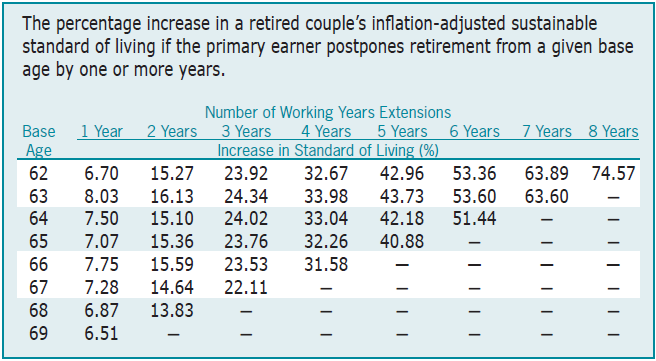
Table 2 shows the standard of living increase for a one-year work extension, from 66 to 67, under different rates of return on 401(k) investments. The main point from this table is that the benefit from working longer is not terribly sensitive to financial returns.Some of these standard of living increases are pretty dramatic. The top row of Table 1 suggests that someone who intended to retire at 62, but instead continued working four more years to age 66, would enjoy a standard of living in retirement that is approximately 33% higher. This higher income lasts for the rest of the couple’s life, as it gets passed on to the secondary earner after the primary earner’s death. The numbers in Table 1 are for conservative investors who realize a rate of return equal to the inflation rate. We conclude that there is a high return to working longer even in a low rate of return environment. For instance, one can increase sustainable retirement resources by approximately 24% or 33% by working three or four years longer.
Table 2. Returns to Working Longer by Real Investment Returns
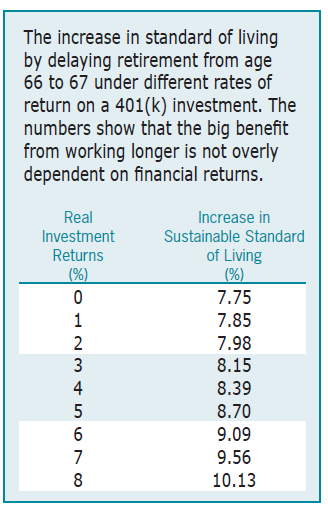
So far, we have shown that working one year longer can improve lifetime retirement resources between 7.75% and 10.13%. Now, let’s evaluate the other alternative, increasing the contribution rate to a 401(k) type of plan.
How much power there is from saving more depends on when you increase your contribution rate. First, let’s look at the case where the primary earner makes an adjustment right from the start, at age 36. Specifically, what if they save 10% for 30 years instead of 9%? The answer depends on the compound rate of return on the 401(k) investments, net of inflation and net of fees over the 30 years. Table 3 shows a set of answers. There you see that if the return net of fees just matches inflation, then saving an extra 1% for 30 years would increase the sustainable standard of living in retirement by just 2.16%. That is a lot less than the 7.75% increase we got for the same case for working one year longer.
Table 3. Returns to Saving 1% More of Earnings by Real Investment Returns
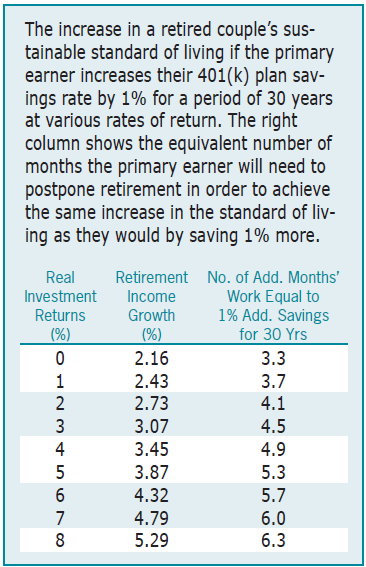
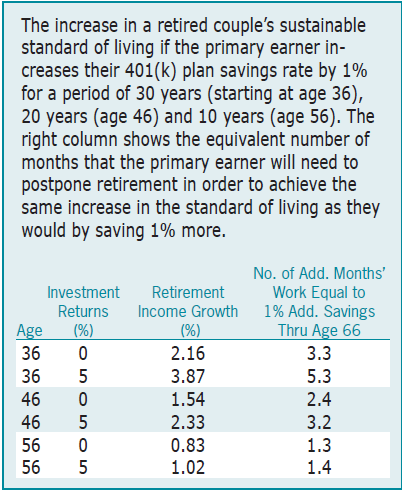
What we just looked at was the best case for saving more—that is, saving more starting at a relatively young age (36). But, what if our primary earner waits until 20 or even 10 years before retirement to address their inadequate projected retirement income? Table 4 shows that saving an additional 1% starting at age 46 is equivalent to working 2.4 months to 3.2 months longer depending on the investment returns realized on the 401(k). Saving 1% more for the final 10 years—starting at age 56—increases the sustainable standard of living by roughly 1%, equivalent to working just six weeks longer.If the retirement portfolio earns a compounded 5% over inflation net of fees, then the extra savings add just under 4% to the standard of living in retirement. You may find the results discouragingly small. How much longer would you have to work to see the same effect on your retirement income? The answers are shown in the third column of Table 3. There you see that the answer is between three and six months longer, which struck us as a relatively short work extension. Just to repeat for emphasis—working from three to six months longer (and delaying Social Security claiming during that time) will have the same impact as saving an additional 1% for 30 years. Now you may understand why we titled the paper, “The Power of Working Longer.”
The lesson we take from Table 4 is that once you wait until your 50s, substantially increasing sustainable retirement resources by saving more is pretty much out of the question. It certainly helps, but not that much. However, working longer is still a very powerful option. The choices shown in Table 1 for raising retirement income by delaying retirement and Social Security are still available.
Table 4. Returns to Saving 1% More of Earnings by Age Initiated
Why is working longer looking so much more powerful than saving more? The answer comes from the fact that around 80% of our average earner’s retirement income will come from Social Security, and only 20% will come from the 401(k) resources. Saving more only impacts the 401(k) balance and doesn’t affect the size of the Social Security check. It only enlarges the smaller of the two checks. But, working longer and delaying the commencement of Social Security increases both checks.
We checked whether these broad results apply to single people as well as primary earners. They do. We checked whether they apply to those who make higher or lower incomes than the average—for example, $20,000 per year or $125,000 per year. They do. We considered the advantage of investing in assets with low expense ratios instead of more expensive ones. In particular, we looked at the payoff from reducing expenses by 60 basis points (0.6%). It certainly helps but, just like saving more, it gets less powerful the later in life you make the change. We found that the advantage of switching to a low-cost portfolio in the 401(k) plan is comparable to the impact of saving 1% more. If someone saved 1% more for 30 years and reduced fees by 60 basis points for the same 30 years, the impact on retirement resources would be about the same as working one year longer.
All of these results are for stylized households who work continuously from age 36 to 66. In these stylized households, couples are the same age, people don’t experience spells of unemployment, don’t get divorced, etc.
In order to check on whether the results apply to real people with much more complicated lives, we looked at a representative sample of Americans over the age of 50 and determined the impact that working longer would have on them. Reassuringly, the results confirmed the answers we report in Tables 1 through 4.
We know that some people don’t have much choice as to when they retire, but many people do. Some people can work at a different job after the completion of their career job. Perhaps they can work part time. It turns out the key to our results is earning enough to allow the deferral of Social Security.
We certainly don’t want to discourage people from saving more or investing more efficiently by lowering overall fees paid to money managers. These things do have a payoff in terms of increasing retirement resources. But, by far the most powerful determinant of retirement resources is when a person retires and commences Social Security benefits. It can take as little as three months of extra work to equal saving 1% more for 30 years. Three or four years of extra work can noticeably change the quality of life in retirement.
Dispatches

Financial Planning
S Alexander from OH posted over 8 years ago:
Steven Sears from IA posted over 7 years ago:
You need to log in as a registered AAII user before commenting.
Log InCreate an account