

Related

Portfolio Strategies
Bill Bengen explains why he now suggests a 4.5% withdrawal rate and what the biggest threat to his withdrawal strategy is.

Charles Rotblut leads a class in AAII's new Essential Investing Video Course. Go to https://www.aaii.com/ves for more information and to subscribe.
Article Highlights
• The safe withdrawal rate is the percentage that a retiree who had the unfortunate luck to experience both high inflation and poor market conditions could have withdrawn and not run out of money.
• A starting point for determining what inflation rate should be used for increasing withdrawals is the consumer price index (CPI). The CPI should be adjusted based on personal circumstances, such as known fixed costs.
• The biggest threat to the 4% (now 4.5%) rule is not a period of low returns, but rather a lasting period of high inflation, with prices incurring percentage increases approaching the double-digit range.
William “Bill” Bengen is a retired financial planning practitioner. We spoke about his groundbreaking research into what is known as the 4% rule (now 4.5%) including its backstory and what investors using it today should take into consideration.
Charles Rotblut (CR): Your research is based on the concept of a safe withdrawal rate. Could you explain for our members who are unfamiliar with the term what a safe withdrawal rate is?
William Bengen (WB): It’s really important to recognize that the word “safe” should be taken with a grain of salt since it’s based upon what’s happened historically. If markets behave differently than they have in the past, what was safe in the past may not be safe in the future.
But in any event, the research I conducted basically went back to look at and reconstruct the experience of investors from 1926 through 1986, retiring them every quarter. I gave them a portfolio of diversified investments. Then I just used the actual investment returns and the actual inflation rates they would have experienced.
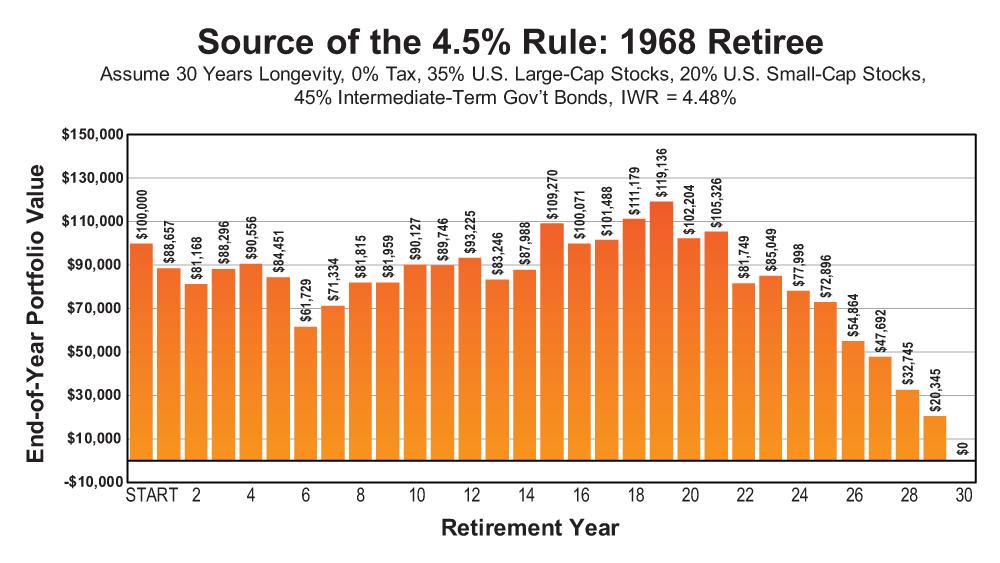
I looked for the worst case, meaning periods when the portfolio ran out of money the soonest. That’s what the 4.5% safe withdrawal is based on: that unlucky investor who retired in October of 1968 and ran into some terrible stock markets and terrible inflation. The combination just devastated their retirement portfolio. By taking out inflation-adjusted 4.5% withdrawals, their money just barely lasted 30 years. [See the box below.]
CR: Originally, in your 1994 study, “Determining Withdrawal Rates Using Historical Data,” (Journal of Financial Planning, October 1994), you used a 4% withdrawal rate. What prompted you to increase the withdrawal rate to 4.5%?
WB: I included more asset classes.
Originally, I only worked with two asset classes. I used U.S. large-company stocks and U.S. intermediate-term government bonds. I then added small-cap stocks. The small-cap stocks added enough of a boost in terms of return to allow the withdrawal rate to be increased.
It was originally around 4.2%, actually. Including small-cap stocks raised it a little bit to about 4.5%. This shows you the importance of having a diversified portfolio during retirement.
A person who retired in October 1968 had the unfortunate luck of encountering periods of both very high inflation and terrible market performance. The combination led to what Bengen found to be to the worst 30-year period for taking retirement withdrawals, as shown in the chart below. This is the period he based the 4.5% rule on.
The dollar amounts for each year are the year-end portfolio balances. An allocation of 35% large-cap stocks, 20% small-cap stocks and 45% intermediate-term bonds was used. Taxes were excluded from the calculation. As you can see, the retiree ran out of money in year 30 by using a 4.5% withdrawal rate.
In discussing the chart with us via email, Bengen commented, “It appears, during the middle of retirement, that after the initial trouble, everything was hunky-dory. Alas, not so. After about the 20th year the portfolio nosedived and never recovered. This is typical of ‘failing’ portfolios from which too much is being withdrawn. The seeds of destruction are sown early in retirement, in this case by a major bear market plus sustained high inflation.”
CR: Before discussing the subject of portfolio allocation further, I’d like to ask what prompted you to do the research on withdrawal rates in the first place.
WB: I became a financial adviser in the late 1980s. I was a baby boomer and most of my clients were baby boomers. By the early 1990s, I had a lot of clients who were 20 years away from retirement. For the first time, they were seriously thinking about how much they should save for retirement, how their investments should be set up during retirement and how much they could afford to withdraw.
I started to look into that information for them, but I couldn’t find anything anywhere pertaining to that. I looked through all my CFP (certified financial planner) manuals and I looked through all the financial planning material. I couldn’t find anything because—quite frankly—at that time retirement was basically a 10- or 15-year affair. People didn’t have to worry about having large amounts of money saved because they weren’t going to live long enough to enjoy it.
A lot of people in my generation expected to live into their 90s and were concerned about having money for 30 or 35 years. So, I decided since I couldn’t find information anywhere I’d do the research myself. I just got the data on investments and the CPI (consumer price index). I then set up the spreadsheet and started running the calculations. I had no idea where it would end up 25 years later.
CR: What was the original reaction to your analysis and findings? It’s pretty well accepted now, but what was the reception when you first had your study published?
WB: It was two-sided. I actually got hate mail from some people who refused to believe that only 4% was all you could take in withdrawals. A lot of people had been advising clients for years and telling them they could take up to 6% or 7%, even 8% based on some very simple, straight-line calculation. But they weren’t taking into account the effect that a major bear market has on your portfolio. It’s just devastating for a retiree. So, there was that.
There were also people who looked at what I did and said “Hey, this is cool. Let’s start using it.” Over time, the reaction became more and more positive and I guess you could say probably even more accepted, as it is today.
CR: Interesting. I didn’t, and I don’t think many of our members, know the strategy’s backstory. Could you explain how the strategy works for those who are not familiar with what it asks retirees to do?
WB: The mechanics of doing the withdrawals?
CR: Yes.
WB: You pick a number based on your preference or maybe a consultation with your financial adviser. Let’s say you take a 4.5% withdrawal and you have a $1 million portfolio. So, the first year you’re going to apply that 4.5% against $1 million. You will take the $45,000 ($1,000,000 × 4.5% = $45,000). That will be your first year’s withdrawal. The second year, you throw away that 4.5% withdrawal and never look at it again.
All you do is look at what consumer inflation was the year before and add that percentage to your initial $45,000 withdrawal. So, let’s say inflation was 10% the year before. You then have to add 10%, or $4,500, of withdrawals for the second year, so your second-year withdrawal totals $49,500. Each year you just increase the withdrawals with inflation. Basically, your lifestyle is keeping pace with the inflation rate.
CR: What would you recommend somebody use for an inflation rate?
WB: Well, in my research, I liked it when you were actually determining your personal inflation rate. But you could use the CPI, even though you’re not obligated to do so. Individuals each have their own different inflation rates depending upon what their expenses are.
Let’s say a person in retirement has a substantial mortgage payment that’s fixed. That portion of his expenses is not going to grow with inflation; it will be fixed. So, he could potentially use a lower inflation rate, a personal inflation rate. Some people might need a higher one. But in general, I would start clients out with the assumption that they would be using the CPI as a starting point for discussion.
CR: Just to be clear, start with the CPI and then modify it based on your personal situation?
WB: Yes.
CR: Getting back to allocations, I know you said that when you went to 4.5%, you added in small-cap stocks to the portfolio. On your recent Reddit thread—which, by the way was great—you suggested allocating between 45% and 55% to stocks, 35% to 45% to bonds and 10% to cash. Is that a correct way of summing it up?
[Bengen participated in a question and answer session on the social media website Reddit in September 2017; you can read through the session here.]
WB: Yes, I said that’s really good.
It’s pretty close to what Harry Markowitz, the great Nobel Prize winner, uses. I asked him about how he personally allocates his portfolio. He said that he’s using the 50% stock/50% bond set up, so that allocation has some pretty good credentials behind it.
CR: In terms of stocks, how are you splitting it? Do you still suggest large caps and small caps?
WB: Well, I would think most investors are probably using a much wider array of investments. They will have some international equities, they may have some real estate. I didn’t use all those asset classes in my research because, until recently, I couldn’t find databases that went as far back as the 1920s. Now that they’ve become available, I’ve updated my research to include them.
Retirement investors should have a very well-diversified portfolio spread out among a number of asset classes. The small-cap stock is kind of like a proxy in my research to represent all the other asset classes that retirees would normally employ in building a portfolio.
CR: What about on the bond side, particularly in the currently still-low interest rate environment? Should retirees just be thinking about intermediate-term government and high-quality corporate bonds? Or should they think about diversifying on the bond side as well?
WB: The research I did indicated that intermediate-term bonds performed the best. You didn’t gain anything by using long-term bonds at all because of the increased volatility. In fact, when I did my research, you could eliminate your bond portfolio completely and replace it with cash. Because of the 0% volatility of cash, you would have done totally well without bonds. I wouldn’t recommend that today because cash is paying so little. We’re living in a very distorted environment today. It’s hard to figure out what to do. But I think investors should probably just follow some basic diversification principles and have different types of bonds.
Folks who hold intermediate-term bonds shouldn’t go particularly long with their bond maturities, but rather should consider having some short-term, some international, some emerging markets … to build a diversified portfolio. This will actually perform the best for an investor.
CR: On the cash side, you talked about holding the 10% in cash. I believe you said that the cash allocation comes out of the bond portion and its purpose is to provide a buffer for retirees. Is that a correct way of summarizing it?
WB: We’re always going to need some cash for withdrawals. I assume retirees will be withdrawing on a regular or monthly basis, so they want to have some cash in their portfolio to handle withdrawals.
I think it’s good to have a little extra, maybe a year or two of withdrawals in cash just in case you run into a bad stock market, a bear market. I find it very comforting for retirees to know they’ve got 10% or 15% cash and they’re not going to have to sell their stock investments in a really bad market environment. They can just live off of that cash for a few years until things recover.
CR: In terms of taking withdrawals, if market conditions are good instead of bad, should retirees think about taking, say, half of the withdrawals out of stock and half of it out of bonds? Or should they split the withdrawals, either equally among all of their asset classes or proportionately?
WB: When I did my research, I assumed we were rebalancing once a year and therefore the cash would come out of whatever asset class had done the best.
As a practical matter, I also looked into rebalancing less frequently. I found out that if you rebalance once every six years, you can actually add about a quarter of a percentage point to your withdrawal rate. The reason is that stocks tend to run in long bull markets and if you rebalance too frequently, you’ll cut those gains off.
So, effectively, the money comes from wherever you’re rebalancing from. You just want to make sure that if you rebalance your stocks, your bonds and your cash, the money should naturally flow from how the investment performed over the previous 12 months.
CR: In terms of taxes, I’m presuming your research treats the withdrawal rate as being independent of tax considerations. Obviously, at the time you did your original study, there weren’t Roth IRAs, but their existence now does not alter the withdrawal strategy, correct? The withdrawals should be calculated based on the investor’s starting portfolio value regardless of the type of account(s) the portfolio is held in.
WB: That’s correct. When we’re dealing with a tax-preferred portfolio like an IRA or a Roth IRA, and so forth, the 4.5% rule applies. The net withdrawals for taxable portfolios are probably about 10% to 15% less. This is based on when I did those calculations; the actual reduction depends upon the prevailing tax rate.
CR: If the retiree has both a traditional IRA and a Roth IRA, should they use the same withdrawal percentage for both? Should they try to adjust in a certain way? Or should they go with the simplest approach, say, “here’s my 4.5% starting point and then I’ll adjust it going forward?”
WB: It shouldn’t make any difference as long as they’re withdrawing from a tax-advantaged account.
When you start getting into a lot of different accounts and types, you almost need software to sort that out and make sure that you’re making provisions for the taxes because that’s an expense. Part of the expenses you will incur are your taxes. That’s where having different types of accounts can get complicated.
CR: What about required minimum distributions (RMDs)? At some point, the absolute dollar amount of the RMDs will exceed the dollar amount suggested by the calculated withdrawal percentages.
WB: They almost certainly will later in life. Basically, an RMD is a transfer of dollars from one account to another, with part of it going to pay taxes. So, it doesn’t really affect things too much. But, once again, it probably requires software to develop a long-term plan and take the taxes into account that are being expended when money is still taken out.
CR: Once retirees take an RMD, I presume they should set aside any excess beyond the amount determined by the inflation-adjusted withdrawal rate—say, put the excess into a savings account or into a taxable brokerage account since in the future the money will be needed to help fund withdrawals. Is that the thought? Any excess amount taken out attributable to the RMD is not money to be spent. It’s money that they should set aside.
WB: It depends on the account size. That money could just flow into a taxable account and be allocated among the same investments and the same asset classes they are currently using right away. I don’t think you want to have an excessive amount of cash sitting around and not earning decent returns.
CR: As far as withdrawal rates—and I’m sure you are aware of this—there are some people now saying we should use lower withdrawal rates if future returns turn out to be lower than historical averages. I’ve seen calls for withdrawal rates of 3.5% or lower. Do you have any thoughts about this?
WB: We’ve had periods of time in the last 90 years when investment returns have been quite low. And yet the 4.5% rule applied. My greatest concern is not the returns going forward.
My concern is having a spurt of very high inflation that would turn out to be lasting. That would tend to jack up your annual withdrawals on a permanent basis and you’d really start running through your portfolio. I haven’t seen any evidence of this occurring, so I don’t have any concerns about it happening in the foreseeable future.
[Editor’s note: Since the 4.5% rule adjusts withdrawals up each year by the rate of inflation, high levels of inflation would increase the withdrawals by a much larger amount in absolute dollars than low levels of inflation would. Since the inflation adjustment is calculated based on the prior year’s withdrawal amount, the effect of high inflation would be compounded and potentially reduce your savings at a much faster rate.]
Even if we earn 1% or 2% for the next 10 years on a balanced portfolio, which I’ve heard some sources quote as being probable, it will just mean that people are unlucky to retire at this time. They will run their portfolios down during retirement, but they won’t necessarily exhaust their savings completely. People are going to have to get adjusted to the point of view that if they start with $1 million, 10 or 15 years from now they’re going to have a lot less. They may still have enough to fund their retirement, but it’s not going to be as much fun as it is for many others who were able to build their wealth up during retirement. It’s a little scary.
CR: With inflation, are we talking about something like we saw in the 1970s? Is it that level versus, say, 4% or 5% inflation that worries you?
WB: Yes, something getting close to double digits for decades—that would be very difficult to deal with. Then I would be concerned about the 4.5% rule holding up, especially if it’s combined with a really big bear market. But so far, I haven’t seen that level of inflation on the horizon. Have you?
CR: No, fortunately I haven’t.
WB: It doesn’t mean it won’t come. It could come as a surprise, and suddenly. But not yet.
CR: What about a bad sequence of returns? Say somebody had the unfortunate luck of retiring in 2007 or somebody is getting near retirement and they start seeing a bear market. Should they stick with a 4.5% withdrawal rate as long as we don’t have that extended period of terrible markets and terrible inflation?
WB: Yes. I’ve done a lot of looking at January 2000 retirees because they’re one of the few groups that retired and faced two major bear markets in their first decade of retirement. Those investors are still reasonably secure with that 4.5% rule, surprisingly. It’s probably because they’ve benefited from an enormous recovery of having held stocks over the last nine years. Now, if we get a third bear market in the next year or two, all bets are off. But so far the 2000 retirees and the 2007 retirees seem to be holding up reasonably well.
Once again, as you know, markets go down. That’s part of the process. And they recover, that’s also part of the process. That’s why I’m not too worried about it.
I’m much more worried about inflation because inflation will cause you to increase withdrawals. Those increases will get locked in for the entire remainder of retirement. There’s no recovery to the portfolio then.
We’ll see. You know, they say this time is not different, but this whole environment feels a lot different than I can ever recall in my career.
CR: It does.
What about a flexible approach to taking withdrawals? I’ve seen some advisers suggest it. Vanguard has even published a study about using a floor-and-ceiling approach to calculating the withdrawals. What is your opinion on this?
WB: When I wrote my book [“Conserving Client Portfolios During Retirement,” (FPA Press, 2006)], I looked at that as a potential methodology, another withdrawal scheme that you might use. The stock market fluctuates, however. Are you familiar with Michael Kitces’ work?
CR: Yes, I’ve spoken with Kitces and we’ve published articles co-authored by him in our magazine.
WB: A couple of years ago, he developed a terrific chart where he plotted market valuations against the safe withdrawal rate year by year. It was an amazingly close negative correlation between the two. The higher that stock valuations are, the lower the safe withdrawal rate turned out to be. [See the box below.]
The chart below compares the cyclically adjusted price-earnings ratio (CAPE), a rolling 10-year valuation indicator developed by Yale professor Robert Shiller and the maximum safe withdrawal rate (“SAFEMAX”) a retiree can take. SAFEMAX is based on the performance of inflation and investment assets in the subsequent 30 years.
As financial planner Michael Kitces originally showed (“Resolving the Paradox: Is the Safe Withdrawal Rate Sometimes Too Safe?,” The Kitces Report, May 2008), there is an inverse relationship between the long-term valuation of the stock market and how much retirees can withdraw without running out of money. During periods of high valuations, lower withdrawal rates are warranted, but during periods of low valuations, higher withdrawal rates can be sustained. A challenge for investors is not knowing what actual future market returns will be. Bengen notes that his SAFEMAX computation does not involve stock market valuations although, as the chart demonstrates, the two have historically been very strongly negatively correlated in the past.
Bengen used a portfolio allocation of 35% large-cap stocks, 20% small-cap stocks and 45% intermediate-term bonds. Taxes are excluded from the calculation. The SAFEMAX data only runs through 1987 to reflect actual 30-year withdrawal periods.

His conclusion was that when you get a CAPE (cyclically adjusted price-earnings ratio) above 20, you should stick with the lowest, the safe, withdrawal rate because otherwise it’s too risky. We’re certainly well above that now. So, I don’t think any kind of a scheme where you attempt to try to take out 5% or 5.5% now is likely to work.
I expect, at some point, that there’s going to be another serious decline back to more normal valuations. You’re going to have to start scaling back what you withdraw each year. It might be painful, after you have misled yourself about the kind of lifestyle you really think you can afford.
CR: Some other people have suggested other strategies. For instance, Wade Pfau, who’s done lots of work with Kitces, has written about using reverse mortgages to supplement withdrawals. As I’m sure you are aware, there is also a camp that says investors should just annuitize all of the money needed to cover expected fixed expenses at retirement. Any thoughts about these alternative strategies?
WB: They’re worth looking at if people are concerned that their money isn’t going to last. I think people ought to sit down with a competent individual who has their interests at heart and work through the numbers. Doing that may make sense.
Click here to hear audio of Bengen’s suggestions for those nearing retirement and the biggest lesson he’s learned over the course of his career.
Portfolio Strategies

Portfolio Strategies

Financial Planning
David Van Knapp from NY posted over 8 years ago:
William Bengen from CA posted over 8 years ago:
John Schuerman from MS posted over 8 years ago:
William Bengen from CA posted over 8 years ago:
Alan Ruger from WA posted over 8 years ago:
William Bengen from CA posted over 8 years ago:
Tom Canfield from PA posted over 8 years ago:
Bill T. from CO posted over 8 years ago:
Bill T. from CO posted over 8 years ago:
William Bengen from CA posted over 8 years ago:
William Bengen from CA posted over 8 years ago:
Lance Casual from PA posted over 8 years ago:
Bill Bengen from CA posted over 8 years ago:
Bill T from CO posted over 8 years ago:
Jack Kulpa from WI posted over 8 years ago:
William Bengen from CA posted over 8 years ago:
Dave Gilmer from WA posted over 8 years ago:
Roderick Johnson from WA posted over 8 years ago:
Roderick Johnson from WA posted over 8 years ago:
Roderick Johnson from WA posted over 8 years ago:
William Mcginty from GA posted over 8 years ago:
John Strudwick from FL posted over 8 years ago:
William Bengen from CA posted over 8 years ago:
William Bengen from CA posted over 8 years ago:
William Bengen from CA posted over 8 years ago:
William Bengen from CA posted over 8 years ago:
John Belanger from OH posted over 8 years ago:
John Jones from NJ posted over 8 years ago:
Robert G from MI posted over 5 years ago:
JACK K from CA posted over 5 years ago:
You need to log in as a registered AAII user before commenting.
Log InCreate an account