


In November 1983, I wrote an article for the AAII Journal about the benefits of international diversification. At that time, very few investors even considered international diversification as an investment option. In almost 30 years since that article was written the world has changed.
In 1983 there were about 23 developed investable markets; in 2010 there are nearly 100! Countries that were not part of the market economy (particularly Russia and China) are not only market economies, but are arguably drivers of the fortunes of many companies worldwide. Yet, during times of crisis, the benefits of global diversification are called into question. This article serves to address this concern.
The Rise and Fall of Correlations
Only in the world of finance do fundamental theories often fall into question when faced with disaster or crisis. Such was the situation during the 2007–2009 recession, when the correlation of equity markets appeared to approach parity—and the benefits of diversification were called into question. The Wall Street Journal propagated this debate with a July 10, 2009, article by Tom Lauricella, “Failure of a Fail-Safe Strategy Sends Investors Scrambling,” which highlighted selected short-term correlation data points.
Correlation is computed as a correlation coefficient, which ranges from –1 to +1. Two random variables (e.g., security prices) are positively correlated if as one variable moves up or down, the other variable moves in lockstep directionally. They are negatively correlated if high values of one variable are associated with low values, or opposite movements, of the other. In portfolio management, finding investments that have low or negative correlation with each other offers the chance for better diversification.
Irrefutably, we have just witnessed a relatively brief period of high correlations between U.S. and international stocks. Using annual data for the five-year period from 2005 through 2009, the correlation of the S&P 500 index to the MSCI EAFE (Europe, Australasia, Far East) index rose as high as 0.99 during the time period. Quite a bit of noise ensued from the press and from Wall Street about the demise of diversification.
However, we have experienced similar short-term periods of very high correlations. For example, for the five-year period from 1972 through 1976 (based on calendar-year returns), the correlation of the S&P 500 index to the MSCI EAFE index rose to 0.87 (when the collapse of exchange-rate controls and an oil embargo coincided with a global stock price downturn). However, over the following five years (1977–1981), the correlation fell all the way to 0.25.
Clearly, correlations wax and wane considerably over myriad market cycles. Importantly, stocks worldwide tend to drop during periods of extreme market or economic stress (correlations move up), just as they did in the 1972–1976 period and in this recent crisis. But historically, U.S. and international returns have diverged shortly after the crisis ended (correlations moved down). This trend is evidenced in Table 1, which shows that correlations among the EAFE index and the S&P 500 during bear market cycles (20% or more drop) have been higher than they were during the bull market cycles that preceded them. Of the six bear markets from 1970 to 2009, five experienced an increase in correlation. Furthermore, all bear markets since 1982 have seen an increase in correlation. It is worth noting that the EAFE index does not include the many emerging markets that are now an important part of the global investment universe. This is a subject of further research at Polaris Capital.
So why the outcry negating the benefits of global diversification? The answer can be explained in one simple word: recency. Recency is the tendency to give too much weight to recent experience, while ignoring the lessons of long-term historical evidence, as defined by Larry E. Swedroe and Jared Kizer in “The Only Guide to Alternative Investments You’ll Ever Need” (Bloomberg Press, 2008).
Bear Market (Short-Term) Correlations
The 1990–2009 period has seen an upward trend in correlations between U.S. and international stock averages. Historically, low correlations were influenced by the differences in economic and political factors among various countries and industries. Implicit in varying economic trends is the fact that, when one company wins, another loses; the same can be said for countries or sectors, leading to low correlations. However, during a crisis investors often disregard this fact and sell all at once, creating higher positive correlations. Moreover, from the mid-1990s to 2006, global economic growth was unusually positive for almost all sectors of the world, and the traditional business cycle—recession—seemed to be suspended. It will be interesting to see if the traditional business cycle returns in a post–Great Recession world.
The Contagion Effect
Short-term correlations tend to be asymmetric: Global correlations rise whenever systemic asset price shocks impair the world’s largest economies, as evidenced in the U.S. in 2007–2009. Historically, the U.S. has been the primary accelerator of world economic growth; when the U.S. falters (bear markets, recessions), many global economies follow suit, dragging down global markets. In fact, with the exception of the 1983–1984 bear market, more than 70% of developed international stock markets have experienced bear markets simultaneous with U.S. bear markets, according to Yesim Tokat and Nelson W. Wicas (“Investing in Emerging Stock Markets,” The Journal of Wealth Management, Fall 2004).
This contagion effect across countries can be easily proven by a review of the past bear cycles. In a March 1995 Federal Reserve Bank of Minneapolis study entitled “Time-Varying Risk and International Portfolio Diversification With Contagious Bear Markets,” authors Giorgio De Santis and Bruno Gerard point to several bear cycles for the U.S. stock market (specifically the S&P 500 index). We have identified two additional cycles, 2000–2002 and 2007–2009, using the methodology presented in the study.
Some of the most severe U.S. bear cycles (since the inception of the MSCI EAFE index) were the periods from January 1973–September 1974 (–48.2%), August 1987–November 1987 (–33.5%), March 2000–September 2002 (–49.1%) and October 2007–March 2009 (–56%). The January 1973 to September 1974 bear market resulted from a plethora of bad news: Watergate, an Arab-Israeli war and an oil embargo that spiked fuel prices. The 1987 bear market lasted just three months, but most of the decline occurred in one day: Black Monday, October 19, 1987 (likely triggered by program trading). The 2000–2002 bear market was caused by the blow-up of the tech/Internet bubble, with stocks shedding nearly 50% of their value. This bear market was prolonged by the September 11 terrorist attack and the Enron and Worldcom scandals. And we all know what has happened in the past two years—no need to rehash the ugly recent past. For these bear market cycles, Table 1 shows that it seems the only thing that goes up in a crisis/bear market is correlations!
Taking a More Balanced View
Data supporting the bear market/high correlation position has been published by many. François Longin and Bruno H. Solnik formally established the statistical significance of this asymmetric correlation phenomenon (“Extreme Correlation of International Equity Markets,” The Journal of Finance, April 2001). High correlations during recessions, at times of high volatility and during bear markets have spawned concern that international diversification offers little safety when U.S. markets tumble. Favored by major media, the diversification issue has been debated at length over the past two years. To ensure a more balanced view, investors should consider the opposing evidence—the cold hard facts—which clearly support diversification even in bear markets:
1) After spiking during bear markets, correlations appear to revert toward the long-term mean.
While the correlation between U.S. and international markets has ranged from 0.11 to 0.99 over the past 40 years, it averaged 0.59 for the period (see Table 4). The impact of high or low levels of correlation can seem alarming in the short turn, but correlations are likely to settle at levels more reflective of long-term averages.
Many economic pundits have already echoed this sentiment in 2010. Equities will enter their next cycle, one traditionally marked by lower stock market correlations. Stocks tend to diverge from one another in the year after a recession ends, and this trend often continues for two additional years thereafter—a pattern reported by Paul J. Lim in The New York Times (“When Stocks Stop Moving Like a Herd,” April 3, 2010). As long as the recovery continues on track, investors should expect correlations to continue to settle back into more or less their historical norms.
2) Although impacted by short-term conditional correlation, foreign and U.S. stocks still have diverging total returns/risk characteristics, even in bear markets.
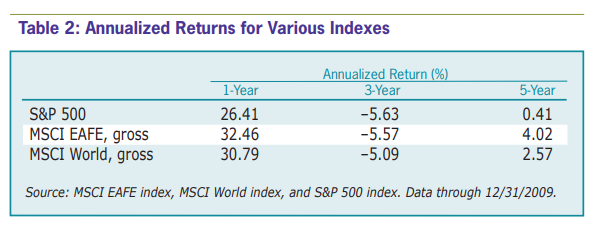
Consider just the past one-, three- and five-year periods, impinged by the 2007–2009 bear market (see Table 2).
As evidenced by these numbers, the inclusion of international equities in a domestic-only portfolio would have increased portfolio performance over the past one-, three- and five-year periods, even in a bear market and despite higher correlations. Some investors might see the increased correlations in bear markets and be tempted to engage in a kind of market timing. However, Table 2 implies that despite higher correlations, the global portfolio would still have performed better than a domestic-only portfolio.
In terms of risk characteristics, Bruno H. Solnik calculated that a fully diversified U.S. portfolio is about 27% as risky as a typical individual stock, while a fully diversified international portfolio is only about 12% as risky as a typical individual stock (“Why Not Diversify Internationally Rather Than Domestically?,” Financial Analysts Journal, July/August 1974).
This implies that, when fully diversified, an international portfolio can be less than half as risky as a purely domestic-only portfolio.
3) Consider another yardstick for diversification: return gaps.
The merits of diversification have typically been measured by correlation, and, as such, we have spent significant time addressing this historical comparison. However, Meir Statman and Jonathan Scheid stated that a return gap is another good measure of the benefits of diversification, because a return gap accounts for the effects of both correlation and standard deviation (“Correlation, Return Gaps, and the Benefits of Diversification,” The Journal of Portfolio Management, Spring 2008).
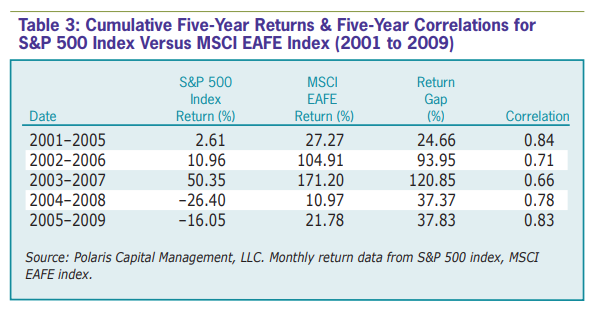
To continue the short-term comparison, consider that the return of U.S. stocks (represented by the S&P 500 index) during the five-year cumulative period ended December 2009 was –16.05%. The corresponding return of international stocks, represented by the EAFE Index, was 21.78%. The return gap between the two was 37.83%. Investors with portfolios concentrated in U.S. stocks lagged investors who diversified 60%/40% (U.S./international) by 15.13%.
The magnitude of these returns gaps is not intuitively obvious from the 0.83 correlation during that five-year time frame. As pointed out by Statman and Scheid, the magnitude of return gaps belies claims that benefits of international diversification have vanished due to high correlations. Looking at other recent five-year periods with high correlations, the same holds true (see Table 3).
Long-Term Correlations
In a March 16, 2010, working paper, data analysis focused on the 2000s (“Is the Potential for International Diversification Disappearing?,” by Peter Christoffersen, Vihang R. Errunza, Kris Jacobs and Xisong Jin, Social Science Research Network). We have already confirmed the high correlations associated with bear markets, of which there were two, in 2000–2002 and 2007–2009, during this narrowed period of focus. However, such correlations do not translate to long-term market trends. In fact, even the working paper research charts indicate that prior to 2000 (more than 25 years of tracking per the report), correlations ranged from approximately 0.40 to 0.60 for the 16 developed markets in the study; correlations were even lower for the 17 emerging markets referenced (see the sidebar on emerging markets).
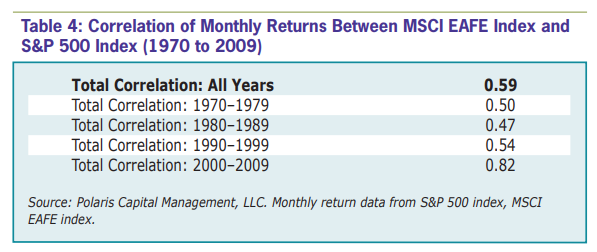
An examination of the 40-year history of S&P 500 and MSCI EAFE annual returns reveals a correlation of 0.59. Breaking that history into four 10-year periods, only the past 10 years have really been witness to a higher correlation, magnified by two bear markets during this same time frame (see Table 4).
Economic Trends
Market panics can be important drivers of short-term returns. However, long-term returns are more about a country’s economic performance, which can very widely across countries, as stated in a March 3, 2010, working paper (“International Diversification Works (Eventually),” by Clifford S. Asness, Roni Israelov and John M. Liew, Social Science Research Network).
Consider the extreme case of Japan, which experienced a property and stock market meltdown in the 1990s. From its December 1989 peak of 38,916, the Nikkei stock average fell 63% during the 1990s and land prices fell between 3%–6% for eight consecutive years. The drop didn’t happen because of a panic or globally coordinated rise in risk aversion; it happened because of a decade-long idiosyncratic economic disaster, according to Asness et al.
Diversification can protect against the adverse effects of holding concentrated positions in countries (e.g., Japan) with poor long-term economic performance.
Emerging Market Returns and Correlations
Today, emerging markets make up about one-fifth of the world’s market capitalization outside of the United States. The Morgan Stanley Capital International (MSCI) Emerging Markets index tracks 22 countries, just seven of which—China, Brazil, South Korea, Taiwan, South Africa, India, and Russia—claim nearly 80% of the market capitalization of the index, according to a September 2009 report from Standard & Poor’s.
On a year-by-year basis, since the inception of the emerging markets index in 1988, emerging market equity returns as a whole ranged from –54% to +75%, while returns in developed markets varied from –42% to +31% (“Investment Insights: Emerging Market Equities as an Asset Class,” by Brett Hammond, TIAA-CREF, September 2010). Market returns for individual countries varied even more, due to factors such as different economic structures and development, different uses of capital and labor, and different governmental and political systems. Trends and crises in emerging markets are frequent (leading to higher volatility), but typically are country specific.
Emerging markets, by definition, are expected to experience faster growth rates, increased consumption and dynamic import/export activity. Performance behavior alone indicates the potential benefits of emerging market equities, since investors can reap the rewards of growing economies and industrialization. Figure 1 shows the explosive growth of $100 based on the MSCI Emerging Markets index in comparison to the S&P 500.
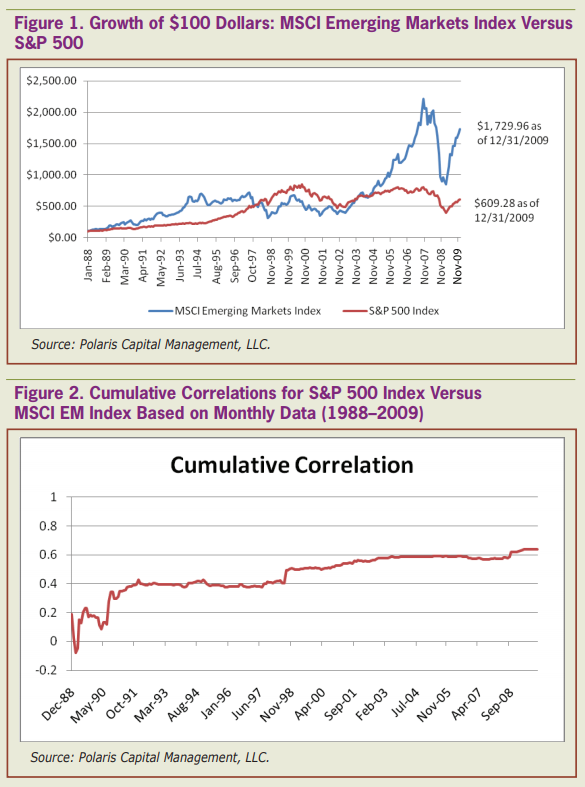
As this entire article focuses on the correlation-diversification issue, we would be remiss not to address that issue in emerging markets. Figure 2 shows the cumulative correlation of emerging markets to the S&P 500 from the inception of the MSCI Emerging Markets Index in 1988 through 2009, showing that correlations now range near 0.60 (similar to historical developed markets). While the 2007–2009 financial crisis led to an increase in correlations similar to the developed market phenomena, we believe that different macroeconomic and fundamental underpinnings of emerging markets will once again lead to lower market correlations and a reversion to historical mean correlations.
—Bernard R. Horn Jr.
Avoiding Home Bias
All countries have differing economies, government regulations, capital-flow sensitivities, monetary and fiscal policies, businesses and inhabitants. All of these differences create inefficiencies on which to capitalize. While globalization has connected businesses closely to one another, companies in different countries have unique characteristics. Differences range from the comparative economic advantages countries have over one another to factors such as tax structures, currency markets, sales channels/geographies, growth prospects, political environments, business cycles, industry structures and central bank issues.
Varying macro-economic environments are exposing investments to more potential risks and rewards than a U.S.-centered portfolio. While U.S. market performance in 2006 was about 10%, stock markets in other countries have done much better—for example, Mexico (+35%), Brazil (+22%), China (+44%), India (+40%), and Spain (+32%).
Yet the average American investor keeps 72% of stock assets in the U.S., a preference for local companies that’s known as “home bias” (“Placing Your Investing Chips in the Right Countries,” by Jason Zeig, The Wall Street Journal, January 30, 2010). Proponents of this strategy miss out on capturing overseas growth: Nearly 60% of world’s equity market capital is outside the U.S., and 2010–2011 global gross domestic product (GDP) growth is expected to come from BRIC countries (Brazil, Russia, India and China) and other emerging markets.
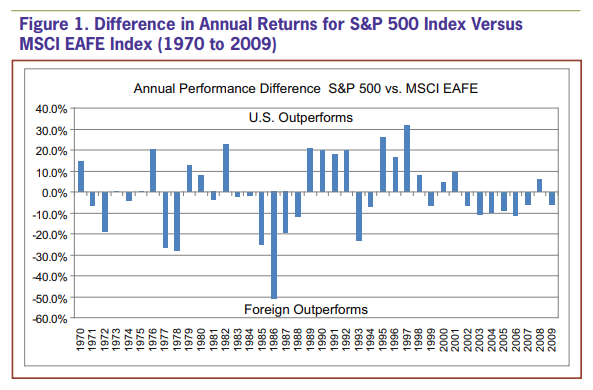
Consider also that over the past 10 years more than 80% of world’s stock markets have outperformed the U.S. market. Figure 1 illustrates how foreign stock markets (as represented by the MSCI EAFE) underperformed during much of the 1990s; but from 2002 on, they have outperformed the U.S. stock market. The performance lead has oscillated between U.S. and international equities: Since the 1970s, the S&P 500 has outperformed EAFE in 45%, or 18, of the last 40 years. Not taking advantage of the growth cycles in both U.S. and foreign markets will prove a detriment to long-term returns.
Conclusion
Swedroe and Kizer noted that investors subject to recency make the mistake of extrapolating the most recent past into the future, as if it is ordained that the recent trend will continue. However, most of the conclusions appropriate for one recent time horizon are misapplied over another period. Indeed, much of investment literature and media is better applied to day traders and market timers, as opposed to the majority of investors who have long-term return goals. It is true that international diversification offers limited protection during short-lived panics or bear markets (due to higher correlations); however, diversification’s risks and rewards will serve investors quite well over the long horizon, when a country’s economic growth matters more to returns.
It is important that investors understand that correlations are not static: They are stochastic, meaning they vary over time. And equity correlations are likely to rise to very high levels during times of crisis. But remember that there are other ways to reduce risk: Diversifying across asset classes can also reduce risk as long as the investor sticks to asset allocation and rebalances, especially during times of crisis. As long as correlations between asset classes don’t reach parity forever (+1), they can still add value as diversifiers. Asset classes may also lose value simultaneously, but typically not by the same magnitude. If one set of assets declines less than another, then it aids diversification by mitigating the degree of the overall portfolio’s decline. On the other end of the spectrum, if one set of assets rises more than another, investors benefit from better returns than they would receive from one country-focused investment.
However, if concerns arise about short periods of rising correlations, investors may want to consider an allocation to high-quality, very-short-maturity debt-based income assets to reduce overall portfolio risk (e.g., adding Treasury bills to the portfolio). This will help you to ride out periods of high correlation and take advantage of the benefits that come from having cash to rebalance into depressed equity investments. It can also help you reduce an overweight equity position during ebullient markets to later rebalance when volatility creates the opportunity. In any case, investors should understand the benefits and risks of global diversification.
Kelly Fitzsimmons Anderson and Samuel J. Horn assisted with this article.
Discussion
FREE REPORT

Stephen from CA posted over 15 years ago:
Paul from OK posted over 15 years ago:
Thomas from CA posted over 15 years ago:
Jaswant Patel from IN posted over 11 years ago:
You need to log in as a registered AAII user before commenting.
Log InCreate an account