


One action promoted by nearly every commentator on the subject of managing taxable income is the “harvesting of tax losses.”
This term means simply to sell positions with a paper loss so that the loss can be used to offset taxable gains and up to $3,000 of other types of income ($1,500 for married individuals filing separately). When harvesting tax losses, investors are instructed to be wary of the wash-sale rules that can result in the disallowance of the capital loss on the sale of the investment.
The purpose of this article is to explain the wash-sale rules in some detail so that investors have the knowledge to harvest tax losses without violating these rules. Done correctly, investors can harvest their tax losses by selling their loss positions, and, if desired, immediately replace their investments with similar holdings without triggering the wash-sale rules.
Basics of the Rules
Tax authorities realize investors have the ability to favorably time the sale of their investments. They understand security losses realized by taxpayers reduce the taxpayer’s ability to pay tax. However, tax authorities object to tax losses being generated and used when the economic position of the taxpayer remains unchanged. This occurs when substantially identical investments are purchased shortly before or after the sale. Such a chain of events results in the losses being viewed as fictitious because the investment remains ongoing and is not in fact liquidated.
The wash-sale rules disallow the loss on the sale of shares of stock or securities when substantially identical stock or securities have been acquired (or a contract or option for such securities has been acquired) during the 61-day period occurring 30 days before the sale to 30 days after the sale. The portion of the loss disallowed depends upon the number of securities acquired versus the number sold. For instance, if 50% of the number of shares sold were acquired within the restricted time period, 50% of the loss would be disallowed. The amount of the disallowed loss adds to the basis of the stock acquired. So the loss is deferred until the replacement shares are sold.
The wash-sale rules only defer losses, not gains. When the amount of securities purchased within the 61-day restricted period is less than the number of securities sold, the securities are matched in accordance with the order of their acquisition, beginning with the earliest acquisition.
Demonstration of the Rules
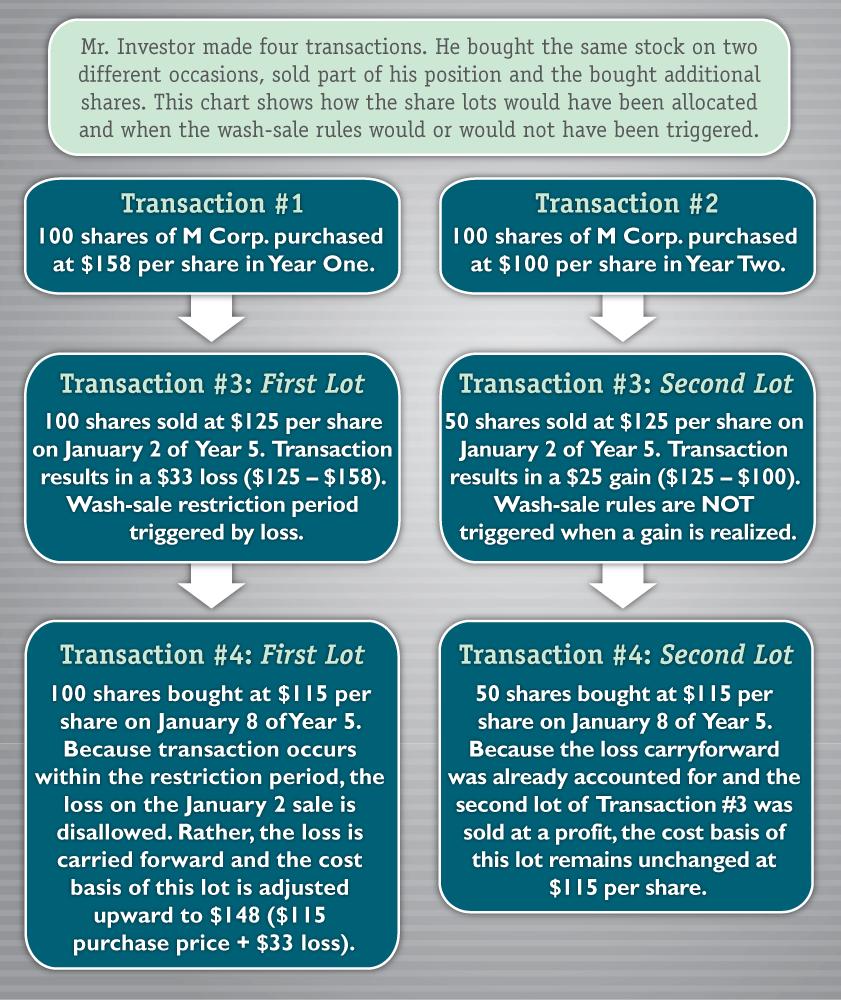
Mr. Investor bought 100 shares of M Corp. stock in Year One for $158 per share and an additional 100 shares in Year Two for $100 per share. On January 2 of Year Five, Mr. Investor sold 150 shares of M Corp. for $125 per share. Then, on January 8 of Year Five, he bought 150 shares of the identical M Corp. stock for $115 per share.
The first lot of 100 shares, purchased in Year One at $158 per share, is sold at a loss of $33 per share ($125 sell price minus $158 cost basis). This results in a loss of $3,300 on the entire lot ($33 times 100 shares). Since 150 shares of the same stock were purchased six days later, the wash-sale rules are triggered and Mr. Investor is disallowed from claiming the loss. He can, however, adjust the cost basis of the first 100 shares he bought in Year 5 by the $33 per share loss. This would raise the cost basis for the new lot to $148 ($115 purchase price plus the $33 loss).
The remaining 50 shares are treated as coming from the lot purchased in Year 2. Since these shares were purchased at $100 per share, a gain is realized ($125 sell price minus $100 purchase price equals a gain of $25 per share.) The wash-sale rules do not apply to gains. This means 50 shares of the 150-share lot purchase in Year Five will not have their cost basis adjusted. Their cost basis will remain at $115 per share.
Figure 1 tracks the transactions and cost basis of the two lots in this example.
Application of the Rules
The wash-sale rules apply to mutual funds, exchange-traded funds (ETFs), and contracts or options to buy securities as well as the actual securities such as stock and bonds. Commodity future contracts and foreign currencies aren’t considered securities for wash-sale purposes.
If an investor sells a stock in one account at a loss and then repurchases it in a different account within the restricted time period, the wash-sale rules will apply. This is true even if the sale of the security is from a taxable account and the purchase is in an individual retirement account (IRA). (The court ruling on the case of this nature did not allow the deferred loss to be added to the taxpayer’s basis of the IRA.) In IRS Publication 550, Investment Income and Expenses (www.irs.gov/pub/irs-pdf/p550.pdf), the Internal Revenue Service also has stated it believes a stock sold by one spouse and purchased within the restricted time period by the other spouse is a wash sale. This position has not automatically been supported by the courts, especially when the spouses had separate accounts and acted independently.
Wash-sale transactions where the purchase is completed in a different account than the sale can catch a tax preparer unaware because investment brokers are only required to report wash-sales transactions that occur within the same account of the taxpayer. Taxpayers must also be wary of wash sales triggered by automatic reinvestment of distributions. Purchases from automatically reinvested dividends and distributions count in the wash-sale rules. If a taxpayer sells a portion of the holding 30 days before or after the date of the distribution, the wash-sale rule will be triggered for the lesser of the number of shares received in the distribution or the number of shares sold.
Definition of Substantially Identical
The wash-sale rules apply to sales and purchases of substantially identical securities within the restricted time period. Despite the more than 75-year existence of this law, the meaning of the term “substantially identical” remains murky in some cases. Whether or not the replacement securities are considered “substantially identical” is a facts-and-circumstances test. This means all facts and circumstances must be considered when making that determination. Unfortunately, the substantially identical determination is a judgment call. There are no bright-line, definitive answers for each situation.
Over time, factors to consider when determining whether securities are substantially identical have developed in case law and administrative rulings.
IRS Publication 550 states, “Ordinarily, stocks or securities of one corporation are not considered substantially identical to stocks or securities of another corporation. However, they may be substantially identical in some cases. For example, in a reorganization, the stocks and securities of predecessor and successor corporations may be substantially identical.”
Publication 550 continues, “Similarly, bonds or preferred stock of a corporation are not ordinarily considered substantially identical to the common stock of the same corporation. However, where the bonds or preferred stock are convertible into common stock of the same corporation, the relative values, price changes, and other circumstances may make these bonds or preferred stock and the common stock substantially identical. For example, preferred stock is substantially identical to the common stock if the preferred stock:
- Is convertible into common stock,
- Has the same voting rights as the common stock,
- Is subject to the same dividend restrictions,
- Trades at prices that do not vary significantly from the conversion ratio, and
- Is unrestricted as to convertibility.”
Thus, one security can be seen as substantially identical as another when, due to particular circumstances, its value is determined by the other security and its other important features are equivalent to that other security.
How to Trigger and Avoid the Wash-Sale Rules
| Security | Avoid Wash Sale | Trigger Wash Sale |
|
Any
|
Buy more than 30 days before or more than 30 days after selling.
|
Buy within 30 days of selling the security. |
|
Stocks
|
Avoid buying same stock or option within 30 days of selling it.
|
Buying same stock or option within 30 days of selling it. |
|
Bonds
|
Purchase a replacement bond from a different issuer, or from the same issuer with substantially different maturity date, interest rate or early redemption provision.
|
Buying the same bond or a bond with a substantially identical maturity date, interest rate or early redemption provision within 30 days of selling it. |
| Mutual Funds or ETFs |
Purchase a different mutual fund or ETF than the one you are selling; risk-averse investors should buy an actively managed fund or choose a fund following a different index when selling an index fund.
|
Buy the same mutual fund or ETF within 30 days of selling it. |
Substantially Identical Bonds
The law has clarified which bonds are considered substantially identical. Revenue Ruling 58-211 summarizes these findings. The Treasury Department determined that to be considered substantially identical the bonds must not be substantially different in any material feature. The material features include the issuer, maturity, interest rate and yield, and any early redemption restrictions provisions. Thus, selling a bond from an issuer and buying a new bond from the same issuer is not a wash sale as long as the maturity date on the new bond is significantly different, or the new bond has a significantly different coupon interest rate or early redemption rights.
Determining what magnitude of change is significant is the challenge here. When considering whether bond maturity dates were significantly different, a court ruled that a six-month difference on a maturity of one year is significant, but a six-month difference on a maturity of 20 years is not. In another case, the court ignored the maturity date difference of 2½ years when both bonds were callable beginning on the same date. If concerned about whether the bonds’ material features are significantly different, investors might be wise to replace the bond with a bond from a different issuer. This will keep the transaction from violating the wash-sale rules.
Substantially Identical Mutual Funds and ETFs
IRS Publication 564, Mutual Fund Distributions, (last published for tax year 2009) states that in determining whether mutual funds are substantially identical, you must consider all the facts and circumstances. Publication 564 continues, “Ordinarily, shares issued by one mutual fund are not considered to be substantially identical to shares issued by another mutual fund.” This statement indicates that the IRS will apply the wash-sale rules to mutual funds but that, ordinarily, a taxpayer can sell one mutual fund and buy another mutual fund without triggering the wash-sale rule.
Congress and the IRS have provided no guidance on situations where they may treat one mutual fund or exchange-traded fund (ETF) as substantially identical to another, nor are there any court rulings on the matter. Certainly, a strong case could be made that one actively managed mutual fund is not substantially identical to another actively managed fund or to an index fund. It could be argued that different index funds following the same index are substantially identical. However, even index mutual funds following the same index likely have substantial differences, including fee structures, weighting schemes, investment management companies, and varying amounts of derivatives to track the index.
If the taxing authorities intend to make this an area of emphasis, taxpayers could expect to see proposed regulations in the future detailing how substantially identical is defined for mutual funds and ETFs. However, unless the tax authorities move in that direction, replacing one ETF or mutual fund with a different ETF or mutual fund should be an adequate change to avoid triggering the wash-sale rules.
An added measure of safety can be attained when replacing an index fund by choosing a fund not following the same index.

Related

Portfolio Strategies
Cliff Rafter from FL posted over 11 years ago:
Charles Rotblut from IL posted over 11 years ago:
Dan Maguire from IL posted over 11 years ago:
E. Austin Porfiri from FL posted over 11 years ago:
David Benda from MN posted over 11 years ago:
Charles Rotblut from IL posted over 11 years ago:
Anthony Cassinelli from FL posted over 11 years ago:
Gerald Filardi from GA posted over 11 years ago:
Charles Rotblut from IL posted over 11 years ago:
Len Pacer from NE posted over 11 years ago:
Charles Rotblut from IL posted over 11 years ago:
Carol from GA posted over 11 years ago:
Charles Rotblut from IL posted over 11 years ago:
Mike Mastriano from FL posted over 10 years ago:
Charles Rotblut from IL posted over 10 years ago:
BRUCE B from IL posted over 6 years ago:
Mark B from LA posted over 6 years ago:
CHARLES R from IL posted over 6 years ago:
KURT L from GA posted over 5 years ago:
CHARLES R from IL posted over 5 years ago:
ANDREW G from CA posted over 5 years ago:
JOSEPH C from VA posted over 5 years ago:
JOSEPH C from VA posted over 5 years ago:
You need to log in as a registered AAII user before commenting.
Log InCreate an account