



The trait most common among successful investors is not intelligence, experience or intuition. It’s discipline.
Disciplined investors actively use a set of proven rules that protect them and guide them through the ups and downs of the stock market. Those ups and downs can stir up costly emotions. Fear and greed (fed by the “noise” of numerous opinions) drive untimely buys and sells. Pride leads us to rationalize losses, and hope makes us hold on to stocks that can demolish a portfolio. Not only do rules prevent disaster, they represent a consistent approach to making profits and taking better control of your portfolio.
Control is the opposite of what most investors have felt this past decade. Since 2000, owning stocks, for all of us, has felt like being in the ring for 12 rounds with Mike Tyson. Your stock gets hit with bad news or an analyst downgrade, and then, just when you’re getting up off of the mat, another earnings season is upon you. Meanwhile, that great fundamental story doesn’t seem to be lifting the stock’s price; you’re still down on the position. Worse, you hear a choir of opinions singing the praises of buying on the dips, saying “what a great value XYZ Corp. is at current prices,” so you buy more. Then one morning you log in to check your account, and your equity is down another 15% or 20% on the year. Just try combating the full range of emotions that enter the picture now. Your retirement is at stake, and you still haven’t recouped losses from the 2000 bear market or maybe the 2008 bear market. Your thoughts get understandably bleak. “I can’t get a break … nothing is working.” Unfortunately, many individual investors are in these shoes right now.
The good news is that every bear market ends at some point, usually when investors least expect it. We all know that stocks outperform all other asset classes over the long haul. But when we are so battered and bruised from this decade, how do we stay optimistic? We do it by standing firm with our investment rules, because we know they will see us through in the end. Incorporating rules isn’t necessarily about being smarter, it’s about being more disciplined. When “X” happens, I do “Y.” It’s that simple. Even better, rules are accessible to all. No matter your investing style or experience level, the investing legend you admire—whether it’s Lynch, Graham, or Buffett—has a set of rules that you can study and apply to your portfolio.
One of the biggest challenges investors face today is the overwhelming amount of investing advice that gets thrown their way. My investment team and I thus have a rule to limit the sources of information we use. Too many outside sources can create confusion, particularly if you listen to the mainstream business media’s constant stream of spot analysis and conflicting recommendations on specific stocks. Buying based on another investor’s recommendation, without knowing why that stock is a good idea or how it fits in your portfolio, is an approach that seldom works. Picking stocks based on a gut feeling, without doing your own research, is another recipe for failure.
Stock Selection Rules: Find the Right Ideas for You
To identify which stocks are suitable, investors must develop a set of criteria that reflects their investment methodology. Then they can find their own relevant ideas by running that criteria through a robust stock screening tool. Regardless of investment approach, screening for stocks using a tool that draws from an institutional-quality database is a must.
The most important subset of your stock selection criteria is fundamental data, particularly earnings and sales growth. In our shop, we focus on growth-oriented, entrepreneurial companies. Then we screen out all companies that are not growing profits by at least 25% each quarter. Once we’re sure the fundamentals are solid, we like to see management owning shares and strong institutional sponsorship of the stock. Preferably, we want to see continuous institutional accumulation on the company’s stock chart. Finally, we sort our watch list by the relative strength of each stock’s industry group. By following these specific stock selection rules, we are ready to start our research with the best stocks in the best groups.
These specific rules and others I discuss throughout this article reflect my growth investment methodology, and I use them here as examples only. Whatever your strategy (value, growth at a reasonable price, income), you will become more expert in your approach and build long-term success in the stock market if you develop rules to govern your investment activity and stick to them.
Portfolio Management Rules: Balance Risk, Keep Your Holdings Manageable
Even if you pick the best stocks out there, if you have no plan for how they fit into your portfolio before you begin buying, your portfolio can pay a high price. Rather than making portfolio allocation decisions in the moment, during market hours, a sound stock portfolio strategy should be developed ahead of Monday’s open. Establishing and maintaining that balance through rules adds clarity to your decision-making and another layer of defense against potential mistakes.
The portfolio management rules my team follows dictate the acceptable percentage to be invested in the market at any given time. That way, we avoid over- or under-buying based on the emotions surrounding individual stocks. Next we decide how many stocks we want to own, which depends on our portfolio size and comfort level. Key to establishing this rule for yourself is knowing how many stock positions you can manage effectively at one time.
To round out our portfolio management strategy, we have rules to determine proper diversification versus concentration. This set of rules is based on risk tolerance, which is highly personal but essential to assess before you begin operating in the market. You also need to assess the personality of each stock you are buying to make sure its volatility doesn’t exceed your risk tolerance. Diversification rules also help balance portfolios against the risk of excessive industry group concentration. For example, an investor might have a rule of never being more than 25% invested in any one industry group. Portfolio management rules such as these make you less susceptible to the inevitable challenges all investors face in the stock market.
Buy Rules: Enter a Position Correctly
Just as important as codifying “what to buy” is “when to buy.” Some investors question whether you can time a stock or time the market. For us, there’s no question. We use charts to time the market and stocks, which has enabled us to make gains well above average and avoid the losses of major downturns. We believe timing buys and sells is one of the few advantages the individual investor has over the institutional investor.
Investors may not all agree on market timing, but we can get consensus on the purchase decision being very susceptible to emotions, especially pride. Rules trump emotions by telling you objectively the best time to buy. Most of the basic timing rules my team uses stem from observing a stock’s behavior on a chart. If a stock has been running up for several weeks, the odds are it will pull back at some point. So we have a rule that prevents us from chasing an extended stock and getting caught in that pullback. We also have a rule that prevents us from buying a stock that is trending down. A downward-trending stock has a high probability of going lower before it comes back. Remember, weakness begets weakness in the stock market.
Buy rules identify areas in a stock’s price movement where you can enter with the lowest risk of price decline and the highest probability of price gain. These entry points present themselves when a stock is experiencing clear signs of institutional accumulation (which you can only see on stock charts). At some point during a stock’s price advancement, the price will stop rising and all gains made during the previous advance will be consolidated. Weak holders will take their profits, and the stock price will move sideways or down for several weeks. Once all of the weak holders are out, and there are no more sellers, the stock will begin to rise again. We look to buy the stock at the point where its price rises past previous highs with convincing volume. This is the sign that big money is pushing the stock back into an uptrend.
The supply and demand balance has shifted to the buy side, and the price begins to rise. Risk is lowered because weak holders have been shaken out of the stock, making the price advance unlikely to run into much resistance. Take a look at Paychex Inc.  (PAYX) in Figure 1 to see these types of patterns, which we have seen repeatedly in the majority of leading growth stocks over the last 125 years.
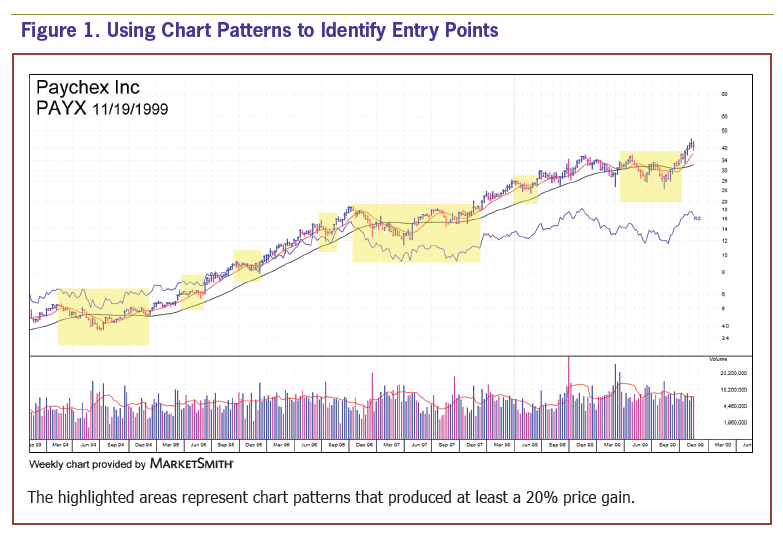
Initiating positions by following rules and using stock charts removes guesswork from your buying decision and gives you the highest probability of success. You will increase that probability even further by continuing to monitor your position on its chart. Charts clearly show when a stock begins to behave abnormally, which is important to recognize early. Spotting this abnormal behavior is the only way to lock down your profits before they slip away. This naturally brings us to sell rules.
Sell Rules: Lock in Wins, Avoid Losses
Ideally, investors should use two sets of sell rules: one that helps them lock in a profit and one that protects them against excessive losses. As a position begins to show a large profit, or a large loss, emotions can influence your decisions more strongly. That’s why sell rules are so important. They help you subdue those costly emotions and focus on the best course of action based on facts. This is not unlike a doctor consulting a chart or X-ray to confirm his course of treatment.
Our number one rule for preserving capital and preventing runaway losses is to limit losses to 8%. If we’ve done our homework correctly and entered the stock at the right point, our position should never be down 8%. If it is, it means we’ve either done something wrong or invested in a poor market environment. Either way, mistakes are always corrected immediately. Cutting losses short also keeps you out of the pride trap: “I know I picked a good company … it will come back.” Or the hope trap: “I hope it will come back so I can sell it and break even.”
Some investors will buy more of a losing position instead of following proper sell rules. Continuing to add shares as a stock’s price is falling can lead to disastrous results, as seen in Figure 2, which shows Neutral Tandem Inc. (TNDM). It may be tempting to lower your average cost in a position when it shows a loss, but when a stock is falling no one knows how far it will drop. In the stock market, losses rarely get better as they float downstream.
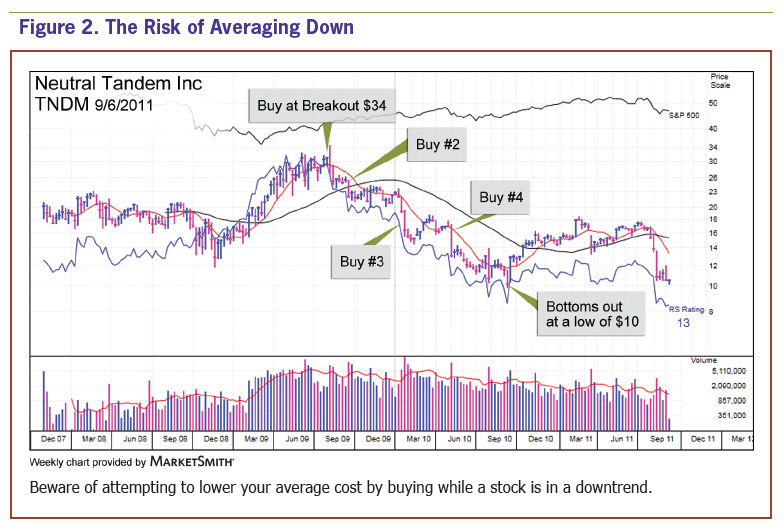
Many investors have just as much trouble handling profitable positions as they do handling losses. That is why they need a set of rules that dictate when profits should be taken. Guessing is not good enough. Most leading growth stocks tend to rise 20%–25% between consolidation areas. So our rule is that we sell most stocks when they are up 20%–25%.
The best time to sell a position is when it’s still going up. While a stock’s price is rising, we are always on the lookout for signs that the uptrend might be slowing or weakening. We can’t wait for the fundamentals of the company to deteriorate (a lagging indicator at this point), because they usually look best at the top, as seen with F5 Networks Inc. (FFIV) in Figure 3.
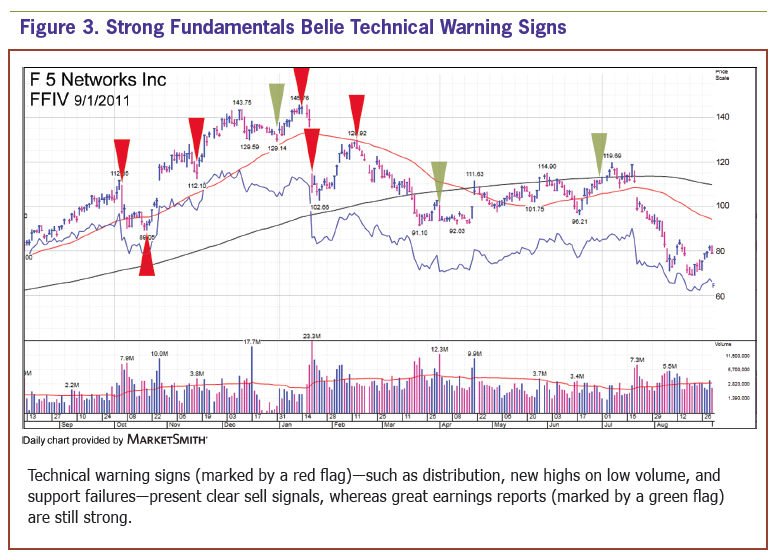
Instead, we look for signs that institutional investors, who are responsible for the prior uptrend in price, are now beginning to unload shares (also known as distribution). Because institutions are so massive, they can’t hide their selling activity from a stock chart. You can also tell that institutions are selling shares if a stock’s price is falling on above-average volume. Other negative signs include stocks making new highs on low volume, a stock repeatedly reversing off highs and/or closing near intraday lows, or when a stock begins breaking logical areas of support like key moving averages and uptrend lines. These are all reasons why we would never sell a stock without looking at a chart.
Overall Market: Make Friends With the Trend
Lastly, it’s important to remember that the majority of stocks always follow the overall trend of the market. Therefore, the first market rule we follow is “the trend is our friend.” No matter how great a stock’s fundamentals, if the market is in a downtrend, we don’t want to own it.
There are also those rare times when it is better to be fully in cash—such as 2008 (see Figure 4). When the market dropped that year, it didn’t matter how strong a stock’s fundamentals were or how compelling the underlying story was, all stocks got hit. The signs of abnormal market action were clear in the charts of the major indexes and leading stocks. If those investors who took a major hit had been following a set of investment rules and tracking the movement of their holdings on stock charts, they would have gotten out of the market in time.
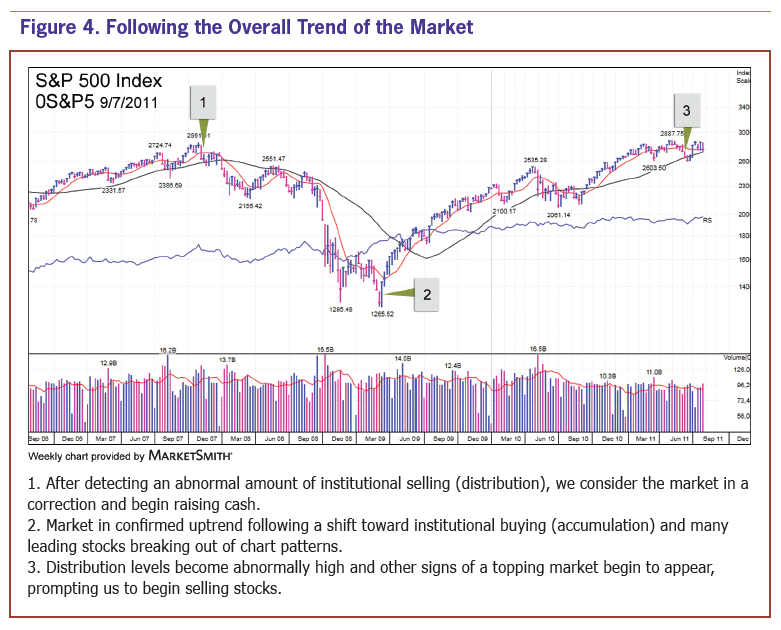
Similar signs were apparent in charts this year. I suggested in a research note as early as May that, based on chart analysis, it was looking like the market was at or nearing a top after a tremendous run that had lasted more than two years. As I write this piece in late August, the market is down close to 20%, after two false rally attempts in July.
Rules: Stick to Them
Looking over the past decade, a clear set of investing rules has served me exceptionally well. It has enabled me to take advantage of some of the decade’s most significant winners. Just as importantly, those rules have helped me avoid multiple downturns, two that were of historic proportion.
Rules are an important component of the investing process. They will protect you and guide you through the difficulties of the stock market. By arming yourself with well-thought-out rules going forward, you will be able to survive in turbulent markets and thrive in favorable ones.
But rules are only as valuable as your discipline in following them. Adopt a set of rules that aligns well with your approach to investing, whether it’s growth or value—and stick to them! Remember, the next bull market is just around the corner.
Percy from IL posted over 14 years ago:
Emory from NV posted over 14 years ago:
Allen from OK posted over 14 years ago:
James from OH posted over 14 years ago:
Per from IL posted over 14 years ago:
Herb from CA posted over 14 years ago:
Robert from AZ posted over 14 years ago:
Larry from NY posted over 14 years ago:
Patrick from NH posted over 14 years ago:
Raymond from NC posted over 14 years ago:
Michael from NY posted over 14 years ago:
Ron from OH posted over 14 years ago:
You need to log in as a registered AAII user before commenting.
Log InCreate an account