


Charles Rotblut leads a class in AAII's new Essential Investing Video Course. Go to https://www.aaii.com/ves for more information and to subscribe.
Burton G. Malkiel is a professor of economics at Princeton University. The 10th edition of his widely read book, “A Random Walk Down Wall Street: The Time-Tested Strategy for Successful Investing” (W. W. Norton & Company, 2011), was published in January. I spoke to him about the case for using index funds.
—Charles Rotblut, CFA
Charles Rotblut (CR): Could you explain the term “random walk”?
Burton Malkiel (BM): Basically, the concept is not that the market is random or capricious, really, just the opposite: that the market is quite efficient in reflecting new information and when news arises that’s true news, the market adjusts without delay. The true news is unpredictable—in other words, if we have a headline today that says “New York digs out of yesterday’s storm,” that’s not news. What was news is that the storm was much bigger than anybody had predicted. So the true news is random or unpredictable. It’s something that you didn’t know before, such as “Egypt is in crisis.” The markets will then react without delay. But since you can’t predict true news, the market is generally unpredictable. It’s not that it’s capricious; quite the contrary: It’s that it reacts to unexpected events. And if you could predict the unexpected events, you could predict the market. But since you can’t, markets are unpredictable.
The term “random walk” was first used in the science magazine Nature. The problem presented was to try to find a drunk who was left in the middle of a field at midnight. Since you have no idea where the drunk is going to go, the question was, how would you begin the search the next morning? The answer was to begin at exactly where you left the drunk, because you can’t predict in what direction the drunk is going to go. The drunk will stagger randomly around. When you look at it, the stock market looks very much like that kind of random walk where tomorrow’s price change is pretty much unrelated to today’s price change, and it’s basically unpredictable. So the idea is that neither individuals nor professionals can predict the short-run direction of the stock market.
CR: Since everything has become computerized, and trading firms try to get as close as they can to an exchange, do you think that the speed at which new news gets priced in has accelerated?
BM: Yes, if anything it should make the market even more efficient. I think that you are exactly right, that this new kind of trading, where you have an advantage if you are milliseconds before somebody else is something that will make the delay even less and would cause the adjustment of markets to news to be essentially simultaneous. And when I say “simultaneous,” I mean within milliseconds.
CR: The flip side is that—and I know you’re against technical analysis—some people try to argue that they can look at charts and identify trends and patterns.
BM: Well, that’s exactly the point; that’s exactly the difference between the “random walk” view and the view of the so-called technical analysts who can “see” patterns. When you examine those “patterns” with sophisticated statistical analysis, you realize that they don’t exist; they’re nothing more than the runs of luck of any gambler.
Let me give you an example. A teacher has a class write down simulated sets of numbers for random flips of a coin; in other words, to write down “Heads, tails, heads, tails, tails, heads, tails.” One student is asked to flip a real coin. And the teacher says, “Put them all on my desk after you’ve done these simulated and actual flips of a hundred coins.” Then the teacher amazes the class by determining which one was the real flip and which were the ones that were simulated. The way the teacher does it is that the real flip has many more runs of heads in a row. In other words, the real flip would tend to have “heads, heads, heads, tails, tails, tails,” whereas the students who were trying to write random ones would typically have them alternate, and you’d seldom have more than two heads in a row.
This is the idea that within a random set of numbers, you can see patterns. But they’re not real patterns; they’re the kinds of things that you would expect in a random series. And because you can “see” a pattern from the past doesn’t mean it’s going to be repeated in the future. That’s basically the idea of those of us who believe that markets are pretty close to a random walk and believe that technical analysis or charting is not useful for investors. Quite the opposite: It makes investors trade too often, and therefore it increases their transaction costs. Furthermore, if they were successful, it means much higher taxes, because short-term capital gains are taxed at regular income tax rates, whereas long-term capital gains today carry only a 15% tax rate.
CR: What about fundamental analysis? Do you think there’s anything in that that can help investors?
BM: Well, most people on Wall Street are fundamental analysts, and certainly that’s how money is managed in the main. What my book has done in each edition is to say, okay, I’m skeptical that it works, let’s look at how people so-called “running money” with fundamental analysis have done. Every time I put out a new edition, and it is certainly true of the 10th edition, I ask, “this is my thesis, does it work?” Every time I do it, I find that two-thirds of active managers using fundamental analysis are beaten by a simple index fund, and those in the one-third who win in one period are not the same ones who win in the next period.
There’s also a chart from the decade of the 2000s in the 10th edition that looks at 14 mutual fund managers using fundamental analysis who had beaten the market in every single year for nine years; the ones who clearly look like they know what they’re doing. The book shows that in the following year, only one of the 14 beat an index fund.
Sure, you can get a lot of heads in a row when you’re flipping a coin. Sure, the reason you’ve got an average is that some people are going to be above the average. But they’re not above average all the time, and in fact, the majority of them are very much below average. The thesis that a simple index fund can be the best thing for the individual investor, I think, continues to hold.
Now I realize that telling people that you can’t beat the market is like telling a six-year-old that Santa Claus doesn’t exist, and I think it is fine if you want to buy some individual stocks. It’s OK if you think you have spotted a trend that other people haven’t spotted and that you’ve got something that’s really going to win. Do it. But at least put the core of any portfolio in low-cost index funds. And then you can try to pick individual stocks with very much less risk to the whole portfolio because its core is indexed.
I’m very skeptical: I don’t think that you can do it, and I don’t think professionals can do it. But you want to have some fun? That’s fine. I think anyone with a gambling instinct will probably want to do a little selection on their own. But do what institutional investors now are increasingly doing: Index the core of the portfolio. And then if you want to make some bets around the edges, that’s fine, and you can do so with very much less risk.
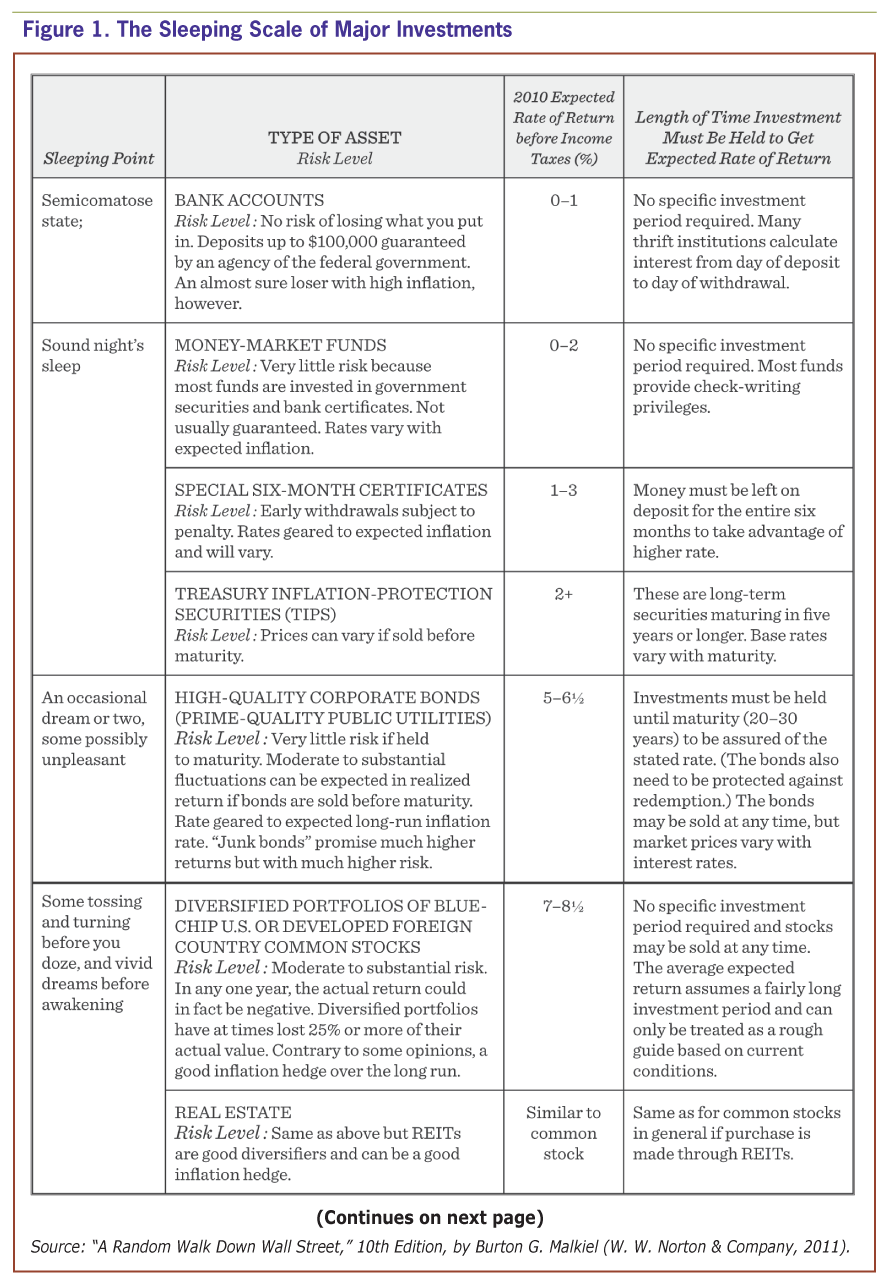

CR: In terms of individual stocks, you talk a bit in your book about companies that can “build castles in the sky.” Can you elaborate on that a little bit?
BM: Think to early 2000, which was really the beginning of the internet taking over. I remember people telling me, “The retail store is a thing of the past; everything is going to be done over the internet. It will completely transform the way we live, the way we shop, the way we learn.” You know, that’s right, but what happened was, internet stocks got priced at over 100 times earnings. And the crash that followed was absolutely devastating for many people. Even a real company like Cisco Systems (CSCO) lost more than 90% of its value after the internet bubble popped.
It’s not that the internet wasn’t real. It was and is real—it has transformed the way we live; it has transformed the way we shop—but that doesn’t mean, as with any of these transformative technologies, that you can necessarily build the stock prices up to the sky. This may very well be happening now with cloud computing. You see a stock like Salesforce.com (CRM) selling at more than 200 times earnings. It’s not that they don’t have something that’s very important, they do. But there’s a tendency, when you have something new, for investors to pay too much for these ideas, and in general, they’ve turned out to be very, very bad investments.
Now, again, what I say is, if you think, “No, this time, the market’s got it right. Salesforce.com’s growth process is so great that it’s worth 200 times earnings,” then fine, go out and buy it. But don’t have these kinds of stocks as your total portfolio. Don’t have a portfolio of the hot stocks, the Salesforce.coms, the Lululemons (LULU) of the present. If you want to play that game, that’s fine, but have the core of your portfolio in low-cost index funds that are very broadly diversified.
CR: And what about individual stock-picking of small-cap value stocks? I know Ibbotson has shown higher long-term returns for both small-cap and value stocks.
BM: I think that there is evidence that small-cap stocks have generally done a little better than large-cap stocks, and this is a big controversy within the economics profession. Some people say, “Well, that shows you the market isn’t efficient, because otherwise you couldn’t make more money by buying small-cap stocks.” The other explanation is that small-cap stocks tend to be riskier, and the idea that markets are efficient does not mean that if you take on more risk, you shouldn’t get a higher rate of return. The idea is that instead, risk and return are related, and if you take on more risk, you should get a higher rate of return. The fact that some of these patterns hold historically is not inconsistent with efficient markets and may simply reflect that risk and return are related. The second point to make on this is that while it’s true that small has generally done better than large, and “value” has done better than “growth,” it doesn’t happen every year, so it’s not a sure way of getting higher rates of return each and every year.
CR: To go back to indexing, the one question I hear—and I’m sure you’ve heard the same thing—is that indexing didn’t work over the last decade. What is the answer to people who have the perception that indexing has failed?
BM: This is probably the best lesson for investors in the book. The first decade of the 2000s has been called the “lost decade,” because most people lost a lot of money. They lost in index funds, they lost more if they were invested in growth funds. But if they were diversified across markets and different investments, and they rebalanced each year, I find that they could have doubled their money during the “lost decade.” This isn’t something I made up after the fact. This is using the asset allocations I have had in earlier editions of the book. The thing you needed to do was to have some bonds in the portfolio and you needed to be diversified internationally, including in emerging markets. You shouldn’t have a portfolio of simply U.S. stocks.
In terms of the stocks, you don’t just buy the S&P 500 index. To the extent that you’re in the U.S., you buy a total stock market fund, which includes all of the small companies—something like the Wilshire 5000 index or the Russell 3000 index. And, secondly, the U.S. is only about 20% of the world economy. You don’t just buy U.S. stocks; you buy foreign stocks, and you buy emerging market stocks. It’s something I’ve emphasized in the 10th edition of the book. China is now about 10%, at official exchange rates, of the world GDP (gross domestic product), and if you make a purchasing power adjustment, it’s probably got 13% of the world’s GDP. You want to have a very strong allocation to emerging market stocks, and you want to rebalance those allocations once a year. What I show is that if you used the allocations that I’ve had in my book over the years, then even in this “lost decade,” using index funds, you doubled your money. You had to be very broadly diversified, with not only stocks but stocks and bonds, and not simply U.S. stocks, but U.S. stocks and foreign stocks, including a very strong allocation to the emerging markets of the world, which are growing much faster than the developed world.
CR: What about gold? I know you wrote about a 5% allocation to that.
BM: I think that’s fine. I think commodities are going to be higher in price over time, but my preference would be to do it through companies. Rather than buying gold and copper, which are two commodities that have been very strong, I would rather buy individual companies that mine these metals. I think it would make a great deal of sense to get commodity exposure through your stocks. Make sure you are sufficiently diversified so that you have some natural resource companies.
Again, that goes back to what I said about being diversified internationally. One of the countries of the world that’s doing so well now is Brazil, because it is a country that is very rich in natural resources. Brazil has the biggest oil find in the Americas. Brazil’s got the copper and lots of agricultural land. You can access countries rich in raw materials with index funds—a Brazilian index fund, an Australian index fund. Australia is doing very well, because it is very rich in natural resources, iron ore and so forth. My own preference would then be, rather than buying the raw material or the gold bullion itself, which doesn’t pay any dividends, to get exposure through owning stocks of producers.
CR: In terms of index investing, some people prefer equal-weighted indexes versus the market-cap-weighted index funds. Any thoughts?
BM: You take on a little more risk with an equal-weighted index because it takes a small company and gives it the same weight as Exxon Mobil (XOM) and Apple (AAPL). It’s a way of getting a small-cap effect. I think it is something you could do; however, there are some problems with it. You have to rebalance very often and that may incur transaction costs and higher taxes. I do some rebalancing, but only once a year, so that if I do sell some of the things that have gone up to bring the allocations back to equal weight, at least I pay a long-term capital gain rather than a short-term capital gain.
CR: Many of our members are in retirement, so they’re faced with a required minimum distribution. In terms of rebalancing, how do they factor that in?
BM: What I always want to do is minimize transaction costs. So in a year like 2010, say, which was a good year, I would use the asset class that went up the most and take the money out of there. In other words, I’m going to get my rebalancing in the same way that I get my minimum distribution. To make a simple example, let’s say you were half stocks and half bonds, and the year is 2008. The stock market fell out of bed in 2008; the Federal Reserve had begun its program of reducing interest rates, so bonds were way up. In that kind of portfolio, you take your minimum distribution out of the bonds part. You’re taking the minimum distribution and you’re rebalancing at the same time.
CR: Regarding bonds, if you’re indexing bonds, there’s a lot of fear about what will be happening with interest rates. Do you suggest people just index the bond portion and not worry about interest rates?
BM: You can never predict what interest rates are going to do, any more than you can predict what the stock market will do. I suggest you have a total bond market index. I know a lot of people think interest rates are too low and the bond market is not a good place to be. It’s true that government interest rates are low, but the fact is that there are still some good risk premiums on corporate bonds and on the old Build America bonds, particularly as people now are so worried about our municipalities. A total bond market fund should be a part of the portfolio. It not only has government bonds but it also has corporate bonds, Build America bonds and so forth. Don’t think you’re going to be able to predict interest rates. It’s quite possible that the low interest rates on government agency securities and government bonds could last for a very long period of time. That’s what the Federal Reserve said at its recent meeting and has said at every previous meeting. So, yes, bonds should be part of a portfolio. Don’t try to outsmart the market and say, “No, stocks are better than bonds now” or “Bonds are better than stocks.” You cannot do that kind of timing—nobody can do it, neither individuals nor professionals.
CR: I know you’ve talked about closed-end funds as an alternative to mutual funds. Can you comment on that?
BM: I’m skeptical of active management. Closed-end funds are generally actively managed funds. And while I’m skeptical that they can beat the market, if you can buy a closed-end fund at a 20% discount, you are buying assets at 80 cents on the dollar. Then even if the manager can’t beat the market, you’re going to beat the market because you bought $100 worth of assets for $80. Closed-end funds, when available at attractive discounts, are even better than index funds, and I have, in the 10th edition of the book, listed a number of them. You’ve got to look and see what the discount is at the time you’re going to buy, but I’ve listed a number of them that I think can be quite attractive.
CR: Is there anything we didn’t discuss that you think is important for investors to think about?
BM: The book is always going to change because it’s an investment guide, and the kinds of instruments that are available to people are going to be different from year to year. One of the things that is new in the book is its focus on exchange-traded funds (ETFs). I think ETFs are a great, low-cost way to index. And there are a lot of brokers who will give you ETF trades at no commission at all. I put a lot more emphasis on ETFs in this edition. They are the fastest-growing part of the financial market, and I think for good reason.
The final thing I would say is, I don’t think people are diversified enough internationally. As I said, China is the fastest-growing major economy in the world. It’s probably 10% or more of the world’s GDP. I know very few investors who have anything like that percentage of their portfolio in China. China, India, Brazil—these are the countries that are growing the most rapidly, and I think investors need to look at their portfolios and ask if they are diversified enough internationally. My guess is, when they look at their portfolios, the answers will be no.
CR: Is there a guide for how much people should diversify internationally?
BM: Obviously, it’s a little riskier to be in Chinese stocks, to be in Brazilian stocks, and it depends on your age, on your capacity to bear risk. The percentage will be different for each person. In the book I give a number of guidelines. In the model portfolio that I have, only 27% is in U.S. stocks. So that gives you some idea of where you might start. I would say in an all-equity portfolio, you certainly should not have more than half of it in the U.S.
Stephen from CA posted over 15 years ago:
John from OR posted over 15 years ago:
SM from TX posted over 15 years ago:
Mel from TX posted over 15 years ago:
Marvin from OH posted over 15 years ago:
Mel from TX posted over 15 years ago:
MORRIS from CO posted over 15 years ago:
Bill from OR posted over 15 years ago:
Larry from IL posted over 15 years ago:
Jane from CA posted over 15 years ago:
Stephen from OH posted over 15 years ago:
R E from GA posted over 15 years ago:
Herschel from NJ posted over 15 years ago:
Harry from FL posted over 14 years ago:
bkpark from CA posted over 14 years ago:
James from VA posted over 14 years ago:
Percy from IL posted over 14 years ago:
PG from NY posted over 14 years ago:
David from IA posted over 14 years ago:
Paul from NY posted over 14 years ago:
Jon F. from OH posted over 13 years ago:
James Fretty from WI posted over 13 years ago:
H Stringer from TX posted over 13 years ago:
Dave K. from CA posted over 13 years ago:
James Jennings from VA posted over 13 years ago:
Charles Salvatori from IL posted over 13 years ago:
Craig Shoemake from MA posted over 11 years ago:
You need to log in as a registered AAII user before commenting.
Log InCreate an account