Stocks: An Underappreciated Asset Class in Retiree Portfolios

Even in retirement, it is important to maintain a large allocation to stocks.

More older Americans than ever before are pursuing second careers in retirement, engaging in their communities through volunteer work, and living healthy, active lifestyles. Yet when it comes to managing their investments, too many retirees are working from an outdated playbook, one that de-emphasizes the crucial role of equities. This disconnect between modern retirement lifestyles and an old-fashioned approach to investing underscores a big risk that can threaten retirement bliss: the chance that a retiree might outlive his or her assets.

Low equity allocations in retiree portfolios persist because of some costly misperceptions. Many retirees reflexively believe that they can live off of the interest from their investments while preserving principal. Using interest payments alone to fund one’s living expenses in retirement may have been possible in decades past, when life expectancies all but guaranteed a shorter retirement and yields on the 10-year Treasury note were in the high single digits. But it is virtually impossible today in light of increasing life expectancies and the backdrop of ultra-low rates brought on by the Federal Reserve’s response to the 2008 financial crisis.

(The life expectancy of an individual born in 1950 is 68.2 years, versus 75.4 years for an individual born in 1990. An individual who turned 65 in 2010 has a projected life expectancy of 84.1 years, while an individual who turned 75 that same year has a projected life expectancy of 87.1 years. See “Table 18. Life expectancy at birth, at 65 and 75 years of age by sex, race and Hispanic origin” at www.cdc.gov/nchs/data/hus/2013/018.pdf for more information.)

Meanwhile, some investors, financial advisers and even the news media continue to advance the idea that dialing down risk is simply a matter of reducing equity exposure in favor of fixed-income holdings and short-term investments like cash. In truth, by “overshooting” and reducing equity exposure too much in retirement, investors are simply trading a potential reduction in short-term volatility for other risks, such as not keeping up with the rising cost of living over time—or worse still, outliving their assets. Risk is in fact multidimensional, and retirees in particular must carefully manage short-term volatility while also managing the threat posed by inflation. Over time, inflation can erode the real value of assets, make future purchases more expensive, and increase the likelihood that a retirement portfolio will run dry.

Retirees Should Consider Boosting Their Allocations to Equities

Equities have been a proven hedge against inflation. The S&P 500 index, for example, has beaten the most widely used measure of inflation in the United States, the Consumer Price Index (CPI), in 95% of all 15-year periods since 1926—by an average margin of eight percentage points, according to analysis of Ibbotson data by T. Rowe Price. (The returns are for the period of January 1926 through December 2013, with a new 15-year period starting each calendar month.)

Nonetheless, retirees remain under-allocated to equities as they shift into their retirement years. According to a recent report by the Employment Benefits Research Institute and the Investment Company Institute (ICI), nearly 28% of individuals in their 60s held 20% or less of their 401(k) portfolios in equities at year-end 2012. By comparison, only 14.3% of 401(k) participants across all age groups held 20% or less in equities at year-end 2012 (ICI Research Perspective, July 2014), available at www.ici.org/pdf/per20-04.pdf).

(To sustain an income stream throughout their retirement, investors should allocate about half of their assets to equities at their retirement date and then gradually move that down to 40% over the first 15 years of retirement.)

Recent market history and the nature of retirement itself play a role. Many retirees and preretirees were deeply scarred by steep stock market losses in 2008. Although markets have rebounded, the impression persists that the basic rules of investing were forever altered, fueled by apocalyptic crisis-era headlines ranging from “Everything you thought you knew about diversification is wrong” to “Advisers ditch ‘buy and hold’ for new tactics.” In reality, investing principles such as asset allocation, diversification and the wisdom of shifting methodically, not drastically, from stocks to bonds as one ages not only survived the crisis, but were fully validated by subsequent market performance.

There is another dynamic in play, as well. When investors create a plan for buying a house or paying for a child’s college education, they are essentially saving and investing for a singular event: the day they write a big check and take possession of the home, or the relatively brief, four-year period (one hopes!) during which they write large checks to a university. Retirement is inherently different. Although many people approach the transition as if it’s a singular event that unfolds the day they turn 67, retirement is one of the few “purchases” in which all the money isn’t spent at once.

Split the Portfolio Into Two 15-Year Increments

From a financial planning perspective, retirement is composed of a multitude of time horizons, each containing different spending goals, whether it is a scuba-diving vacation and monthly visits with the grandkids or day-to-day living expenses and the cost of a knee replacement.

To simplify how retirees think about their time horizons, it’s best to break a 30-year retirement into just two distinct 15-year periods. Viewing it this way helps bring the appropriate role of equities into sharper focus. Conceptually, since about than half of a retiree’s assets won’t likely be needed until the second 15-year horizon, this portion of the retirement portfolio must be invested appropriately and that, generally speaking, means allocating the funds almost exclusively to equities.
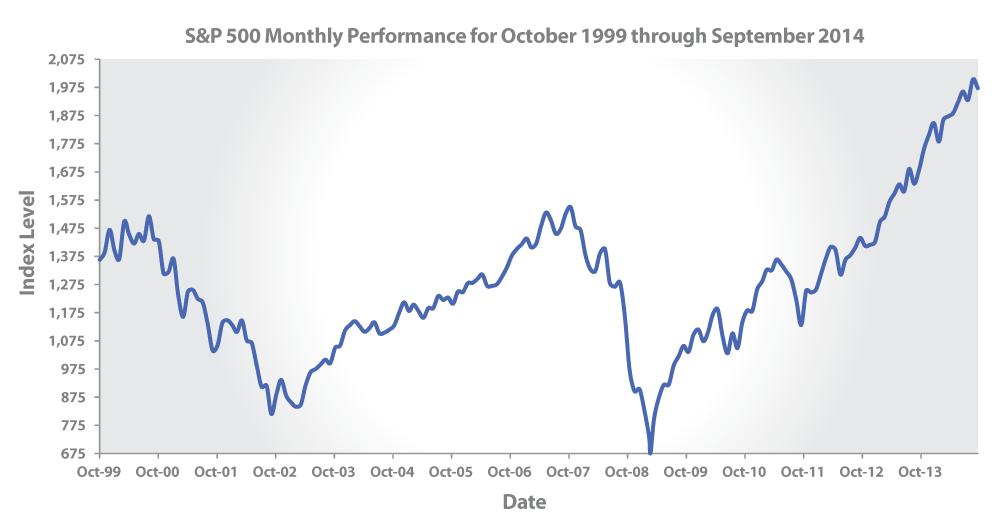
Figure 1. Performance of the S&P 500 Over the Last 15 Years
Chart is for illustrative purposes only and not intended to represent the returns of any specific security. It is not possible to invest directly in an index. Past performance cannot guarantee future results.
Source: T. Rowe Price and moneycentral.msn.com.


If history is any guide, investors can take comfort in such a decision. Of all the rolling 15-calendar-year periods beginning in 1926 and ending in 2014, the S&P 500 index has never had a negative period. Even during the tumultuous decade-and-a-half that included the bursting of the tech and telecom bubble and the fallout from the global financial crisis—from October 1999 to September 2014, to be precise—the S&P 500 index delivered more than a 55% cumulative return to investors who stayed the course, as shown in Figure 1.

Higher Equity Allocation Leads to Better Success

Investors who maintain a healthy allocation to equities in retirement may be able to reduce their likelihood of running out of money—and may generate higher ending account balances after 30 years of annual retirement withdrawals. A study by T. Rowe Price compared two glide path strategies of target date portfolios: one with a 55% allocation to stocks and one with a 46.5% allocation to stocks at the retirement date. The higher equity glide path resulted in fewer 30-year periods in which the asset allocation was not able to support annual withdrawals ranging from 4% to 5%. Additionally, the evidence suggests that target date portfolios with more exposure to equities are more likely to deliver higher residual wealth after 30 years of annual withdrawals across a range of historical rolling periods.

For retirees, stock market volatility may feel like the most important, or only, risk. But it is only one of several key risks that must be effectively managed over what is, increasingly, a long planning horizon. A retiree’s asset allocation strategy must balance protection against short-term volatility with protection from longevity and inflation risk. To be sure, retiree asset allocations should likely include a substantial allocation to bonds and short-term investments which, by definition, are less susceptible to short-term volatility. But now more than ever, retirees need a healthy exposure to equities, with that exposure sensibly decreased over time in order to keep market risk in check.

Past performance cannot guarantee future results. All investments in equities involve risk, including possible loss of principal. Analysis is for illustrative purposes only and not intended to represent the returns of any specific security. It is not possible to invest directly into an index.

Discussion

Tom Feeney Eng from NY posted over 11 years ago:

The Bull Market has been in full force for 6 years and valuations are high, certainly not undervalued. Recommending high equity exposure at this point sounds extremely risky.


Tom Feeney Eng from NY posted over 11 years ago:

The Bull Market has been in full force for 6 years and valuations are high, certainly not undervalued. Recommending high equity exposure at this point sounds extremely risky.


Victor Stankevich from NC posted over 11 years ago:

I believe the theory is that money in equities isn't needed for 15 years. Thus, in 15 years, even if (really when) there is an intervening bear market, that part of the portfolio will still have grown more than inflation. This seems to be a variation on the "bucket" system I am using.


Robert Greving from TN posted over 11 years ago:

I, too, am using a 'bucket' approach to my retirement portfolio. Expense needs covering 2 years of cash or near cash, 8 years of intermediate investments, mostly bonds, and the remainder in long term assets, mostly equities. Using only IRA or 401(k) asset allocations to determine equity allocation may be a bit misleading for many investors. For those in tax paying situations putting income producing assets like bonds in tax-sheltered portfolios provides the best tax results in most cases. However, this would show what the article found, that many investors hold less than 20% equities in these tax favored portfolios. Mine, for example has no equities in it yet I am nearly 70% in equities across all of my investments.


Stephen Sanders from NY posted over 11 years ago:

This article contradicts another AAII article Building a Balanced Portfolio which states that one should allocate to these four asset classes: • 20% equities, • 20% commodities, • 30% long-term Treasuries, and • 30% long-term TIPS.


John Neumann from CA posted over 11 years ago:

Where can I find the best source of expected returms per asset class(say ave return + or - 1SD) ??-for example 1.LC stocks 2.MC stocks 3 SC stocks 4 international developed Market stock (etf) 5) 5-7 year Corporate bonds (inv grade) 6) tips 7 High Yield bonds (6.2% ?) 8 MLPs (5.6) 9. REITs (3.5) 10 treasuries I know these all need further definition. Another way is to tAke age, risk tolerance,year to invest and ask the question what portfolios will give me 4%, 5%, etc for a moderate risks or conservative risk approach. John


Roger Poundstone from AZ posted over 11 years ago:

Life expectancy means nothing to the individual. The article does not take into account the wealth of the investor or age. Also, it all depends on the current conditions of all markets. I write with some 60 years experience of being an investor.


Charles Rotblut from IL posted over 11 years ago:

John, The Ibbotson SBBI yearbook lists long-term historical returns and volatility (standard deviation) for many asset classes. I would check your local library. If they do not have it, try the business school library at a local university. (The book costs $185 and is sold by Morningstar.) As far as expected returns, those are based on forecasts. Depending on whose forecast you look at, the rates of returns will vary considerably. They also can be difficult to find for many of the asset classes you mention. -Charles


Donald Myers from AZ posted over 11 years ago:

As pointed out by at least one commenter, it is important to look at all of your accounts. Looking only at my IRA, Roth IRA and brokerage acct I have 60-65% in equities but I also have a significant amount in a university retirement account that is nearly 100% in TIAA Traditional. As with most retirees both I and my wife are drawing Social Security. I also have a non-trivial defined benefit pension. All this in addition to my wife's brokerage acct and an IRA and a Roth IRA. We were already retired when the tech bubble broke and we went thru the 2008 downturn, we have been drawing on my IRA and university retirement plan the whole time. Had we dropped the fraction invested in equiti8es we would now be much worse off. Everyone's situation is different but I agree that the advice to keep a higher fraction of equities is good as opposed to what almost all the target date funds do.


Max Hinchman from CA posted over 11 years ago:

The article and above comments overlook the "bond/fixed income aspect" of Social Security to retirees. This can be significant to a retiree depending upon their working income stream. Nonetheless, it is a vital consideration such that it would probably, or should, increase ones equity investments and decease their bond type investments. And, it also depends upon whether they are renting, have a mortgage, or don't have a mortgage.


Fred Ruggiero from FL posted over 11 years ago:

Essentially one adjusts to one's income level. This assumes that income is higher than expense. At an income of $250,000 and no mortgage and no loans one should easily manage on an income of $150,000. Age, health, habits, family, hobies, and other pursuits are determining factors. Make sense??


Jerry Boswell from CO posted over 11 years ago:

Stuart Ritter offers some good advice based on the purpose of his article. However, one's allocation of asset classes and the proportions to a retirement investment portfolio, in my opinion, should be determined only after development of a rather comprehensive and thoughtful personal financial plan. Primary factors are the person's or family's financial assets, the main objectives/goals, and the timeframe for attaining the goals. Of course, unless one has a balanced financial plan and funding that provides appropriate types of insurance (especially health and long-term care), an income stream for basic living expenses, etc., then other goals such as travel and contributions to the welfare of children likely will be in jeopardy. From my observations, major weaknesses in retirement planning are underestimating living costs and, particularly, medical costs to be incurred during retirement years. The returns from a retirement portfolio will seldom overcome significant deficiencies in personal financial planning. Two major considerations not dealt with in the article are the emotional makeup and the skill set of the investor, both of which should receive much attention prior to setting the equity vs. fixed income allocations for a retirement portfolio, initially and over time.


Dennis Roubal from MI posted over 11 years ago:

Equities will be a great investment, after the next big market sell-off. Stocks have gone straight up for 6 years. Global growth is terrible, kept alive by massive, central bank money printing. Shiller CAPE ratio is at the level that has always seen a major market crash. Buying at major market highs does not create good returns. If you bought the S&P in before the crash in 2000 you have made about 3% per year. Even a small sell-off will turn that 15 year return negative. If you bought at the bottom in 2009, your stocks investments tripled in 6 years. The world is in a different investing environment, than it was years ago, but the same basic rule still applies: Buy low, sell high.


Justin Murphy from CT posted over 11 years ago:

Excerpt: "According to a recent report by the Employment Benefits Research Institute and the Investment Company Institute (ICI), nearly 28% of individuals in their 60s held 20% or less of their 401(k) portfolios in equities at year-end 2012. By comparison, only 14.3% of 401(k) participants across all age groups held 20% or less in equities at year-end 2012 (ICI Research Perspective, July 2014), available at www.ici.org/pdf/per20-04.pdf)". Do these statistics reflect the whole picture? Maybe retirees are smartly keeping more fixed income assets in retirement accounts for the favorable tax treatment, and keeping lower taxed equities in their taxable accounts. For example, my IRA (401K rollover) is 100% in a corporate bond ETF, but my overall portfolio is 70% equities/30% fixed income.


Philip Mercer from Maryland posted over 11 years ago:

Although you wouldn't want your entire portfolio in this asset class, there are many CEFs that have paid distributions of 6-9% for 10-15 years, providing a very reliable source of income for retirees. Most pay monthly, and many are taxed favorably, either capital gains, or the good form of return of capital.


William Dickinson from Wisconsin posted over 11 years ago:

I see a flaw in the suggested approach. First off, how many times have we heard "Past performance is no guarantee of future performance" yet the premise of the article is based on studies citing past market performance. When your only income is social security, and having no confidence in the market at the current moment in time, I can't afford to lose half or more of my IRA in the next crash (which seems to be around the corner). Buy and hold just doesn't cut it anymore.


Terry Muse from FL posted over 11 years ago:

Mr. Mercer, what is the CEF you refer to above? Thanks.


Jim Linnemann from MI posted over 11 years ago:

I'm guessing Mr. Mercer refers to Closed End Funds. Mr Boswell comments on equity allocation in terms of emotional makeup and skill set. Emotional makeup is hard to get around as far as reaction to volatility is concerned. But if you don't insist market timing and trading, equity exposure via index funds needn't require extensive skill. Note that professional equity fund managers have had a very hard time matching index returns. Interestingly, in the Schiller interview article in this issue, he shares Mr. Roubal's concern about the current level of CAPE, but finds it hard to turn that concern into an actual action plan.


David Logan from Mixhigan posted over 10 years ago:

I've saved the max allowable in my IRA since 1975. So I"m pretty well set for a long retirement. Percentage allocations don't make sense. I keep enough in cash equivalents to cover three years expenses- in case the market goes sour. I've kept the course largely in equities during the downturns of 2000 and 2008 with significant increased assets. Ten years in retirement I"m better off than ever. To keep 50% or more in bonds is insane.......


Gerard Bieker from Kansas posted over 9 years ago:

When you can receive 2.10% return on a 10 year government bond or 2.10% on a dividend yielding quality stock I see stocks as the better bargain today. I also don't believe that the Fed can raise interest rates too quickly over the next decade because it would do major harm to federal and state pension plans that are already in trouble. If we have good economy stocks should be fine. The US also, thank goodness, has a growing population base which means products and services will be needed. I first got involved with investing when the market was 1200. I believe today a 50/50 stock/bond portfolio is okay for healthy senior citizen regardless of age. John Bogle recently discussed that also. The fact of the matter is that working age people need to have a job and pay taxes for bonds or stocks to any value. Thanks


Jim Egbert from CO posted over 8 years ago:

My wife and I currently have part of our portfolio invested in rental properties to provide a monthly income stream sufficient to cover our living expenses. Our other assets are invested in equities and our primary residence. I am 78. Our estate plan is a generation skipping trust which will be managed by our 4 children for the benefit of their children: our 12 grandchildren. Our investment planning horizon is long term.


You need to log in as a registered AAII user before commenting.
Create an account

Log In

Get your free copy of our special report analyzing the tech stocks most likely to outperform the market.

Download the FREE Report Here: