

Article Highlights:
-
The dramatic impact on wealth from compound returns really starts to pick up after an investing period of 20 to 25 years.
-
Older investors should place a bigger emphasis on saving more than building aggressive portfolios with higher risks of large losses in a given year.
-
Lower savings rates require higher returns to achieve the same ending wealth, but those higher returns may not be feasible or realistic.
There are two engines of growth in an investment portfolio: (1) the contributions made by the investor, and (2) the rate of return generated by the portfolio itself.
The question is this: Which has the greater impact? The answer is based on your age.
The Savings Matrix
The Savings Matrix, shown in Table 1, gives various ending account values at age 65 based on four different starting ages of an investor. The baseline figures (shaded in gray) assume 6% of income is saved annually. (This is a 6% savings rate or, if you prefer, a 6% portfolio contribution rate. For the sake of simplicity, contributions are made to the portfolio at year end.) The baseline figures also assume a 6% annualized portfolio return. The variables in this analysis are increasing the savings rate from 6% to 10% or realizing a 10% return on the portfolio instead of a 6% portfolio return. In both cases, the other variable is kept constant.
|
Whether the savings rate or portfolio return realized has a bigger impact on wealth depends on the investor’s age and investing time horizon. |
|||
| Retirement Portfolio Value at Age 65 | |||
|---|---|---|---|
| Age When Starting to Save for Retirement | 6% Savings Rate & 6% Return ($) | 6% Savings Rate & 10% Return ($) | 10% Savings Rate & 6% Return ($) |
| 25 | 491,658 | 1,259,917 | 819,429 |
| 35 | 311,971 | 605,655 | 519,952 |
| 45 | 177,128 | 266,657 | 295,214 |
| 55 | 75,937 | 91,010 | 126,562 |
| Baseline figures are shown in gray. | |||
Starting at Age 25
For an investor who began investing in their retirement portfolio at age 25, the terminal value at age 65 would be $491,658 (assuming a $35,000 starting salary and 3% annual increases in pay) if the savings rate was maintained at 6% and an annualized portfolio return of 6% was realized. Interestingly, this individual earned over $2.63 million during their 40-year working career.
What if the annual portfolio return increased to 10% and the savings rate stayed at 6%? The portfolio value at age 65 would be nearly $1.26 million. On the other hand, if the savings rate increased to 10% per year and the portfolio return stayed at 6% annually, the ending portfolio value at age 65 would be $819,429. Figure 1 charts the results over time.
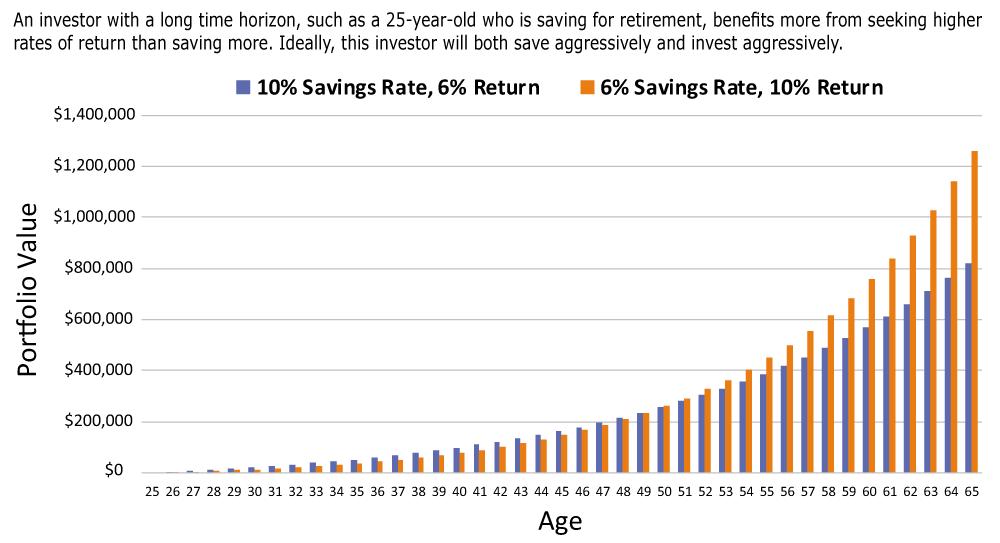
Clearly for a young investor, the portfolio rate of return has more impact than the annual savings rate on the ending account value at age 65. Of course, one might suggest that the best of all worlds for a 25-year-old investor is to save 10% of income each year AND have a portfolio return of 10%! No question about that—as the ending portfolio value would be an astounding $2,099,861 (again, assuming a starting annual salary of $35,000 and a 3% annual increase in salary over a 40-year career).
Starting at Age 35
Next, we consider a 35-year-old investor. Assuming a 6% savings rate and a 6% annualized portfolio return, the baseline ending portfolio value at age 65 would be $311,971 (assuming a salary, adjusted for 3% annual raises, of approximately $47,000 at age 35 and further 3% annual increases in pay). If the portfolio annual rate of return increases to 10% (holding the savings rate constant at 6%), the ending account value at age 65 would be $605,655. Comparatively, the portfolio would be worth $519,952 if the savings rate was increased to 10% while portfolio return was held at 6% annually. Once again, for a “younger” investor, increasing the portfolio return from 6% to 10% provides greater impact than increasing the savings rate from 6% to 10%. Clearly, a 6% or 10% savings rate and a 6% or 10% portfolio return are not the only possible rates of return and savings rates, but the point of this specifically focused analysis is to isolate the general impact of altering the savings rate versus changing the portfolio return (by virtue of employing different asset allocation models) at various ages.
Starting at Age 45
At age 45, things get interesting. The 45-year-old has an annual income of approximately $63,200 and continues to receive 3% annual increases in pay until age 65. (The income figure of $63,200 is simply a 3% annual growth rate applied to a $35,000 salary for a 25-year-old.) Assuming a 6% savings rate combined with a 6% portfolio return, the ending balance would be $177,128 at age 65. If the savings rate increased to 10% (holding the portfolio return constant at 6%) the ending balance increases to $295,214, whereas a 6% savings rate with a 10% portfolio return would result in an ending balance of $266,657. This is an advantage to the savings increasing to 10% rather than the portfolio return increasing to 10%.
A person who starts investing at age 45 benefits more by increasing their savings rate from 6% to 10% than by attempting to increase their portfolio return from 6% to 10%. This may be counterintuitive because conventional wisdom may seem to suggest that if a person is “late to the retirement planning game,” they need to make up for lost time by building a portfolio that is largely equity-based—that is, a portfolio that can crank out returns of 10% to 12% per year. This research suggests otherwise. In fact, the “older” investor should prioritize saving more each year rather than build an overly aggressive, high risk/high return portfolio.
Think of it this way, if the time frame of the investor is reduced from 40 years to 20 years (as is the case for a 45-year-old who is now starting to invest in their retirement account), the beneficial impact of compounding (that is, the portfolio performance) has been dramatically reduced by the shorter time frame. The dramatic compounding-based growth in a portfolio really starts to pick up steam after 20 to 25 years. Thus, with a shorter time frame to work with, a portfolio benefits more from the direct contributions made to it. Plus, when “juicing” a portfolio to crank out higher returns, the downside risk is significantly larger in any given year. And we should all know by now that a loss of 50% requires a gain of 100% to break even—which clearly suggests that we stay away from big portfolio losses as we age.
For example, over the past 48 years (1970–2017), a portfolio design that generated a 6% average annualized return had a worst one-year return of –1.87% (based on an asset allocation of 75% cash, 15% bonds and 10% large U.S. stocks). By the way, that negative return of 1.87% was the only loss during the 48-year period and, not surprisingly, occurred in 2008.
Conversely, a portfolio design that generated roughly a 10% annualized return had a worst-case one-year return of –27.6% (based on an equal one-seventh allocation to large-cap U.S. stock, small-cap U.S. stock, non-U.S. stock, bonds, cash, real estate and commodities—with annual rebalancing). In all fairness, however, that was the largest loss by far during the 48-year period. The equally weighted seven-asset portfolio only had five other years where a negative return occurred, but none of those five other losses exceeded 5.53%. The single big loss of 27.6% happened in 2008. The point is that a higher return portfolio is also a higher risk portfolio—and older investors are not keen on taking large losses since they have fewer years to recover from such losses. Not to mention the emotional toll that large portfolio losses inflict on investors.
Starting at Age 55
For the investor who starts investing for retirement at age 55 with a salary of nearly $86,000, raising the savings rate from 6% to 10% increases the ending account value by over $50,000 (from $75,937 to $126,562). By contrast, if the portfolio return increases from 6% to 10% the ending balance at age 65 increased by only $15,073 to $91,010. Figure 2 charts the results over time.

Understandably, this is an investor who is starting a bit late. Our role is not to judge why they are “late,” but rather to encourage them to do all they can in preparation for retirement.
One thing that must happen, as clearly demonstrated by this analysis, is that the 55-year-old should focus on saving more of their income rather than cranking up the portfolio risk in an attempt to make up for lost time. To be more specific, a 55-year-old that is just getting started on building their retirement portfolio will need to save more than 10% of their income to hit any sort of reasonable nest egg target value.
The practical outcome of these findings is actually quite helpful. What is being suggested here is that older investors should save more rather than build aggressive portfolios that expose them to the risk of large losses in any given year. It is large losses that can emotionally undermine older investors who—naturally—have less time to recover from such losses.
Investors Can Control Contributions More Than Returns
Contributions are an investing “variable” that is more in the control of the investor, while portfolio performance (particularly in the short run) is less controllable. As a result, investors who rely upon the performance of the portfolio to do the “heavy lifting” (that is, to make up for their insufficient contributions during their working years) will usually fall into the trap of having too much equity exposure and therefore be exposed to too much risk of loss.
It is my opinion that the performance or “return” of an investment portfolio should accomplish two primary goals: (1) preserve and protect the contributions of the investor, and (2) provide a modest rate of return.
Understandably, in an era of “super-sized” meals, drinks, vehicles, houses and egos, the notion of a “modest” rate of return may sound rather unsophisticated. Nevertheless, I’m suggesting that the performance of a portfolio should never be expected to make up for under saving on the part of the investor.
It is our job as investors to adequately contribute to our retirement investment accounts. A contribution rate of 2% to 3% of our income into a 401(k) account or individual retirement account (IRA) is simply inadequate. Frankly, I suspect we all know that. But, perhaps we allow a long list of “wants” to put the squeeze on our retirement savings rate. This reminds me of the Fram oil filter commercial many years ago: “You can pay now, or pay me later.” The implication of that advertisement was that the cost later (of potentially repairing the engine) would be much higher than the cost now (of changing the oil and the oil filter). The corollary is that an inadequate savings rate now will inflict a heavy price later as our nest egg is only a fraction of what it needs to be.
If younger investors are willing to take more risk, there is a distinct payoff in the long run—and they have a long run to work with. But for older investors to take on more risk exposes them to potential losses that they have neither the time to resolve nor the emotional stamina to endure.
An Illustrative Comparison of Savings Rates Versus Returns
A 25-year-old worker begins her career earning $35,000 per year. Her salary increases 3% annually over the next 40 years. If she invests 10% of her income each year (which could represent a 10% savings rate by her alone OR a 6% savings rate by her and a 4% match from the employer) into a 401(k) each year, she will have a nominal balance of $263,904 accumulated by age 65 assuming a portfolio rate of return of 0%. She has amassed over a quarter of a million dollars entirely as a result of her own contributions—representing the first engine of growth. Now, let’s consider the second engine of growth, namely portfolio performance. If her 401(k) account averages an annualized return of 6% per year, her account value at age 65 will be $819,429 (of which $263,904 were her contributions). Clearly the “return” of the portfolio is a significant part of the ending account value, but so are her contributions. Keep this figure of $819,429 in mind as this example continues.
Let’s now assume that our 25-year-old worker invests only 2% of her salary each year until she retires at age 65. Assuming a 0% return in her retirement portfolio, she will have an account balance of $52,781. Assuming a 6% average annualized return over 40 years, her balance would only be $163,886. To achieve an ending balance of $819,429 at age 65 (while maintaining her low 2% contribution rate), her retirement portfolio would need to generate an average annualized return of 12.6%. In other words, her inadequate contributions force the portfolio to do the heavy lifting. Can a portfolio reasonably be expected to produce an average annualized return of 12.6% over a 40-year period?
Over the past 92 years there have been 53 rolling 40-year periods. The S&P 500 index has never produced a 40-year annualized return in excess of 12.6%. (The highest 40-year return was 12.49% from January 1, 1950, to December 31, 1989.) Of course, that represents a 100% equity retirement portfolio, which is far more volatile than many investors can stomach. In case you’re curious, the average rolling 40-year return for the S&P 500 from 1926–2017 was 10.9%.
A more reasonable asset allocation for most investors might be a 60% stock/40% bond portfolio. Never once has a 60/40 portfolio produced a 40-year annualized return of 12.6% or higher since 1926. In fact, the average 40-year rolling return (over the 53 such periods since 1926) for a 60/40 portfolio was 9.25%. If our 25-year-old worker wants to achieve this target retirement account balance of $819,429 by age 65, and she earns an average return of 9.25% (the historical average for a 60% stock/40% bond portfolio), she would need to increase her annual savings rate from 2% to 4.7%.
What if bond returns (40% of the return of a 60/40 portfolio) are not as impressive over the next 10 or 20 years as they’ve been over the past several decades? During the 34-year period of rising interest rates from 1948 through 1981, the annualized return of U.S. bonds was 3.83%, versus 7.86% over the past 36-year period of 1982 through 2017 (a period of generally declining interest rates). During the period of rising interest rates from 1948 through 1981, a 60/40 portfolio had an average annualized return of 8.52%. So, if we assume a portfolio return of 8.52%, our 25-year-old worker will need to save 5.6% of her income each year (i.e., a 5.6% savings rate) to hit her retirement target of $819,429 by the age of 65.
This type of hypothetical analysis can go on forever. It need not. The analysis already sufficiently illustrates a glaring reality: a 2% savings rate will not get the job done to be adequately prepared for retirement. Nor is a 4% savings rate adequate. An annual savings rate of 5.6% is the lowest feasible rate for a 25-year-old using a 60/40 allocation and assuming sustained lower bond returns in the future. Obviously, if you are starting to prepare for retirement at an age of 35 or higher, the needed savings rate will have to increase.
Conclusion
The most important thing that can be done right now to help America’s population be better financially prepared for retirement would be to increase the annual savings rate to at least 6% of annual income. An annual savings rate of 10% would be the long-term goal. A savings rate of 10% or higher is particularly important for investors over the age of 45.
This may seem very discouraging to someone who is doing their best to set aside 4% to 5% of income each year into their retirement portfolio. Don’t be discouraged. If 4% is your best effort right now, take courage in that. However, work toward a 6% savings rate or higher—with 10% being the ideal goal. As with many goals, we have to work our way there over time.

Related

Portfolio Strategies
Asset Returns During High and Low Inflationary Periods
Related

Financial Planning
Steven Sears from IA posted over 8 years ago:
BRADFORD M from NY posted over 3 years ago:
You need to log in as a registered AAII user before commenting.
Log InCreate an account