


In May 2011, LinkedIn (LNKD), a social media company that allows individuals to create professional and business networks, went public to great fanfare, with the stock price doubling on the offering date.
While Linkedin reported only $20 million in operating income on revenues of $243 million in 2010, the market capitalization of the firm was $10 billion on the date of the initial public offering (IPO). The reaction from investors and analysts fell along predictable lines. Value investors and fundamentalists argued that the market capitalization was absurd, pointing to the sky-high price-earnings ratio (in excess of 1,000). In reaction, investors who were bullish about the company countered that traditional valuation metrics and approaches don’t work for young growth companies.
Both groups are wrong. The traditional value investing approaches tend to attach too much weight to existing assets (and earnings), whereas the growth and momentum investors are making a mistake in abandoning valuation principles.
Shared Characteristics
While young growth companies have diverse histories and are in different businesses, they share some common attributes. First, many have limited histories, having been in existence for a year or two, or less. Second, revenues are often small or non-existent and many report large operating losses as they spend money to establish themselves. Third, most don’t survive. A study that used data from the Bureau of Labor Statistics Quarterly Census of Employment and Wages concluded that only 31% of all businesses that were founded in 1998 survived until 2005. Fourth, it is not uncommon for these companies to grant options to early equity investors (venture capitalists and private equity) that affect later equity investors.
Valuation Difficulties and the Dark Side
The fact that young companies have limited histories, are dependent upon future growth and are particularly susceptible to failure makes them more difficult to value. There are four pieces that make up the intrinsic valuation puzzle: Cash flows from existing assets, expected growth from new investments, the discount rates that emerge from our assessments of risk in both the business and its equity, and the assessment of when the firm will become a stable growth firm (allowing us to estimate terminal value). Each of these inputs becomes a challenge to estimate, as illustrated in Figure 1.
[Editor’s note: The discount rate is the rate of return you expect to earn in exchange for cash flow that will not be realized until some point in the future. Terminal value represents the present value of all future cash flows beyond a certain point. For any given expected rate of return, you need to invest a smaller amount now to realize a certain amount of cash flows for each year further out that you forecast because of the power of compounded returns. After a certain point, the present value of those future cash flows is too small to justify calculating on an annual basis; hence the reason for calculating terminal value.]
Figure 1. Valuing Young and Start-Up Companies: The Four Inputs
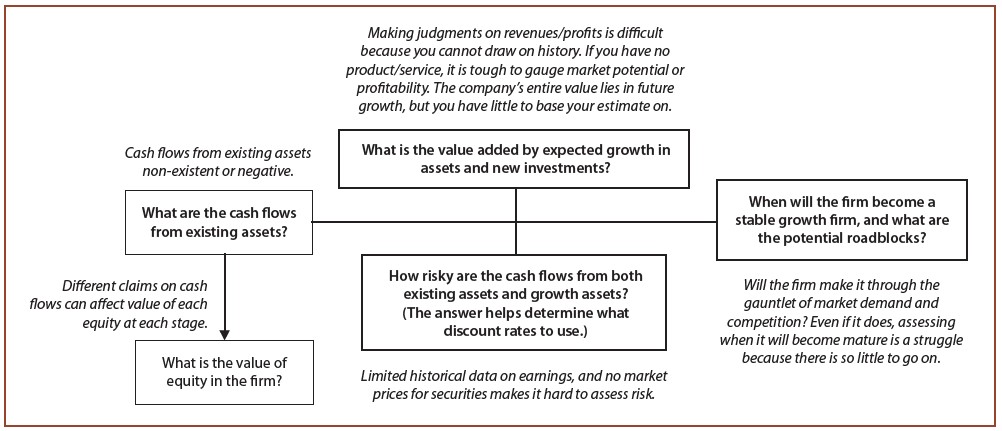
For most companies, the value of existing assets is the base on which the rest of the valuation is built, but with young growth companies, this base is small or non-existent. Turning to growth assets, you find yourself having to make estimates of future revenues, earnings and reinvestment, with little historical basis for the forecasts. With discount rates, the standard approaches used to estimate costs of equity and capital are dependent on past price data, which is not available for unlisted or just-listed public companies, and which even when available is volatile and unreliable. Finally, for terminal value, making judgments on when the firm will become a stable growth firm and what it will look like when it does mature gives rise to more questions than answers. Analysts who try to use multiples and comparable firms are stymied by the same problems, with multiples of earnings—such as price-earnings ratios and ratios of enterprise value to earnings before interest, taxes, depreciation, and amortization (EBITDA)—rendered meaningless when earnings are negative and multiples of book value and revenue yield astronomical and absurd values.
Faced with this uncertainty, investors are often tempted by the “dark side of valuation,” where principles are abandoned and common sense is a casualty. Some stay within the discounted cash flow framework, but are cavalier about estimating inputs: Revenues grow at unsustainable rates for long periods (with little attention paid to overall market size or competition), earnings magically materialize and grow to justify preconceptions of value, and discount rates become receptacles for all uncertainty. Others concoct new multiples that relate value to sector-specific measures: value per website visitor or eyeball (as occurred with the dot-com companies in the late 1990s) or value per member for the social media companies of 2011. LinkedIn, we are told, is cheap, since you pay only $500 per member while Groupon, a social coupon website, is priced at $800 per member. Many abandon valuation altogether and use the allure of the macro story to justify investing in companies that benefit from that story: Chinese and Indian consumer product companies are cheap because of the explosive growth in the middle classes in both countries, and social media companies are cheap because people spend large chunks of their day checking out their Facebook pages.
An Intrinsic Value Solution
To value young growth companies, recognize that uncertainty is not a flaw that can be eliminated by building bigger, better models, but a reality to be grappled with in the process of valuation. Be prepared to make estimates, lots of them, and to be uncertain about each and every one of them, and be prepared to be wrong, sometimes monumentally so.
Step 1: Start with revenues
With young companies, you have no choice but to begin with revenues and forecast revenue growth for future years. There is no one-size-fits-all template for this estimation, but it usually begins by determining the size of the market that the firm is competing in for its business and what share of that market you think it will capture. In making these estimates, draw on the quality of the company’s management and your knowledge of the product and service being offered by the company and how it measures up against both current and potential competition.
Step 2: Estimate operating margins over time
Revenue growth notwithstanding, a firm ultimately has to generate profits to become valuable. To estimate the evolution of operating income (and margins) over time, separate the process into two parts. First, estimate a “target margin” that the firm will be able to generate, once it gets through its growth pains, by looking at larger and more established firms in the business. Second, consider how rocky the path to that target margin will be at the firm, taking into account the extent of fixed costs and the nature of the competition.
Step 3: Assess “reinvestment” to sustain growth
In any competitive business, neither revenue growth nor margin improvement is delivered for free. You must estimate how much the firm will need to reinvest to generate the forecasted growth. Not only will this reinvestment require cash and thus affect cash flows, it may create the need for capital infusions in future years, which will dilute your share of value. One of the dangers of forecasting revenues, earnings and reinvestment separately, as in these first three steps, is that you may be making unrealistic assumptions about how much capital will be needed as the business grows. In other words, you may be estimating too little reinvesting, given your forecasts of expected revenue growth, or too much. One simple test that can be used to check for consistency is to compute an imputed return on capital, based upon the earnings and reinvestment forecasts.
Imputed return on capital = Expected operating income after taxt ÷ Capital invested in the firmt-1
The numerator is the forecasted operating income and the denominator is computed as the cumulated total of all reinvestment over time, through period t-1, added on to the initial capital invested. The imputed return on capital, as you approach steady state, can then be compared to both the industry average return on capital (to ensure that you are not making your company an outlier) and to the company’s own steady state cost of capital.
Step 4: Estimate costs of equity and capital over time
Rather than trying to estimate the cost of capital from a young company’s very limited history, use sector averages for your risk parameters (beta, cost of debt and even the debt-to-equity ratio), focusing on the riskiest and smallest companies in the sector for the initial phase of high growth and on more mature companies for the later phase of stability. A young growth company cannot and should not be valued using a cost of capital that remains unchanged over time. As the high revenue growth and operating losses in the early years change into lower revenue growth and operating profits in later years, the cost of equity and capital should change as well.
Step 5: Estimate expected value today and adjust for risk of failure
To get the value of the business today, you have to determine when the firm you are valuing will become a mature firm, which is tough to do with any firm but doubly so with a young firm. In making this judgment, though, recognize that relatively few companies are able to sustain high growth for long periods, notwithstanding the storied exceptions. [It is undeniable that Microsoft (MSFT), Wal-Mart  (WMT), Coca-Cola (KO) and a few other companies were able to maintain high growth for decades, but the very fact that we can name them should be an indication that they are exceptions and not the rule.] While it is possible that the young growth company you are valuing today will be the next Microsoft, assuming that it will be so (and giving it a growth period to match) will ensure that anything less than perfection will be a negative surprise. Consequently, don’t use growth periods longer than 10 years for any company, no matter how exceptional it looks today. In addition, give your firm the characteristics of a stable growth firm at that point: a mature-company cost of capital, a growth rate less than that of the economy in which it operates and a return on capital just above or equal to the firm’s cost of capital.
In making the assessment as to whether the firm you are valuing will survive, here are some considerations. First, a company that is dependent upon large infusions of cash over long periods to survive is at graver risk of failure than a firm with a more flexible cost structure that can defer growth and cut costs if faced with a funding crisis. Second, a company that is dependent upon one or a few key personnel for its success is more exposed to failure than a firm that has a deep bench when it comes to management or a technological barrier to entry (a patent or a license). Third, the probability of failure will also be a function of overall market conditions, rising during periods of market crisis (the last quarter of 2008) and falling during periods of market stability.
Step 6: Adjust for other equity claims
To get from the value of equity in the aggregate to a value per share may not be straightforward for young growth companies and will generally require two additional steps. First, if there are options that have been granted to prior equity investors in the business (venture capitalists or private equity), they have to be valued and netted out of equity value. In valuing these options, steer away from simplistic exercise value (what the options will be worth if exercised today) and use models that incorporate the time value of the options. Second, if there are shares with different voting rights, you have to allocate value across shares accordingly, attaching a lower value per share to the shares with reduced or no voting rights.
The sidebar applies these six steps to valuing LinkedIn.
Multiples and Real Options
Using multiples to value young growth companies is a practice fraught with dangers, but there are simple practices that cannot only prevent egregious valuation errors, but also lead to better valuations. First, rather than anchor the multiples to current earnings, book value or revenues (all of which will be puny numbers), forecast the operating results for the firm and calculate valuations based on those future results (say, five years from now). Second, take into account the characteristics that the firm will have at the time of the forward estimate. In other words, the growth that you should use to justify a forward price-earnings ratio (using estimated earnings from year five) should be the growth rate after year five (and not the growth rate for the first five years).
In both discounted cash flow and relative valuation, the expectations of success are built into revenues and earnings. Thus, the potential upside is already reflected in the value. However, success in one business or market can sometimes be a stepping-stone to unexpected success in other businesses/markets. Apple’s introduction of the iPhone to take advantage of the customer base that it had developed with the iPod would be an example. This “optionality” can be used to justify a premium on intrinsic or relative value for young growth companies, but only if the firm in question has exclusive rights to the expansion option. While Apple clearly meets this threshold (by owning the operating system), most companies do not. Many analysts mistake opportunities for options, using the real options argument to add a premium to any company that has high growth potential, from technology companies in growing markets (software and alternative energy, for example) to small companies in large, emerging markets (Indian and Chinese companies). In the process, they often double-count the value of growth—first through the expected cash flows in discounted cash flow valuation and again when they add the premium.
The Payoff
If you follow these rules, will you be rewarded? Unfortunately, I cannot make that promise.
In fact, it is entirely possible that you will watch neighbors and friends who use far less sensible approaches to investing make money on these stocks as they rise, while your portfolio languishes. It is also likely that you will watch these same people lose that money just as quickly when the “correction” comes (as it inevitably will).
Crass though it may seem, you may be able to take advantage of these market swings through a strategy of buying young growth companies when they become value plays and selling them when they are overvalued.
Example: Valuing LinkedIn
Revenue Growth
LinkedIn generates its revenues from three sources: premium subscriptions from members (20%), advertising (40%) and hiring solutions (40%). Looking at the size of the advertising and manpower services businesses, we estimated a growth rate of 50% a year in revenues for the next five years, starting from a base of $243 million last year, and then a gradual scaling down of growth rates to 3% in perpetuity.
Operating margins
While the company is currently profitable (generating $20 million in pretax operating income on revenues of $243 million), the pretax operating margin will rise over time to 15%, the median for established online advertising companies.
Reinvestment
We assume that the firm will have to reinvest a dollar in capital to generate $2.14 in incremental revenues (which is the median across established firms in the business). Thus, dividing the increase in revenues each year by this number yields the reinvestment for that year.
Cost of Capital
For the first five years, the cost of equity is based on a high beta (1.80) and on the assumption that the firm will stay all equity-funded, meaning no debt will be issued. Using a risk-free rate of 3% and an equity risk premium of 5%, the cost of capital (and equity) is estimated to be 12% for the first five years. (The math is 3% + (1.8 (KO) 5%) = 12%.) After year five, the cost of capital steadily decreases to reach the stable period cost of capital of 7.5%.
Expected Value and Survival Adjustment
LinkedIn is expected to become a stable firm in year 11, growing 3% a year in perpetuity. There are several factors working in its favor when it comes to survival. The first is that the firm is not heavily dependent on a few key personnel for its success and is the first-mover in this segment of the professional networking business. The second is that the firm has no debt and will have a significant cash balance after it goes public, making it less likely to fail. Table 1 summarizes revenues, earnings before interest and taxes, and the present value for the next 10 years.
Note that the reinvestment necessitated by growth creates negative cash flows for the first seven years. At the end of year 10, the terminal value for LinkedIn is computed assuming that the firm will have low growth (3% forever), a stable company cost of capital of 7.5% and will generate a return on capital of 10% forever.
Using the following formula results in a terminal value of $7.152 billion:
Terminal Value
= [EBIT(1-t) (KO) (1 + growth rate)] (KO) [1 – (growth rate ÷ return on capital)] ÷ (cost of capital – growth rate)
= [446 (KO) (1 + 0.03)] (KO) [1 – (0.03 ÷ 0.10)] ÷ (0.075 – 0.03)
= (459.38 (KO) 0.70) ÷ 0.045
= $7.146 billion*
*Editor’s Note: The terminal value here is slightly different because the EBIT(1-t) in Table 1 has been rounded. The author used a more precise number, resulting in a terminal value of $7.152 billion.
The present value of the terminal value is $2.603 billion, and is calculated by multiplying $7.152 billion by the discount rate of 0.364.
Adding the terminal value to the cumulative present value of the cash flows over the next 10 years yields a value for the operating assets today of $2.4 billion. Adding the cash balance ($93 million) and subtracting debt ($0) yields a value for the equity of $2.493 billion.
Adjust for other equity claims: At the time of the public offering, LinkedIn had 94.5 million shares outstanding, but it also had 17.8 million options outstanding, with an average strike price of $6.50 apiece. Netting out the value of the options, the value per share, assuming identical shares, is:
Value per share
= ($2,493 – $294) ÷ 94.5 = $23.27
However, the 7.8 million shares offered in the initial public offering had one-tenth the voting rights of the 86.7 million shares held by the founders. Allowing for a 10% discount, the value per non-voting share is $20.94, below the $43 per share offering price set by investment bankers for the IPO and well below the market price of $100 per share at the end of the offering day.
{{"object":1814,"classes":"object-type icon-html"}}
Discussion
FREE REPORT

Get your free copy of our special
report analyzing the tech stocks
most likely to outperform the
market.
Don from NV posted over 14 years ago:
William from SC posted over 14 years ago:
Edmund from FL posted over 14 years ago:
Bill from Florida posted over 14 years ago:
You need to log in as a registered AAII user before commenting.
Log InCreate an account