


Related
Stock Strategies
Sustainable value creation requires a competitive advantage that has both magnitude and duration.
by Brian Haughey | June 2026

Successful investors recognize that stock performance is ultimately driven by earnings. Benjamin Graham described the stock market as a popularity contest in the short term, but as a weighing machine in the long run. Peter Lynch agreed, noting that a stock’s long-term performance depends on the company’s underlying results. Investors should therefore seek to understand not only whether a company is profitable today, but whether it is likely to remain profitable and, ideally, earn returns well above those of its competitors over time.
In his book “Common Stocks and Uncommon Profits” (Second Edition, Wiley, 2003), Philip Fisher offered a 15-point framework that sought to identify those businesses with durable competitive advantages in innovation, distribution and management quality that could support sustained earnings growth. Warren Buffett described such firms as possessing an economic moat, likening them to well-protected castles. “What I love, of course, is a big castle and a big moat with piranhas and crocodiles,” commented Buffett.
Owning a well-protected business is important because when a business in a competitive economy earns unusually high returns, there will be a reaction. New entrants will flood in. Competitors will lower prices, which leads to compressed margins and returns being driven back toward the average. Research by Michael Mauboussin and Dan Callahan, CFA, suggest that it is difficult for U.S. firms to continue earning abnormal returns on invested capital (ROIC) for periods longer than a decade. Investors should therefore look for firms with enduring moats.
Finding a firm with a durable competitive moat is not easy. Of the more than 800 U.S.-listed companies covered by Morningstar analysts, only around 1 in 4 earns a wide-moat designation. Morningstar defines “wide moat” as a competitive advantage expected to last at least 20 years. Firms with such advantages do tend to generate high and persistent returns on invested capital, have stable or expanding profit margins and possess genuine pricing power. They can also usually generate strong free cash flow.
While the term “economic moat” is a general description of competitive advantage, it can arise from a number of distinct sources.
Cost advantage is straightforward. Companies that produce goods or services more cheaply than their rivals can maintain or gain market share by reducing prices, or can sustain higher margins.
Walmart Inc.  (WMT) is a striking example. Its vast distribution infrastructure, unmatched supply chain scale and logistics network allow it to source and deliver goods more cheaply than virtually any competitor. It can use that cost advantage as a competitive weapon: lowering prices to levels that rivals struggle to match without sacrificing margins.
Network effects arise when a product becomes more valuable as more people use it. As additional users join social networks such as Meta Platforms Inc.’s (META) Facebook and Instagram, existing users have more reasons to engage.
Payment networks such as those operated by Visa Inc. (V) and Mastercard Inc. (MA) also serve as textbook illustrations. As more customers become cardholders, merchants are more likely to accept their cards, in turn encouraging more cardholders. Once established, this virtuous cycle is extraordinarily difficult for a newcomer to overcome.
Platform moats are a variation of the network effect. A platform is a multisided market in which the business is an indispensable connection between two or more groups.
Alphabet Inc.’s (GOOGL) YouTube is a compelling example. Creators upload content because viewers are there, and viewers come because creators are there. Neither side has meaningful value without the other. Plus, the scale of that two-sided network is virtually impossible for a newcomer to replicate.
A platform moat is typically distinguished from a simple network effect by creating both switching costs and network effects simultaneously.
Switching costs exist when a product is so deeply entrenched in a customer’s workflow that changing providers would be costly or disruptive. Microsoft Corp.’s (MSFT) Office suite is embedded in enterprise operations worldwide, and its Azure cloud infrastructure creates deep technical dependencies. Businesses are reluctant to replace these underlying systems, regardless of whether a cheaper alternative exists, because of training and other costs associated with migration.
A powerful variant of switching costs is ecosystem lock-in, where multiple products from the same company reinforce each other so strongly that leaving any one of them means losing the value of all of them. An Apple Inc. (AAPL) customer who owns an iPhone, MacBook, Apple Watch and AirPods benefits from seamless call handoff, AirDrop, unified messages and a single photo library spanning every device. Each additional Apple product makes the ecosystem more valuable and exit more painful.
Membership-based models can create a subtler but equally real form of switching costs. For example, a Costco Wholesale Corp. (COST) customer who has paid an annual fee, formed regular shopping habits and come to rely on the value proposition is genuinely sticky. Costco’s membership renewal rates above 90% illustrate this dynamic, as the membership fee aligns incentives, generates return visits and makes switching to a rival feel like a conscious, effortful decision rather than a passive one.
Intangible assets, including brands, patents and regulatory licenses, confer powerful and often durable pricing advantages. Coca-Cola Co.’s (KO) brand is essentially a static moat because its formula is largely unchanged and sustaining it requires little more than consistent marketing. Competitive threats are minimal because replicating 140 years of consumer familiarity is effectively impossible. Apple’s brand, in contrast, offers a dynamic moat. It is powerful but requires continuous reinvention. If a new iPhone were to disappoint, the brand would take a real hit.
Regulatory licenses represent a similarly durable form of intangible moat: Banking charters and broadcast spectrum licenses can effectively bar competition regardless of a rival’s financial resources.
Buffett highlighted the pricing dimension of intangible moats: “If you’ve got the power to raise prices without losing business to a competitor, you’ve got a very good business. And if you have to have a prayer session before raising the price by 10%, then you’ve got a terrible business.”
Efficient scale characterizes industries that naturally support only a handful of competitors. The utility sector is a classic example: The infrastructure costs required to build a competing power grid are so prohibitive that duplication is economically irrational. This is precisely why these industries tend to attract regulatory oversight. The competitive positions of incumbents can be remarkably durable as a result, although that same regulation typically limits the economic returns they are permitted to earn.
The strongest businesses are protected by multiple moats. Apple benefits simultaneously from brand intangibles, a platform moat through the App Store and switching costs. Each moat reinforces the others.
Microsoft combines switching costs on top of cloud-scale efficiencies and a developer platform. A particularly powerful feature of Microsoft’s business is that it is largely asset-light. Unlike a manufacturer or retailer that must invest heavily in physical infrastructure to grow, Microsoft can scale its cloud and software offerings to meet rising demand with minimal incremental investment. Similarly, in an economic downturn, it is unburdened by large fixed-cost overheads that weigh heavily on capital-intensive businesses. This combination of a high return on invested capital, low capital intensity and operational flexibility is precisely why asset-light businesses with strong moats tend to command premium valuations.
Amazon.com Inc. (AMZN) serves as another example of moat stacking. Its retail moat depends on a fulfillment network built through two decades of aggressive reinvestment. The company delivers goods at a speed and cost that rivals cannot match without replicating that infrastructure from scratch. Amazon has also built a marketplace platform connecting third-party sellers with hundreds of millions of buyers, resulting in a data moat fed by decades of purchase history and behavioral signals. Amazon Prime membership offers delivery, video, music, pharmacy and grocery to tens of millions of households. While a competitor may be able to match one of these advantages, to overcome all four simultaneously is a very different proposition.
Moat stacking can arise from deliberate management strategy. Walmart’s core moat has always been its cost advantage arising from its supply chain and distribution network.
An important new dimension to moat stacking is the rise of artificial intelligence (AI). The defining moat of the coming decade may not be algorithms or computing power, both of which can be replicated or purchased, but proprietary data that cannot.
Data moats operate in two distinct ways. The first is defensive, as accumulated data can improve an existing product or service. Billions of queries over two decades have allowed Alphabet to refine its Google search engine, while Amazon’s recommendation engine has been trained on purchase histories that no newcomer could replicate overnight. As more users interact with the product, more data is accumulated and the product becomes better.
Proprietary data can contribute to a moat in a second way through the creation of entirely new products or services that competitors cannot replicate because they lack the data. For example, Rolls-Royce Holdings PLC’s (RYCEY) engine leasing model creates switching costs for airlines. Additionally, sensor data produced by millions of flight hours from engines in service enables Rolls-Royce to optimize maintenance schedules. This data can also influence the design of future engine generations, providing Rolls-Royce with real-world performance data that competitors without equivalent operational history simply cannot replicate.
It would be a mistake to treat any moat as permanent. The iPhone’s launch in 2007 is a perfect example of moat destruction because it destroyed two dominant incumbents simultaneously. The former Motorola’s flip phone was the best-selling mobile phone, while BlackBerry Ltd. (BB) dominated mobile email. Both firms appeared to have unassailable market share, yet Apple rendered both obsolete by introducing a single general-purpose computing platform built around touch, apps and consumer experience.
The right moat question is not just “Can a competitor beat us at our own game?” but “Can a competitor change the game entirely?” Zoom Communications Inc. (ZM) displaced Cisco Systems Inc.’s (CSCO) WebEx through sheer ease of use, only to be undercut when Microsoft and Google introduced similar functionality into their existing ecosystems.
Even a business with multiple stacked moats can begin to erode them through its own decisions. Amazon’s introduction of advertising into Prime Video—requiring subscribers to pay an additional fee to remove ads from a service they are already paying for—is noteworthy. Because the company has chosen to extract short-term revenue from the Prime relationship rather than invest in deepening it, customers may come to view Prime membership as less attractive.
Declining market share can reveal moat erosion. Research by Mauboussin and Callahan suggests that industries where the average absolute change in market share is less than 2% over five years tend to be structurally stable, with incumbents benefiting from durable advantages. Industries in which market share is shifting more rapidly, such as social media, reflect a vigorously competitive landscape. Investors should watch for margin compression, rising customer acquisition costs and falling returns on invested capital—any of which can signal that competition is intensifying.
The true test of a moat’s value lies in what management does with the cash it generates and how much capital is required to sustain it in the first place. This is where the concept of asset-light businesses becomes particularly relevant. Some companies with strong moats can grow revenue substantially without proportional increases in invested capital.
Software platforms and payment networks scale digitally, with minimal incremental investment. Consumer franchises built on intangible assets such as Coca-Cola—whose brand and formula generate revenue through a global network of licensed bottlers without requiring significant capital investment—enjoy the same asset-light economics. As revenue increases, the return on invested capital expands and free cash flow conversion ratios can exceed 100%.
As I discussed in my March 2026 AAII Journal article, “Cash Is King and Free Cash Flow Wears the Crown,” free cash flow conversion is one of the clearest signals of business quality. Asset-light moats tend to produce the most impressive conversion ratios of all. Visa processes trillions of dollars in transactions with minimal physical infrastructure.
Management then must decide how to allocate capital: reinvest organically in the business, pursue acquisitions, pay down debt or return cash to shareholders through dividends or buybacks. Each choice has different implications for long-term value creation, so the quality of those decisions over time can matter as much as the strength of the moat itself. A company that earns a 30% return on invested capital but squanders its free cash flow on overpriced acquisitions destroys value just as surely as one with no competitive advantage at all.
The printing business of former information technology company Hewlett-Packard Co. generated extraordinary free cash flow for decades through its moat built on proprietary printer ink cartridges. However, its acquisition of Autonomy Corp. in 2011 for $11.1 billion resulted in an $8.8 billion write-down just one year later—one of the largest write-downs in corporate history. The moat generated cash, but poor capital allocation destroyed value.
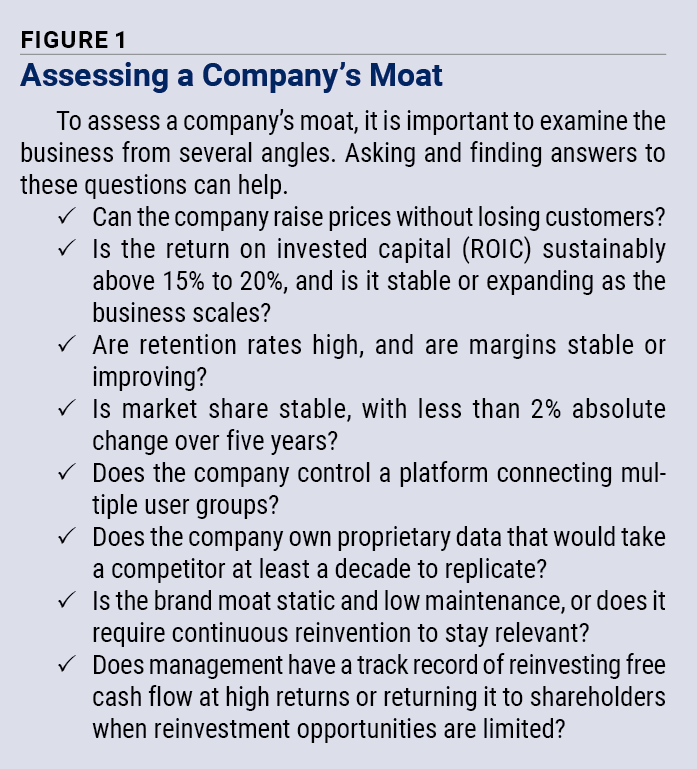
Figure 1 lists questions that investors should ask when seeking to assess a company’s moat.
The value created by a firm depends on the firm’s size, its investment spread (the difference between funding cost and return on invested capital) and the duration over which the company sustains that spread. A firm that can sustain a spread of 15% for 20 years is much more valuable than one that can sustain a spread of 25% for five years. This is the true economic value of a moat: It extends the duration of excess returns. Table 1 illustrates how business quality and the persistence of competitive advantage translate into justifiable valuation multiples.
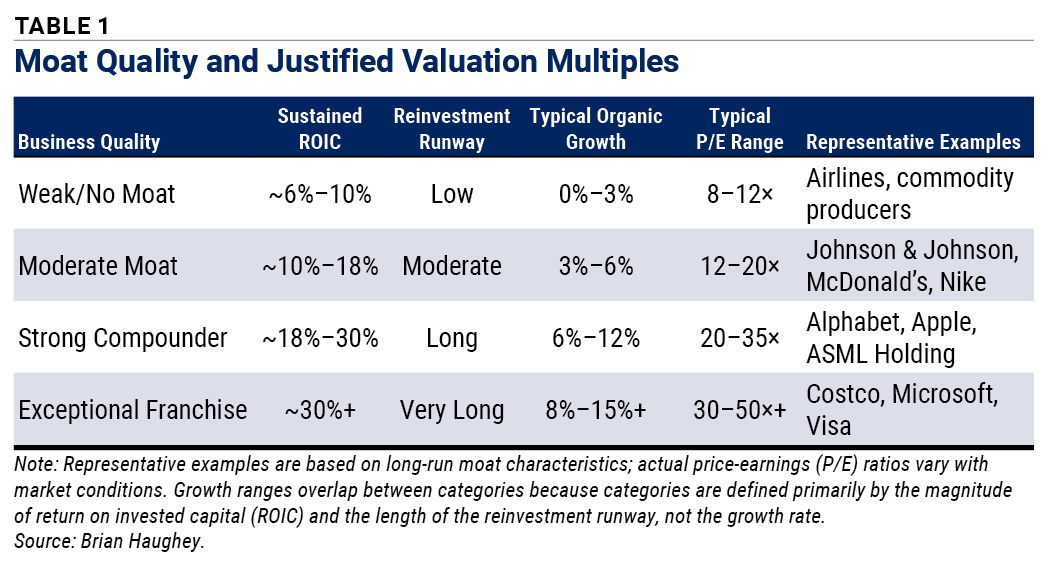
Airlines, steel producers and most undifferentiated retailers are examples of firms with weak or nonexistent moats. Companies with strong brands in competitive categories have moderate moats. Strong moat compounders possess durable advantages and high reinvestment runways but often require continuous reinvestment or product reinvention.
Firms with near-permanent moats, exceptional returns on invested capital and very long reinvestment runways are rare and are often asset-light businesses. Microsoft and Visa frequently trade with a price-earnings (P/E) ratio in the mid-20s to low 30s, reflecting investor confidence in their ability to sustain high returns. Despite its modest net margins, Costco trades at a premium because investors are willing to pay for the durability of the business model.
In the long run, a stock’s performance follows its underlying business results. Sustainable value creation requires both magnitude and duration of competitive advantage. Truly wide moats are far rarer than most investors appreciate.
A moat is not a static barrier; it is dynamic. It must be maintained and occasionally rebuilt as technology, regulation and customer preferences evolve. Some moats, such as a century-old consumer brand, a payment network or a regulatory license, are largely self-sustaining. Others require continuous investment in innovation for firms to sustain their market share. In the age of AI, proprietary data has emerged as a new type of moat.
Moats create enduring value only when management allocates the resulting cash flow wisely. The best investments are firms that earn high returns on invested capital, can grow without consuming proportionate amounts of new capital and possess the structural advantages to protect against competitors for many years to come.
Stock Strategies

Financial Statements

Financial Statements

ROBERT A from NC posted 4 months ago:
BARRY J from TX posted 3 months ago:
You need to log in as a registered AAII user before commenting.
Log InCreate an account