


Related

Financial Statements
How the cash flow statement tells you whether a company is realizing cash (copacetic) or burning through it (unsustainable).

Charles Rotblut leads a class in AAII's new Essential Investing Video Course. Go to https://www.aaii.com/ves for more information and to subscribe.
The cash flow statement, a critical tool for investors, is often the most overlooked financial statement. The cash flow statement measures how much cash a company has brought in and how much has flowed out.
Cash is the lifeblood of any company. It pays suppliers and employees. It funds marketing, expansion and development. It can reward shareholders with dividends and pay interest to bondholders.
Plus, the cash flow statement is the least susceptible of the three financial statements to accounting preferences and manipulation. Executives have leeway over depreciating assets and recognizing the timing of expenses. They have little leeway in reporting how much cash has flowed in or out over a certain period.
In this fourth installment of our updated series on financial statements, we show you how to analyze the cash flow statement. We explain the three parts and highlight key items to pay attention to.
Publicly traded corporations use accrual accounting. Accrual accounting recognizes transactions when their economic benefits become probable. This often leads to differences between income and cash flow, with the balance sheet impacted as well.
Say a company lands a big contract with a new customer. To simplify the example, we assume that revenues from the sale will not be recognized until the product is delivered.
The company purchases parts and raw materials to create the product after the order is placed. Inventory and accounts payable increase on the balance sheet. The two offset each other on the cash flow statement. Once the company pays for the inventory it purchased, an outflow will be recognized on the cash flow statement.
The company recognizes revenues and income on its income statement at the time the product is delivered. Accounts receivable increases on the balance sheet to reflect the amount owed by the customer while inventory decreases. The cash flow statement will not recognize the dollar amount of sale until the customer has paid—which may be in a different quarter than when the sale was recognized.
As you can see, the recognition of cash flows is often different from when transactions are recorded on the income statement and balance sheet.
It’s worth noting that accounting rules provide corporate executives some leeway in recognizing revenues and expenses. They don’t have the same leeway when it comes to reporting cash flows. Cash flows must be recognized at the time they are realized.
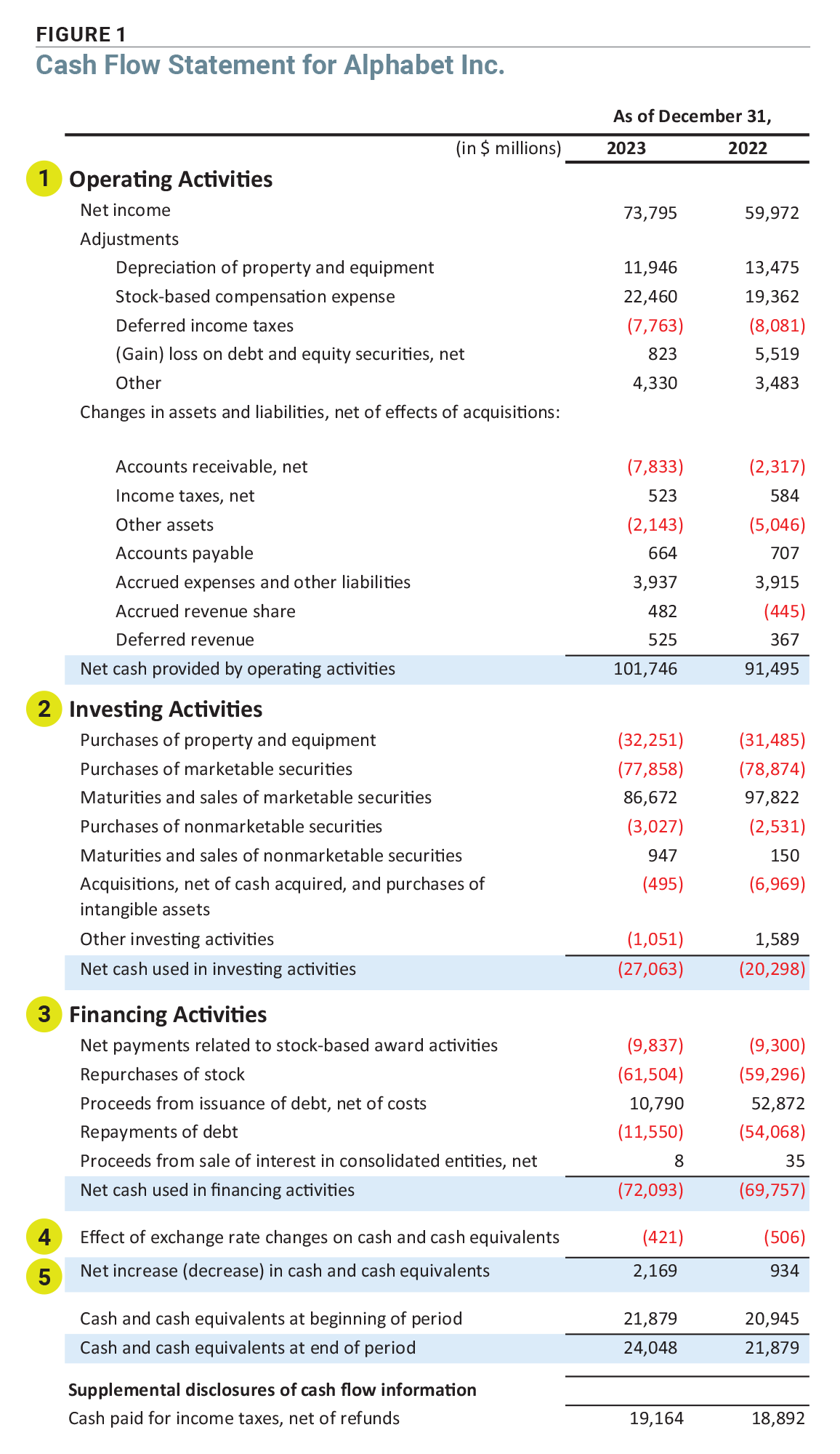
The cash flow statement consists of three primary segments: cash flow from operating activities, cash flow from investing activities and cash flow from financing activities. You can see this in Figure 1, which shows the cash flow statement for Alphabet Inc  (GOOGL).
Each segment of the cash flow statement provides a different look at how a company takes in and spends its cash. Once you understand the role all three segments play, you’ll be better able to incorporate the cash flow statement into your analysis of a company.
Cash flow from operating activities tells you how much cash is realized or spent by normal day-to-day business operations. Positive numbers should be the norm over most, if not all, years. Positive operating cash flow occurs when a company brings in more money from selling products and/or providing services than it spends. Negative numbers are concerning because they signal that the company is spending more than it receives from running its operations.
Normal operations include, but are not limited to, selling products, providing services, marketing, labor costs, acquiring inventory, paying vendors and collecting invoice payments from customers.
Cash flow from operating activities can be negative during a single quarter or year due to timing issues or business cyclicality. Management should explain the reason for such occurrences.
There are two methods that companies can use to determine cash flow from operations: the direct method and the indirect method. Most publicly traded companies in the U.S. use the indirect method.
The Direct Method
The actual operating cash flows for each primary operating segment are reported under the direct method. These include collections received from customers, payments made to employees, payments to suppliers of goods and services such as goods used in inventory and advertising, interest expenses and taxes. You can easily spot when the direct method is being used because cash flow from operations will begin with collections received from customers.
The Indirect Method
The indirect method is the most common way of determining cash from operating activities. Companies such as Alphabet using the indirect method will list net income at the top of their cash flow statements, as shown in Figure 1.
Net income is an accounting figure. The indirect method adds back noncash expenses. It then further adjusts net income for nonoperating income, nonoperating expenses and balance sheet changes attributable to operating activities.
Alphabet makes two types of adjustments to net income. The first is noncash. These include depreciation, deferred income and the gain or loss on investments. None of these result in cash coming in or flowing out. For example, the decrease in a server’s resale value does not impact cash flow while Alphabet continues to own it.
Accounting rules require companies to include unrealized gains and losses on investments in reported net income. These do not impact cash flow and thus are adjusted for on the cash flow statement.
The second type of adjustment is balance sheet changes. These frequently include changes in accounts receivable and accounts payable. Increases in accounts receivable are deducted from net income because they represent invoices customers have yet to pay. Increases in accounts payable are added to net income because they represent amounts the company owes but has yet to pay to its vendors.
Beyond their day-to-day business operations, companies invest in themselves. Long-term expenditures are made with the intent of boosting future revenues and profits. As such, they are listed separately on the cash flow statement.
The types of investments included in this section vary by what a company does. Companies that are more capital intensive, such as industrial and construction companies, will spend heavily on equipment. Financial firms make loans and invest in other companies.
Capital expenditures (capex) are typically the first line item. Alphabet says its capex includes land and buildings, information technology assets, construction in progress, leasehold improvements and furniture and fixtures. Capex is recorded on the cash flow statement when money is spent on such assets. Those assets are then depreciated on the balance sheet and expensed on the income statement over periods lasting from a few to many years. As noted before, deprecation is a noncash expense.
Capex will be positive if a company sells a large asset such as a building or disposes of several long-term assets in a single year or quarter.
Cash spent on acquiring other companies is recognized as an outflow. Divestitures of product lines and business units are cash inflows.
Market securities purchased or sold are generally listed here for most companies. This differs from the unrealized gains and losses that impact net income—they are adjusted for in the operating activities section of the cash flow statement. Buying and selling securities impact cash flow, while unrealized gains and losses do not.
Some transactions involving securities will appear under cash flow from operations. These include securities bought or sold for trading purposes by financial companies. Such activities are part of their normal business operations. Companies that use derivatives to hedge against commodity price fluctuations categorize them as an operating cash flow activity. The key difference is whether the securities are directly related to a firm’s normal operations (e.g., to lock in oil prices) or are purchased as a longer-term investment.
The first two segments of the cash flow statement focused on activities related to the company’s business structure. This third section focuses on how the company raises and distributes capital.
It can be helpful to think of this section in terms of equity and debt. Equity is ownership interests sold to or repurchased from shareholders. Debt includes long-term loans taken, bonds issued and the repayment of either.
Proceeds from the sale of stock (either common or preferred shares) increase cash from investing activities since they bring cash into the company. The repurchase of shares is a cash outflow from the company to shareholders. Alphabet, for instance, spent more than $61.5 billion in 2023 buying back shares of stock.
Alphabet includes net payments related to stock-based award activities on its cash flow statement. This refers to stock-based rewards that were settled in cash. Other companies that rely on stock-based compensation may include this line item on their cash flow statements.
On the liabilities side, companies can issue debt, pay down debt or both. These are loans taken out to fund the business. It is helpful to understand which direction cash is flowing. Proceeds from the issuance of debt bring cash into a company. Repayments of debt are an outflow because the company is paying its creditors (bondholders).
Beyond the three primary sections is the accounting of any significant currency translation recognized by the company. This shows the impact exchange rates had on cash flow. The more a company operates outside the U.S. and/or interacts with foreign companies, the proportionately larger its currency translation will be. Currency translation can be either positive or negative depending on exchange rates.
There are accounting rules written to supervise how currency is translated. A separate line item, often called “cumulative effect of exchange rate changes,” details the effect of the currency exchange rate changes on the company’s cash flow.
Near the bottom of the income statement is a line showing the net cash change. It is often listed as “Net increase (decrease) in cash and cash equivalents.” This line item shows the difference between the cash the company held at the beginning of the reported period and the amount that it holds at the reporting period’s end.
Alphabet incurred a $2,169 million increase in net cash and cash equivalents for 2023. It is an informational figure affected by the timing of when cash flows were recognized. The number matters less than how the cash was generated (positive numbers) or spent (negative numbers). Timing factors will affect this number. Positive cash flows from operating activities should be seen repeatedly over several years with prudent decisions made regarding investing and financing activities.
A good rule of thumb is that a company should hold on to enough cash to fund growth, weather cyclical downturns and reward shareholders. The amount of cash should also be below a level that enables management to make potentially bad decisions regarding expansion and acquisitions.
On the last line of Figure 1, Alphabet lists how much cash was spent on income taxes. This is purely informational for most individual investors.
A useful metric derived from the cash flow statement is free cash flow. Free cash flow is cash available to spend on activities not directly related to the company’s ongoing operations.
A business needs a certain level of funding to maintain its operating activities. There should also be enough cash flow to maintain and upgrade fixed assets (facilities, plants, machinery, computers, etc.) Any additional cash flow is “free” to be used at management’s and the board of directors’ discretion. Such amounts can be distributed as dividends, used to repurchase stock, spent to expand the business operations or be set aside for future use.
Free cash flow can be calculated by subtracting capital expenditures and dividends paid from cash flow from operating activities.
Positive free cash flow protects a company from business downturns. It also enables a company to maintain its dividend and interest payments when income drops.
Free cash flow may be negative because of bad management decisions, a poor business model, capex made to grow the business or timing. Capex can be elevated for a period of time as a company builds facilities to fund expansion. Cyclical downturns or spending on product development may also temporarily depress free cash flow.
Conversely, free cash flow can be positive for companies that are struggling. This occurs when expenses are falling faster than sales. During such situations, less money is spent on replenishing inventory, funding new products and labor. This boosts cash flow in the short term but is not sustainable if the business is not stabilized.
The cash flow statement tells you whether a company is realizing cash or burning through it. The former is good while the latter is unsustainable.
A simple way to use the cash flow statement is to determine whether cash flow from operating activities has been mostly positive or negative over the past several years (e.g., five to seven years). Then look at or calculate free cash flow to determine if it is positive or negative.
You will also want to look at the most recently reported 12-month period or calendar year to understand why free cash flow is positive or negative. For example, it is not unusual for retailers to have negative free cash flow during their first quarter, as sales drop following the busy holiday season. Companies less exposed to cycles, such as Alphabet, will generally have more consistent cash flow trends.
The cash flow statement also shows the impact of changes on the balance sheet and income statement. For example, if sales and income are rising, but cash flow from operations is not, it may mean that customers are slow to pay.
Our next financial statement analysis article on data providers will appear in the November AAII Journal. All articles in this series can be accessed at AAII.com in the AAII Journal article index.
Financial Statements

Financial Statements

Financial Statements

ROBERT A from NC posted over 2 years ago:
JIM C from AZ posted over 2 years ago:
BARRY J from TX posted over 2 years ago:
You need to log in as a registered AAII user before commenting.
Log InCreate an account