


Charles Rotblut leads a class in AAII's new Essential Investing Video Course. Go to https://www.aaii.com/ves for more information and to subscribe.

- Explains Trump Accounts, including eligibility, structure and government seed contributions
- Details account rules: contribution limits, investment options and the process of opening an account
- Compares benefits and drawbacks, helping readers evaluate Trump Accounts versus other savings options for children
Trump Accounts became available in July 2026. Created by the One Big Beautiful Bill Act (OBBBA) of 2025, these government-seeded savings accounts for minors grow on a tax-deferred basis and allow contributions to be made until the account owner turns 18 years old.
The accounts have both positives and caveats to consider. I review the rules, explain how to open and contribute to a Trump Account, and compare them to other savings options.
Overview of Trump Accounts
Trump Accounts are described as a type of a traditional individual retirement account (IRA) for minors. The bipartisan idea behind the accounts is simple: to help children save early in life so they are in a stronger financial position in adulthood.
Participants must be U.S. citizens, have a Social Security number and be under the age of 18 at the time the account is opened.
Accounts opened for qualifying children born between 2025 and 2028 can be seeded with a $1,000 pilot contribution from the U.S. Department of the Treasury. Some employers or other donors may provide additional contributions. Michael Dell and Susan Dell, for instance, have pledged to provide $250 each to 25 million children who were born between 2016 and 2024 and who live in ZIP codes with a median annual family income of $150,000 or less.
The child is the owner of their account, though the accounts operate in a custodial-style structure. The child’s parent(s) or legal guardian(s) are responsible for managing the account until the child reaches age 18. At that point, the child will take over managing the account.
The Bank of New York Mellon Corp.  (BNY) is the financial agent for these accounts, and Robinhood is the broker and sole initial trustee. Guidance on rolling over Trump Accounts to other financial institutions had yet to be issued as of mid-July.
Initial Investment Options
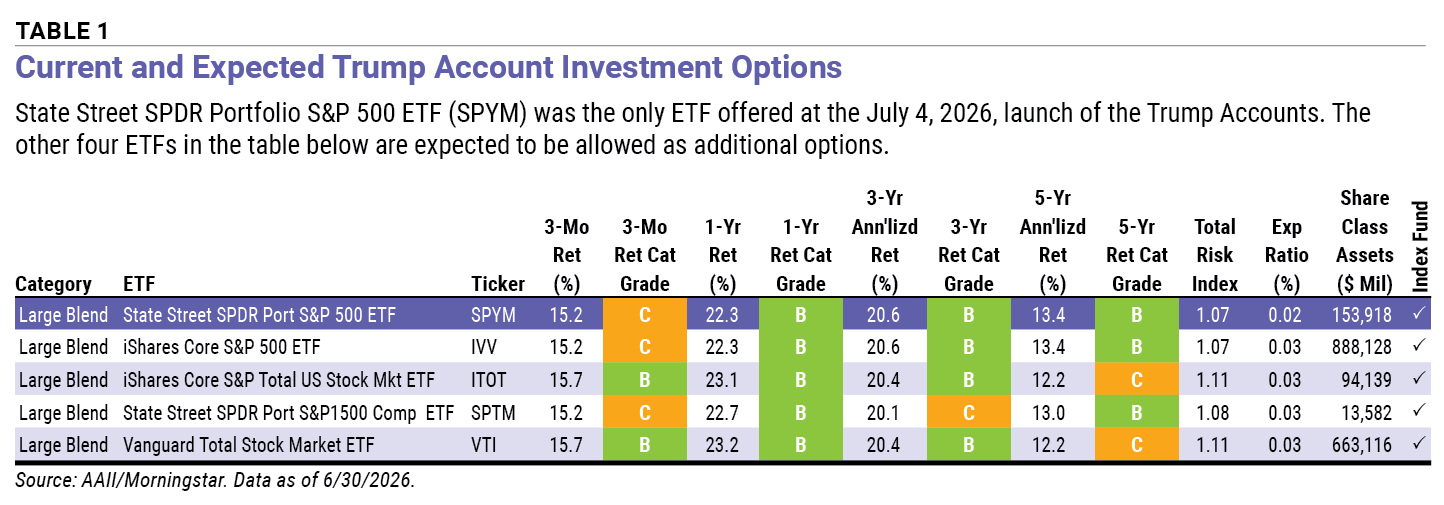
When Trump Accounts launched in July 2026, all contributions were invested in State Street SPDR Portfolio S&P 500 ETF (SPYM). This large blend exchange-traded fund (ETF) has an expense ratio of 0.02%.
Later in 2026, the Treasury Department expects to allow parents or guardians to allocate across the following additional investment options.
-
iShares Core S&P 500 ETF (IVV)
-
iShares Core S&P Total U.S. Stock Market ETF (ITOT)
-
State Street SPDR Portfolio S&P 1500 Composite Stock Market ETF (SPTM)
-
Vanguard Total Stock Market ETF (VTI)
All four of these ETFs have expense ratios of 0.03%. Since these ETFs are market-capitalization weighted, they do not provide significant diversification relative to each other. However, iShares Core S&P Total U.S. Stock Market, State Street SPDR Portfolio S&P 1500 Composite Stock Market and Vanguard Total Stock Market do provide some exposure to small-cap stocks. Table 1 provides a comparison of the five ETFs.
Once the Treasury Department establishes rules for rollover accounts at other financial institutions, custodians and account owners are expected to have additional investment options made available to them. Investment options will be limited to those with expense ratios of 0.10% or lower.
Opening a Trump Account
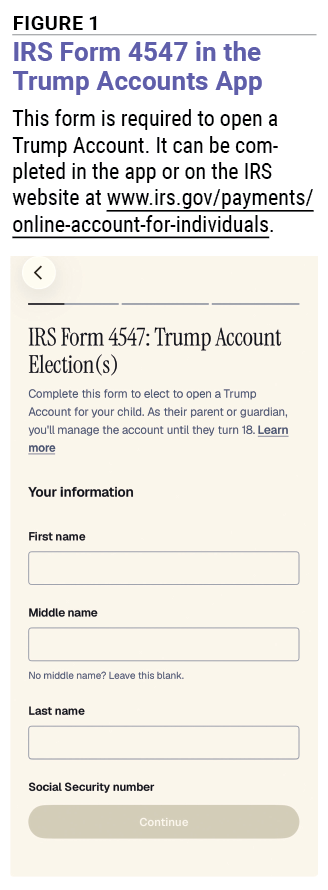
The Trump Accounts app is available for iOS devices on Apple’s App Store and for Android devices on the Google Play store. Accounts can be opened through this app or on the Internal Revenue Service’s (IRS) Online Account for Individuals page. If you use the IRS’ website, you will be asked to use or create a free ID.me account.
Either method requires IRS Form 4547 to be submitted. The form can be filled out in the app (Figure 1).
An initial Trump Account generally must be opened by an authorized individual. If no pilot contribution is requested from the Treasury Department at the time the account is opened, the authorized individual is, in order of priority: the child’s legal guardian, parent, adult sibling or grandparent. If the $1,000 pilot contribution is requested, the authorized individual must be someone who anticipates that the child will be their qualifying child for the tax year in which the election is made.
Contributing to Trump Accounts
Contributions by individuals, subject to the rules below, can be made in the app or online. According to the Trump Accounts call center, the app includes a shareable QR code for making donations. For example, a parent can share the QR code with relatives who wish to contribute to the account.
The IRS lists five types of contributions that can be made to a Trump Account. They are:
- Pilot program contribution of $1,000 per child from the Treasury Department;
- Qualified general contributions—funded by states (or political subdivisions thereof), the U.S., the District of Columbia, Indian tribal governments or section 501(c)(3) tax-exempt organizations—for members of a qualified class of account beneficiaries;
- Employer contributions that are not includible in the gross income of the employee;
- Qualified rollover contributions (which are transfers to a rollover Trump Account of the entire amount of the child’s prior Trump Account); and
- Contributions from other sources (such as the child, the child’s parents or any other person).
Maximum Annual Contribution
The contribution limit is $5,000 per year. Pilot program contributions, qualified general contributions or qualified rollover contributions are not subject to the annual contribution limit. In other words, they do not count against the $5,000 limit. This limit will be subject to cost-of-living adjustments (COLAs) after 2027.
Contributions by the child’s parent and relatives as well as other nonexempt contributions all count toward the $5,000 limit. Section 128 employer contributions are subject to a $2,500 limit per employee. (This limit will also be subject to inflation adjustments after 2027.)
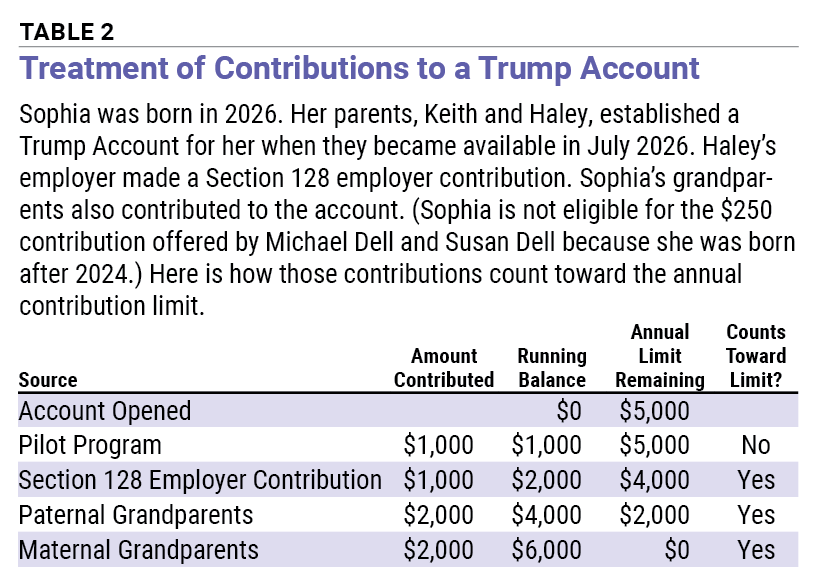
An example makes the rules easier to understand. Keith and Haley’s baby, Sophia, was born earlier in 2026. The couple immediately applied for Sophia’s Social Security number after she was born. In July 2026, the new parents opened a Trump Account for her. Haley’s employer made a Section 128 contribution to the account. Sophia’s grandparents also contributed.
The combined contributions give Sophia a starting balance of $6,000. She receives $1,000 from the pilot program, and an equal contribution is made by Haley’s employer. Both sets of grandparents give $2,000 each to maximize the allowable contribution for this year. Table 2 provides a breakdown.
Sophia is not eligible for the $250 contribution offered by the Dells because she was born after 2024.
Gift Tax Guidance
Regarding gift taxes, guidance issued by the Treasury Department in June 2026 provided a transfer tax safe harbor for contributions to Trump Accounts. Taxpayers who meet all of the following requirements will not be required to file gift tax returns that report Trump Account contributions:
- The taxpayer is an individual;
- The only taxable gifts made by the taxpayer during the calendar year are cash contributions to one or more Trump Accounts, each made before the calendar year in which the account beneficiary attains age 18;
- The taxpayer’s total gifts during the calendar year to each individual who is an account beneficiary, including contributions to that account beneficiary’s Trump Account, do not exceed the annual gift exclusion amount ($19,000 for 2026);
- Contributions to Trump Accounts made during the calendar year do not generate for that calendar year either a gift or a generation-skipping transfer (GST) tax liability; and
- No gift tax return is required to be filed, and no gift tax return is otherwise filed, for that calendar year by or on behalf of the taxpayer, whether for GST tax, portability or other purposes.
Employer Contributions
Employers may contribute up to $2,500 to a Trump Account of an employee or an employee’s dependent. This annual limit is per employee and not per dependent of the employee. The IRS specifically states: “[If] an employee has two or more children that have Trump Accounts, an employer with a Trump Account contribution program may only contribute up to $2,500 in the aggregate for 2026 to those Trump Accounts.”
The $2,500 cap will be adjusted for inflation starting in 2028. Employer contributions count toward the annual $5,000 limit for each Trump Account.
Growth Period Strictly Limits Withdrawals
Trump Accounts are locked up during what the IRS calls the “growth period.” The growth period ends on January 1 of the calendar year in which the child turns 18—not on the child’s 18th birthday. For example, a child born on October 1, 2025, will turn 18 on October 1, 2043, but their growth period will end after December 31, 2042.
During the growth period, no distributions are allowed, with four narrow exceptions:
- A transfer of the entire balance to another Trump Account,
- A rollover of the entire balance to the child’s Achieving a Better Life Experience (ABLE) account (which is permitted only during the calendar year in which the child turns 17),
- A distribution of excess contributions, and
- A distribution upon the death of the child.
Hardship withdrawals are not permitted.
Options at the End of the Growth Period
The account owner has three basic choices: Keep the account as a Trump Account operating under traditional IRA rules (retaining the favorable separate basis treatment), roll the balance over to a regular traditional IRA, or convert some or all of the balance to a Roth IRA. The latter option is potentially attractive for a recent graduate in a low tax bracket, though additional IRS guidance on conversions is expected.
A rollover may happen automatically: The IRS will allow a Trump Account’s governing documents to provide for an automatic trustee-to-trustee transfer to a traditional IRA at the end of the growth period. Whether this occurs depends on the custodian’s documents, so account owners should not assume either outcome.
Withdrawal Rules After Growth Period Ends
Once the growth period ends—again, at the start of the calendar year in which the child turns 18—most of the special Trump Account rules fall away. The account is thereafter treated as a traditional IRA, subject to the ordinary rules for contributions, investments, distributions, rollovers, Roth conversions and, eventually, required minimum distributions (RMDs). At this time, the young adult takes over management of the account.
The tax treatment of withdrawals follows the traditional IRA framework. Contributions made by parents, relatives and other individuals are not tax-deductible. These aftertax dollars create what is known as basis in the account and come out free of federal taxes. The $1,000 pilot contribution, qualified general contributions and Section 128 employer contributions do not create basis in a Trump Account and are taxed as ordinary income when withdrawn. All earnings are also taxed as ordinary income to the account owner, generally at their own tax rate. (See the kiddie tax discussion below regarding all taxable withdrawals.)
Contributions cannot be withdrawn first. Rather, basis is recovered pro rata. Each withdrawal is split between a tax-free portion and a taxable portion based on the ratio of total basis—comprising the contributions specified in the preceding paragraph—to the total account value. One favorable wrinkle is that this calculation is applied to the Trump Account by itself. Unlike other traditional IRAs, which are aggregated when determining the taxable portion of a withdrawal, a Trump Account is kept separate from the owner’s other IRAs.
Withdrawals taken before age 59½ are generally subject to the 10% additional tax on early distributions. The standard exceptions apply, including withdrawals for qualified higher education expenses, up to $10,000 for a first home purchase and up to $5,000 for the birth or adoption of a child. These exceptions waive only the penalty; ordinary income tax still applies to the taxable portion.
One trap for college-age withdrawals is the kiddie tax. The taxable portion of a withdrawal is unearned income. For a full-time student under age 24, unearned income above the annual threshold could be taxed at the parents’ marginal rate. A withdrawal intended to cover tuition could therefore trigger a larger-than-expected tax bill—a meaningful disadvantage relative to a 529 plan.
Alternatives to Trump Accounts
Many parents and grandparents contribute to 529 plans to save for their child’s/grandchild’s education expenses. Contributions are made using aftertax dollars, allowing the invested funds to grow tax-deferred, with withdrawals tax-free when used for qualified education expenses. A beneficiary is designated to receive the amounts paid into the 529 account; one child can be the beneficiary of multiple 529 accounts. Contributions are subject to the annual gift tax exclusion, which is $19,000 for individuals and $38,000 for consenting couples filing jointly in 2026.
529 plan assets can be rolled over into a Roth IRA after the 529 account has been open for at least 15 years. Rollovers are subject to the annual Roth IRA contribution limit, which is currently $7,500 per year. The lifetime maximum that can be rolled over is $35,000 per beneficiary. The beneficiary must have earned income to do the rollover.
Custodial brokerage accounts can trigger the kiddie tax if large enough. Otherwise, they are subject to the capital gains and dividend taxation rules. There is no limit on contributions, but contributions are subject to the gift tax if they exceed the $19,000 single/$38,000 married joint annual limit. Taxable custodial brokerage accounts cannot be rolled over or converted to Roth IRAs. Moving the money requires selling assets—thereby realizing capital gains—and contributing the cash to a Roth IRA, which requires the child to have earned income and is subject to the annual contribution limit.
Custodial IRAs can be opened by a parent or guardian on behalf of a minor child who has earned income for the year. The account is transferred to the child once they reach the age of majority. Contributions are limited to the lesser of earned income or the annual cap (currently $7,500). Earned income generated from W-2 wages or self-employment qualifies, whereas interest income, allowance money and gifts are not eligible. Minors do not need to contribute their own money to the IRA but are not limited from doing so.
All of these accounts have higher contribution limits than Trump Accounts. Custodial accounts provide the most choices of investments (individual stocks, mutual funds, ETFs, etc.) Beneficiaries can be changed on 529 plan accounts—a benefit to families with more than one child or grandchild. Investment options in 529 accounts are limited to the plan menu.
The big advantage of Trump Accounts is the seed money. For this reason alone, it makes sense to open an account for a child born between 2025 and 2028. Outside of this group, the flexibility of the 529 plans and custodial accounts should be taken into consideration before opening a Trump Account.

Related

Related

Discussion
FREE REPORT

Get your free copy of our special
report analyzing the tech stocks
most likely to outperform the
market.
ROBERT A from NC posted 2 months ago:
You need to log in as a registered AAII user before commenting.
Log InCreate an account