

Related

Portfolio Strategies
Any plan to help a young family member provide for their future starts with the most important component: time.
by Paul Merriman | April 2023

Paul Merriman leads a class in AAII's new Essential Investing Video Course. Go to https://www.aaii.com/ves for more information and to subscribe.
The following may surprise some people, but it’s true: When you’re investing for retirement, the most precious resource you can have isn’t money to invest, it’s time. I’ve become acutely aware of this when trying to help young people provide for their future—including my own children and grandchildren as well as high school and college students I have taught—and, of course, many parents, grandparents, aunts and uncles who want to give a young person a head start.
 I’ve written repeatedly about ways young people can take advantage of this most precious resource, time. Most recently, I wrote about a gift my wife and I gave to our baby granddaughter last November. I think we came up with a wonderful plan, starting with a one-time initial investment of $10,000 just days after she was born.
If this gift can manage to survive a myriad of challenges over the coming decades, our granddaughter could wind up with a much more comfortable retirement than she would otherwise have.
I want to dive a bit deeper into the potentials and the pitfalls of doing this sort of thing. There are valuable lessons here for investors of all ages, even if you’re not trying to help a young person get a head start.
In this article, I dig into two essential components that must go into any such plan for it to be successful. First, as I’ve mentioned, is time. Lots of it. Second is the challenge of choosing investments that are likely to make it possible for the recipient to stay the course.
Some parents and grandparents have tons of money available to set aside for a young person. But for the rest of us, if the choice is between ample time and ample money, I would always vote in favor of time.
Obviously, not every parent or grandparent can set aside $10,000 for a newborn child, but I think most parents could set aside $1 on the day a child is born. And most of them could find a way to do the same thing the next day, and the next and so on—every day for a year.
At the child’s first birthday, the parents could have fairly painlessly set aside $365 for that child’s long-term future. If they put the money into a low-cost (or no-cost) index fund starting on day 1, in a decent year they might have gains of $15 to $30 by the child’s first birthday.
If that amount is so small that it seems like a joke, I assure you that it’s not. In fact, it is the very beginning of what can become a lifetime of compound earnings. And as we shall see, the potential growth is unbelievable.
If a child’s parents can add $1 per day for one full year and if they believe in the plan, they can probably do it for a second year. And so forth.
One dollar per day can seem pretty trivial. But with many decades of time on your side, you would be surprised. In a MarketWatch.com article titled “Make your kid rich for $1 a day,” (June 6, 2019), I did the math. Here’s what I found: Investing just $1 per day for the first 18 years of a child’s life could ultimately lead to a portfolio worth a bit more than $4 million at age 65.
At 12% annualized returns (hardly out of the question for a small-cap value index fund), all those little dollar bills could grow into a nest egg of $20,348 on that child’s 18th birthday. If the child leaves the amount alone throughout their working years, the amount could become $4,185,703 by age 65—all without adding another dime.
Maybe you’re thinking that number is unrealistic, and you’re right. But before we discuss that, let’s dive even deeper into the math.
Imagine the recipient of this gift is a girl named Emma. When she reaches 18, she sees that she has $20,348—and growing.
She doesn’t pay much attention until two years later when she’s 20, she gets a job and realizes she could start putting away some money herself. She decides to start with $2,000 and determines she’ll do the same thing every year. To her way of thinking, before too long this new pool will probably “catch up” to the one her parents started when she was born.
But the math says otherwise. If Emma’s investments grow at the same 12% rate as those that her parents made, her $2,000 per year will never catch up.
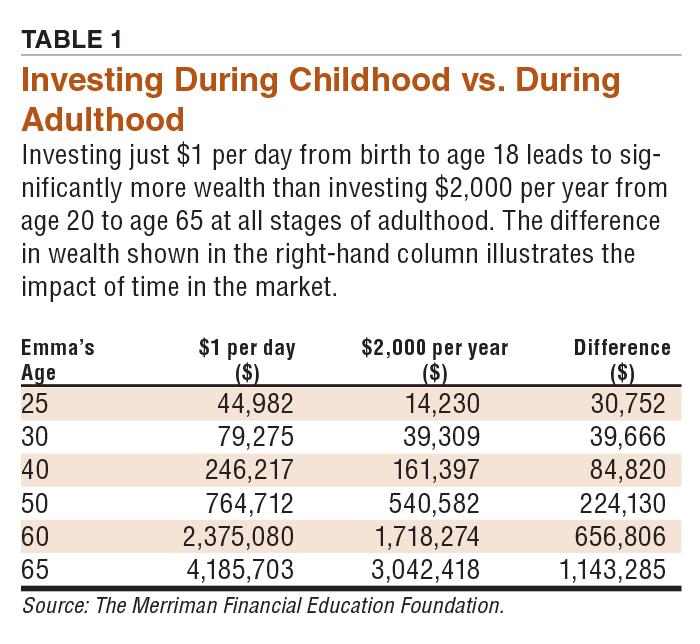
In fact, the longer she keeps adding “only” $2,000 per year, the farther she falls behind. This is especially puzzling to her because no new money is going into that original investment from her parents. Table 1 shows this.
If Emma at age 20 wanted her own investments to “catch up” with the money her parents invested, she would need to commit to putting away $2,455 every year. Those numbers are trying to teach us a very important lesson: It takes a whole lot of dollars to make up for lost time.
These numbers are suspect, for two main reasons: taxes and inflation.
Emma’s investments could appreciate tax-free inside a Roth IRA. But unless annual contribution limits changed considerably, she could not invest her $20,348 at age 18 all at once, let alone add an additional few thousand dollars per year.
Without a tax shelter like an IRA, even the most tax-efficient funds will generate some taxable income. This tax cost will reduce her returns unless Emma adds in more money or has other sources of cash to cover the taxes.
Although it cannot be replicated in real life, the comparison between these two plans is still quite valuable.
Then there’s inflation.
Obviously, in 65 years, $4.1 million won’t have anything near the purchasing power it has today. We did the math: In today’s dollars (meaning when Emma was born), the portfolio would be worth $612,787 on her 65th birthday assuming an annual inflation rate of 3%. [Editor’s note: Purchasing power refers to the ability to buy goods and services with a certain amount of dollars.]
By itself, that’s hardly enough to retire on. Still, for an initial outlay totaling $6,570 when that child is young ($1 per day for 18 years), plus many years of patiently doing nothing, it’s impressive. (In fact, parents and/or grandparents could accomplish the same thing with a one-time investment of $2,700 in the first few months of a young person’s life.)
Using the assumed 3% inflation rate (which equates to the long-term average), we can calculate what the parents’ 18 years of contributions might “really” be worth to Emma at age 65. As I previously mentioned, her portfolio of $4,185,703 would have purchasing power of $612,787.
For the rest of this discussion, I’ll quote constant dollars. That means, assuming 3% future annual inflation, all the numbers are comparable in purchasing power to today.
Back to Emma: If she chose to withdraw 5% of her portfolio balance at age 65 during her first year of retirement, she would receive a distribution of $30,639.
Not impressive. Not until, that is, you realize that this sum, which she gets to spend in just one year, is worth more than 4.5 times all the money that her parents contributed over 18 years ($30,639 ÷ $6,570 = 4.66).
If Emma lived another 30 years, continued to earn 12% and took out 5% of her portfolio every year, her total retirement income over those 30 years would be just shy of $1.5 million.
Here’s something even harder to believe: On her 95th birthday, Emma’s portfolio would be worth $1.39 million. This large amount is all from the under $7,000 that her parents contributed $1 at a time. That ending value plus all the retirement income she received amounts to approximately $423 for every one of those daily $1 parental contributions, adjusted for inflation.
Even if the account grew to only half that much, the power of time would have turned each original dollar into about $212.
All this seems too good to be true, and it probably is.
A very long-term compound rate of 12% seems attainable using an asset class like small-cap value. But no investment is going to appreciate steadily every year at 12%. There will inevitably be negative years and even negative decades.
Unless a portfolio like this is locked up in a trust, the owner/beneficiary will be sorely tempted many times to change the investment or take the money prematurely—or both. That temptation is likely even without the losing years and decades.
Anybody trying to put together a plan like this faces the huge decision of how to invest the money to ensure that the recipient is likely to stay the course.
One easy answer, as I’ve suggested, is a small-cap value fund. Of the four major U.S. asset classes (which also include large-cap blend stocks like those in the S&P 500 index, large-cap value stocks and small-cap blend stocks), small-cap value stocks have the highest long-term return.
That’s the good news about small-cap value stocks. The bad news is that they are more volatile than the S&P 500.
This is often taken as evidence that small-cap value stocks are riskier. But the volatility is mostly on the upside, not the downside. Careful study shows that the losses in small-cap value stocks are not much greater than those of the S&P 500.
How can this be applied to a gift for a young child? In my view, the ingredients of a 95-year plan should include a mix of high-octane investments (small-cap value stocks) and more comfortable investments such as the S&P 500. The former is there to produce growth; the latter to reduce anxiety. I think there’s much to be said for a 50%/50% combination of those two.
Before we dive into some more numbers, it’s important to note that over the past 95 years, stock market losses have always been temporary. At least, that is, for investors who have stayed the course.
However, one year at a time and even a decade at a time, market returns are pretty random.
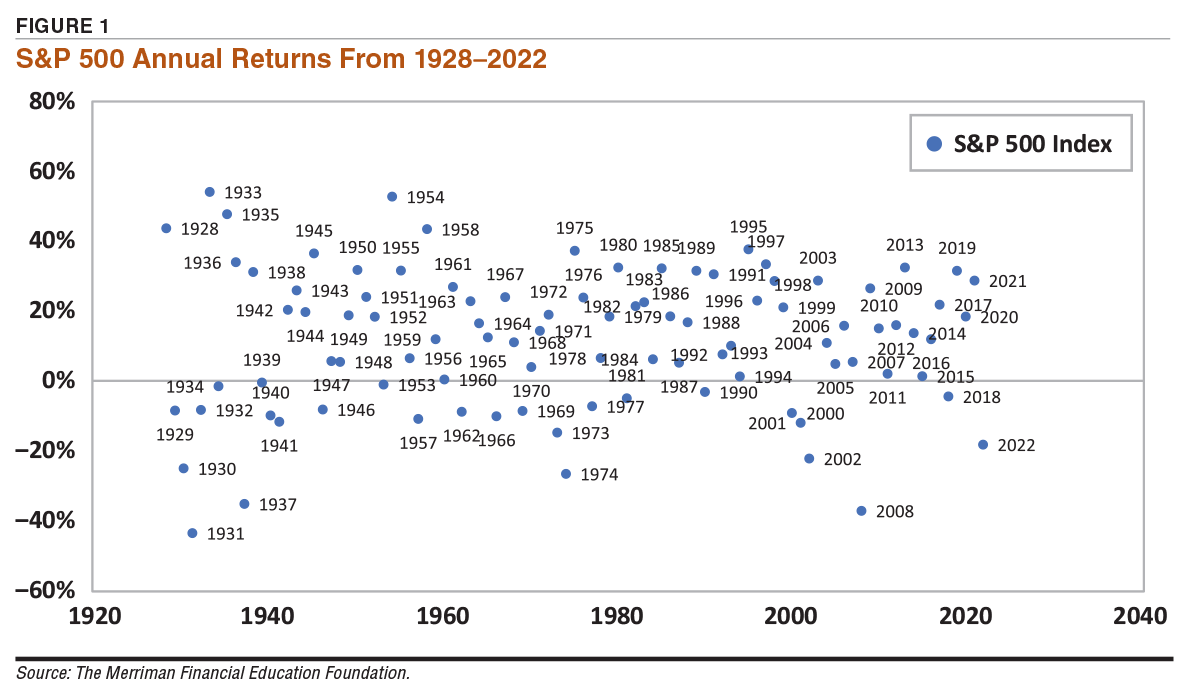
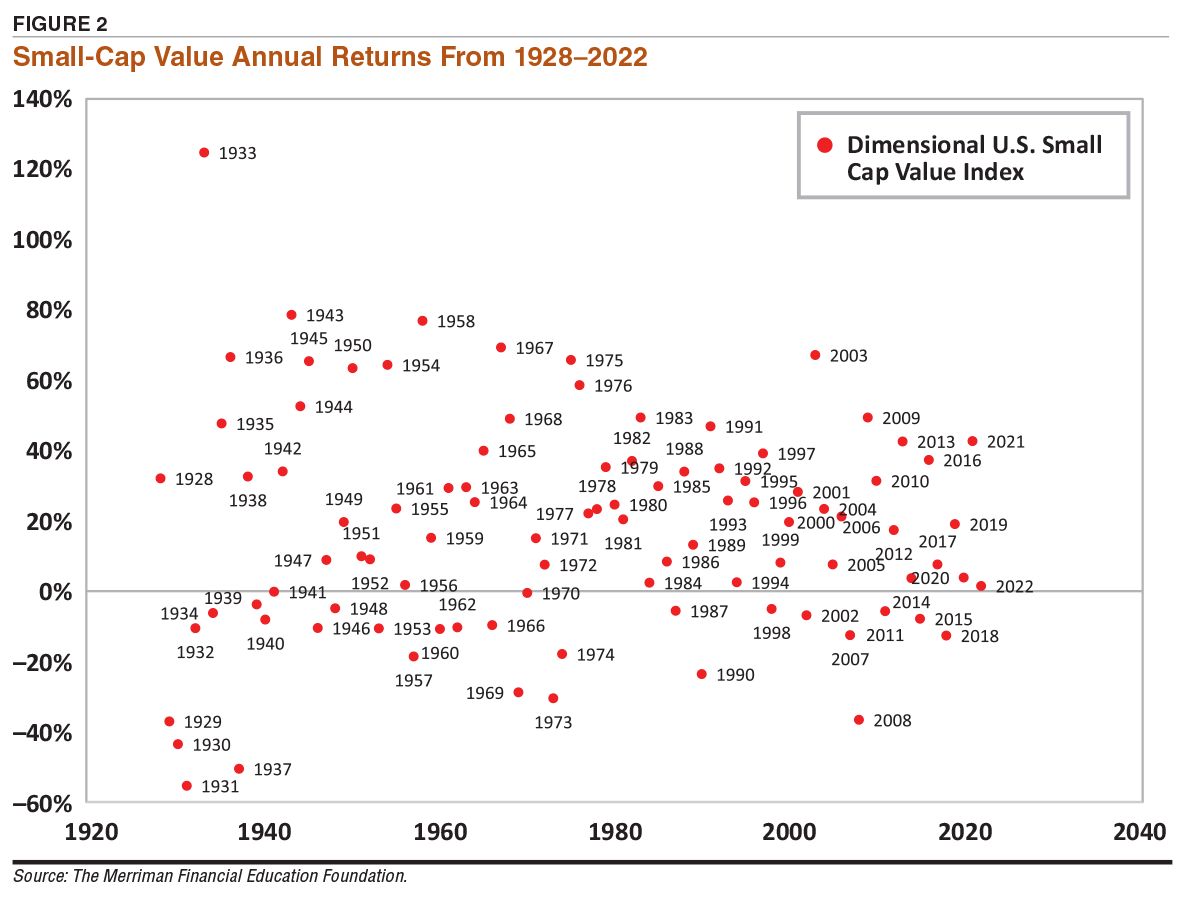
Since 1928, the S&P 500 has turned in a few really awful years: 1931, 1937, 2008. And there have been a few terrific years, including 1933 and 1954. You can see this visually in Figure 1, which is a scatter chart. The year-by-year returns of small-cap value stocks are similarly all over the map, as you can see in Figure 2.
You’ll see one incredibly good year and a generous handful of one-year returns higher than 60%. One of the biggest losses occurred in 2008, and most of the rest were in the 1930s.
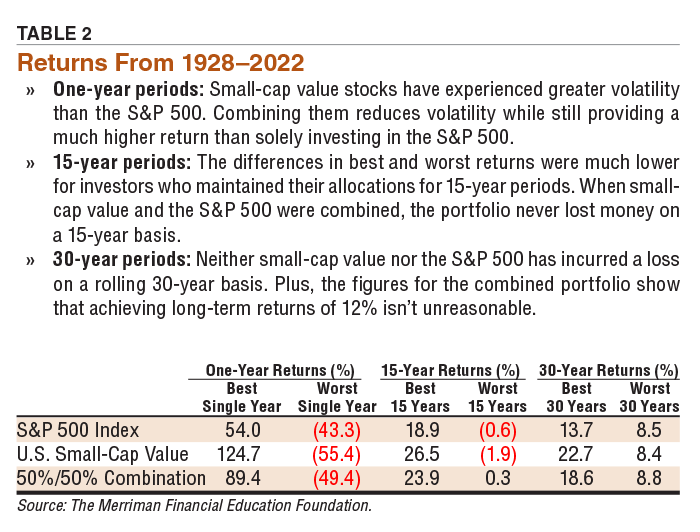
If this data seems dense, I think Table 2 can help make some sense of it.
As you can see, the difference between the best single year and the worst single year was much greater for small-cap value than for the S&P 500. The third row shows the results of combining equal parts of those two asset classes.
Table 2 also shows that the differences between best and worst were much lower for investors who held on for 15 years. As you can see in the third row, the combined portfolio never lost money on a 15-year rolling period basis.
Looking at returns over 30-year periods is a real eye-opener. The worst 30-year periods in each case were positive. They were all reasonably productive. And the worst 30-year losses were remarkably close to each other.
Relatively few investors would be comfortable sticking with an all small-cap value portfolio for 30 years. But for those who could stomach the 50%/50% combination, these figures suggest that very long-term returns of 12% aren’t totally unreasonable.
That was my conclusion, so I decided to subject it to a harsh reality check based on the past 95 years of actual data. From 1928 through 2022, the S&P 500 compounded at a 9.9% rate. Small-cap value stocks compounded by 13.2%. And a 50%/50% combination of those two asset classes compounded by 11.8%.
This of course is the past, not the future. But it suggests that long-term annual compound returns of 12% are not as unreasonable as many people might think.
If you’re thinking you would like to initiate a very long-term plan like this, there are a few other important things to consider.
Here’s the most important one: More than anything else, the success of your plan will depend on the young recipient of your generosity. What they do or do not do will matter much more than what happens in the stock market.
I really hate to tell you this, but what they do will also matter much more than your infinite wisdom in choosing investments. If you’re reading this, I guarantee you won’t be around to control what happens to this money for the next 95 years.
Therefore, while you’re still in the picture, your job is to make sure this young person is educated about the market and what is reasonable to expect. You will have no control over their emotional attributes such as patience and resilience. You won’t be able to control outside forces that could make it necessary for them to liquidate some or all of this investment prematurely.
But there is one more useful thing you can do that could help with all this: Introduce them to an adult (younger than you) who understands your intentions and who can be trusted to give good guidance on all these issues over the years when it is needed.
When you’ve done that, your job is exactly the same as that of your young recipient: Step back and let things play out.
Portfolio Strategies

Portfolio Strategies

AAII InvestoGraphic

BARRY J from TX posted over 3 years ago:
PETER P from IL posted over 3 years ago:
JAMES F from FL posted over 3 years ago:
MICHAEL W from IL posted over 3 years ago:
ROBERT A from NC posted over 3 years ago:
ROBERT A from NC posted over 3 years ago:
JAMES H from CA posted over 3 years ago:
JAMES H from CA posted over 3 years ago:
Paul M from FL posted over 3 years ago:
ROBERT A from NC posted over 3 years ago:
Don P from USA posted over 3 years ago:
PAUL B from NJ posted over 2 years ago:
You need to log in as a registered AAII user before commenting.
Log InCreate an account