

Related

Computerized Investing
What you can do to spark loved ones’ interest in investing and further their financial acumen.

Many of you may be thinking about, and planning for, the legacy you may leave to your family and loved ones. And while this might include savings or investments, have you considered leaving more than a monetary legacy? How about passing on your passion for investing?
With April designated as Financial Capability Month (frequently referred to as Financial Literacy Month), now is an ideal time to reflect on your own experiences and think of ways to build the financial capability of the youth around you. Think back to your first experiences with investing. What was it that sparked your interest? Did a family member or friend help you get started? Was your first investment through an employer-sponsored retirement plan? Did you jump into the deep end with excitement or wade in the shallows with trepidation? What factors helped contribute to your growth as an investor?
In 2020, a surge of new individual investors entered the market, despite market and income volatility due to the coronavirus pandemic dramatically altering the financial well-being of many U.S. households. Who were these newcomers and what spurred this behavior?
 According to new research by the FINRA Investor Education Foundation and NORC at the University of Chicago, new investors in 2020 were more likely to be younger, more racially and ethnically diverse and with lower incomes than investors who already owned taxable investment accounts prior to 2020. Nearly two-thirds of these new investors were under age 45. Moreover, the group included growing numbers of African American and Hispanic/Latino investors. While across all investors the majority reported earning incomes of $100,000 or more annually, only 28% of new investors reported earning that amount. In fact, almost a quarter of new investors reported earning incomes of less than $35,000 annually.
What else did the study reveal?
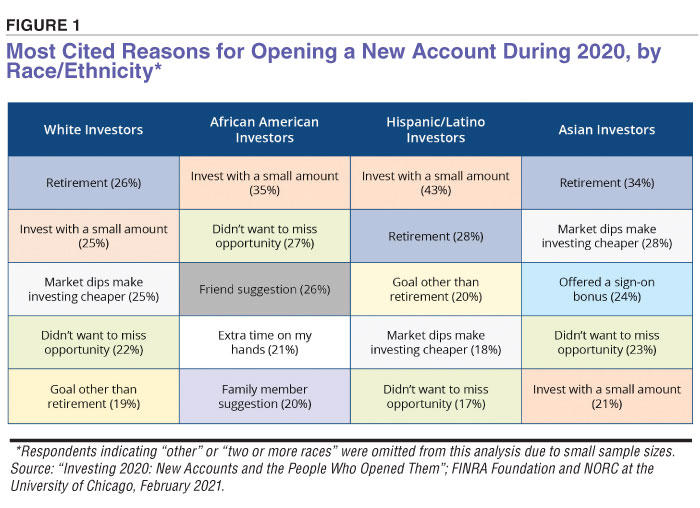
Future goals of new investors aligned somewhat with the rationale to open an account. Despite the study’s focus on investing in taxable accounts (as opposed to tax-advantaged or tax-deferred accounts), those who opened investment accounts in 2020 most frequently cited saving for retirement as a top motivation (Figure 1). This varied somewhat by race and ethnicity. Although saving for retirement was the most cited reason among white and Asian American investors for opening a new investment account in 2020, it did not rank among the top five prompts for new account openers who identify as African American. Instead, a suggestion from a friend or family member more frequently prompted this cohort of new investors to open an account.
Lower barriers to entry impacted the ability to participate and increased motivation. The study revealed that younger and inexperienced investors entered the stock market in part because market dips made stocks cheaper to buy and allowed new investors to enter the market with small amounts of money. Among new African American and Hispanic/Latino investors, the ability to invest with small amounts of money was the top reason for opening a new account.
There appeared to be a disconnect between financial risk tolerance and actual risk taking. While a majority of new investors were most likely to report taking average financial risks and expecting average returns, four in 10 (40%) reported a willingness to take substantial or above-average financial risks, expecting substantial or above-average returns. Moreover, 61% of new investors reported making at least one trade per month. And roughly two-thirds reported trading individual company stocks, which was the most frequently traded investment type. While a well-diversified mutual fund typically carries a lower level of risk than individual company stocks, only about one-third reported trading mutual funds and exchange-traded funds (ETFs). In general, most new investors reported taking average financial risks, yet many engaged in behavior that resulted in above-average risk-taking.
Many don’t know a lot, and don’t seem to realize it. The investment knowledge of new investors, measured through a five-question quiz, was very low. On average, new investors could answer only 1.4 out of five questions correctly. When asked to assess their overall investment knowledge, they reported considerably high levels of confidence relative to their objective knowledge. However, they were not alone in their overconfidence. Many investors who already had accounts prior to 2020 also reported considerably high levels of confidence, despite modest performance on the same quiz.
A March 2020 survey by AAII revealed many members are interested in helping young people get started with investing, and the most common approach was to give them advice (“How AAII Members Help Kids and Grandkids Get Started With Investing,” April 2020 AAII Journal). While advice can be tremendously valuable, advice alone may not be enough to result in the desired action. B.J. Fogg, a behavior scientist at Stanford University, posits there are three things that need to come together at the same time for any behavior to happen. There needs to be motivation and an ability to engage in the behavior, and a prompt to encourage action.
Using this behavioral framework, below are a few ideas for leaving your legacy of a passion for investing.
Make “money talk” a family affair. Talking openly about finances and financial goals may feel unnatural, but it is an important part of the equation. Money doesn’t have to be off limits when it comes to family gatherings. To the contrary, many investors have told us that dinner conversations with family—from grandparents, to parents, to a favorite uncle—inspired their interest in the markets, investing and saving.
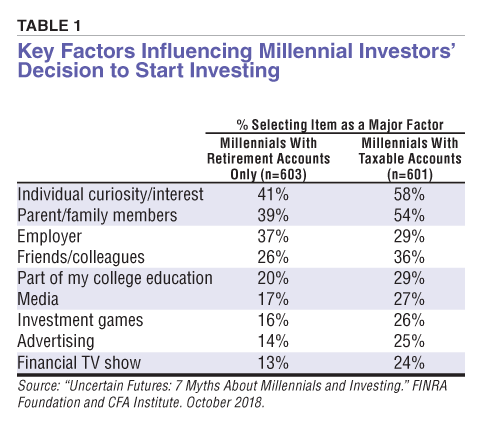
According to a 2018 research study by the FINRA Foundation and the CFA Institute on the investing behaviors and attitudes of millennials (born 1981–1996), parents or other family members are key influencers when it comes to the decision to begin investing, whether via retirement or taxable accounts (Table 1). In fact, the age at which parents talk with their children about investing may play an important role in their decision to start investing. According to the same study, millennials with taxable accounts whose parents or family members talked to them about investing before age 18 were more likely to have invested at a young age. This link is not necessarily causal, but it does shine a light on the important role family members can play in encouraging young adults to start investing.
Motivate with a match. For some, obtaining a match—whether a small fraction, 1:1, or more—is motivation enough to save or invest for the future. Consider establishing some guidelines for matching funds. For instance, I offer a 100% match on all deposits that my two young teens voluntarily contribute to their savings accounts, and I set up a vesting period to discourage withdrawals. One colleague described for me how her father would quip “So what’s your contribution beyond another great idea to spend my money?” whenever she or her siblings wanted to do something “extra” with his money. In this way, he encouraged them to be prepared to match his contributions and discouraged their spending on a whim.
For young adults, consider matching contributions to a retirement account. If your mentee has access to an employer-sponsored plan that offers a match on personal contributions, help them recognize not just what they will gain by contributing, but also what they are losing by not contributing. In other words, tap into what’s known as “loss aversion bias” to motivate your mentee toward action by explaining how they could be leaving free money on the table. You could also help establish a Roth account (more on that later) and offer matching contributions, as I do for my children’s savings accounts.
Build knowledge of investment basics. While the format and depth of your money talks will vary by age and experience, be sure to highlight key concepts. Start by talking about your financial goals. “Retirement” might feel like an esoteric goal for many younger investors, but its elements—having the financial freedom to pursue your hobbies, covering your expenses when you’re no longer working, and the like—may resonate. Provide examples of the different types of goals associated with investing—the more relevant and tangible, the better. And look for tools that show—rather than simply describe—how compound interest works, especially with the benefit of a relatively long time horizon. Not to be overlooked is the importance of discussing risk, the relationship between risk and return, and the important role that diversification can play in mitigating risk. And while many brokerage firms now tout commission-free trading, discuss how fees and expenses—including and beyond commissions—can impact the overall return of an investment.
Add an interactive element. Start by getting a baseline of their financial and investment knowledge using an online quiz like we offer on our website. Then follow up with opportunities for online learning delivered by unbiased sources. The FINRA Foundation’s Smart Investing series offers a perfect primer on investment basics. The six online micro-courses build essential investment knowledge and skills in under 10 minutes each. Topics include setting investment goals, defining terms, risk and return, rate of return, diversification and fees and expenses. For more online tools for building investment knowledge, search “investing” in the Jump$tart Clearinghouse.
Combat choice overload. Today’s consumers have far more choices—for everything from mayonnaise to mutual funds—than existed in the past. In 1949, a typical American supermarket carried fewer than 4,000 items. Today, the number is closer to 30,000—which is about the same as the number of mutual funds, ETFs, exchange-traded notes (ETNs) and money market funds available to investors. Even choosing among the limited investment selections typically found in a defined-contribution plan can be overwhelming. A 2016 study by BrightScope and the Investment Company Institute found that the average large 401(k) plan contained 27 investment options, including a mix of equity, bond and target-date funds. Sorting through the options can be paralyzing, even for more experienced investors.
One way to combat choice overload is to narrow the scope of the selection. One investor recounted how his uncle helped him learn to research and understand investments. His uncle preselected up to 10 mutual funds representing a variety of asset classes and sectors and shared a framework for comparing the funds. After the new investor completed research using the framework, they would get together to discuss which fund or funds he would like to invest in and why. In this way, his uncle helped narrow the scope of the investment choice, empowered the new investor to do his own research and provided a sense of ownership over the ultimate selection.
FINRA’s Fund Analyzer is a free tool that can help you sort through and compare tens of thousands of mutual funds, ETFs, ETNs and money market funds. The tool automatically applies a fund’s applicable fees and commonly available discounts, and better yet, the Fund Analyzer does the math for you and visually demonstrates how fees and expenses impact the value of the funds over time. [Editor’s note: Investors can also see a fund expense ratio and grade by typing a ticker into the search box on AAII.com.]
Explore investing virtually. Experience is often the best teacher, and the virtual world offers an opportunity to put investing skills into practice without the risk of losing real money. Consider setting up a watchlist challenge, specifying a diverse range of investments—by market cap, industry and product type—that your mentee needs to identify, and then review the choices. You can use an online portfolio tracker or website with a watchlist feature. [Editor’s note: AAII’s My Portfolio is one such tool.]
Practice investor protection. Equally important to knowing what to do is knowing what not to do and the pitfalls to look for when it comes to managing finances. Share with your mentee tips on investor psychology and ways to protect their money. As a regulator, FINRA offers a host of resources, from articles and podcasts to videos and games at www.finra.org/investors. Watch the FINRA Foundation’s Thinking Money documentary, produced in partnership with Maryland Public Television, for an entertaining way to teach new (and seasoned) investors to recognize the role psychology plays in money decisions.
It’s also important for investors to learn to spot and avoid fraudulent offers. The “Con ’Em If You Can” video game helps players learn to recognize the red flags of fraud and ways to defend against them. The game may be played on a desktop computer or via an app, and the website includes an Educator’s Guide, fraud quiz and educational videos. Both FINRA and the U.S. Securities and Exchange Commission provide great investor protection tools, resources and information.
Help set up an account. To what extent you are involved in opening an investment account depends on several factors including, but not limited to, the age of the individual you are helping, your relationship to that individual and whether they have wages of their own (and perhaps access to an employer-sponsored retirement account). Look for an account that has low account fees and investment minimums. Many firms now offer the ability to purchase fractional shares, which, as noted in our new investor survey, was an important factor for new investors in 2020.
Under the Uniform Gift to Minors Act or Uniform Transfer to Minors Act, you can open up custodial brokerage accounts for your child or relative as long as they don’t have taxable income or wages. The account will initially be in your name, and the child will be able to take full control of it once they reach age 18 or 21, depending on state laws. If the young adult has taxable wages or income, consider whether a custodial Roth IRA is appropriate. And if your mentee has access to an employer-sponsored retirement plan, encourage them to sign up!
Taking the step to open, and care for, an investment account—and assigning ownership of the account to the new investor—may have additional benefits. Some researchers have found that financial education and financial accounts have an iterative relationship. This means that the new investor may be more likely to seek out opportunities to increase their investing knowledge after opening an account of their own.
Automate it. Investing, like going to the gym, is easier once it becomes a habit. Encourage your mentee to consider setting up consistent, small contributions to their account or portfolio. In this way, they can take advantage of dollar-cost averaging, which can help take the emotion out of investing and can result in paying a lower average price per share over time. By wading in, as opposed to handing over the money all at once, dollar-cost averaging can help limit the losses in the event the market declines. Some financial firms even allow account holders to save or invest spare change from unrelated purchases, making the process automatic and simple. One investor told me she used this invested spare change as the down payment for her first house!
Give gifts that keep on giving. As birthdays and holidays come around, many parents or grandparents reach into their wallets to give the gift of money. What about gifting stock, a love for investing or an AAII membership instead? If you are looking to get a family member involved in investing, simply gifting stock or fractional shares in some of their favorite companies can be enough to spark the investment fire.
Hopefully these ideas have sparked your thinking about how you might inspire future generations to invest for their future. By providing motivation, strengthening ability and prompting action, you will leave a legacy to be proud of. Not to mention, a comfort in knowing your heirs will have a strong financial foundation.
We think you’d like this related webinar! The Individual Investor Show: Financial Capability, Bond Ratings and Investing Community
Computerized Investing

Portfolio Strategies

Beginning Investor

CLAUDE P from GA posted over 5 years ago:
R S from CO posted over 5 years ago:
ROBERT A from NC posted over 5 years ago:
You need to log in as a registered AAII user before commenting.
Log InCreate an account