

Related

Computerized Investing
Zero commissions and mergers are changing the face of the online discount broker arena.
by AAII Staff | January 2021

There have been two big changes to the online discount brokerage industry’s landscape. The first is lower prices: Account fees and commissions are becoming things of the past when comparing brokers. A glance at this year’s fee table will tell you that. The second is mergers: Last October, Schwab completed its purchase of TD Ameritrade and Morgan Stanley completed its purchase of E-Trade.
To stay competitive, brokers have mostly all switched to a model of charging zero commissions for trading stocks and exchange-traded funds (ETFs). The largest brokers are also mostly charging zero commissions for mutual funds. This is, of course, good for individual investors. Stocks, ETFs and mutual funds represent the most commonly traded securities among AAII members surveyed on their use of brokers.
As costs creep toward absolute zero, a broker’s size and resources are becoming the most obvious differentiator when shopping for where to open investment and retirement accounts. The largest brokers tend to be older and the result of industry consolidation. Newer brokers are focused on the cost efficiencies of digital services and online banking. Some of these newer brokers use mobile apps as their primary platform.
Both TD Ameritrade and E-Trade are currently continuing to operate brokerage platforms separate from their acquirers. They are treated as such in this year’s guide. Schwab expects it will take 18 to 36 months for its integrations to be combined with TD Ameritrade’s. Morgan Stanley intends to provide some of its offerings through E-Trade in the future. See the box below for more on these mergers.
This past October, Charles Schwab completed its purchase of TD Ameritrade and Morgan Stanley completed its acquisition of E-Trade. Here is a quick overview of what to expect.
TD Ameritrade
Schwab expects that integrating its operations with TD Ameritrade’s will take 18 to 36 months. Until then, TD Ameritade will continue to operate separately. TD Ameritrade and Schwab clients should continue to contact their respective brokerage firms.
Answers to many common questions can be found on Schwab’s website at https://welcome.schwab.com.
E-Trade
E-Trade will continue to operate as a separate website. Morgan Stanley says it hopes “to combine the best of both of our offerings into one experience,” though no time frame is provided. Investors with accounts at both Morgan Stanley and E-Trade can link and view both on Morgan Stanley’s website and on its mobile app.
Answers to many common questions can be found on E-Trade’s website at https://us.etrade.com/l/morganstanley/faqs.
Surveyed members mostly use the largest brokers in the U.S. The top five brokers of surveyed members were Fidelity, Charles Schwab, TD Ameritrade, Vanguard and E-Trade. The popularity of mobile-only brokers such as Robinhood is still concentrated on a younger demographic of investors.
The majority of survey respondents—about 66%—said they do not use the mobile app offered by their broker. Common dislikes centered around a feeling of limitation when using the app. This applied to what data was accessible as well as what kinds of trades could be executed efficiently on a smartphone or tablet. Some members also had security or privacy concerns. Generally, a desktop platform felt more robust in its tools and analysis to a majority of survey participants.
When members expressed what they liked about their broker’s mobile app, the answers centered on convenience and accessibility. Broker apps are deemed handy for common tasks on the fly—to quickly look up quotes, to check the status of trades or to monitor certain investments. One member remarked that the portability allowed them to use it when in line at the grocery store.
Another growing trend is the use of “smart” portfolios or robo-advisers. These platforms select investments and allocations instead of being self-directed, like a traditional discount brokerage account is. Predefined portfolios designed to appeal to different investment styles, risk tolerances and asset allocations are created with algorithms used to automatically adjust their assets. The efficiency of robo-adviser products has caused some companies that are not traditionally brokers to launch their own portfolio services.
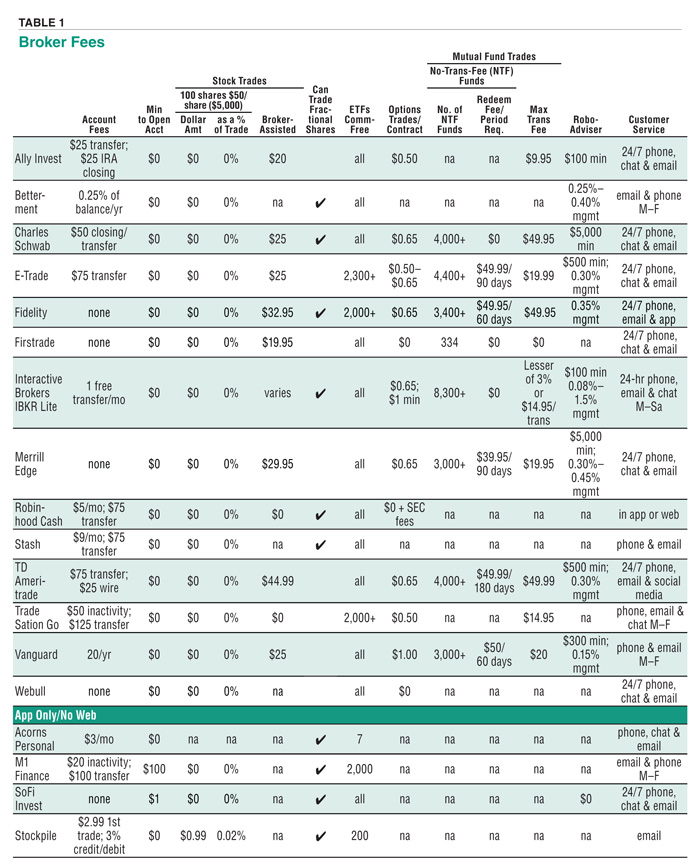
Regardless of specific personal interests, technology is providing more and more products and services for the individual investor to take advantage of. Research, tools and analysis are more prevalent than ever before and so is the ability to trade securities. This year’s online discount broker guide includes almost 20 companies as we try to cover an ever-expanding industry. See Table 1 for a quick overview of them all.
As an investor it is important to be aware of the different types of brokerage fees that brokers charge to hold and manage your investments. These fees may include, but are not limited to, annual fees, fees for researching investment data, inactivity fees if you aren’t trading regularly and account transfer & closing fees.
While not as common as before, annual fees are still being charged by a handful of brokers in the market. Vanguard, for example, charges a $20 annual fee for each opened account under $10,000, while Betterment charges 0.25% of your account balance per year.
Minimum deposit requirements to open accounts and online commission trades have mostly become a thing of the past. From our list of brokers, only M1 Finance and SoFi Invest still require a minimum deposit to open an account, but even then, the requirements are $100 and $1, respectively. Stockpile is the only broker on our list that charges a fee per trade ($0.99). However, if you’re someone who would prefer trading securities with assistance from a broker—at, say, Charles Schwab or TD Ameritrade—then it can cost you anywhere from $25.00 to $44.99 per broker-assisted trade. Note that when you open an account at Robinhood, you are automatically enrolled in an Instant account, which is a margin account and requires $2,000 minimum; Robinhood’s Cash account does not have a minimum to open.
Although most trading fees and account balance requirements have been eliminated, some trades are still subject to small charges. Exchanges pay a transaction fee to the U.S. Securities and Exchange Commission (SEC) based on the volume of securities sold. The exchanges, in turn, levy a fee on brokers to offset what they pay the SEC. If the charge is then passed down to the investor, you may see it listed as an SEC or processing fee on your trade confirmations. These fees are typically nominal in size.
While inactivity fees are also becoming more and more uncommon, transfer and closing fees are still very much normal in today’s brokerage landscape. Transferring or closing an account at big-name brokers such as Charles Schwab or TD Ameritrade can cost you $50 to $75 and can even reach up to $125 for brokers such as TradeStation.
Ever since $0 commission trades became the new standard among brokers, the number of commission-free ETFs offered by each broker has become mostly irrelevant. Most discount brokers now offer all U.S.-listed ETFs on a zero-commission basis. Most of the discount brokers included in this guide also offer a large number of no-transaction-fee (NTF) mutual funds.
Of the AAII members who responded to our survey, 26% use Fidelity, 22% use Charles Schwab and 13% use TD Ameritrade—all of which offer $0 commission trades on stocks, ETFs and options. Though options can now be traded for $0 commission at most discount brokers, a $0.65 per contract fee is still common. App-based brokers such as Firstrade, Robinhood and Webull typically do not charge contract fees.
More information about the fees charged by the brokers in this guide can be found in Table 1.
Most of the discount brokers discussed here facilitate the trading of stocks, ETFs, bonds, options and mutual funds. Investors have a limited choice of brokers that trade futures, currencies or commodities. Out of those covered in this article, only Charles Schwab, E-Trade, Interactive Brokers, TD Ameritrade and TradeStation facilitate futures trading. Forex, or foreign currency exchange, trading is only offered by Ally Invest, Charles Schwab, Interactive Brokers and TD Ameritrade. Those who want to trade cryptocurrencies such as bitcoin and ethereum can do so through Robinhood, SoFi Invest, TradeStation and Webull. TD Ameritrade allows bitcoin futures to be traded.
Robinhood does not offer trades for mutual funds or bonds. Stash only offers a few hundred stocks and 60 ETFs. Stockpile offers more than 1,500 stocks, ADRs and ETFs. Acorns automatically invests clients’ deposits into one of five ETF portfolios. Acorns does not facilitate the trading of individual stocks or ETFs; however, this app-based broker takes a unique approach, aiming to facilitate the needs of beginner traders by guiding investors toward diversified and risk-averse prebuilt portfolios.
Every platform has its own unique interface and almost all of them offer analytical tools, screeners or helpful charts. What it really comes down to is finding the best one for you as an investor, the one that fits your personal wants and needs.
For the casual trader who just wants to easily invest or someone who is new to trading, Acorns, Ally Invest, SoFi Invest, Stash and Stockpile offer remarkably simple platforms that make it easy to invest your money. Stockpile is an app-only broker that allows you to buy fractional shares in blue-chip stocks. There are no complicated analytical tools or added features, but it offers an uncomplicated way to invest from your phone. Ally Invest, SoFi Invest and Stash are very similar to Stockpile but offer larger selections of stocks and ETFs. Acorns is a unique broker in that the user doesn’t choose what they invest in, they simply choose how aggressive and risky they want the portfolio to be and then their money automatically gets allocated to different ETFs based on their goals.
For intermediate traders who want to trade on the go, Betterment, Firstrade, Robinhood, TradeStation and Webull are options to consider. They go more in-depth than the beginner platforms, offering features like analyst ratings, customizable indicators, education materials, community chats and other tools. They also allow investors to trade options, futures and cryptocurrencies. They’re all designed for mobile use but have quite robust companion websites as well.
For active traders, Charles Schwab, E-Trade, Fidelity, Interactive Brokers and TD Ameritrade have both websites and mobile-based platforms that deliver sophisticated trading features. TD Ameritrade has two different mobile trading apps, one for advanced traders that offers additional tools and trading capabilities. Charles Schwab also has two similar mobile apps, Schwab and StreetSmart, along with a browser platform called StreetSmart Edge that has advanced features including charting tools and free live streaming of CNBC. Fidelity provides an additional resource for its active traders through the company’s browser platform at ActiveTraderPro.com. Interactive Brokers offers a powerful app that provides advanced features and tools that aim to mimic the browser-based platform. E-Trade has two mobile apps, E-Trade Mobile and OptionsHouse, that provide an integrated and easy-to-use interface with access to almost all the same features as the company’s browser.
While Merrill Edge’s website is easy-to-use and offers several screeners and analytical tools, the company’s mobile-based platform is less robust. The app provides far fewer analytical tools and does not include any screeners. Unlike most brokers, Vanguard does not facilitate trades through its mobile app, only allowing users to check accounts, analyze portfolios and conduct research.
Fractional investing allows investors to buy a portion of a stock instead of a full share. It is helpful for those with small balances, those who make small deposits and those who have leftover cash in their account. Fractional share trading allows investors to acquire fractional ownership of stock trading at a price above $100 or $1,000 per share. Acorns, Betterment, Charles Schwab, Fidelity, Interactive Brokers, M1 Finance, Robinhood, SoFi Invest, Stash and Stockpile allow the purchase of fractional shares.
Prior to the increase in availability, fractional trading was mostly only available via dividend reinvestment options facilitated by brokers or via dividend reinvestment plans (DRIPs). A dividend reinvestment plan allows investors to reinvest their dividends and acquire more of the same stock. If the dividend payment is less than the cost of the whole share, an investor will receive fractional shares. These programs generally only allowed investors to reinvest in the stock that made the payout. The broker apps that facilitate dividend reinvestments, but not fractional investing, include Ally Invest, E-Trade, Firstrade, Merrill Edge, TD Ameritrade and Vanguard. Other broker apps that offer DRIPs include Acorns, Charles Schwab, Fidelity, M1 Finance, Robinhood, SoFi Invest, Stash and Stockpile.
See the box below to see what AAII members surveyed think about the ability to buy fractional shares.
Fractional investing allows investors to buy a portion of a stock or fund instead of a full share.
Only 20% of surveyed AAII members said they used fractional share buying. Those that did said that their fractional shares were reinvested dividends or were a result of buying shares in whole, rounded dollar amounts. Dollar-cost averaging was one of the reasons cited by members who took advantage of their broker’s dividend reinvestment plan (DRIP), as well as to keep their portfolios fully invested. Otherwise, as a member said, “you end up with a few cents not invested.”
In the last 10 years, most industry-leading brokers have made it easy to reinvest dividends automatically. Previously, investors had to sign up for programs individually through each dividend-paying company or fund. Brokers with enough scale are willing to facilitate the transaction for you.
Fractional share buying has made investing more accessible, especially to investors who couldn’t afford to buy shares of certain stocks or funds at an efficient scale. “With the prices of some stocks, fractional is critical,” a member said.
Most of the online brokers covered in this article offer similar kinds of basic research and analysis, as well as tools to conduct your own analysis and screening. Many offer around-the-market news, research reports, earnings estimates, the ability to set alerts, watchlist tracking, fundamental stock data and educational materials. The main differences emerge with the size of the broker and who their target customer is.
Large brokers, such as Fidelity, Schwab and TD Ameritrade, have the most features and what they offer is generally comparable across the industry. For example, Fidelity offers stock research from 20 third-party providers, ETF research from five providers and options strategy ideas from an options analysis software. The broker’s stock quote page shows an Equity Summary Score, which is a consolidation of all the ratings from its research providers. Investors with Fidelity can also take a short quiz to identify providers that match their investment style, limiting the amount of research they have to wade through.
Basic screeners are also available with most brokers. TradeStation has screeners for stocks, ETFs, mutual funds, options and fixed-income assets. Its stock and ETF screeners allow you to screen on technical or fundamental data with predefined and customizable screen options. Webull also has predefined and customizable screens but only for stocks. For most brokers, what they offer in this area depends on the assets you can trade on their platform.
More and more of these analysis tools are being integrated into brokers’ mobile apps. Interactive Brokers’ IBKR Mobile features over 170 data columns, 60 chart studies and indicators, in addition to institutional research and its Fundamentals Explorer tool, which allows it to provide the same information and analysis that its desktop Trader Workstation platform offers.
While many of the apps do offer technical analysis capabilities, it’s important to keep in mind that a majority have more advanced features on their desktop-based platforms. Ally Invest has screening tools for stocks, ETFs, mutual funds, options and fixed-income assets but these screeners are not found on its mobile app. Robinhood doesn’t offer screening and analysis tools; however, users can access research from third parties and market data from Nasdaq for a premium. Acorns and Stockpile, aimed at passive and beginning investors, do not offer any research or analysis tools.
Almost all of the brokers featured in this article have educational materials to introduce their users to the investment basics or instruct users on how their platforms work. Merrill Edge offers the Merrill Edge Investing Classroom, a series of in-depth online courses that cover stocks, mutual funds, bonds and ETFs from investor basics to sophisticated strategies. Interactive Brokers has a similar course-style series within its IBKR Campus. Some brokers also offer digital conferences and webinars, especially due to the restrictions the coronavirus pandemic has placed on gatherings. Ally Invest hosts a quarterly digital conference streamed for free on YouTube.
At a bare minimum, smaller brokers have educational materials that will familiarize their users enough to get them investing. SoFi Invest’s Investing 101 Center has tips for beginners, explanations of common investment terminology and basic investment strategy in blog-style articles.
Robo-advisers, which are digital platforms that provide financial planning services with little to no human supervision, continue to grow in popularity. Business data platform Statista estimated that robo-advisers would have reached nearly $1 billion in worldwide assets under management (AUM) by the end of 2020. AUM could more than double by the end of 2023. It is even becoming common for traditional financial planners to white-label robo-advisers for their clients, taking the complex task of choosing assets out of their hands and allowing them to focus more time with their client addressing individual tax, estate and financial planning issues.
The typical robo-adviser works by collecting information from clients about their financial situations and future goals, usually through an online survey, and then using a preprogrammed algorithm to both generate advice and automatically invest in assets for its client. The top robo-advisers on the market offer simple account setups, advanced goal planning, account services, portfolio management and security features, attentive customer service, comprehensive education and, an investor’s favorite, low fees. Most robo-advisers charge an annual flat fee of 0.2% to 0.5% of a client’s total account balance. Consequently, robo-advisers work well for investors who desire professional guidance but have smaller amounts to invest, don’t have complex financial situations, prefer a systematic approach over an approach based on human judgment and/or simply prefer a low-cost solution.
Looking at our list of brokers, we found that the majority of them offer robo-advisory services. They include Ally Invest, Betterment, E-Trade, Fidelity, Interactive Brokers, M1 Finance, Merrill Edge, Schwab, SoFi Invest, TD Ameritrade and Vanguard. App-based brokers such as Acorns, Robinhood, Stash, Stockpile and Webull typically do not offer robo-advisory services. [To learn more about robo-advisers, see “Robo-Advisers Expand Services and Experience Some Growing Pains” by Ken Schapiro, in the June 2019 AAII Journal.]
Most of the established discount brokers discussed in this article offer various banking services on a browser- and/or mobile-based platform. Digital technology has allowed even the smallest brokers such as Acorns and Stash to offer FDIC-insured account services that come with a debit card.
Mobile app banking features generally allow users to deposit checks, transfer money and pay bills. Brokers with online banking services have generally integrated these features with a cash management account, but some keep them separated from individual broker accounts. Some accounts offer better interest rates than others on savings accounts. Most have no fees and offer free check writing and online bill pay services.
SoFi Invest offers a separate cash management account. Its mobile-based SoFi Money account comes with a debit card and no account fees. Interactive Brokers has an integrated cash management account with bill pay, debit card and money transfers among other typical banking features. Since Merrill Edge operates under Bank of America, it offers fully integrated online banking services.
For the many who do not use their broker as their primary bank, it is most important that a broker offers services that make depositing, transferring and generally using your money easy. Because brokers offer disparate banking services under different types of accounts, make sure a broker has the online banking features you want.
Security is incredibly important when it comes to protecting your investments. Without good security, your future and financial freedom are at risk. However, brokerages take cyber-security seriously. In fact, all the brokerages on this list have fraud protection guarantees and offer, or require, two-factor authentication. In addition, all of them use encrypted websites and platforms, and every platform with online banking has security alerts coupled with the ability to lockdown money transfers immediately.
They are also all audited to meet SOC 2 compliance standards, or otherwise have had their security audited by third parties.
Finally, every single platform on this list is SIPC-insured for up to $500,000. [See “Are You Protected If Your Broker Goes Bankrupt?” from this issue for more about SIPC protections.]
For those who prefer to handle certain investing and wealth management activities in person rather than over the phone or the internet, the location of physical offices matters. However, newer brokers are forgoing in-person services in favor of digital-only services to offer the most cost-effective automated solutions to investors.
Physical offices are somewhat of a legacy service now. Larger brokers with additional in-person advisory services to sell are the brokers that still have accessible networks of physical offices. Charles Schwab, E-Trade, Fidelity, Merrill Edge, TD Ameritrade and Vanguard are the brokers featured in this article that have networks of physical offices to visit. ▪
Acorns
www.acorns.com
Ally Invest
www.ally.com/invest
855-880-2559
Betterment
www.betterment.com/investing
646-600-8263
Charles Schwab
www.schwab.com
800-435-4000
E-Trade
www.etrade.com
800-387-2331
Fidelity
www.fidelity.com
800-343-3548
Firstrade
www.firstrade.com
800-869-8800
Interactive Brokers
www.interactivebrokers.com
877-442-2757
M1 Finance
www.m1finance.com
312-600-2883
Merrill Edge
www.merrilledge.com
888-637-3343
Robinhood
www.robinhood.com
SoFi Invest
www.sofi.com/invest
855-525-7634
Stash
www.stash.com
800-205-5164
Stockpile
www.stockpile.com
TD Ameritrade
www.tdameritrade.com
800-454-9272
TradeSation
www.tradestation.com
Vanguard
www.vanguard.com
877-662-7447
Webull
www.webull.com
888-828-0618
Computerized Investing

Investor Professor

Portfolio Strategies

JOHN E from AZ posted over 5 years ago:
BARRY J from TX posted over 5 years ago:
CHRIS C from ID posted over 5 years ago:
JOHN H from GA posted over 5 years ago:
JIM M from MI posted over 5 years ago:
Greg T from MO posted over 5 years ago:
KATHLEEN M from IL posted over 5 years ago:
You need to log in as a registered AAII user before commenting.
Log InCreate an account