



Featured Tickers:
- Explains how covered call writing generates income by selling options on owned stocks, which can supplement other sources of income
- Describes key mechanics, risks and trade-offs, including limited upside, premium income and exposure to stock declines
- Compares strategies and teaches strike selection, timing and risk management to balance income generation with share retention
For millions of retirees and preretirees, the central financial challenge shifts from accumulating wealth to generating reliable income from assets already owned. In an environment of persistent market volatility, uncertain interest rates and longer life expectancies, traditional income sources—bond yields and stock dividends—often fail to meet ongoing cash flow needs.
Covered call writing is an options strategy that addresses this gap. By selling call options against shares already held, investors can generate recurring premium income—weekly or monthly—without liquidating their core holdings. When applied systematically, the strategy can supplement dividends and capital appreciation with a third income stream while modestly reducing downside exposure.
In this article, I cover the mechanics, strike selection, and trade management of covered call writing and portfolio overwriting.
How Covered Call Writing Works
A covered call consists of two components held simultaneously:
- The investor owns at least 100 shares of a stock or an exchange-traded fund (ETF). Each standard option contract represents 100 shares, so positions must be held in 100-share increments.
- The investor sells (writes) a call option against those shares. This grants the option’s buyer the right to purchase the shares at a specified strike price on or before a set expiration date.
In exchange for granting that right, the investor receives an option premium. The premium is a cash payment received when selling a call option. It is credited immediately and kept regardless of how the trade resolves.
The word “covered” refers to the underlying shares already being owned by the seller, limiting the risk profile relative to uncovered (naked) call writing. [A naked call is one written by an investor who does not own the underlying shares.]
Most brokerage firms permit covered calls in self-directed individual retirement accounts (IRAs) and Roth IRAs, subject to account approval.
A Hypothetical Covered Call Trade Example
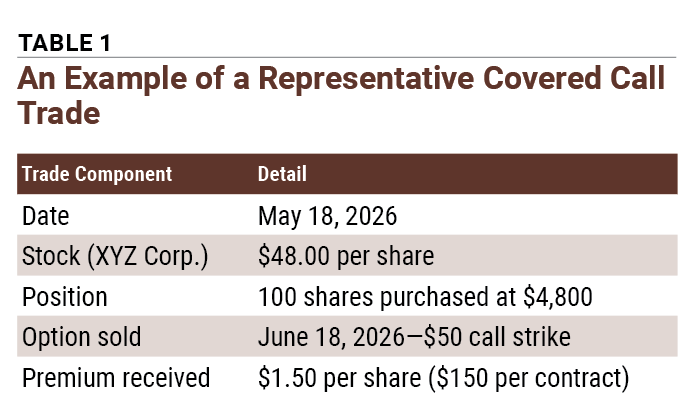
Table 1 illustrates what a representative covered call trade looks like. This trade has the following key return metrics.
- Initial return: 3.13% ($1.50 premium ÷ $48.00 share price)
- Potential upside from stock appreciation: 4.17% [($50 strike price − $48) ÷ $48]
- Maximum one-month return: 7.29% [($1.50 + $2.00 maximum capital gain) ÷ $48]
- Breakeven price: $46.50 ($48.00 − $1.50 premium received)
The trade-off is straightforward: By selling the call, the investor accepts a ceiling on upside participation above $50. Any appreciation beyond the strike price accrues to the option buyer rather than the seller. In exchange, the $1.50 premium provides immediate, guaranteed income and partial downside protection.
Covered call writing is conservative relative to most options strategies, but it is not risk-free. The investor remains fully exposed to declines in the underlying stock below the breakeven price.
Factors That Determine an Option’s Premium Income
Premium size is largely a function of two variables: implied volatility and time to expiration.
Implied Volatility
Implied volatility reflects the market’s consensus expectation of future price movement in the underlying security. Higher implied volatility produces higher premiums because the more a stock’s price is expected to fluctuate, the greater the probability that the option will expire “in the money”—meaning that the stock is trading above the contract’s strike price at expiration.
However, elevated implied volatility also signals greater uncertainty and, typically, greater downside risk in the underlying stock. Investors should weigh premium income potential against the corresponding risk profile.
Time to Expiration
Longer-dated options carry larger absolute dollar premiums, but shorter-dated contracts—which carry weekly and monthly expirations—typically generate higher annualized returns. Beyond return optimization, shorter expirations offer practical advantages:
- More frequent reassessment of market outlook and stock selection,
- Greater flexibility to avoid earnings announcement windows and ex-dividend dates, and
- Faster premium capture and position turnover.
For most covered call applications, weekly and monthly expirations represent the most effective balance of return and flexibility.
Two Strategic Approaches to Covered Call Writing
Covered call writing can serve two quite different purposes, depending on the investor’s objectives.
Traditional Covered Call Writing
In the traditional approach, assignment—that is, the situation where the contract is exercised and the shares are called—is an acceptable outcome. If the stock rises above the strike price, the investor is willing to sell shares and redeploy capital. The focus is on maximizing near-term income.
- Monthly return target: 2%–4%; target returns can be adjusted based on the investor’s personal risk tolerance and income goals
- Weekly return target: 0.5%–1.0%
- Strike selection: Near or slightly out of the money (close to current market price)
- Well suited for investors without a strong attachment to specific holdings
Portfolio Overwriting
Portfolio overwriting is designed for investors who hold long-term positions with significant unrealized appreciation and ongoing dividend income. Selling those shares, whether by choice or through assignment, could trigger capital gains taxes, eliminate future dividend income or disrupt a long-term investment plan. The objective shifts from income maximization to income generation while preserving share ownership.
- Annualized return target: 4%–15% (supplemental to existing dividends and appreciation)
- Strike selection: Well out of the money, at low delta [explained below]
- Well suited for long-term holders with concentrated positions or significant unrealized gains
From this perspective, portfolio overwriting functions as a potential third income stream—alongside capital appreciation and dividend distributions—layered onto an existing equity portfolio.
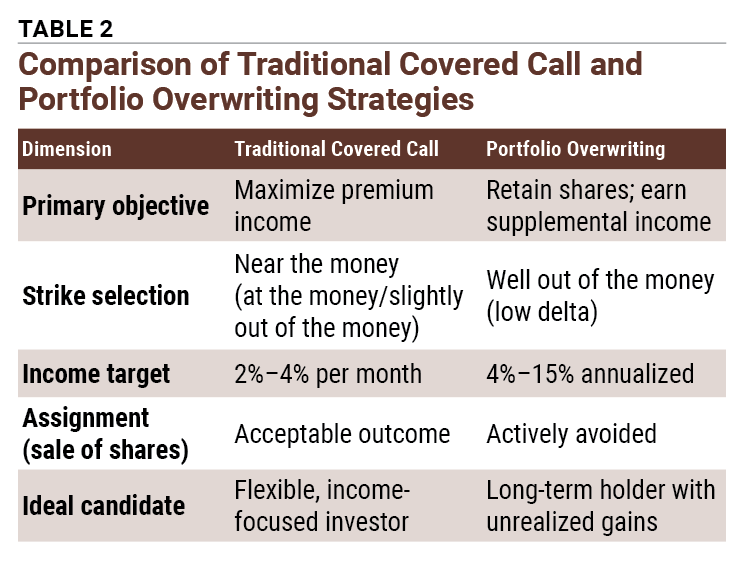
Table 2 provides a comparison of traditional covered call writing and portfolio overwriting strategies.
Delta: Quantifying Covered Call Assignment Risk
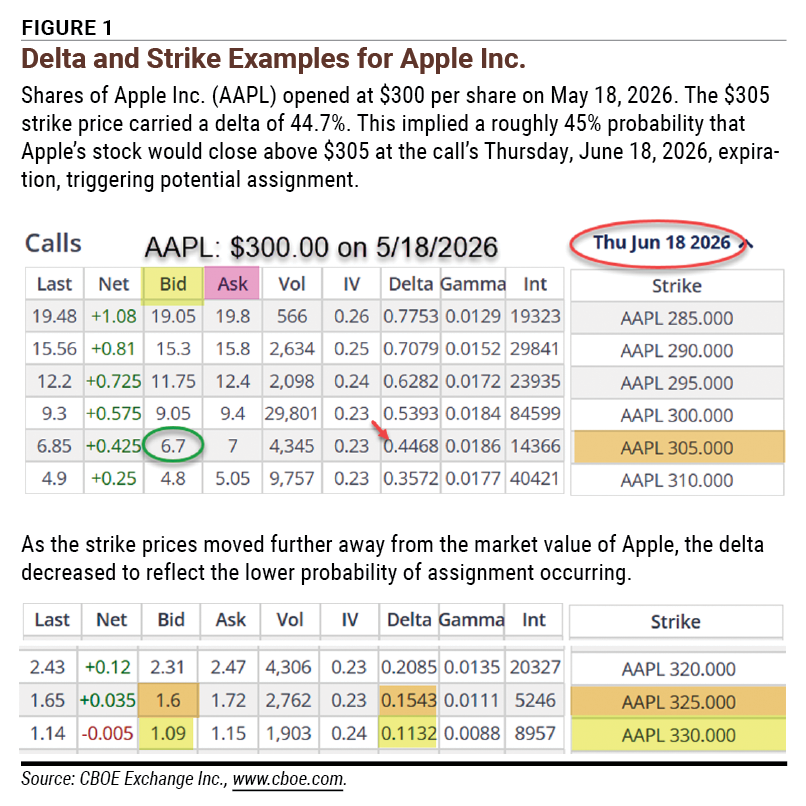
Delta is a standard options metric representing the approximate probability that an option will expire in the money. For covered call sellers, delta approximates the likelihood that shares will be called away. Figure 1 provides an example of how delta changes based on a contract’s strike price.
For portfolio overwriting—where share retention is the priority—lower-delta strikes are preferred. Table 3 illustrates how delta declines as the strike price moves farther above the current $300 per share market value for Apple Inc.  (AAPL).
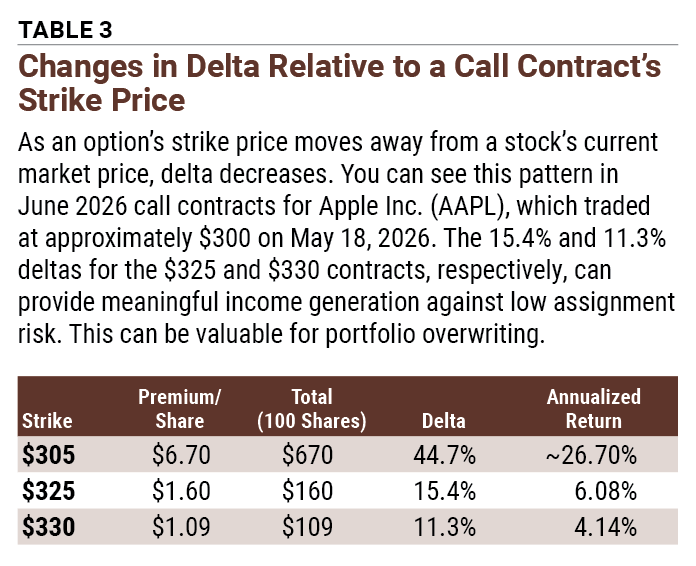
The $330 strike generates considerably less premium but reduces assignment probability to approximately 11%. Importantly, the annualized returns from covered calls are earned in addition to any dividends and capital appreciation already accruing on the position—returns that, for long-term holders, may represent years or decades of compounding.
For portfolio overwriting, delta values between approximately 8% and 15% balance meaningful income generation against low assignment risk.
The Three Expiration Outcomes for Covered Calls
Three outcomes are possible for covered calls at expiration.
1. Option Expires Worthless
When the stock closes below the strike price at expiration, the option has no value and the contract’s buyer receives nothing. The investor retains the full premium and continues to own the shares, making another covered call available to sell in the next cycle. This is the most favorable outcome for income-focused and share-retention strategies alike.
2. Option Is Exercised
When the stock closes above the strike price at expiration, absent any action, the option will likely be exercised. In this scenario, the stock is sold at the strike price and the premium is retained. For traditional covered call writing, this is an acceptable (and profitable) outcome. For portfolio overwriting, it represents the scenario to be managed.
3. Option Is Closed Prior to Expiration
If the stock approaches or exceeds the strike price before expiration, the investor may buy back the short call to eliminate the contractual obligation to sell. This removes assignment risk entirely, though the cost of buying back the call reduces net premium income. When the buyback cost is modest relative to the value of retaining long-term shares, this technique is almost always the prudent choice.
Combined with a low-delta strike selection, the buyback technique can reduce effective assignment risk well below 1%.
Monthly options expire on the third Friday of the month. Weekly options expire on Fridays. On expiration days, monitor positions where the stock is near or above the call option’s strike price. If necessary, buy back the option before the 4:00 p.m. Eastern Time market close to guarantee share retention.
Why Early Exercise Is Uncommon
Most equity and ETF options are American-style, meaning that the buyer may exercise at any time before expiration. In practice, early exercise is rare for a clear-cut reason: Selling the option in the open market typically generates more value than exercising it.
Returning to the hypothetical example used in Table 1, let’s assume that the stock is now at $52 per share. This makes the $50 per share call in the money. There are two actions the contract holder (aka the buyer) can take:
- Exercise the contract early and buy the stock at $50 per share. This results in capturing $2 per share of intrinsic value ($52 – $50).
- Sell the option contract. Doing so leads to a gain of $2.50 per share ($2.00 of intrinsic value + $0.50 of time value). The amount of time value depends on volatility and time to expiration.
Exercising the call option early forfeits the remaining time value—$0.50 in this example—and requires the buyer to deploy full capital to purchase the shares. Selling the option instead captures that time value at no additional cost. Rational option buyers almost always choose to sell the contract.
Here is a simple analogy: If a store gives you a coupon allowing you to buy a $52 item for $50, the coupon already has $2 of immediate value. That $2 is the intrinsic value. If someone pays you $2.50 for that coupon, the extra $0.50 represents the time and opportunity remaining before the coupon expires.
The primary exception for early exercise is near ex-dividend dates. When a dividend is large relative to remaining option time value, early exercise can become advantageous for the buyer, transferring the dividend from the call writer to the exercising party.
Critical Calendar Management
Beyond expiration dates, there are two additional dates that those engaging in covered call strategies should pay attention to.
Earnings Announcement Dates
Earnings releases can produce significant price gaps, upward or downward, that override technical and statistical probabilities. A positive surprise may push a stock well above a low-delta strike in a single session, substantially increasing assignment risk even on conservatively structured trades.
A standard practice is to avoid holding open covered call positions through earnings announcements or to close positions before the announcement date. [Editor’s note: AAII members can use My Portfolio to track earnings announcement dates by creating a customized view.]
Ex-Dividend Dates
The ex-dividend date is the record cutoff: Shareholders must own the stock before this date to receive the upcoming dividend. For covered call sellers, this date is significant because it creates conditions under which early exercise becomes rational for the option buyer. Deep in-the-money calls may be exercised early specifically to capture the dividend.
To preserve both share ownership and dividend eligibility, investors should avoid holding short call positions through ex-dividend dates. [Editor’s note: AAII members can also add ex-dividend dates to customized My Portfolio views.]
Position Expiration Dates to Your Advantage
An advantage of shorter-dated (weekly/monthly) options is that they provide greater structuring flexibility. This makes it easier to position expiration dates that avoid both earnings and ex-dividend windows.
Implementation Framework for Covered Call Strategies
Here is a practical implementation checklist for those seeking to use covered call strategies.
- Obtain brokerage approval for covered call writing (Level 1 or equivalent options authorization; generally available in IRAs).
- Identify equity holdings in 100-share increments, or purchase additional shares to reach that threshold.
- Review weekly or monthly option chains; for portfolio overwriting, filter for strikes with delta between 8% and 15%.
- Confirm that the premium received on the selected strike aligns with the target annualized return range (4%–15% for portfolio overwriting).
- Verify that no earnings announcement or ex-dividend date falls within the selected option period.
- Execute the covered call trade and collect the premium immediately upon fill.
- Near expiration: If the stock is at or above the strike, repurchase the short call before 4:00 p.m. Eastern Time on expiration day to avoid assignment.
- Repeat the cycle for the next expiration period.
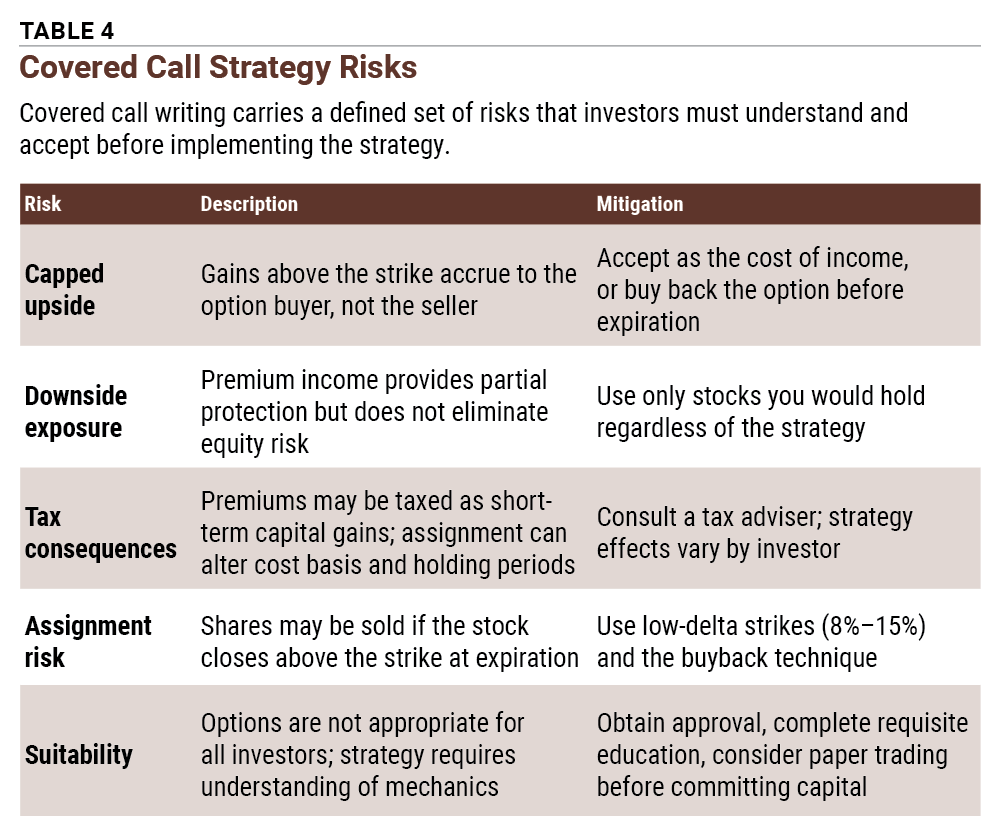
Table 4 lists risks associated with covered call strategies that investors must understand and accept before implementing the strategy.
Concluding Observations
Covered call writing is a well-established, conservative options strategy with direct applications for retirement income planning. When integrated into an existing equity portfolio, it has the potential to generate consistent supplemental income without requiring the sale of core holdings.
Portfolio overwriting, the more specialized application, is particularly suited to long-term investors who need additional cash flow but cannot afford the tax, dividend or emotional cost of liquidating appreciated positions. By selecting low-delta strikes, managing around earnings and dividend dates, and using the buyback technique when necessary, investors can realistically target 4%–15% annualized supplemental income with minimal disruption to their long-term strategy.
Successful execution requires disciplined strike selection, a clear understanding of implied volatility, consistent calendar awareness and sound position management. Covered call writing offers a practical path to transforming a passive equity portfolio into a consistent, income-producing asset.

Related

Trading Strategies
Using a Covered Call Strategy to Generate Income
Related

Trading Strategies
Managing a Portfolio of Covered Calls
Discussion
FREE REPORT

Get your free copy of our special
report analyzing the tech stocks
most likely to outperform the
market.
JOHN L from NJ posted 2 months ago:
ALAN E from FL posted 2 months ago:
EARL K from FL posted 2 months ago:
ROBERT A from NC posted 2 months ago:
ALAN E from FL posted 2 months ago:
JOHN L from NJ posted 2 months ago:
ALAN E from FL posted 2 months ago:
DAVE G from TX posted about 1 month ago:
ALAN E from FL posted about 1 month ago:
DAVE G from TX posted about 1 month ago:
ALAN E from FL posted about 1 month ago:
You need to log in as a registered AAII user before commenting.
Log InCreate an account