

Don't Judge a Bitcoin ETF by Its Name
by Charles Rotblut | October 21, 2021
Featured Tickers: GBTC
GBTC
On Tuesday, the ProShares Bitcoin Strategy ETF (BITO) began trading to quite a bit of fanfare. Media reports say the fund debuted as the second-most heavily traded new exchange-traded fund (ETF) on record.
One question I, and likely others, have is: How many of the people who now own the ProShares Bitcoin Strategy ETF understand what they purchased? Just like books shouldn’t be judged by their cover, ETFs should never be judged by their name. The fund may not be what you think it is.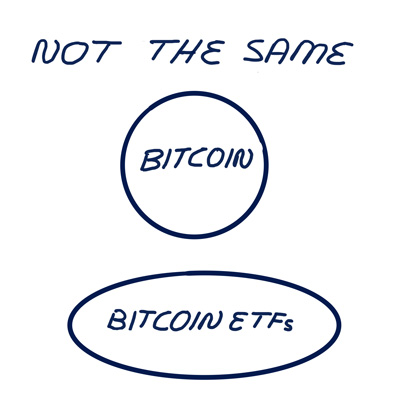
I’m going to use bitcoin and the ProShares Bitcoin Strategy ETF as examples, but the lessons apply to many other ETFs and mutual funds as well. Always stop and make sure you fully understand what you’re buying before opening your wallet. Even a minute of looking at the prospectus may reveal a fund to be not exactly what you thought it was.
A comparison of three different ways of getting exposure to bitcoin shows why.
Bitcoin—This is the actual cryptocurrency. When you buy bitcoin, your return will directly reflect the price movement in bitcoin, adjusted for any transaction fees you incur. The cryptocurrency can be purchased through various platforms and exchanges. The largest exchange is Coinbase. I personally own 0.00056422 of bitcoin in my Venmo account. (Venmo offered me a $25 bonus if I bought $25 worth of bitcoin. As of last night, my cryptocurrency position was worth a whopping $37.25.)
Grayscale Bitcoin Trust  (GBTC)—This is an exchanged-traded trust that holds bitcoin. Investors who purchase shares of Grayscale Bitcoin Trust are buying an interest in the trust. This differentiation has led to the shares often trading at prices separate from the value of the underlying assets. For instance, Grayscale Bitcoin Trust’s one-year price return is 208.6%. Its one-year NAV return is 291.6%. Net asset value (NAV) is the net value of the fund’s assets. Differences between the price return and NAV return occur when an ETF trades at a discount or premium to its NAV.
Grayscale Investments filed a proposal with the U.S. Securities and Exchange Commission (SEC) this week to convert Grayscale Bitcoin Trust into a bitcoin spot ETF. The proposal calls for the ETF to own bitcoin directly. The SEC has so far been opposed to such requests. Media reports are pessimistic that Grayscale’s conversion proposal will be accepted by the SEC within the foreseeable future.
ProShares Bitcoin Strategy ETF—This new ETF uses futures contracts to provide “exposure to bitcoin returns.” Futures contracts are bets on what the price of a specific asset will be on a certain date in the future. While the ProShares Bitcoin Strategy ETF’s intent is to provide bitcoin-like returns, it is holding futures contracts—which in and of themselves are volatile—on an asset that is highly volatile.
As you can see, there are differences in all three. Grayscale Bitcoin Trust and ProShares Bitcoin Strategy ETF offer the advantage of being able to be purchased for and sold from brokerage accounts. Their disadvantages, besides fees, are that investors are not investing in bitcoin itself. Bitcoin cannot be bought directly in U.S. brokerage accounts. Rather, investors have to use a different platform, like Coinbase, or store it themselves (e.g., on their own hard drives).

- We recently published a more in-depth look at the options for investing in cryptocurrency and other crypto assets.
- Not only are investors sometimes unclear about what they are buying, many don’t understand the fees they are being charged in their 401(k) plans.
- Since this week is National Estate Planning Awareness Week, we’ll point out that there are many articles addressing estate planning on AAII.com.
- IRA expert Ed Slott explains when the 10-year withdrawal rule on inherited IRAs applies and when it doesn’t in the current issue of the AAII Journal.
- Wayne Thorp will be hosting an open house of AAII Platinum at a special time next week: Monday at 2:00 p.m. Central. Join him for this live webinar.
AAII Sentiment Survey
The results from the latest AAII Sentiment Survey saw bullish sentiment increase, rising above its historical average. In addition, the number of investors who describe their outlook for stocks as neutral and bearish significantly decreased.
Bullish sentiment, expectations that stock prices will rise over the next six months, rose 9.0 percentage points to 46.9%. This is the first time in six weeks that bullish sentiment is above the historical average of 38.0%.
Neutral sentiment, expectations that stock prices will stay essentially unchanged over the next six months, fell by 5.0 percentage points to 25.4%. This is the second consecutive week that neutral sentiment is below the historical average of 31.5%.
Bearish sentiment, expectations that stock prices will fall over the next six months, decreased by 4.0 percentage points to 27.8%. This is the first time in six weeks and the second time out of the last 12 weeks that bearish sentiment is below the historical average of 30.5%.
The return to normalcy from the coronavirus pandemic, monetary and fiscal stimulus and inflationary pressures are influencing individual investors’ outlook for stocks. Other factors include earnings, valuations and the Biden administration’s initiatives.
In this week’s special question, we asked AAII members to share which factors were currently influencing their six-month outlook on stocks the most.
Respondents could list more than one factor. Out of the 100+ responses we received, 28% consider inflation as a factor. Furthermore, 22% of responses cite government and consumer spending. This compares to 13% of responses selecting supply chain issues as a factor and another 10% mentioning the coronavirus pandemic. About 6% of responses cite taxes as a factor. Four percent of responses are for other shortages not specifically pertaining to supply chains. Around 2% of responses factor in infrastructure. Moreover, international factors are mentioned in 2% of responses. About 12% of responses fall into other factors.
Here is a sampling of the responses:
- “There are short-term factors such as inflation, debt situation, government spending, Federal Reserve chairman. These will be offset by continued growth. I expect much volatility with the market moving in a narrow range overall.”
- “Inflation will drive investors into equities; supply chain issues and lower-than-expected growth will slow the economy—hence my neutral view of the six months ahead.”
Bullish: 46.9%, up 9.0 points
Neutral: 25.4%, down 5.0 points
Bearish: 27.8%, down 4.0 points
Bullish: 38.0%
Neutral: 31.5%
Bearish: 30.5%
See more Sentiment Survey results.

October 14, 2021 Two New AAII Member Benefits
October 7, 2021 Seven Pitfalls Dividend Investors Should Avoid
September 30, 2021 Automate Retirement Savings and Retirement
September 23, 2021 What You Can Expect at Our Forthcoming Conference

Discussion
Juan Kellogg from FLORIDA posted over 4 years ago:
The factors listed in these responses are comprehensive.
john from ohio posted over 4 years ago:
you can buy selected cryptocurrencies in some US brokerages, eg, tastyworks.
You need to log in as a registered AAII user before commenting.
Create an account