

Stocks Gone Wild and Other April Charts of Interest
by Charles Rotblut | April 23, 2026
Featured Tickers: AMZN
BIRD
CAR
GOOGL
JPM
AMZN
BIRD
CAR
GOOGL
JPM
Investors’ appetite for risk has been rising even though the Strait of Hormuz remains shut. We have been observing a rotation into growth stocks, but some investors—speculators is a better word—have chosen to take on far more risk, as I explain this week. I then turn the focus of this month’s charts of interest to stock and bond correlations, gasoline prices and, finally, a reminder of why investment expenses still matter.
As a reminder, the monthly charts of interest highlights charts and tables I’ve come across that have not made their way into other AAII commentaries.
How Much Is That Rental Car?!
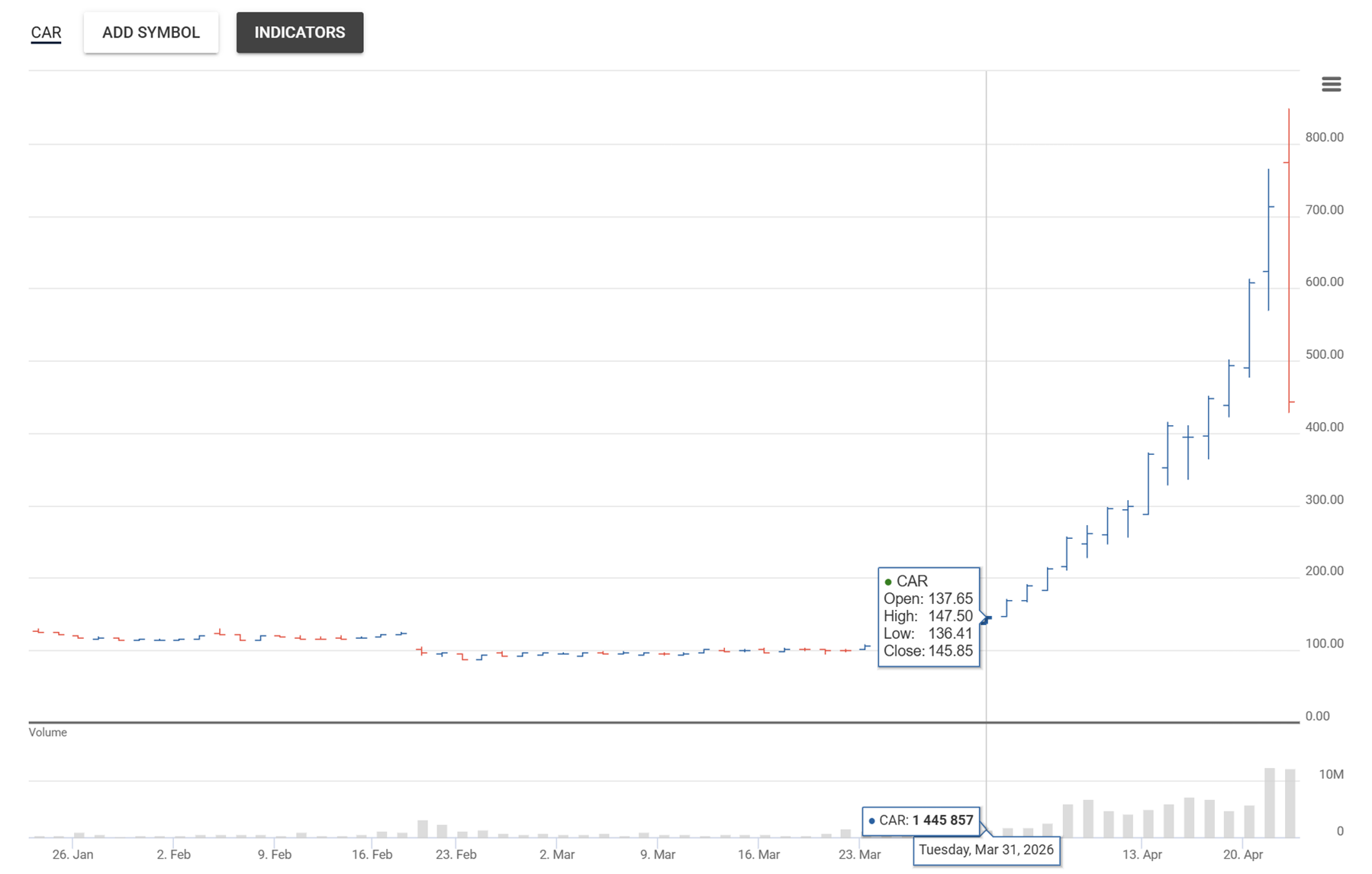
Shares of Avis Budget Group Inc.  (CAR) ended Tuesday, April 22, up 390% month to date, before pulling back yesterday and today. The surge is being attributed to a short squeeze. A short squeeze is a run-up in a stock’s price that is intensified when short sellers buy shares to close out their positions. Short squeezes occur because the potential losses from holding a short position are unlimited.
According to Barron’s and other media outlets, about 71% of the company is owned by SRS Investment Management and Pentwater Capital Management combined. This has led to a relatively small float: the number of Avis Budget shares available for trading. The actual number may be even smaller than the listed 10.2 million float. The two firms reportedly hold derivatives that push their combined ownership above 100%.
Beyond this, there is not an identifiable catalyst for the stock’s run-up. Avis Budget filed a registration statement with the U.S. Securities and Exchange Commission (SEC) on March 27 to sell up to five million shares. That is about 14% of its currently outstanding shares.
Whenever a stock experiences this level of volatility, attempting to trade it is very risky.
Source: AAII.com. Data from QuoteMedia as of 4/22/2026.
“We’re Switching From Shoes to AI”
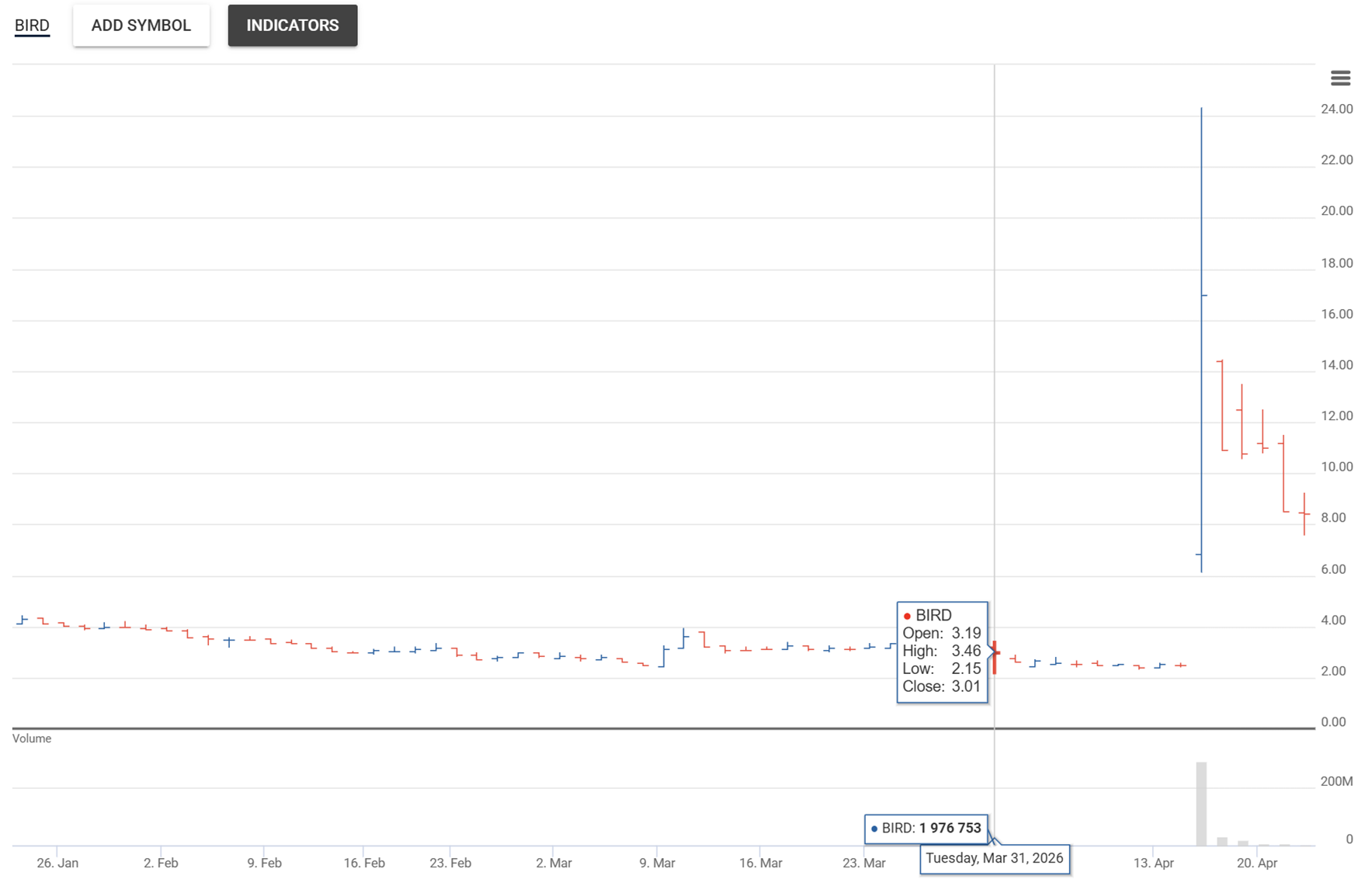
Shares of Allbirds Inc. (BIRD) had their own recent spike. The reason? Allbirds is switching from making and selling casual shoes—a business it was unsuccessful at—to renting out artificial intelligence (AI) computing power under the name NewBird AI.
The speculators who jumped into the stock in response to the announcement are already tripping over their shoelaces. As for me, I’m happy to hold onto my Allbirds sneakers while continuing to avoid the stock.
Source: AAII.com. Data from QuoteMedia as of 4/22/2026.
Bonds Have Become More Correlated to Stocks
Bonds have historically been suggested as diversifiers to stocks because the two have had negative to near-zero correlation. The relationship has changed so far this decade. Bonds have become positively correlated to stocks, according to investment firm AQR Capital Management.
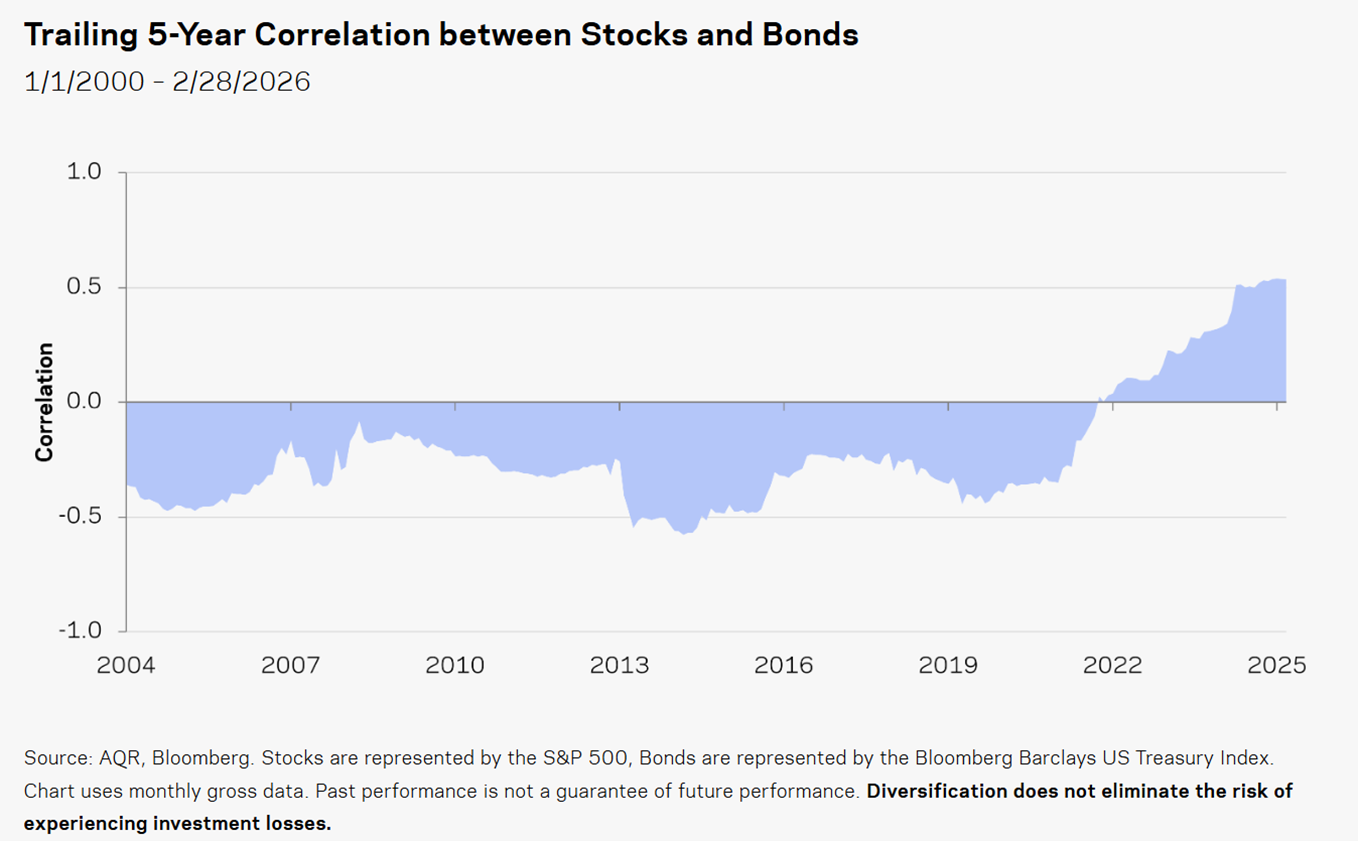
Even at the current correlation levels, bonds still provide diversification benefits relative to stocks. The extent of this diversification depends on both the size of the allocation to bonds and how you get exposure to bonds. Holding individual bonds or defined-maturity bond funds will provide certainty of return. Owning a traditional bond exchange-traded fund (ETF) or mutual fund will expose you to more of the elevated correlation because their future returns are not certain.
Prices at the Pump Lag Wholesale Gasoline Prices
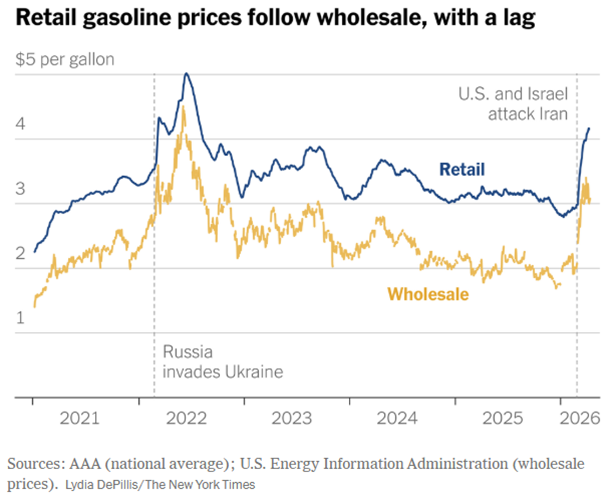
Gas prices remain high across the country due to the Iran war. Even once the Strait of Hormuz is finally reopened, there will be a delay before we see relief. This is partially because prices at the pump lag wholesale prices, as this chart from The New York Times shows.
A friendly reminder not to direct your anger at the owner of your local gas station. They have very little control over prices.
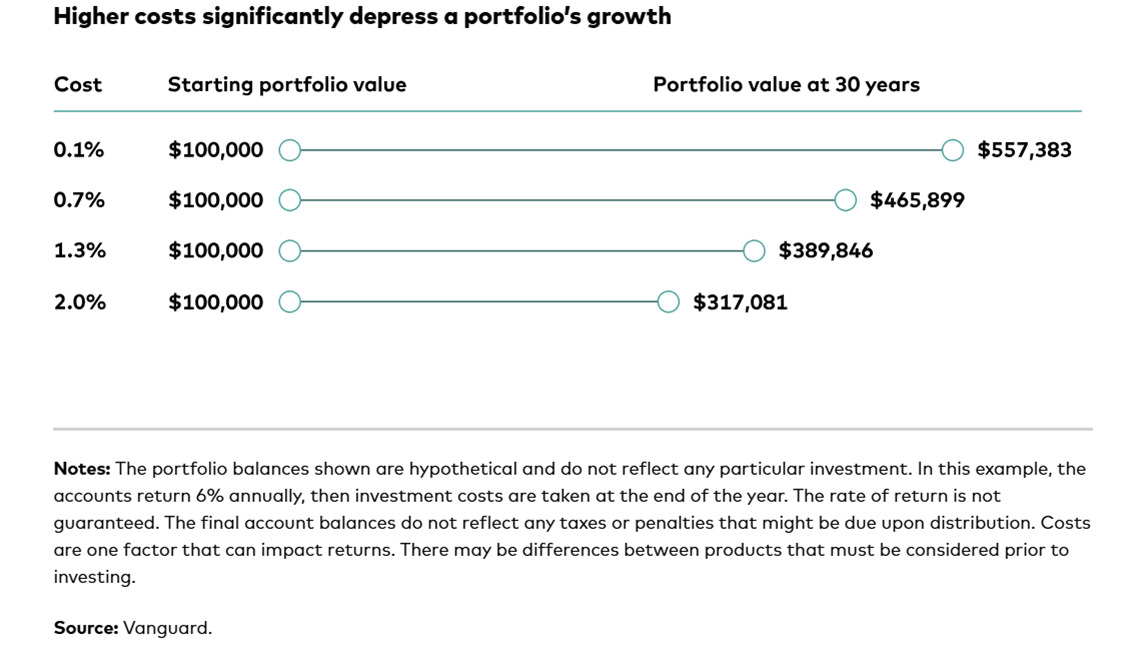
Finally, a Reminder that Fund Expenses Matter
The only part of returns that investors have control over is costs. The higher the fees you pay, the higher the return you must realize just to break even with a lower-cost alternative.
Vanguard reminded investors of this in its new report, “50 years. 50 facts. Indexing since 1976.”
AAII Stock Bracket Challenge Championship Recap
The championship round of the AAII Stock Bracket Challenge went from being a rout to a nail-biter. Thirteenth seed JPMorgan Chase & Co. (JPM) got the better of 11th seed Alphabet Inc. (GOOGL) in terms of returns for the final week, after the latter went cold down the stretch.
Timing was a factor. Alphabet had a higher total return than JPMorgan over the entire challenge period.
We also saw the element of timing play out in the four-week returns for all 16 stocks included in the tournament. Amazon.com Inc. (AMZN), the third-most-favorited stock among AAII members, had the biggest overall gain at 20.6%. Like a college team basketball team whose shooting goes cold at the wrong time, Amazon was knocked out of the tournament early.
Both Alphabet and Amazon are great examples of how arbitrary time periods influence the reported performance numbers. One of the biggest advantages we individual investors have is never having to report our quarterly or annual performance.
Congratulations to Jim’s bracket for winning the challenge—and receiving a lifetime subscription to AAII Platinum. Second-place winner MyShots and third-place winner Dave’s EZ pick are receiving three- and one-year AAII Platinum subscriptions, respectively. Congratulations to the two of you as well. Thank you to the more than 800 AAII members who participated.

-
Building Bond Ladders With Mutual Funds and ETFs
Quasi-bond ladders can be created with mutual funds or ETFs instead of individual bonds by choosing funds with differing durations. -
Understanding Mutual Fund Fees and Expenses
While it is natural to focus on the performance track record when selecting a fund, expenses and fees can have a dramatic impact on your realized rate of return. -
Managing the Tax Impact of Capital Gains Stacking
Understanding all the income sources and deductions that drive your tax bill can help you identify opportunities to lessen their tax impact. Find out how in the April 2026 AAII Journal.
AAII Sentiment Survey
Optimism among individual investors about the short-term outlook for stocks increased in the latest AAII Sentiment Survey. Meanwhile neutral sentiment and pessimism decreased.
Bullish sentiment, expectations that stock prices will rise over the next six months, increased 14.3 percentage points to 46.0%. Bullish sentiment is above its historical average of 37.5% for the first time in 10 weeks.
Neutral sentiment, expectations that stock prices will stay essentially unchanged over the next six months, decreased 5.9 percentage points to 19.5%. Neutral sentiment is unusually low and is below its historical average of 31.5% for the 92nd time in 94 weeks.
Bearish sentiment, expectations that stock prices will fall over the next six months, decreased 8.4 percentage points to 34.4%. Bearish sentiment is above its historical average of 31.0% for the 11th consecutive week.
The bull-bear spread (bullish minus bearish sentiment) increased 22.7 percentage points to 11.6%. The bull-bear spread is above its historical average of 6.5% for the first time in 11 weeks.
This week’s special question asked AAII members if they think other investors are too bullish or too bearish right now.
Here is how they responded:
- They are too bullish: 45.6%
- Their sentiment toward the market is about right: 17.2%
- They are too bearish: 27.8%
- Not sure/no opinion: 9.5%
Bullish: 46.0%, up 14.3 points
Neutral: 19.5%, down 5.9 points
Bearish: 34.4%, down 8.4 points
Bullish: 37.5%
Neutral: 31.5%
Bearish: 31.0%
See more Sentiment Survey results.

April 16, 2026 Wide Valuation Dispersion Creates Stock-Picking Opportunities
April 9, 2026 What's Driving 2026 Stock Market Rotation by Size and Sector
April 2, 2026 The Outsized Influence of AGI on Your Tax Return
March 26, 2026 The Median Stock Loses Money: Sell Rules Are Critical

Discussion
Barry from TX posted 5 months ago:
Charles, good to have you checking our six. #1 I cannot muster any sympathy for anyone who chased CAR or the continuing meme-stock list. Even Forrest Gump knew that “Stupid is as stupid does.” That quote suggests that a person is only truly "stupid" if they act foolishly or harmfully. #2 Believing that an in unsuccessful BIRD management team can transmogrify itself [using OPM] into a successful business in an unrelated industry populated by at least “7” enormously wealthy and successful competitors with stockpiles of cash, easy access to billions of low-interest loans, and growing cashflows, makes you “stupider” than Gump. #3 IMHO gas prices are just a small inconvenience we pay to subjugate a nuclear pariah, a sponsor of global terrorism, and oppressor of is population. A few more $1/gallon is insignificant to the possible gain of destroying a menace with nuclear ambitions. Count your blessings. Breathe in, breathe out, and move on. #4 . The changes in AAII sentiment INCREASED the magnitudes of historical averages significantly, notably almost doubling the historical bears and bulls spread. Someone will be wrong.
Barry from TX posted 5 months ago:
Charles, the Vanguard/Bogle chart example proves that, even after 30 years of 2% fees every year on the total portfolio, these investors still accumulated $217K more than they had 30 years earlier. The lowest fee would have provided $240K more growth. 6% compounded over 30 years with 0% fees would have produced a little under $700K.Then there's the Taxman that demands 15% (minimum) that drains another $100K and 3% inflation drains $21,000 in purchasing power. That $317K gain shrinks "take home" to $200K. But this is much better than the alternative. $0 from not investing. Is the glass half full or half empty?
Barry from TX posted 5 months ago:
Charles, in the article, A Positive Stock-Bond Correlation Is a Terrible Reason to Add More Equity Risk to Your Portfolio, April 8, 2026, by Cliff Asness, Daniel Villalon and Antti Ilmanen, you omitted that they recommended that equities in a portfolio be “balanced” by Private Credit, Buffers, and Bitcoin. A Hobson’s Choice at best. Reread the title carefully: A Positive Stock-Bond Correlation …. IS A TERRIBLE REASON TO ADD MORE EQUITY RISK TO YOUR PORTFOLIO. Your recommendation makes more sense: ”Holding individual bonds or defined-maturity bond funds will provide certainty of return.” I do not recommend reading this article. A sugar-coated donut would have done me more good.
You need to log in as a registered AAII user before commenting.
Create an account