


Related

ETFs and Mutual Funds
Quasi-bond ladders can be created with mutual funds or ETFs instead of individual bonds by choosing funds with differing durations.

Bond ladders are like a good set of all-season tires. They can be structured to perform well under a number of market conditions. Investors can capture higher yields in rising interest rate environments by reinvesting the proceeds from maturing bonds. When interest rates are falling, investors will benefit from having exposure to bonds that were purchased when interest rates were higher. The idea is to limit timing risk by holding bonds with varying purchase and maturity dates.
A traditional bond ladder accomplishes this with a portfolio of bonds spaced out over a specified time period (e.g., five, 10 or 20 years) and held to maturity. As time passes, each bond’s time to maturity decreases. At maturity, the bond’s proceeds are either used to fund portfolio withdrawals or are reinvested by purchasing a bond with the longest maturity in your ladder. The new rung restores the original length of the ladder. Holding each bond to maturity yields regular interest payments over the bond’s life. At maturity, the principal amount is repaid.
In a high or rising interest rate environment, bond ladders help you to take advantage of higher future rates. A ladder with bonds maturing over the short term—e.g., one- to five-year bonds—will allow for the reinvestment of proceeds at potentially higher rates as they mature. Investment-grade corporate bonds or Treasurys can help provide stability, while Treasury inflation-protected securities (TIPS)—U.S. government bonds that adjust principal and interest payments based on changes in the consumer price index (CPI)—can be used to hedge inflation.
When interest rates are falling, extending the ladder by adding longer-term bonds to preserve higher interest rates can make sense. High-quality bonds can avoid credit risk during economic slowdowns.
An evenly spaced ladder using bonds that mature every one to two years over a period of time can smooth out reinvestment risk when interest rates are flat or the rate environment is uncertain. Diversifying across government and corporate bonds can help manage risk while also providing the opportunity for higher yields.
Drawbacks exist to building a ladder using individual bonds. Selecting bonds to establish and maintain the ladder is time consuming. Though Treasury bonds can be purchased directly from the government through TreasuryDirect.gov, corporate and municipal bonds must be purchased on the open market. Low trading volume in such bonds can make it difficult to purchase them in odd lots (amounts of less than $100,000). For these reasons, mutual funds and exchange-traded funds (ETFs) can be used to create a quasi-bond ladder.
Passively managed funds typically offer lower expense ratios compared to actively managed funds but lack portfolio manager discretion over bond selection. Holdings change as bonds in the underlying or tracking index mature or are replaced when the index is rebalanced.
Active managers can adjust their portfolios in response to or in anticipation of shifts in monetary policy and the credit cycle. Fixed-income markets are decentralized, with trading volumes differing significantly across bonds. As a result, pricing inefficiencies may arise, creating opportunities for active managers.
Traditional bond mutual funds and ETFs are designed to last in perpetuity, meaning they don’t mature and distribute their balance the way bonds do. Diversification can be obtained by investing in funds with differing durations. Duration approximates a bond’s sensitivity to interest rate changes. Expressed in years, it represents the expected change in a bond’s value for a 1% shift in interest rates. Bond investors can dial duration up or down by selecting bonds or bond funds with short- or longer-term maturities.
Fund distributions can include both capital gains and portfolio income. Cash flows are variable. A traditional bond, in contrast, distributes fixed-coupon (interest) payments and, at maturity, its par (face) value. Certain bonds can be called before maturity.
Investors should understand that the liquidity of the securities held within a fund is important. It may be difficult for a fund manager to trade quickly depending on the type of bond held and prevailing market conditions. As a result of illiquidity, the price of an underlying bond can vary from transaction to transaction, making it challenging to estimate the fund portfolio’s value.
Fees, expenses and taxes should be considered. Fees are built into the price of bonds when purchased or sold, though there are no fees on TreasuryDirect.gov. Mutual funds and ETFs have different fee schedules. Both have expense ratios, but mutual funds may have sales loads, redemption fees and 12b-1 fees. Brokers will charge transaction fees for mutual funds not on their preferred list.
Defined-maturity ETFs can be used to build a more traditional bond ladder. Like bonds, they return capital to shareholders and mature on or around a specified date. Like bond funds, they benefit from the economies of scale and diversification that a large portfolio offers.
Investors will typically receive monthly distributions from defined-maturity bond funds. During the year of the fund’s expected termination, the net asset value (NAV) of the fund’s assets is distributed to investors. Unlike individual bonds, the actual amount distributed at maturity is not predetermined. The longest maturities of defined-maturity funds are typically no more than eight years, whereas long-term corporate bonds, U.S. Treasury bonds and bond funds can have maturities of 10 to 30 years.
We used AAII’s Mutual Fund and ETF Screeners to identify domestic bond funds that could be used to build a quasi-bond ladder. For mutual funds, we limited the universe to true no-load funds available in share classes that individual investors can purchase, and we required no more than $50,000 for a minimum initial investment. We placed an emphasis on funds with higher yields.
All funds were required to have A+ Investor Grades of C or higher (average or better) for five-year NAV returns. We were more flexible with the expense ratios for mutual funds while avoiding the most expensive funds (those with expense ratio grades of F). All ETFs were required to have an average daily trading volume of greater than 5,000 shares.
We selected funds within the taxable fixed-income universe. Mutual funds with yields of 3.5% and above are shown in Table 1, while ETFs with yields greater than or equal to 2.6% are shown in Table 2. The funds are ranked by yield within their given category.
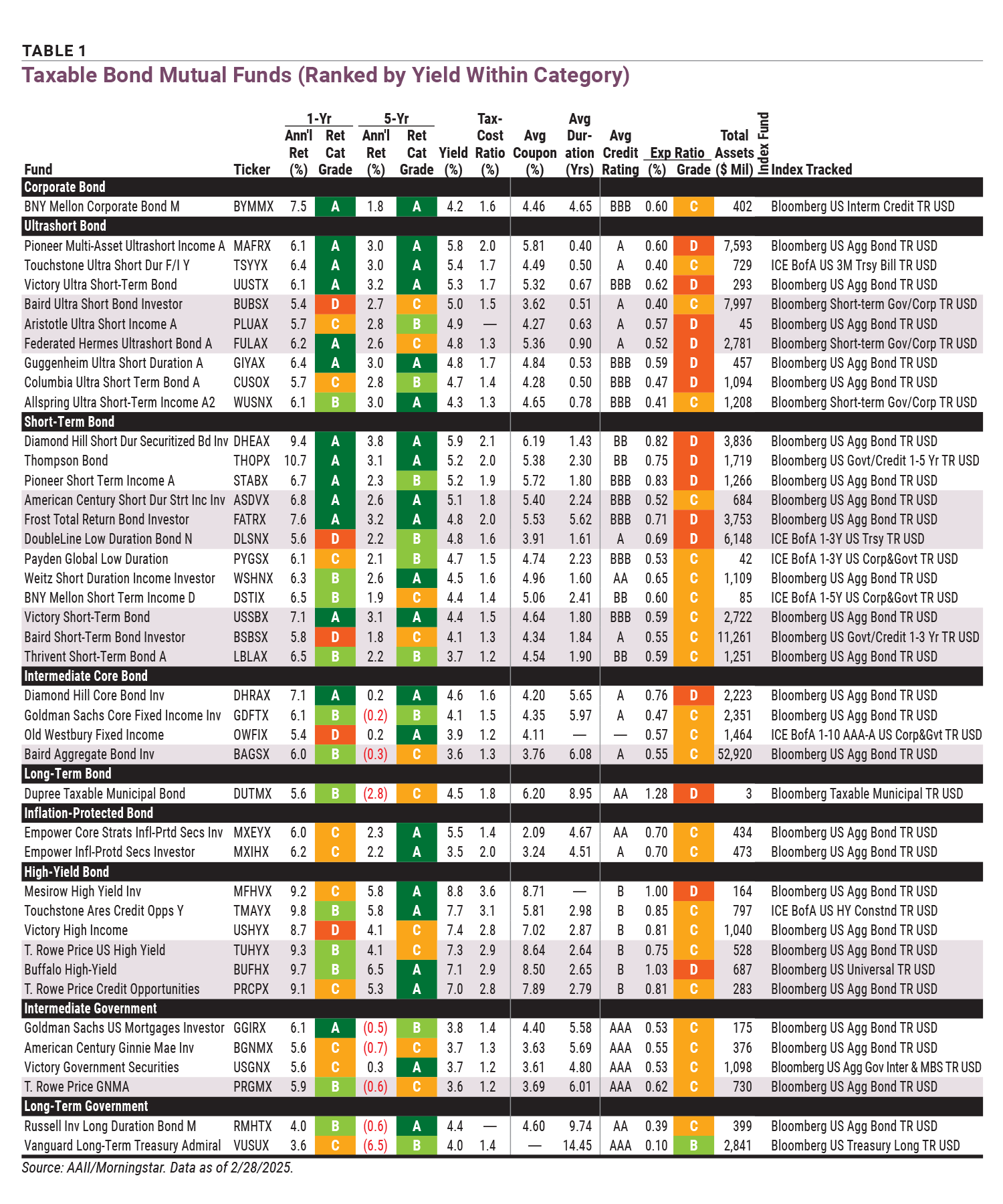
Download the Excel spreadsheet of Table 1.
Yield is calculated as income for the most recent 12 months divided by month-end NAV. The average yield for the mutual funds shown in Table 1 is 5.0%, with the highest yield at 8.8%. The highest yield for the ETFs shown in Table 2 is 8.0%, and the average yield is 5.1%.
The average coupon, duration and credit rating are also shown. AAA/Aaa is considered the highest credit rating, while ratings of C and D are given to bonds in default. Credit quality is reflected in the yield and return, with lower-rated bonds having a greater risk and thus higher yields. Overall economic conditions play a role as well. Spreads between higher- and lower-rated bonds are narrower during better economic conditions and become wider as uncertainty increases.
All of the mutual funds in Table 1 are actively managed, whereas most ETFs in Table 2 are passively managed and track an index. Expense ratios for actively managed mutual funds are generally higher than those of passive funds but are competitive overall. The average mutual fund included in Table 1 has an expense ratio of 0.63%. The average ETF included in Table 2 has an expense ratio of 0.17%.
The tax-cost ratio measures how much a mutual fund or ETF’s annualized return is reduced by the taxes an investor in the highest tax bracket would pay on distributions.
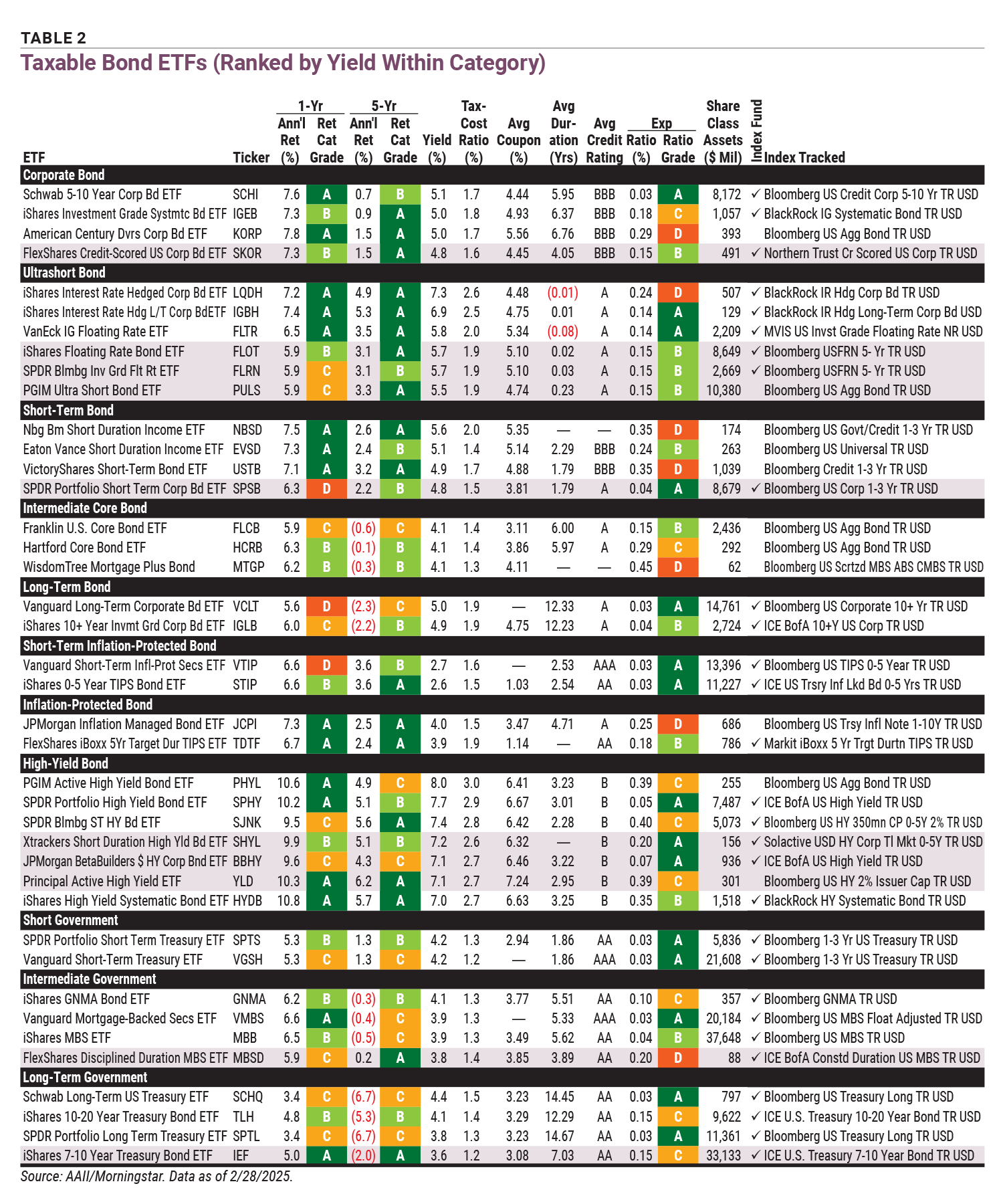
Download the Excel spreadsheet of Table 2.
Quasi-bond ladders can be created by choosing mutual funds and ETFs with differing durations from the tables.
A potential way to structure such a bond ladder with funds is to create duration-based “rungs” of one to three years, three to five years, five to seven years and seven to 10 years.
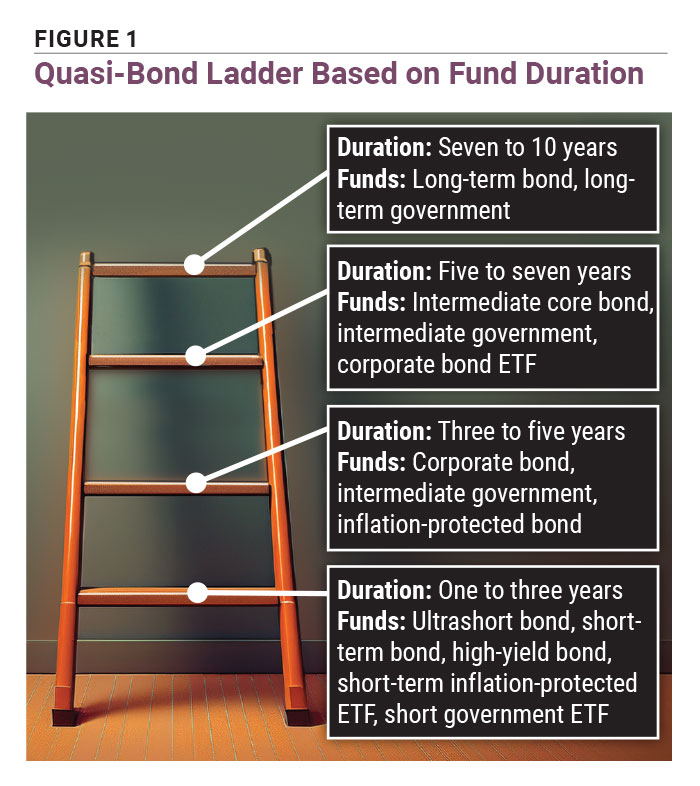
Funds found in the ultrashort, short-term and high-yield categories can be placed on the one-to-three-year duration rung. ETFs from the short-term bond, short-term inflation-protected and short government categories can also be used. Researching the holdings may reveal U.S. Treasury notes, U.S. Treasury bonds and U.S. government agency debt of varying yields and maturities, along with sovereign debt, corporate debt and securitized debt. Inflation-protected funds hold TIPS.
For the next rung, choices in the corporate bond and intermediate government categories exist for both mutual funds and ETFs. There are also inflation-protected bond funds offering three-to-five-year durations.
Intermediate core bond and intermediate government funds can generally be used for five-to-seven-year duration needs. A few choices for this duration also exist in the corporate bond ETF category.
The final “rung” of the ladder, with a seven-to-10-year duration, can be filled with funds from the long-term bond and long-term government categories. Durations in these categories range from 7.03 to 14.67 years.
Replacing a fund whose duration changes will keep the ladder close to its intended range. Shifting portfolio dollars from a fund with a longer duration to one with a shorter duration can be used to rebalance the ladder as portfolio withdrawals are taken.
A portfolio of defined-maturity ETFs can also be used to replicate a traditional bond ladder. With this approach, dollars from maturing ETFs would either be reinvested into defined-maturity ETFs with longer durations or used for portfolio withdrawals.
Note that a few of the ultrashort corporate bond ETFs have negative duration due to their strategies for managing interest rate risk. The iShares Interest Rate Hedged Corporate Bond ETF  (LQDH) hedges against rising interest rates by holding long corporate bond positions and shorting U.S. Treasury futures or swaps, creating a negative duration effect. The VanEck Investment Grade Floating Rate ETF (FLTR) invests in floating-rate corporate bonds, where rising rates increase coupon payments, resulting in low to negative duration.
A bond bucket strategy can be used to approximate a bond ladder. In this strategy, buckets are set up for near-, medium- and long-term spending needs.
Here is an example based on a 25-year time horizon. Bucket one is the portion of the portfolio designed to cover living expenses in the first two years of retirement. Its goal is stability of principal with modest income production. It could contain cash and cash-like investments, along with bonds from the ultrashort bond, short-term bond, short government and high-yield bond categories. Bucket two covers years three to 10 and could contain funds from the corporate bond, inflation-protected bond, intermediate government and long-term government categories. Bucket three would contain equity securities because this component of the portfolio will remain untouched for the next decade, except for rebalancing. (Investors wanting bond funds in this bucket would focus on those with the longest durations.) Proceeds from this bucket could be used to replenish the next two buckets.
A bucket plan can be customized to suit an investor’s own specifications. For example, an older retiree with an expected 10-year time horizon might have just two buckets—one for very short-term needs and another earmarked for the medium term.
ETFs and Mutual Funds

ETFs and Mutual Funds


ROBERT A from NC posted over 1 year ago:
BARRY J from TX posted over 1 year ago:
VICTOR S from NC posted over 1 year ago:
JOE D from CA posted over 1 year ago:
THOMAS S from MN posted over 1 year ago:
CRAIG B from WI posted over 1 year ago:
CHARLES L from PA posted over 1 year ago:
JOHN F from OR posted over 1 year ago:
You need to log in as a registered AAII user before commenting.
Log InCreate an account