

Optimism Was Low Last Year, But Individual Investors Stayed With Stocks
by Charles Rotblut | January 30, 2020
Last year, the average level of optimism recorded in our weekly Sentiment Survey was the seventh lowest it has ever been. (The survey started in July 1987.) Bullish sentiment averaged just 31.5%. Furthermore, there were only 12 weeks during all of 2019 when optimism was above its long-term historical average of 38.0%.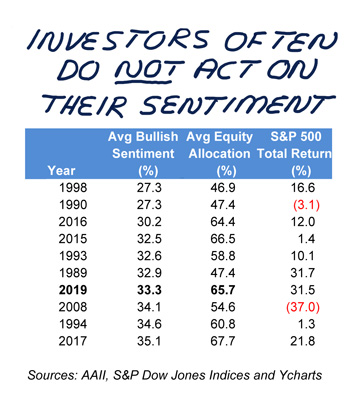
We’ve long said that there is a difference between individual investors’ expectations for how the market will perform and what they do with their portfolios. Data from our monthly Asset Allocation Survey supports this. As you can see on the table on the right, AAII members have often kept more than half of their portfolios in stocks even when their collective optimism about the direction of stock prices was low.
This isn’t to say all individual investors are disciplined enough to avoid bailing out of stocks when their market outlook is dreary. Some do pull out of equities, and our surveys only reflect the views and allocations of AAII members. Still, the data from our surveys should question the use of terms like “smart money” and “dumb money.” It is the much deeper pockets of institutional investors, hedge funds and other large investors constituting the so-called smart money that have a much bigger impact on the market’s direction.
Last year, AAII members maintained an above-average exposure to stocks even though their collective optimism was low. This occurred even though many expressed frustrations with Washington politics, uncertainty about the trade war and concern about valuations. Many told us that they paid attention to the trends in economic and earnings data. Also playing a role was monetary policy, including the ongoing low level of interest rates.
A simple reason explains why many AAII members have maintained their exposure to equities even when they aren’t optimistic about the prospects of stocks rising over the following six months (as of the date of each weekly Sentiment Survey): They’re long-term investors. While some do take tactical steps or otherwise adjust their allocations based on market conditions, it has been our observation that many AAII members look past short-term fluctuations. There is a difference between expecting tougher market conditions and acting on those feelings.
Many refer to Warren Buffett’s advice of being “fearful when others are greedy and greedy when others are fearful.” Our survey lends support to this guidance. Opportunities to buy stocks arise when many others don’t expect them to do well. While the link between unusually low and high levels of bullish sentiment and market performance is not causal, it can be a sign to look beyond what individual investors are doing with their portfolios and to consider the broader market and economic mosaic. Ask what is occurring that would give individual investors reason to feel unusually cautious or encouraged. The answer may reveal whether it makes sense to check your allocation to see if it is still approximately in line with your goals, if any presently held investments are violating your sell rules or if it is time to see if there are investments that have been put on sale because of prevailing market conditions.

-
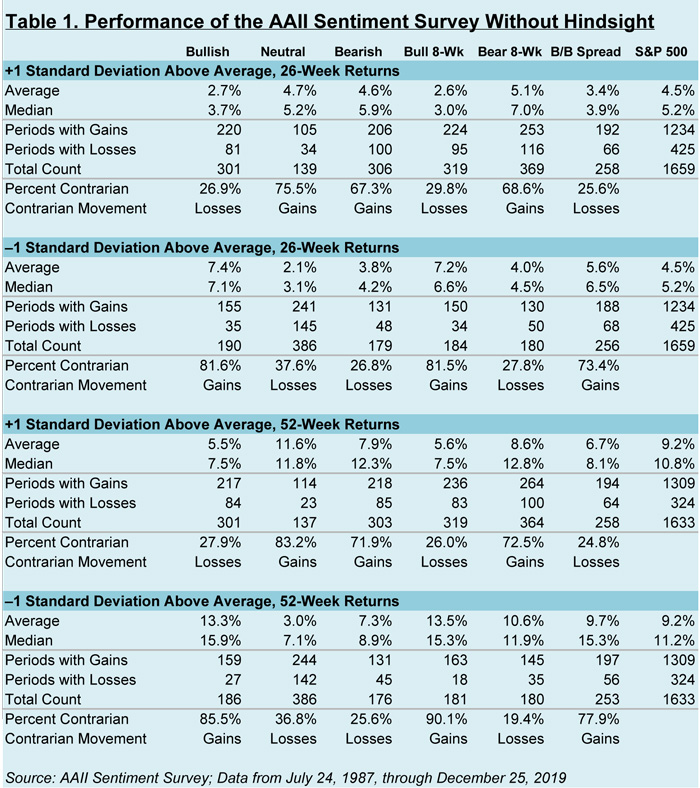
Analyzing the AAII Sentiment Survey Without Hindsight – I discussed how we determine what an unusually high or low reading is, and our rationale for doing so, in this 2014 AAII Journal article. The data is older, but the explanations remain valid.
-
Investment Sentiment Indicators: Quite Contrary? – In this 2004 article, Mark Hulbert discussed the history of sentiment indicators and made observations on their usefulness.
Pessimism among individual investors about the short-term direction of the stock market surged to its highest level in more than three months. At the same time, optimism in the latest AAII Sentiment Survey plunged.
Bullish sentiment, expectations that stock prices will rise over the next six months, fell 13.6 percentage points to 32.0%. Optimism was last lower on December 4, 2019 (31.7%). The historical average is 38.0%.
Neutral sentiment, expectations that stock prices will stay essentially unchanged over the next six months, rebounded by 1.5 percentage points to 31.2%. The historical average is 31.5%.
Bearish sentiment, expectations that stock prices will fall over the next six months, jumped 12.1 percentage points to 36.9%. Pessimism was last higher on October 9, 2019 (44.0%). This the first time bearish sentiment is above its historical average of 30.5% in 15 weeks.
All three indicators are currently within their typical historical ranges.
Our survey period runs from Thursday through Wednesday, with reminders to take the survey sent to a rotating group of AAII members every Monday. The timing of the reminders may have played a role in this week’s results as the global stock markets fell on Monday over fears about the new coronavirus. It’s also worth noting that optimism had reached a 15-month high last week.
Also affecting individual investor sentiment is the market’s upward trend, the phase-one trade deal between the U.S. and China, the November elections, Washington politics, earnings growth, monetary policy, the economy and valuations.
This week’s special question asked AAII members to share their thoughts about the S&P 500 index’s low volatility. (The index had gone 71 days without experiencing a daily move of greater than 1% prior to Monday’s 1.6% drop.) Nearly 54% of respondents state that the low volatility is both unusual and unsustainable. Many within this group expect a correction in the near future. Conversely, 30% of all respondents think that the low volatility reflects low interest rates and a strong market. Many of these respondents believe that while there may be upticks following global news, the overall volatility levels will remain fairly low. Approximately 16% of respondents state that the low volatility trend has benefited their holdings but are unsure of how it will change in the future.
Here is a sampling of the responses:
- “Likely to end within the next year. Might increase significantly in the short-term due to the coronavirus spreading rapidly.”
- “It’s a good thing and indicates that institutional and private investors alike are showing restraint to the media frenzy.”
- “I think volatility is about to increase, and there may be temporary corrections. The economy is still strong overall, although corporate earnings will likely be lower than in 2019.”
- “It’s curious but not meaningful. Investors wish for cause & effect, but often strange things just happen.”

Bullish: 32.0%, down 13.6 points
Neutral: 31.2%, up 1.5 points
Bearish: 36.9%, up 12.1 points
Bullish: 38.5%
Neutral: 31.0%
Bearish: 30.5%
January 23, 2020 Despite the Headlines, Mr. Market Is Quite Content
January 16, 2020 The New Features We’ve Added to Our Website
January 9, 2020 Part 2 of My Investing Resolutions for 2020
January 2, 2020 My Investing Resolutions for 2020, Part 1

Discussion
Steven Sears from Iowa posted over 6 years ago:
As bad as things look here in the USA things are a lot worse in other parts of the world. What has been propping up our market and creating the long bull run is a lot of foreign money. Mr. Trump brags that our prosperity is all from his deal making expertise. What will he say when the tide turns?
You need to log in as a registered AAII user before commenting.
Create an account