

The Bond Market Armageddon That Didn’t Happen
by Charles Rotblut | December 12, 2019
Yesterday, the Federal Open Market Committee (FOMC) voted to maintain its target federal funds rate range of 1.50% to 1.75%. The decision was widely expected as Federal Reserve chairman Jerome Powell had previously expressed his desire to keep rates unchanged for the time being, barring a slowdown in the economy.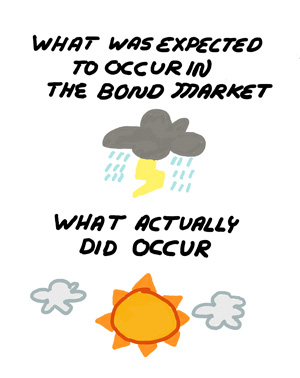
What was lost in the announcement is how little interest rates have moved relative to the start of this decade. On January 1, 2010, the target rate range was 0.0% to 0.25%. Ten years later, we are effectively just six quarter-point rate hikes higher. (Since 2015, there have been nine rate hikes and three rate cuts.) Even the decade’s peak wasn’t very high at 2.25% to 2.50%.
Throughout much of this decade, anyone predicting that rates would end 2019 at their current level would have been perceived as an outlier—to put things politely. At the 2012 Morningstar Investment Conference, Loomis Sayles’ Dan Fuss described interest rates as being at the “foothills of a long rise.” In March 2014, the average longer run (beyond 2016) forecast among FOMC members was for the fed fund rates to be 4%.
Both were wrong, as were many others. As we near the end of the decade, we’re witnessing the bond market Armageddon that didn’t happen.
Instead, it’s been a decent—but not great—period to remain allocated to bonds. Consider the iShares Core U.S. Aggregate Bond ETF (AGG). This fund tracks the Bloomberg Barclays U.S. Aggregate Bond Index, a well-established proxy for the U.S. investment-grade bond market. The exchange-trade fund’s (ETF) 10-year annualized return is 3.5%. While below the index’s long-term average return, it’s certainly not the negative or near zero return that would have likely happened had yields jumped this decade.
Granted, the period since 2008—when interest rates were slashed in response to the financial crisis—has been a painful one for those of you who rely on bond yields and interest from cash accounts/money market funds for portfolio income. But that’s not the point of this week’s commentary.
Rather it’s to build upon what I discussed last week when I focused on this decade’s biggest S&P 500 winners: Forecasts are often wrong. Neither conviction nor consensus lead to accuracy. Rather, the future often plays out in ways we don’t expect it to.
Could a bond Armageddon still occur? It’s within the realm of possible outcomes. But so is the combination of a massive earthquake striking the west coast around the same time Midwestern states are flooded and a severe hurricane hits the eastern U.S. (I don’t want any of these events to occur.) Furthermore, many of the factors that currently lead people to be fearful about interest rates rising significantly in the future existed 10 years ago: low current rates, perceived accommodative monetary policy, high government debt, political risks, etc.
Taking the other side of the coin, many of the factors that could cause interest rates to fall in the future also existed 10 years ago. They include manufacturing job losses, the impact of technology/innovation and an aging population in the developed world.
Just because you can identify a catalyst doesn’t mean the actual outcome will be what you expect it to be.
So, where does this leave you, the individual investor? I don’t think it changes much in terms of how you should allocate. Bonds will continue to provide a ballast against stock market volatility and a source of portfolio cash flow. Laddering bond maturities can help offset the uncertainty of where rates will be in the future. At the same time, stocks should continue to be viewed as long-term drivers of wealth.
Will we see volatility in the bond and equity markets over the next decade? If history is any guide, the answer is probably. But how assets are priced at the end of 2029 could well be influenced by factors that are either not being talked about much right now or will turn out to be big surprises. Given this, I see little reason to make big portfolio bets on specific forecasts about where interest rates will be in the future.

-
Tug of War in the Bond Market – From our archives, this article reflects some of the bond market perceptions that existed early in the decade but still contains useful suggestions for those of you who want to be tactical.
-
Should You Maintain an Allocation to Bonds When Current Rates Are Low? – AAII Journal contributing editor Craig Israelsen says history shows an advantage to owning bonds in a diversified portfolio even when rates rise.
Optimism among individual investors about the short-term direction of the stock market rebounded in the latest AAII Sentiment Survey. Both neutral and bearish sentiment declined.
Bullish sentiment, expectations that stock prices will rise over the next six months, rose 5.9 percentage points to 37.6%. The increase was not large enough to prevent optimism from staying below its historical average of 38.0% for the 40th time this year.
Neutral sentiment, expectations that stock prices will stay essentially unchanged over the next six months, pulled back by 2.8 percentage points to 36.3%. Even with the decrease, neutral sentiment is above its historical average of 31.5% for the 29th time in 30 weeks.
Bearish sentiment, expectations that stock prices will fall over the next six months, fell 3.1 percentage points to 26.1%. Pessimism is below its historical average of 30.5% for the eighth consecutive week.
At current levels, all three indicators are within their historical ranges.
Most of the responses to this week’s survey were recorded prior to yesterday’s decision by the Federal Open Market Committee (FOMC) to keep interest rates unchanged. The survey period runs from Thursday through Wednesday.
Low interest rates continue to have an impact on individual investors’ allocation decisions, while the ongoing trade war and Washington politics are influencing their expectations for the stock market. Also playing roles are earnings growth, the economy and valuations.
This week’s special question asked AAII members how they think the average consumer is faring relative to a year ago. More than half of respondents (53%) believe that the average consumer is doing better. Low unemployment, tax cuts and increased spending are all cited as reasons why. One-third of respondents (33%) think the average consumer is fairing about the same. These respondents view low levels of unemployment and tax cuts as being offset by stagnant wages. About 14% of respondents think the average consumer is faring worse because of tariffs, flat wages and higher expenses including health care and gas.
Here is a sampling of the responses:
- “Consumers are doing better than a year ago. Jobs are available, but not as plentiful as three months ago. Consumer spending is strong, but with high levels of debt.”
- “Holiday spending is up from last year. The surviving stores are crowded with shoppers who are carrying packages. It would seem the average consumer is doing well and is confident of the future.”
- “Unemployment is down but there is still homelessness and an income distribution problem. If the average consumer owned stocks, they would be fine, but I do not think that is the case.”
- “Not well, consumers are increasing their debt to the danger point; just look at the delinquency rate on car loans.”

Bullish: 37.6%, up 5.9 points
Neutral: 36.3%, down 2.8 points
Bearish: 26.1%, down 3.1 points
Bullish: 38.5%
Neutral: 31.0%
Bearish: 30.5%
December 5, 2019 The Biggest Winners May Not Be the Stocks You Expect
November 28, 2019 Reasons for Individual Investors to Be Grateful
November 21, 2019 What the Proposed Change in RMDs Means for Investors
November 14, 2019 Big Losers Can Turn Into Short-Term Winners

Discussion
No comments have been added yet. Add your thoughts to the discussion!
You need to log in as a registered AAII user before commenting.
Create an account