

What the Proposed Change in RMDs Means for Investors
by Charles Rotblut | November 21, 2019
The amount retirees are required to withdraw from their retirement savings accounts may soon decrease. The Treasury Department released a proposal to revise the life expectancy tables. These tables determine the required minimum distribution (RMD) a retiree must take on an annual basis after they reach age 70½. Accounts subject to the RMD rule include traditional IRAs; SEP IRAs; SIMPLE IRAs; 401(k), 403(b) and 457 plan accounts; and Roth 401(k) accounts. Inherited IRAs are also subject to the RMD rules. Roth IRAs are notably excluded [which is why it makes sense to roll over a Roth 401(k) account to a Roth IRA].
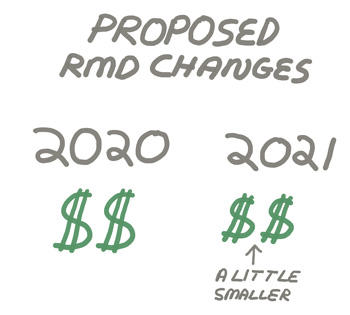 The changes are being made because people are living longer. The existing tables used for determining RMDs were developed in 2002 using mortality rates for 2003. They are based on a 50%/50% split of life expectancies for men and women. An executive order in 2018 required the Treasury Department to determine if the tables should be revised. The updated estimates assume a 29.1-year life expectancy for a 70-year-old IRA owner versus the previous expectancy of 27.4 years. Additionally, the uniform life table will extend out to 120 years, up from 115 years now.
There are some details to be aware of and items of interest. I’ll get to those in a moment. Before I do, I want to point out that the proposed changes are intended to take effect in 2021. Until then, the existing tables will be in effect. The Treasury Department is seeking feedback on the changes through January 7, 2020. You can submit feedback at www.regulations.gov (indicate IRS and REG-132210-18). You can also mail in your comments. See the proposal in the Federal Register for information on how to do so.
Those who stick to the minimum withdrawal amounts would notice a decrease, but not a significant one. A 70-year-old retiree would see their RMD decrease from 3.65% of the account’s balance to 3.44% of the account’s balance. A 90-year-old retiree with $250,000 in their retirement account will be required to withdraw $20,661 (8.26% of the balance) under the proposed rules instead of $21,930 (8.77% of the balance) if the current rules were to stay in place. Relatively small savings, but still money retirees can keep in their accounts and continue growing on a tax-deferred basis [or tax-free in the case of a Roth 401(k)].
The transition is a bit more complicated for those turning 70½ in 2020 and for those who inherit an IRA prior to 2021 or already have inherited one.
A person who turns 70½ in 2020 will use the older tables to calculate their first RMD even if they delay taking their first RMD until April 1, 2021. This individual would then switch to the new tables for their 2021 distributions.
In the case of inherited IRAs, the rules are a bit trickier when the account owner has died prior to 2021. The Single Life Table will be switched to for distributions starting in 2021 with the initial life expectancy reduced by one for each year subsequent to the year for which it was initially set.
Here’s an example from the Treasury Department. An employee died at age 80 in 2018. Their designated beneficiary (who was not the employee’s spouse) was age 75 in 2018.
“For 2019, the distribution period that applies for the beneficiary is 12.7 years (the period applicable for a 76-year-old under the Single Life Table) … for 2020, it is 11.7 years (the original distribution period, reduced by one year). For 2021, taking into account the life expectancy tables under the proposed regulations and applying the transition rule, the applicable distribution period would be 12.0 years (the 14.0-year life expectancy for a 76-year-old under the Single Life Table in the proposed regulations, reduced by two years).”
In all cases, your broker or mutual fund company should automatically make the calculation change for you, but it would be a good idea to mark your calendar to follow up just to be sure.
Many retirees won’t be affected by the new rules. Just 20.5% of all individuals required to take an RMD take the minimum amount, according to the Treasury Department. Those of you following the 4% rule or a similar type of strategy may see your RMDs eventually exceed what your withdrawal strategy suggests. These changes may delay the crossover and will allow you to keep more in your retirement savings account when it does happen.
The rules are currently in a comment period, though they seem likely to go through since they are tied to an executive order. The Wall Street Journal reports that the Obama administration considered a similar update “but didn’t get to it before the administration ended.”
The aforementioned Federal Register entry provides more details and more examples of how the rules would apply.

-
Strategies for Managing Required Minimum Distributions – Even with the proposed changes, some of you may like to withdraw even less from your retirement savings. Here are some strategies for doing so.
-
Asset Allocation, RMDs and Portfolio Survival – RMDs can be used as a withdrawal strategy, as contributing editor Craig Israelsen explained in the April 2017 AAII Journal.
Optimism among individual investors about the short-term direction of the stock market fell back below 40% for the first time in three weeks. The latest AAII Sentiment Survey also shows higher levels of neutral and bearish sentiment.
Bullish sentiment, expectations that stock prices will rise over the next six months, fell 6.5 percentage points to 34.2%. Bullish sentiment is below its historical average of 38.0% for 37th time this year.
Neutral sentiment, expectations that stock prices will stay essentially unchanged over the next six months, rebounded by 2.3 percentage points to 36.7%. The increase keeps neutral sentiment above its historical average of 31.5% for the 26th time in 27 weeks.
Bearish sentiment, expectations that stock prices will fall over the next six months, rose 4.2 percentage points to 29.0%. Even with the increase, pessimism remains below its historical average of 30.5% for the fifth consecutive week.
Though there was a decrease in optimism this week, the change wasn’t significant relative to the trends we’ve seen throughout the year. At current levels, all three indicators are well within their typical ranges.
This week’s special question asked AAII members what factors are influencing their six-month outlook for stocks. The most frequently named factor is low interest rates. Approximately 34% of respondents state that interest rate policy is limiting their investment options. Other respondents from this survey (26%) state that trade disputes are the biggest influence on their outlook. About 21% say political turmoil and the upcoming election are the biggest influences on their outlook. Finally, 18% of respondents say earnings growth and economic data are the major factors influencing their outlook for stocks.
Here is a sampling of the responses:
- “General turmoil in Congress and uncertainty in China trade deal.”
- “Unsettling political issues in Washington; worldwide slowdown (I think); unsettled trade issues, very long bull market.”
- “Low interest rates; positive gross domestic product (GDP) growth; equities represent the best alternative to fixed-income return.”
- “Election year. Companies will hold on until 2021, though spenders have employment and still want to spend.”

Bullish: 34.2%, down 6.5 points
Neutral: 36.7%, up 2.3 points
Bearish: 29.0%, up 4.2 points
Bullish: 38.5%
Neutral: 31.0%
Bearish: 30.5%
November 14, 2019 Big Losers Can Turn Into Short-Term Winners
November 7, 2019 Considerations for Roth IRA Contributions and Conversions
October 31, 2019 Relying on Process During a Good Year for My Portfolio
October 24, 2019 Choosing Between Return and Risk

Discussion
J F Sefcik from NY posted over 6 years ago:
Is this the same as the SECURE act which has passed the House but not the Senate? If so, as a recent widower, I am much dismayed that my sons and grandsons will be forced to take RMDs at a time not in their best interest as heretofore. I also think that not enough attention is given to those who have sufficient resources outside their IRAs to suggest they consider not waiting until 70.5 to take their RMD in order to reduce future tax burdens. The emphasis is always on Save and Delay which might not always be the most productive way to go.
Charles Rotblut from IL posted over 6 years ago:
This is separate of the SECURE Act. It is a Treasury Department proposal that can be put into place without Congressional approval. The SECURE Act is a bill that is currently being held up in the Senate.
You need to log in as a registered AAII user before commenting.
Create an account