


Updated on October 1, 2022


You are forced to spend down traditional IRAs at a steady rate after age 72, whether you need the cash or not.
For many people, the required minimum distributions (RMDs) aren’t a problem because they need the money to fund their retirement expenses. For others, however, RMDs increase income taxes and disrupt retirement and estate plans.
The RMD schedule doesn’t fit the spending patterns or income needs of many retired Americans. More significantly, there are a number of people who have large IRAs and also income and assets outside of their IRAs that are sufficient to sustain their retirement standards of living. People in this situation often view their IRAs first as something for their heirs to inherit and second as a source of emergency spending.
What Is an RMD Waterfall?
The secret of required minimum distributions—that many people don’t realize until they are well into retirement—is that under the IRS tables used to calculate RMDs, the percentage of an IRA that must be distributed increases each year. For example, the first RMD is 3.65% of the IRA. By age 76, 4.22% must be distributed, and by age 90 the RMD is 8.20% of the IRA balance. Figure 1 shows how the RMD steadily increases, even as the IRA balance declines, through about age 92. This steady increase in forced distributions is what I call the RMD Waterfall.
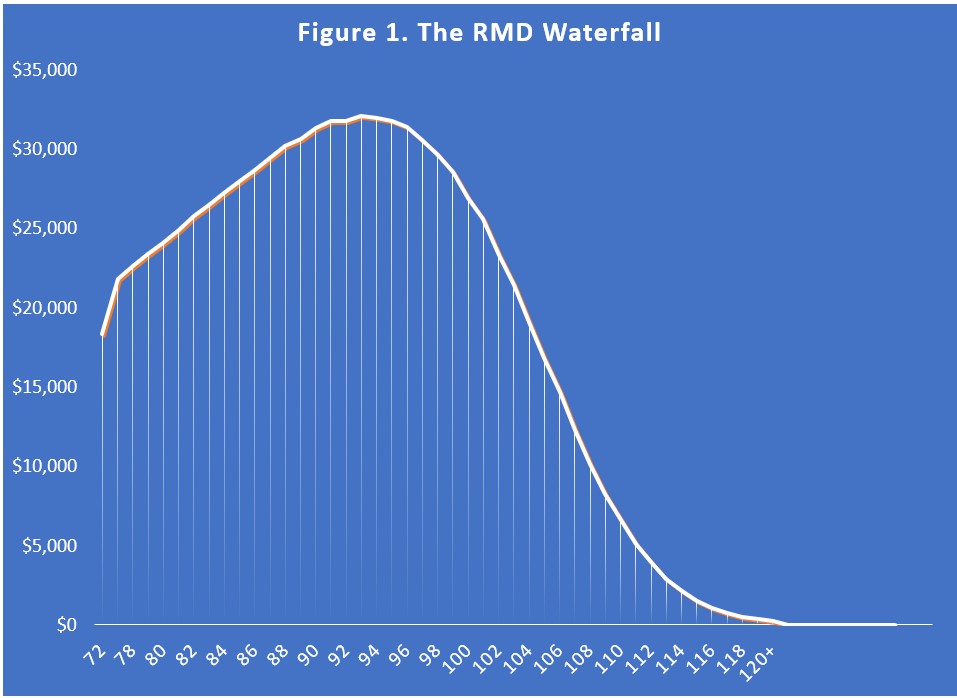
The RMD Waterfall becomes a burden because distributions from traditional IRAs are included in gross income and taxed as ordinary income (except for distributions of nondeductible contributions). Over time, the RMDs steadily increase gross income and adjusted gross income (AGI). This increases income taxes and can push you into a higher tax bracket.
Perhaps more importantly, a higher AGI can trigger the “stealth taxes.” These are tax provisions that increase your gross income, reduce tax deductions or impose additional taxes as income levels rise. They include the Medicare premium surtax, inclusion of Social Security benefits in gross income (or a greater percentage thereof), reductions in personal and dependent exemptions and itemized deductions, the alternative minimum tax and more.
Retirees often don’t realize the full effects of RMDs until they reach their late 70s and beyond, when they are paying substantial taxes on income they don’t need and realize they are caught in the RMD Waterfall.
5 Strategies for Reducing RMDs
Fortunately, there are strategies to reduce or eliminate RMDs. The strategies can be implemented at any time during retirement, but the earlier you take action the more options you have and the better the results will be.
The conventional advice is to delay taxes for as long as possible. Yet, tax deferral can come back to bite some retirees when they reach the RMD Waterfall. That’s why most of the strategies involve paying taxes early on the traditional IRA.
In this article, I discuss strategies you can consider in order to avoid or reduce the RMD Waterfall. This will help you effectively plan and take RMDs, so you aren’t forced to endure the burden of RMDs if it doesn’t suit your retirement needs. RMD strategies come in all shapes and sizes, so you’ll want to look at your financial goals, risk tolerance and overall allocation to decide if the strategy you choose is right for you.
Interested in learning how to prepare for retirement? The PRISM Wealth-Building Process and online academy can help you build a financial plan that is necessary to achieve your financial goals.
1. Emptying Your IRA Early
The simplest strategy to reduce or eliminate RMDs is to take money out of the IRA before you have to, pay the taxes and invest the aftertax amount through a taxable account.
The strategy can increase aftertax wealth because of several factors.
First, distributions from traditional IRAs are taxed as ordinary income, therefore the IRA converts tax-advantaged income into highly taxed income. That’s the price of tax deferral. Long-term gains and qualified dividends earned in the traditional IRA become ordinary income. Taking distributions before you have to ends that conversion.
Second, you have more control over taxes in a taxable account. You can choose not to invest in assets that pay ordinary income. You can let gains compound and then decide when to sell and incur capital gains taxes. You can also use tax-efficient strategies such as offsetting gains with losses.
Your heirs and beneficiaries also reap rewards. When a traditional IRA is inherited, the tax basis of the assets isn’t increased. The beneficiaries pay taxes on distributions just as you would have. They really inherit only the aftertax value of the IRA. But when a taxable account is inherited, the tax basis of the assets is increased to the current fair market value. The heirs can sell appreciated assets and not owe any capital gains taxes.
An IRA can be emptied early in a lump sum or in stages over a period of years to avoid pushing you into a higher tax bracket. You don’t want to take distributions before age 59½ unless you qualify for one of the exceptions to the 10% early distribution penalty. Otherwise, the earlier you implement the strategy the better the results, because it takes time for the aftertax returns of the investment account to make up for paying the taxes early.
To determine whether early distributions are a good idea for you requires some careful number-crunching. I recommend constructing a spreadsheet that compares the projected aftertax wealth of continuing the IRA to taking distributions and investing the aftertax amount in a taxable account. Several assumptions will determine which is the better route, so I recommend that you test the results under different assumptions. The key assumptions are current and future tax rates, investment returns and the rate of turnover in the taxable account.
2. Converting a Traditional IRA to a Roth IRA
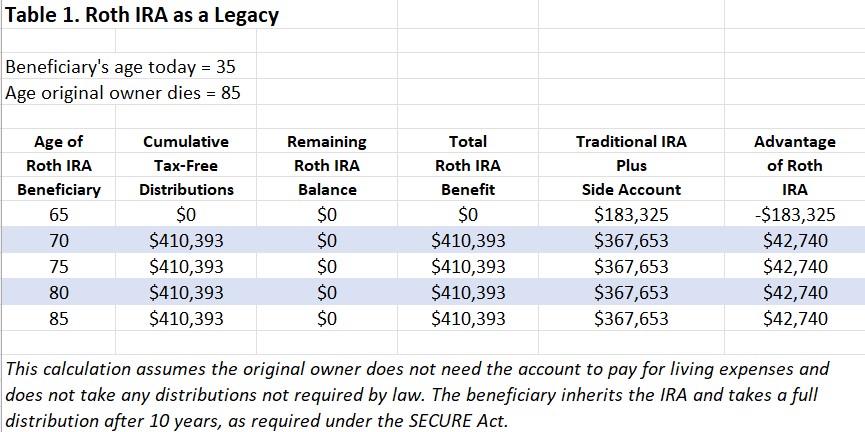
Converting a traditional IRA to a Roth IRA is likely to generate more aftertax wealth than simply emptying the IRA early, as shown in Table 1, and thus will benefit more people.
The basics of a conversion are well known. You include the amount converted in gross income just as though it were distributed to you (except for nondeductible contributions). Once the money is in a Roth IRA, income and gains compound tax-free. Distributions are tax-free after a five-year waiting period. There are no RMDs during your lifetime. Your beneficiaries must take RMDs over their life expectancies and distributions are also tax-free to them.
While most people are aware in general about conversions, there’s a lot of misinformation and misunderstanding. Rule number one about IRA conversions is to ignore rules of thumb and general advice. Each situation is unique and requires careful analysis.
Variables to Consider When Converting a Traditional IRA to a Roth IRA
Several variables must be considered when evaluating a conversion. There’s a lot of interplay between these factors, so don’t use an intuitive approach. Instead, conduct a full analysis that considers as many key factors as possible. Also, see how the results vary when assumptions about the factors are changed. Look at the long-term results, not only the next few years. I recommend developing a spreadsheet, using the many calculators available on websites or working with a financial or estate planner.
Here are the variables to consider:
- Post-conversion period: Returns should compound in the Roth IRA for a period of time to make up for paying taxes early. My research shows that a converted IRA needs at least seven years of compounding at an 8% annual return to make up for the taxes. It takes longer at a lower rate of return or for someone in the top tax bracket. Don’t conclude from this that people older than a certain age shouldn’t convert. Seven to 10 years isn’t a long time for many people, especially when the main goal is to leave the Roth IRA to children or grandchildren. In effect, you are prepaying taxes for them.
- Paying conversion taxes: For maximum benefit, the taxes should be paid from non-IRA funds. If you use IRA funds to pay the taxes, you have to distribute money from the IRA; if you are under the age of 59½, you will also owe the 10% early distribution penalty. (Converted amounts are not subject to the 10% penalty.) That increases the cost of the conversion and increases the payoff period.
- Changes in tax rates: A major factor is any difference between the tax rate in the year of conversion and the future rates in the distribution years. Conversions often make sense when your tax rate will be the same or higher in the future. They are less profitable or take longer to pay off when you’re likely to pay a lower tax rate in the distribution years.
- Amount of all conversion taxes: If you convert a sizable amount, it could push you into a higher tax bracket or trigger stealth taxes, decreasing or eliminating the benefits of the conversion. Don’t forget to consider state income taxes on both ends of the conversion, keeping in mind that some states tax Roth IRA distributions.
- Investment rate of return: The higher the rate of return on the investments, the shorter the payoff period and the more sense a conversion makes. If you plan to invest conservatively for a low rate of return, the payoff period will be longer or might not exist.
- Don’t forget the RMD: When you are at the age of 72 or older, you need to take the RMD for the year before converting any amount.
- Tax diversification: A conversion can be a good idea even when the financial analysis doesn’t show a clear benefit, because the conversion gives you tax diversification. You can’t know what the tax law will be in 10 or 20 years. Tax diversification gives you more flexibility and better control over your tax bill in the future and can reduce the damage from major tax law changes. It’s probably safer to have some money in taxable accounts, tax-deferred accounts and tax-free accounts.
Maximizing the Benefits of a Conversion
There are actions that can improve the probability that a conversion will increase aftertax wealth.
An IRA doesn’t have to be converted all at once. You can convert an IRA in stages over a period of years in whatever increments work for you. For example, you can convert just enough each year to avoid rising into the next tax bracket or triggering stealth taxes.
The traditional IRA can be converted into multiple Roth IRAs, placing a different type of asset in each Roth. After a while, you can consolidate all the Roth IRAs into one.
If a conversion doesn’t make sense this year, don’t consider that a final decision. In a future year, you might fall into a lower tax bracket because of a job change or some other factor. You might have unusually large tax deductions or have more cash to pay conversion taxes than this year. Revisit the decision any time there’s a change in your finances.
Make your decision about an IRA conversion carefully because a conversion no longer can be reversed.
3. Buying Life Insurance With RMDs
An alternative strategy is to convert a traditional IRA into a permanent insurance policy. In addition to being guaranteed, the life insurance benefit could very well be higher than the starting IRA balance, depending on your age, health and the type of policy. Someone who is a good candidate for conversion to a Roth should also consider life insurance strategies.
There are many different ways to convert a traditional IRA to permanent life insurance. I’ll review a few.
In the first strategy, take distributions from the traditional IRA each year for a period of years and use them to pay insurance premiums. For example, a 65-year-old man in average health with a $500,000 traditional IRA can distribute $166,000 each year for three years to pay the premiums on an indexed universal life insurance policy with a benefit of just over $2 million. The policy will also have a cash value account that the owner can tap through either distributions or tax-free loans. (Details of the policy benefits and premiums will vary based on your age, health and the economic and life expectancy assumptions the insurer uses.)
The distributions of course will be included in gross income and taxed as ordinary income. The taxes can be paid from the distributions, reducing the amount available to pay premiums and the policy benefit amount, or the taxes can be paid from other funds or from borrowing from the cash value account. Loans will be tax-free, but will reduce the benefit eventually paid to policy beneficiaries if they aren’t repaid. The advantage of paying the taxes with a loan is that you convert the traditional IRA to life insurance without using any cash.
The second strategy is good at any age, but it is especially good for someone who’s already taking or about to take RMDs. It consists of these steps:
- Name your spouse as the primary beneficiary of the traditional IRA and a charity (or a donor-advised fund) as the contingent beneficiary.
- Take out a permanent life insurance policy owned by an irrevocable trust with your children or grandchildren as beneficiaries. A joint and survivor policy issued to you and your spouse is likely to have the best results and a benefit about equal to the current value of the IRA.
- Take RMDs or other distributions from the IRA each year and contribute them to the trust to pay the premiums. Use additional funds to pay the taxes or pay taxes out of the distributions by coordinating the insurance benefit and distributions. The gifts to the trust likely will qualify for the annual gift tax exclusion, so there shouldn’t be any gift tax consequences.
After one spouse passes away, the surviving spouse continues to use distributions from the IRA to make gifts to the trust to pay the premiums. After both spouses die, the charity receives the IRA balance. The life insurance policy pays its benefit to the trust, and the trust makes income and principal distributions to the beneficiaries according to the terms you put in the trust.
The beneficiaries should receive a tax-free amount that was at least equal to the initial value of the IRA. After taxes, they receive more from the trust than they would have from inheriting the traditional IRA. They also avoid any reduction in the value that might have occurred from RMDs during the parents’ lives and from poor investment returns. In addition, the IRA remains intact during the parents’ lives, giving them access to the money if needed. They are also able to benefit a charity by naming it the contingent beneficiary of the IRA.
A third life insurance strategy is sometimes known as the Family Bank Strategy.
The IRA is distributed to the owner, who uses the aftertax amount to make a single-premium deposit on a permanent life insurance policy. The cash value portion of the policy should earn interest each year of about 5% to 8% that will compound tax-free. Eventually, the policy beneficiaries receive the life insurance benefit free of income taxes. During the owner’s lifetime, if money is needed, they can borrow against the cash value of the policy. The cash value loans are tax-free. If they aren’t paid back, the loan amount and accumulated interest reduce the death benefit paid to beneficiaries. [Editor’s note: The loans of cash value are tax-free as long as the policy stays in force. If you surrender the policy or it lapses for any reason—such as nonpayment of premiums or borrowing too much of the cash value—the outstanding loans will be treated as income paid to you under the tax code. Always check with your insurance agent or insurer before taking a loan.]
A variation of this strategy is to make annual premium payments instead of a lump-sum premium. Each year distribute only enough of the IRA to avoid rising to the next tax bracket.
The major advantages of each of these strategies are that the life insurance benefit is likely going to be worth substantially more than the money transferred into the policy and, unlike an IRA, market changes aren’t going to cause the insurance policy’s value to decline. If loved ones inherit a traditional IRA, they’ll really inherit the aftertax balance, and the balance will change with the markets.
Life insurance strategies can be customized for your situation. The premium payment schedules can vary. Also, the amount of the cash value and your access to it can vary by the type of policy selected. These are not do-it-yourself strategies; you will need to talk to a professional who is well-versed in them.
4. Charitable Distributions
The charitably inclined who are age 70½ or older might avoid the negative effects of RMDs by using the qualified charitable distribution (QCD).
Normally, when a charitable contribution is made from a traditional IRA, the contribution is treated as a distribution and included in your gross income. You receive a charitable contribution deduction if you itemize expenses.
With the QCD, however, the charitable contribution is not included in gross income, yet it counts as all or part of the RMD for the year. You don’t take a deduction for the contribution, so there effectively are no income tax consequences to the QCD.
You must be over age 70½ at the time of the contribution for it to be a QCD. The contribution also must be made directly from the IRA custodian to the charity, or you can be given a check made out to the charity and deliver the check. The QCD is available for up to $100,000 of charitable contributions annually.
5. Qualified Longevity Annuity Contracts
A qualified longevity annuity contract (QLAC) can defer RMDs. A QLAC is an annuity that defers income payments to you for two years or longer. IRS rules say that when an IRA owns a QLAC, the amount invested in the QLAC isn’t counted when calculating your RMD for the year. The QLAC must begin paying you income by age 85.
In a QLAC, you give a lump sum to an insurer and tell it when to begin making regular payments to you. The insurer tells you what the amount of the payments will be and promises to continue them for the rest of your life. Once the payments begin, they are included in your gross income.
How to Choose the Right RMD Reduction Strategy
RMDs can disrupt a lot of financial planning, especially for IRA owners who don’t need the bulk of their IRAs to fund retirement expenses. Fortunately, a range of strategies is available to reduce the negative effects of RMDs. The strategies have the potential to leave you and your heirs with more aftertax wealth than simply holding the traditional IRA and taking the RMDs.
Choosing the best strategy for you requires some rigorous financial analysis. Don’t rely on rules of thumb or someone else’s decision. There are many variables that interact with each other, making each situation unique. Use all the resources available to determine whether you should stick with the traditional IRA, distribute the IRA early, convert to a Roth IRA, convert to a life insurance policy or use another strategy.
Additional Resources About RMD Strategies
Approaching the age when you need to start taking your RMDs or figuring out an effective withdrawal strategy that fits your needs can feel daunting. If you’re looking for additional resources and educational materials about RMD strategies, check out the list of articles we’ve compiled below:
- Asset Allocation, RMDs and Portfolio Survival
- Many Retirees Limit Withdrawals to the RMD Amount
- When Is the Best Time to Take Your RMDs?
This article was originally published in the October 2017 AAII Journal. Click here for a PDF of the original article.
Related
Investor Professor
Online Exclusive: Roth IRA vs. Traditional IRA—Differences You Should Know
Related
Portfolio Strategies
Asset Allocation, RMDs and Portfolio Survival
Discussion
FREE REPORT

Get your free copy of our special
report analyzing the tech stocks
most likely to outperform the
market.
Allan Martin from NJ posted over 9 years ago:
Paul Arnold from LA posted over 9 years ago:
Michael Carlin from OH posted over 9 years ago:
Don Mc Auley from IN posted over 9 years ago:
P Hendrickson from WA posted over 9 years ago:
Lewis Christman from PA posted over 9 years ago:
Patrick Schmitzer from CA posted over 9 years ago:
H Mercer from TX posted over 9 years ago:
Dave Gilmer from WA posted over 8 years ago:
Peter Hansen from Fl posted over 8 years ago:
Donald Myers from AZ posted over 8 years ago:
James Schmirler from WI posted over 8 years ago:
William Andrews from Florida posted over 6 years ago:
D RANDALL S from CO posted over 4 years ago:
K Z from WV posted over 4 years ago:
BARRY J from TX posted over 2 years ago:
You need to log in as a registered AAII user before commenting.
Log InCreate an account