


Related

Portfolio Strategies
An objective analysis of diversification calls into question the conventional wisdom that 15 to 20 stocks suffice, in this article from the January 1990 AAII Journal.

It is human nature for investors to make decisions using both intuition and actual analysis. Frequently an intuitive opinion and an objective evaluation are complementary and support the same conclusion.
Unfortunately, there are times when the intuitive and analytical approaches conflict, particularly in situations that involve probabilities and uncertainty. A number of studies of highly educated and experienced people have found that their gut reaction to risk differs considerably from their conclusions based on an analytical assessment. Furthermore, there is a particular case in which intuition and the conventional interpretation of analytical results combine to increase risk for investors. The following example demonstrates the potential problem.
Suppose a broker recommends four stocks, three of which outperform the market. Another broker suggests 20 stocks and 12 of them do better than the market. In which case is the evidence stronger that the broker is doing a good job?
Most people decide that the evidence is stronger in the first case because the 75% success rate is much higher than the 60% rate in the second. However, statistical analysis indicates that there is a 30% chance of choosing three or more winners with four selections, compared to only a 25% chance of picking 12 or more winners with 20 recommendations.
This example demonstrates the statistical law of large numbers: Large samples are more reliable than small samples. The chances are very good of getting three heads with only four tosses of a coin. But with many tosses, the chances of getting a result so different from the true odds of 50-50 are very small. Nevertheless, the general finding is that people usually ignore this basic principle and consider small samples as reliable as large ones. Tongue-in-cheek, some have called this the law of small numbers: People tend to believe that the law of large numbers applies to small numbers.
A belief in the law of small numbers may lead an investor to underestimate the need for diversification and bear unnecessary risk. Yet statistical analysis will show that the chances are quite high that a small sample of stocks will produce a return that is substantially below the market average.
An analytical assessment of investment risk begins by breaking total uncertainty into two components: the general risk of variations in the market return and the specific risk of variation in individual stock returns. Figure 1 indicates the magnitude of this second component of risk by showing the tremendous variation in the rates of return of the 1,528 stocks listed on the New York Stock Exchange during 1988. The horizontal axis shows the rate of return consisting of dividends and capital gains, and the vertical axis reports the percentage of stocks that achieved those returns. The graph indicates that 21% of all stocks produced returns that ranged between 10% and 20%. A 51% majority of stocks had returns between 0% and 30%. For the 1,528 stocks listed on the New York Stock Exchange for the entire year, the average return was 19%.
There is nothing that investors can do about general market uncertainty. Individual investors simply have to accept the risk associated with swings in the market if they are investing in the stock market and desire the returns related to this risk. The specific risk of choosing particular stocks, on the other hand, can be reduced with diversification. Spreading an investment over many stocks reduces the chances of a return substantially below the market average. The probability of all the stocks doing poorly is small, and the negative effects of a few bad choices are diluted within the large portfolio.
The practical problem is simply determining how many stocks are necessary in order to achieve the benefits of diversification. The conventional wisdom based on a number of analytical studies is that investing in only 15 to 20 stocks provides the benefits of diversification. This advice reinforces the “law of small numbers” intuition that a small sample of stocks will accurately reflect the overall result of the stock market. In fact, investing in 15 to 20 stocks does not nearly exhaust the risk-reducing advantages of diversification. Many investors will choose to invest in far more than 20 securities in order to reduce risk to an acceptable level.
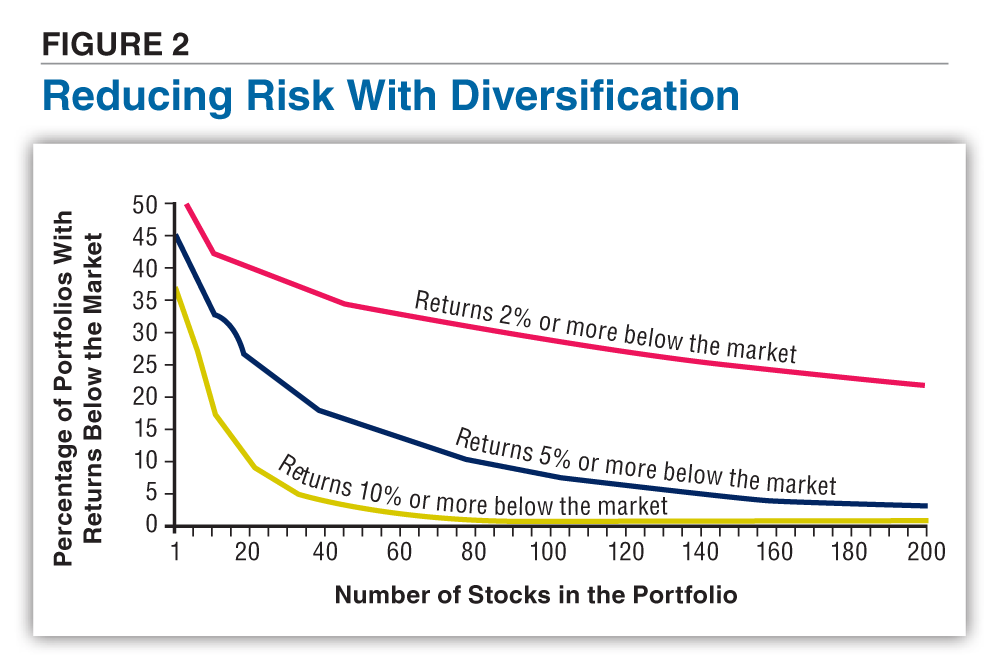
The information in Figure 2 allows an investor to make an informed choice about the appropriate level of diversification and risk. This graph shows the returns for all possible portfolios drawn from the 1,528 securities listed on the Big Board. The horizontal axis indicates the number of stocks in the portfolio, and the vertical axis shows the percentage of these portfolios with a return substantially below the market.
How do you interpret these results? Figure 2 demonstrates that 10% of all portfolios consisting of 20 stocks had returns that were below the market average by 10% or more. Moreover, 26% of these 20-stock portfolios were under the market by 5% or more and 40% by 2% or more. Clearly, there is a substantial amount of risk that can be avoided by diversifying beyond 20 stocks. An investor willing to accept only a 10% chance of missing the market by 5% or more needs to diversify across 80 stocks. Put another way, the closer an investor wants to get to the market rate of return, the more diversification is necessary: An investor willing to accept a 30% chance of missing the market by 5% or more can diversify among only 18 stocks, but if the investor wants a 30% chance of missing the market by only 2%, he must diversify among at least 90 stocks.
Figure 2 shows that, compared to investing in only one stock, diversifying across 20 stocks produces a substantial reduction in risk: The chance of a return 5% below the market falls from 47% to 26%. However, adding 20 more stocks (for a total of 40 stocks) to the portfolio only reduces the risk from 26% to 18%. The fact that reductions in risk are increasingly difficult to achieve is the source of the conventional wisdom that 20 stocks adequately provide the benefits of diversification.
Some analysts see the slow reduction of risk apparent in the graph and conclude that diversification beyond a small number of securities is not worthwhile. A far better conclusion is that the slow rate necessitates diversification across a large number of stocks in order to eliminate the substantial amount of specific risk. Figure 2 demonstrates that the law of small numbers is not valid; in fact, investing in a large number of stocks is necessary to approximate the performance of the market with some reasonable degree of confidence.
The wide swings in stock prices in recent years furnish convincing evidence that investing in the stock market is a very risky business. There is no need for an investor to bear both the general risk of changes in the market and also the risk of choosing specific securities. This latter component of total risk can be reduced with diversification.
However, individual investors ought to be aware that following the conventional wisdom of diversifying across only a small number of stocks still leaves a considerable amount of specific risk. The information presented in Figure 2 permits an investor to make an informed decision about the appropriate level of diversification and risk. The results also make a strong case for investing in common stock mutual funds that are diversified, since many individual investors would find it impractical to invest in the large number of stocks suggested here on their own.
Portfolio Strategies

Stock Strategies

Portfolio Strategies

No comments have been added yet. Add your thoughts to the discussion!
You need to log in as a registered AAII user before commenting.
Log InCreate an account