


Related

Investor Professor
The dates used to determine who is eligible to receive a dividend and when it will be paid can affect when you should buy or sell stock.

Derek Hageman leads a class in AAII's new Essential Investing Video Course. Go to https://www.aaii.com/ves for more information and to subscribe.
Stocks that pay dividends provide investors with a periodic source of income. The declaration of a dividend is accompanied by various key dates. These dates are used to determine who is eligible to receive the dividend and when the dividend will be paid. They are important dates that should be understood and considered before buying or selling stock.
The four dates that are essential for dividend investors are:
The first important date for dividend investors is the declaration date. The declaration date is the date that the board of directors announces a dividend. The statement typically includes the size of the dividend, the date of record and the payment date. Once the dividend has been declared, the company has a legal responsibility to pay it.
The next important dividend date is the date of record (or record date). The company sets a date of record on or before which you must be “on the company’s books” in order to receive the declared dividend. Shareholders who are not on the company’s books do not participate in the company’s dividend distribution.
Once the record date is set, the ex-dividend date can be determined, which is widely regarded as the “most important dividend date.” Shareholders must purchase the stock before the ex-dividend date in order to receive the cash dividend. This means that if you purchase shares on or after the ex-dividend date, you are not eligible for the payment and the seller of the stock will receive the dividend.
The U.S. Securities and Exchange Commission (SEC) sets the ex-dividend date, not the company paying the dividend. The SEC sets the ex-dividend date to one day before the record date, so that buy and sell information is captured before the record date. The time difference between the dividend record date and ex-dividend date allows the necessary time to prepare paperwork and electronic records.
The SEC previously used the T+2 rule for the ex-dividend date, meaning it was set two days before the dividend record date. The period was reduced in September 2017 to one business day (T+1) before the record date. Business days are defined as working days with the exception of weekends and major public holidays when U.S. stock exchanges and banks are typically closed. For example, if the record date is a Monday, then the ex-dividend date will be adjusted to the prior Friday, not Sunday, because weekends and holidays do not apply.
The ex-dividend date also represents the date at which the stock’s price is adjusted. When a stock trades ex-dividend, its price is adjusted downward by the dividend amount because the payment of a dividend generally represents a reduction in the company’s capitalization. The cash dividend transfers assets from the company to the shareholders and its market value (share price times number of outstanding shares) adjusts on the ex-dividend date to reflect the decrease in assets. This is not typically easily observed amid the up and down movements of normal trading. Don’t worry, you’re not losing any value in your investment on the ex-dividend date; the adjustment simply reflects the forthcoming transfer of cash from the company to its shareholders.
Learning Objective: Ex-Dividend Date
If an investor purchases shares of a company on its ex-dividend date, which of the following statements is accurate? The solution to this question is provided at the end of the article.
A) The investor will receive the dividend when it is paid by the company.
B) The investor will not receive the dividend when it is paid by the company.
C) The investor will receive a portion of the dividend when paid by the company.
D) The investor will receive the dividend when it is paid by the company and receive a $20 Starbucks gift card.
The payment date is the last of the four dividend dates. The dividend cycle ends on the payment date, when the company actually pays the dividend. The payment, or payable, date is usually between two to four weeks after the record date to give the company registrar time to account for the shareholders and prepare the payments. The payment date does not have to be a business day. It can also occur on a weekend or holiday.
On January 29, 2020, BlackRock Inc.  (BLK) issued a news release titled “BlackRock Declares Quarterly Dividend of $3.63 on Common Stock” and simply said:
“NEW YORK--(BUSINESS WIRE)--BlackRock, Inc. (NYSE: BLK) today announced that its Board of Directors approved a 10% increase in the quarterly cash dividend to $3.63 per share, payable March 23, 2020 to shareholders of record at the close of business on March 5, 2020.”
Many companies declare their quarterly dividend along with the quarterly earnings results, although some make the announcement just before or after the quarterly performance announcement. BlackRock declared this dividend two weeks after it reported its fourth-quarter and full-year 2019 results.
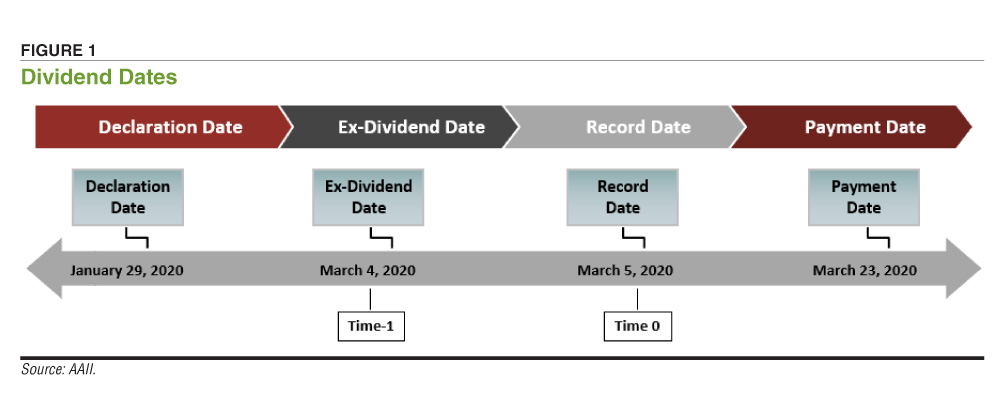
Let’s use the BlackRock example above to illustrate the four important dates for dividend investors.
To summarize, if you buy a stock before the ex-dividend date, then you will receive the next upcoming dividend payment. If you purchase the stock on or after the ex-dividend date, you will not receive the dividend.
(The solution to the question in the box is B. The investor will not receive the dividend when it is paid by the company.) ▪
Investor Professor

Stock Strategies

Investor Professor

Elmar Lawaczeck from Alabama posted over 6 years ago:
Charles Rotblut from IL posted over 6 years ago:
Bill Schrader from Idaho posted over 6 years ago:
Jim M from New Jersey posted over 6 years ago:
JOHN S from MS posted over 6 years ago:
Frank G from NY posted over 5 years ago:
GREG W from MI posted over 5 years ago:
Thomas M from CAN posted over 4 years ago:
You need to log in as a registered AAII user before commenting.
Log InCreate an account