

Related

Financial Planning
Increasing Social Security’s full retirement age (FRA) does not cause a lockstep change in retirement timing.
by AAII Staff | July 2020

Increasing Social Security’s full retirement age (FRA) does not cause a lockstep change in retirement timing.
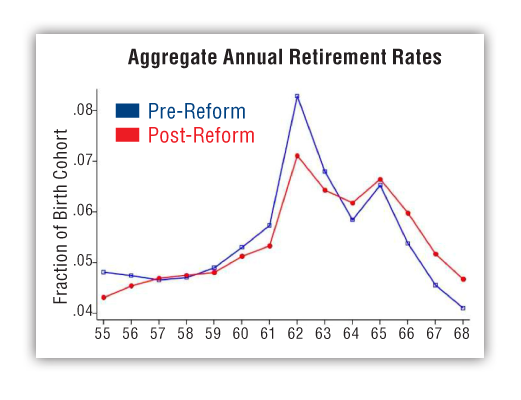
When the FRA was increased from age 65 to 66 because of the 1983 Social Security Act Amendments, most continued to retire at age 65, which was the old FRA.
The change in the FRA was made to reduce the cost of Social Security and because Americans were both living longer and had the capacity to work longer. The change also caused meaningful changes in the labor market and in Americans’ choices around retirement that showed this persistent pattern.
To measure the change, researchers looked at the benefit claiming habits and labor force exit timing for retirees at the Early Eligibility Age (EEA) of 62 before the reform, at the old FRA of 65, and the newer FRA post-reform of 66 (for those born between 1943 and 1954). The data showed that independent of other variables, such as gender and year of the cohort, most workers still timed their retirement and exit from the work force at 65. However, the change to the new FRA of 66 did cause many retirees to claim their actual Social Security benefits later than 65.
The researchers also investigated why this phenomenon might be happening, including whether there was a delay in learning and adjustment about the new FRA, eligibility for health insurance through Medicare, geographical location (specifically people who moved from one employer to another as they approached retirement age from 50 to 60), and whether employer-provided pensions played a role in retirement behavior. The strongest evidence for shifting retirement behavior was for those who moved between employers and workplaces where more individuals retired at 65, suggesting that employers play a significant role in shaping the retirement decisions of their employees in relation to Social Security’s FRA.
Source: “How Sticky Is Retirement Behavior in the U.S.? Responses to Changes in the Full Retirement Age,” by Manasi Deshpande, Itzik Fadlon and Colin Gray; National Bureau of Economic Research, May 2020.
Financial Planning
Financial Planning

No comments have been added yet. Add your thoughts to the discussion!
You need to log in as a registered AAII user before commenting.
Log InCreate an account