Financial literacy plays an important role in investors’ decision-making.
Using data from a 2018 survey of 350,000 Japanese households and the Research Institute for Socionetwork Strategies (RISS), the study’s authors discovered that investors with a high level of financial literacy “take too many risks, overborrow, and hold naïve financial attitudes.” However, this high level of financial literacy also lends itself to better retirement planning, since people with more financial literacy are more likely to have a retirement savings plan. In addition, “financially literate households earn higher financial returns than illiterate ones.”
In looking closer at the correlation between financial literacy and investment behavior, the study’s authors found that “the effects of perceived financial literacy may be confused with the effects of the actual one.” This is where they discovered that some investors could believe they are more financially literate than they are. In this way, financial literacy can make people “more daring and reckless financially.”
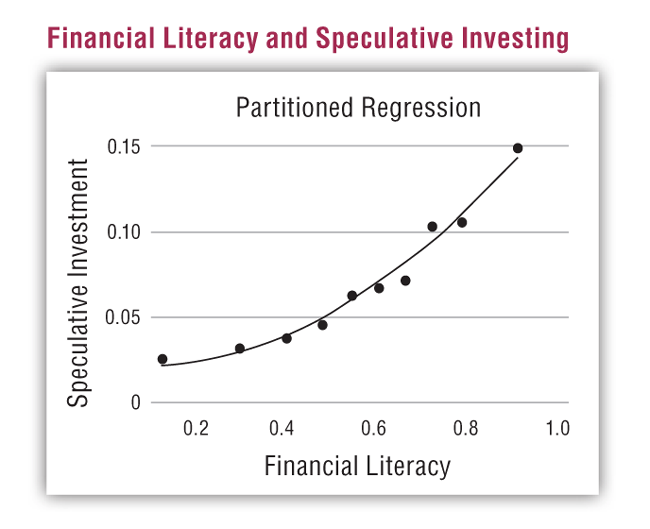
Investors who believe they are more financially literate than they actually are have increased confidence in their ability without any substantial increase in their financial ability. They could also be holding more risky assets or overborrowing. The study’s authors continue, “Experts in finance become overconfident when making certain highly unpredictable financial decisions, such as speculative investment, but, in contrast, are good at making predictable financial decisions, such as retirement planning.”
When it comes to the unpredictable, the researchers encourage further financial education. They believe financial education that stresses “the dangers of reckless financial behaviors,” as well as the importance of financial literacy, will provide a more well-rounded approach. They conclude, “the aim of this education should be not only about teaching financial economics but also about ensuring consumer protection through teaching about the dangers inherent in financial literacy.” They also ask for the further research on this topic to include the general population.
Source: “Is Financial Literacy Dangerous? Financial Literacy, Behavioral Factors, and Financial Choices of Households,” by Tetsuya Kawamura, Tomoharu Mori, Taizo Motonishi and Kazuhito Ogawa; SSRN, July 2020.







No comments have been added yet. Add your thoughts to the discussion!
You need to log in as a registered AAII user before commenting.
Log InCreate an account