

Related

Exchange-Traded Funds
A look at attitudes of AAII members to the historic low interest rates and the Federal Reserve’s intention to keep rates low.

Charles Rotblut leads a class in AAII's new Essential Investing Video Course. Go to https://www.aaii.com/ves for more information and to subscribe.
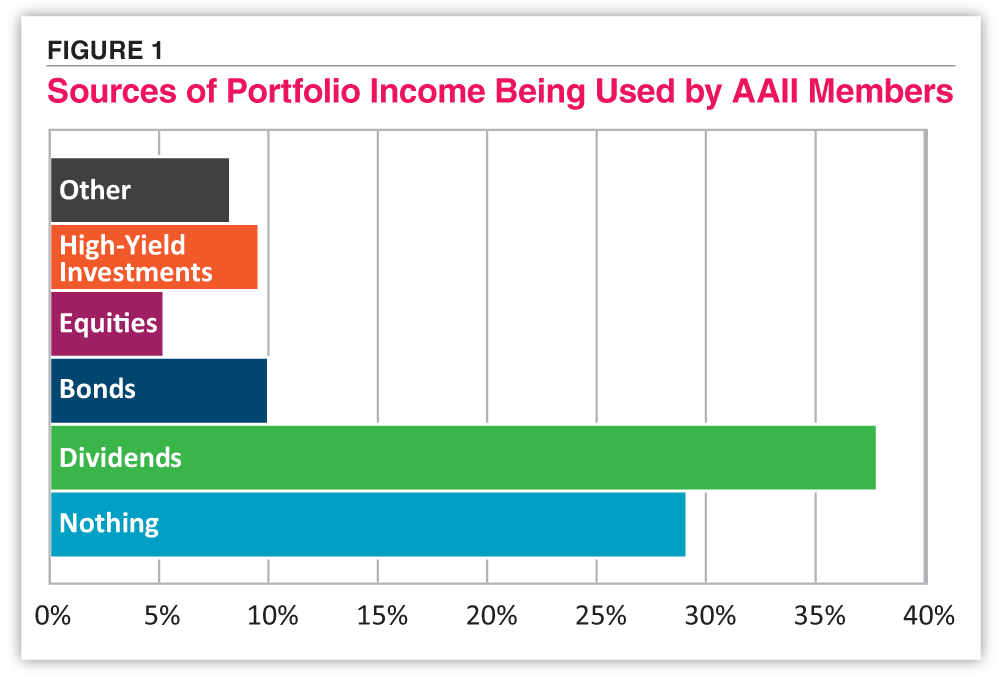
Many individual investors are relying on stocks to provide portfolio income in the current interest rate environment. While not every individual investor is making portfolio income a priority, those who do seek income are primarily turning to dividends.
More than two out of every five surveyed AAII members told us that they are relying on stocks and other types of equity investments for income. This is not surprising given the low yields on bond investments and the Federal Reserve’s current intention to keep interest rates between 0% and 0.25% for an extended period of time.
These responses came from our latest “big question” survey. The survey focused on the current interest rate environment and what investors are doing in response. We asked AAII members about their sources of portfolio income, their allocations, their cash savings and what they thought about the Fed’s current plans for interest rates.
The survey is part of a periodic initiative to give individual investors a chance to talk about their investment decisions and challenges. Each survey asks what we’re describing as a “big question” about a subject affecting many investors. A randomly selected group of AAII members is asked a specific question, as well as follow-up questions intended to provide more clarity and background.
This fifth survey in the series was emailed to AAII members in July 2020. The results were tabulated based on responses sent to us. We received 230 responses from the survey invitation. The average age was 71 with a range of ages from 40 to 91.
Q: Given the current low interest rates, what are you doing to realize portfolio income?
About 38% of respondents told us they are relying on dividends for income (Figure 1). An additional 10% said they are relying on bonds, while another 10% hold what they categorized as high-yield investments. Though most respondents are in their 60s and 70s, nearly one-third said they aren’t doing anything in particular to realize portfolio income.
Dividend stocks, in general, are popular among those surveyed. Nearly two-thirds (66%) invest in dividend-paying stocks directly or via mutual funds, exchange-traded funds (ETFs) and/or closed-end funds (which we refer to collectively as “funds” here). The difference between the percentage of respondents that own dividend payers and the percentage that rely on dividend stocks for income can be attributed to other reasons for holding such stocks and funds.
Exposure to income-producing stocks was not limited to dividend stocks. Real estate investment trusts (REITs) were held in 15% of respondents’ portfolios. Almost 7% of respondents allocate to preferred stocks. Covered call options—a strategy used to realize income by selling call options on owned stocks—were used by just under 4% of respondents.
AAII member William Hall is among those to have increased their equity exposure. “I am buying dividend-paying stocks and closed-end funds. I am looking at increasing dividend stocks and decreasing bond funds. In addition to reducing my bond exposure, I am shortening the duration of my bond funds,” explained Hall.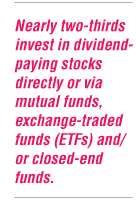
Jules Van Denack also increased exposure to equities, writing, “I moved 10% of portfolio to a high-dividend fund. My portfolio is currently 70% stocks, 25% bond funds and 5% cash.”
Nevertheless, 70% of all respondents have an allocation to fixed-income investments. This can be explained by the fact that many who hold bonds aren’t relying on them as a key source of income. Furthermore, 18% of all respondents told us their current exposure to fixed-income investments is lower than it previously was.
Proportionately few of the individual investors who allocate to bonds are holding long-term bonds/bond funds (just 20%). Rather, they are holding short-term, high-quality bonds (40%) and/or intermediate-term, high-quality bonds (44%). About 24% are taking on more credit risk by holding high-yield bonds. (Respondents were allowed to choose more than one answer. The question grouped individual bonds and bond funds together for each fixed-income category.)
Among those who aren’t taking on more risk to achieve a higher yield is Carl Altenburg. “Not stretching for yield, no reward in it,” he wrote. “I’m investing maturing bonds in short duration, low-management-fee funds, mainly ETFs, at least until yields exceed inflation. It’s a painful wait.”
Q: How have low interest rates influenced the percentage of your portfolio allocated to stocks and stock mutual funds/ETFs?
One adage often referred to in the ongoing environment is “there is no alternative” (TINA) to stocks. Given the perception of TINA being a driving force behind higher equity exposure, we directly asked survey respondents how the low interest rates have influenced their allocation decisions.
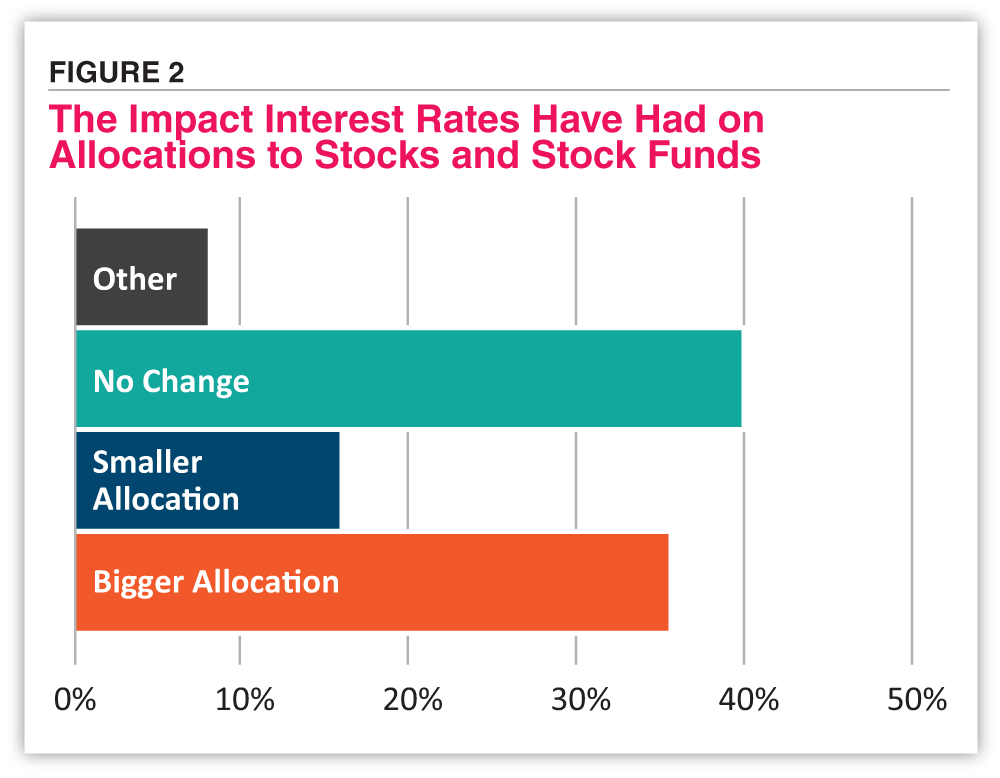
More than two out of five respondents (40%) said they haven’t changed their allocations because of low interest rates (Figure 2). Conversely, more than one-third of respondents (36%) said they have increased their exposure to stocks and stock funds because of low interest rates. In what may be surprising to some, 16% of respondents reduced their equity exposure because of low interest rates.
“Low interest rates are not influencing my portfolio allocations,” Roy Lozano Jr. told us. “I am keeping steady with the portfolio allocations I have established as part of my investment policy/plan.”
Q: Please explain what your allocation to stocks, REITs and equity-focused funds currently is relative to what you think it would be if interest rates were closer to their historical averages.
Viewing allocation from a different perspective, we asked respondents how their portfolios might be different if interest rates weren’t so low. Two out of five respondents (40%) said they would have greater exposure to bonds. About 11% said they would have a greater exposure to REITs, while 7% said they would hold more in stocks.
Louis Kleiman thinks his allocation to equities would be lower because “higher interest rates would probably influence me to move more money into cash in banks.” In a separate email, he added, “I’d put more cash into my ultra-safe emergency fund in the online bank account paying the highest interest rate I can identify.”
“I am fully retired now, and it seems very difficult to generate enough income using REITs or bond funds/ETFs,” responded John Usher. “I think I would have more in these areas if interest rates were closer to their historical averages.”
 Nearly one-third of surveyed AAII members (31%) think their portfolio allocations would not be any different if interest rates were higher. This group included Ward Harris, who answered, “Interest rates have very little impact on my portfolio, and I don’t think I would allocate my investments any differently with higher interest rates.”
Q: What impact have low interest rates had on your withdrawal strategy?
Since many AAII members are retired (including 83% of the survey’s respondents), we wanted to know if the current interest rate environment has altered their withdrawal strategy. Slightly more than 53% of retired respondents said it hasn’t had an impact, while 47% said low interest rates have only had a modest impact.
Many respondents told us that they limit withdrawals to the required minimum distribution (RMD). Peter Barnum is among them. “So far I have been able to make do with only the required amount each year from my traditional IRA.”
Q: Have you done anything to realize a higher interest rate on your cash savings?
Another area where low interest rates have had a noticeable impact is on the interest paid on savings and money market accounts. Again, the split in how individual investors have reacted was noticeable. About 38% have taken steps to realize a higher rate of interest, while 57% have not.
 Of those respondents who shared what steps they have taken, the most common action was to change banks. Many switched to an online bank/ financial institution to get higher rates. Many AAII members sought out higher yielding certificates of deposit (CDs) and/or money market funds as well.
Art Hansen told us he “looked for banks offering higher rates and took money from [his] checking account and lower-interest accounts to place with banks with higher rates.” In a follow-up, he added, “After estimating my probable expenses for the next year, I kept that amount in savings accounts and put the rest in higher-rate CDs.”
Q: Do you agree with the Federal Reserve’s decision to keep interest rates at current levels potentially through 2022?
The low-interest-rate environment is a reflection of both the economic environment and the ongoing accommodative stance by the Fed—including the monetary stimulus it has provided during the coronavirus pandemic. So, our final questions asked AAII members whether they thought the Fed should keep interest rates at current levels for an extended period of time, and the rationale behind their opinion.
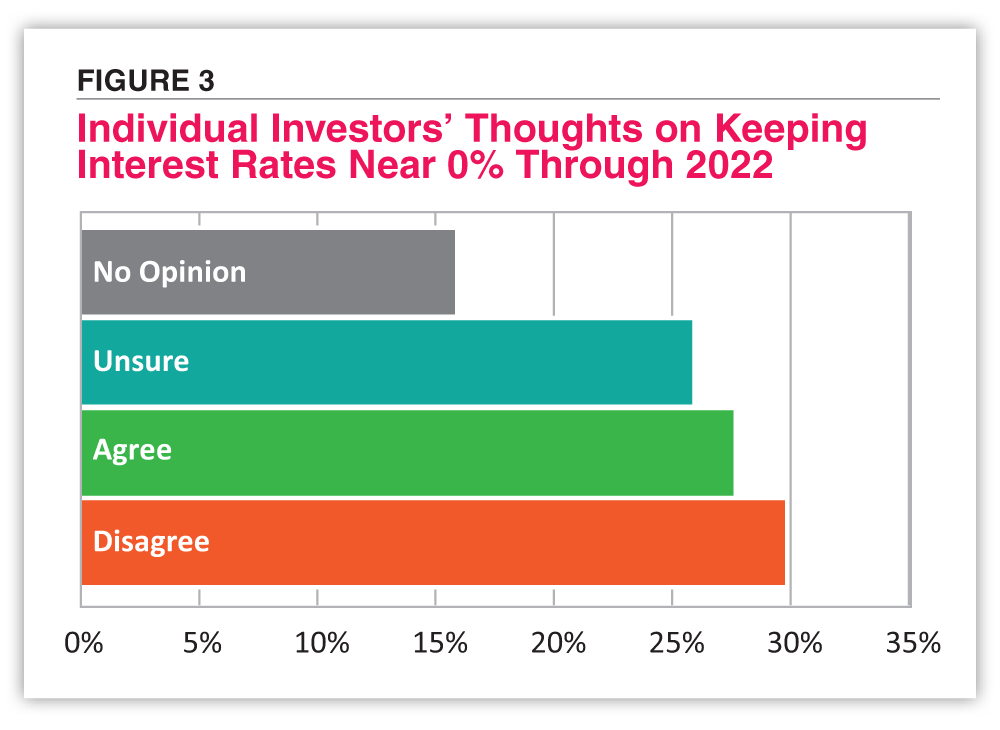
Once again, respondents were split (Figure 3). Nearly the same percentage said they agree with the decision to keep the interest rate target range at 0% to 0.25% potentially through 2022 as said they disagree with the decision (28% versus 30%). An additional 26% said they were unsure if the Fed should keep rates low for such a lengthy period of time.
As to the primary reasons why, 19% of respondents view the low rates as stimulating the economy and helping businesses. Conversely, 12% of respondents think that the current monetary policy is bad for the stock market, and 13% worry that it could lead to long-term inflation.
Malcolm Buxton says he expects “the economy to continue to struggle due to the coronavirus pandemic through all of 2021 and possibly into 2022.” As such, he thinks “the low interest rates stimulus would be appropriate.”
Bill Kittler shared an opposite viewpoint: “It is contributing to a large number of ‘zombie’ companies and misallocation of capital, and an overloading of corporate debt to do share buybacks.” In a follow-up email, he added, “cheap money is addictive, and the withdrawal of it will be extremely painful, as evidenced by the so-called ‘taper tantrums’ engendered by Fed tightening after the 2007–2009 financial crisis. The current situation reminds me of the lead-up to that crisis, when every attempt to tighten mortgage lending standards led to the evaporation of loan volume and capitulation on the part of lenders, setting up an inevitable day of reckoning.”
Bill Boyle also expressed concern: “I’m afraid it will contribute to inflation in the long term and removes one option if the economy should falter in the near term.”
Exchange-Traded Funds

Stock Strategies


RONALD M from PA posted over 6 years ago:
RON H from OH posted over 6 years ago:
You need to log in as a registered AAII user before commenting.
Log InCreate an account