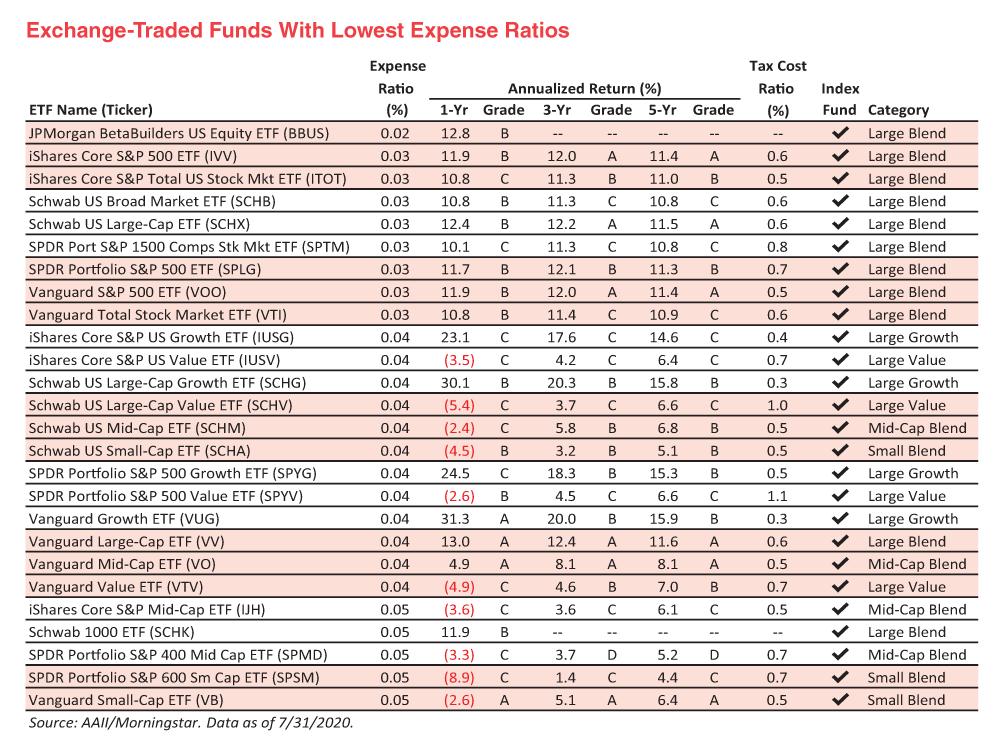
Exchange-traded funds (ETFs) are known for having low expense ratios, but some have extremely low expense ratios. This month’s ETF First Cut identifies 26 domestic equity ETFs charging 0.05% or less. A 0.05% expense ratio is equivalent to paying to $0.50 for every $1,000 invested.
ETFs classified as investing in large-cap stocks account for the overwhelming majority of the passing funds. This may be partially due to the reduced trading costs and higher demand for these types of stocks. Even those large blend funds targeting a broader range of stocks tend to hold market-capitalization-weighted portfolios, meaning large-cap stocks account for a larger portion of their portfolios. A handful of mid-cap and small-cap ETFs make the list as well.
Several of the passing ETFs have experienced good relative performance, as can be seen by their AAII grades (scale of A–F). Not all have. A grade of C next to the annualized return implies that the ETF’s performance is about average for its group. This is likely most attributable to the index that an ETF is designed to track relative to its peers. Nonetheless, all things being equal, a lower cost will give a fund a relative advantage.
The passing funds here have a minimum asset size of $100 million. ETFs smaller than this are at greater risk of being closed for failing to have achieved a significant size. The size requirement was not included in the full screen results; this list, updated monthly, is available to A+ Investor subscribers at First Cut Screens in the ETFs section of AAII.com. ▪





STEVEN H from IN posted over 6 years ago:
BARRY E from CA posted over 6 years ago:
You need to log in as a registered AAII user before commenting.
Log InCreate an account