


Related

Small Cap Value Investing
Turnover in the Model Shadow Stock Portfolio was highest during the challenging year of 2007 and may increase later this year.

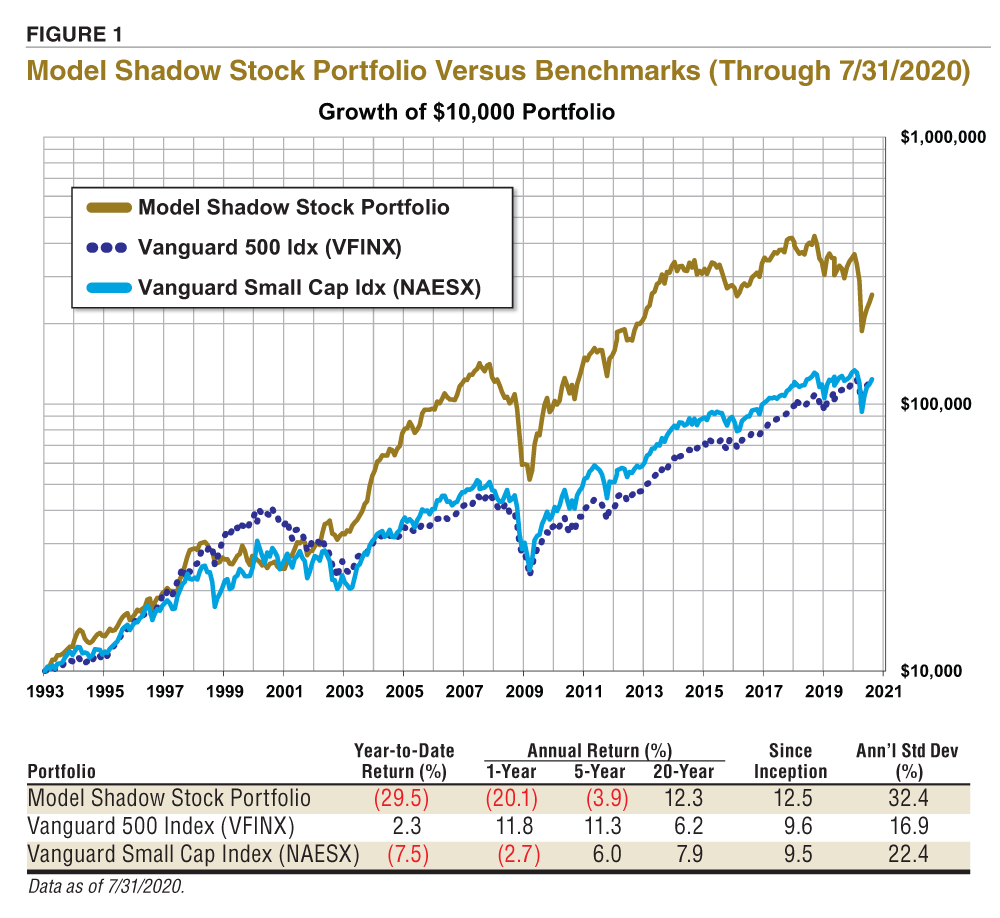
The Model Shadow Stock Portfolio has gained 36.8% since the end of March 2020 but remains down 29.5% year to date through July 2020. In contrast, the S&P 500 index, as represented by the Vanguard 500 Index fund (VFINX), has gained 27.3% since the end of March but is now up 2.3% during 2020 through the end of July. The Model Shadow Stock Portfolio fell 48.5% during the first three months of 2020, while the Vanguard 500 Index fund declined 19.6% over the same time frame. The Vanguard Small Cap Index  (NAESX) is down 7.5% year to date. It is up 32.3% since March, after losing 30.1% in the first three months of 2020. As we noted previously, the Model Shadow Stock Portfolio has typically declined more severely during bear markets only to recover faster than the S&P 500. Of course past performance is no guarantee of future results. Figure 1 shows performance over longer periods.
The market’s strong rebound occurred even during continued uncertainty over the ability of the economy to bounce back from the sudden and severe shutdowns brought about by the coronavirus pandemic. Around two-thirds of the Shadow Stock holdings have reported their second-quarter results, and more than half of the companies now have negative GAAP earnings over the trailing four quarters.
When screening for new candidates for the Model Shadow Stock Portfolio, the filter requires positive earnings from continuing operations for the firm’s last quarter as well as its trailing four quarters. If a company is followed by analysts, the estimates must be positive for the current quarter and current year. Only 40% of all exchange-listed companies today pass that filter. In contrast, 53% of exchange-listed companies passed the positive earnings test at the end of 2019.
Once a company has been added to the Model Shadow Stock Portfolio, its reported earnings are monitored and the stock is removed if its earnings turn negative after a probationary period. If the last 12 months’ earnings (sum of the four most recent quarters) are negative, the stock is put on probation; if a subsequent quarter has negative earnings prior to 12-month earnings from continuing operations becoming positive, the stock is sold. When available, adjusted (non-GAAP) earnings are used to put stocks on probation or sell them. These are earnings that have been adjusted to eliminate the impact of nonrecurring events, such as markdown of inventory or goodwill. These are earnings reported in the media, in press releases and used as the basis of estimates of future earnings. Adjusted earnings are used because they better reflect the ongoing company operations.
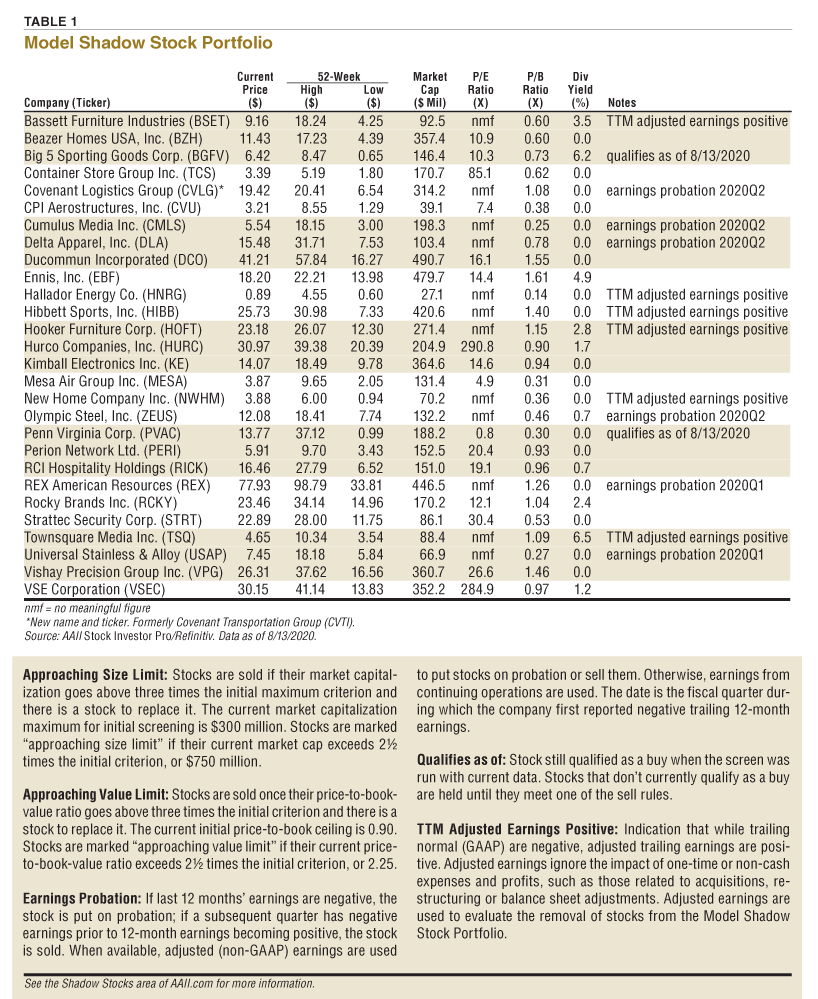
Table 1 presents the current holdings of the Model Shadow Stock Portfolio with data as of August 13, 2020. Twelve of the 28 stocks have negative trailing 12-month earnings after reporting earnings recently. When available, the adjusted earnings calculated by earnings reporting services such as I/B/E/S were examined to determine if the companies should be placed on earnings probation. Your brokerage company research page is a good source of this type of information. Six of the companies with negative earnings had adjusted earnings declines large enough to place them on earnings probation. They will be removed from the model portfolio if they report negative adjusted quarterly earnings before their trailing 12-month earnings turn positive. The other six have negative GAAP earnings, but positive adjusted earnings for the trailing 12 months.
 The earnings probation rule was added in 1997 to maintain reasonable turnover, which is very costly with micro-cap stocks yet removes stocks with declining prospects. The initial earnings losses were frequently observed to be one-time write-downs. The impact of such write-downs is often a long-term positive, while the negative price impact often occurs prior to the next portfolio review. As a result, the earnings probation rule was created. A loss over the last 12 months will put the stock on a probationary status, but it will be sold only if the following quarter’s results are negative. From then on, a probationary stock is sold only if the 12-month results are negative and the most recent quarter’s earnings are also negative. If 12-month earnings return to positive, the stock is taken off probation.
To help guard against buying and selling a large number of marginal stocks that were dropped when earnings went negative but qualify again in a few quarters in the future, a rule was added that a stock removed from the portfolio within the past two years would not be added back.
The Model Shadow Stock Portfolio was set up with an eye to the investor who would only spend minimal time managing their portfolio. Since corporate reporting data is only quarterly in most cases, there is little reason to review stocks more frequently. If an individual wants to spend additional time, they could check the portfolio each month for the stocks that had earnings reports the previous month and then act accordingly.
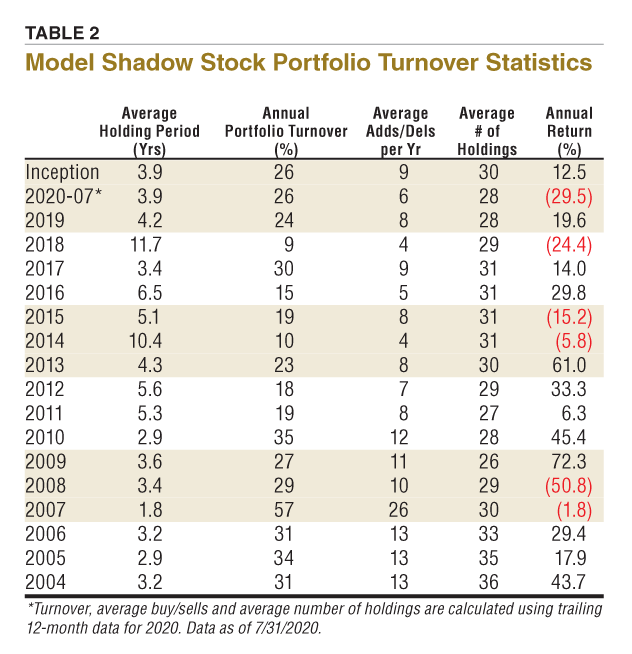
Table 2 shows the annual turnover of the Model Shadow Stock Portfolio since 2004. The portfolio has averaged an annual turnover rate of 26% over this time frame, indicating that portfolio holdings have been replaced (turned over) after an average of just four years. Of course, some holdings are held longer, while others are held for just a few quarters. Turnover was highest during 2007 (57%), which coincided with the start of the financial crisis and the previous economic recession. Turnover may increase later this year with six stocks currently on earnings probation. Just over half of the stocks sold in the Model Shadow Stock Portfolio since 2003 were removed because of negative earnings. (For a detailed examination of the pattern of Shadow Stock sells see the May 2019 Model Portfolios column in the AAII Journal.)
The next portfolio review will take place around the end of August, and any changes made then will be reported in the October 2020 AAII Journal. You can keep abreast of the Model Shadow Stock Portfolio on AAII.com in the Shadow Stocks area. To receive monthly email updates along with alerts to any changes made to the portfolio, please sign in to AAII.com and go to www.aaii.com/email. ▪
Small Cap Value Investing

AAII Model Portfolios


JOHN H from CA posted over 6 years ago:
S K from MD posted over 5 years ago:
You need to log in as a registered AAII user before commenting.
Log InCreate an account