People whose jobs require more manual labor develop health deficits faster both before and after retirement than those whose jobs do not require manual labor.
Using data from the Survey of Health, Aging and Retirement in Europe (SHARE) from 2004, 2006–2007, 2011, 2013 and 2015, the researchers looked at adults ages 50 to 85. Though “individuals accumulate health deficits as they grow older” no matter their occupation, individuals older than age 85 were excluded from this study because a number of people older than 85 exhibited what the authors call “super healthy characteristics (likely because of selection effects).” The study’s authors focused on individuals from Austria, Belgium, Switzerland, Germany, Denmark, Spain, France, Italy, Netherlands and Sweden.
Since “some occupations exert a higher toll on human health than others,” the authors found that although retirement plays a role in alleviating some of the stress the body undergoes while working a manual labor job, when those workers retire they can accumulate health deficits faster than individuals whose jobs do not require manual work. The health of men working in manual labor was more positively affected after retirement than women: “Retirement causes a particularly large reduction of health deficits for men in high-burden occupations, regardless of the dimension of burden.”
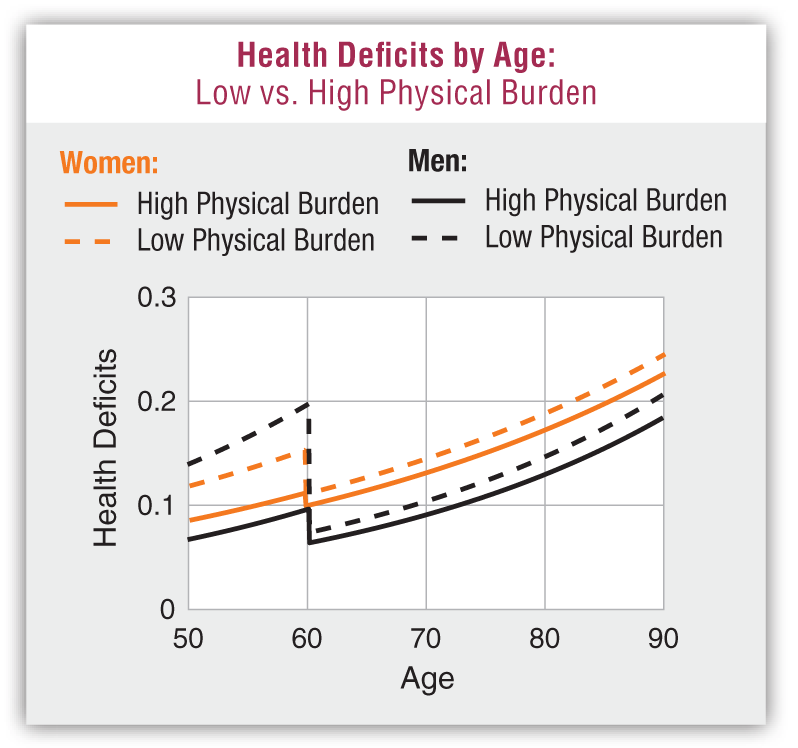
Although there are many factors other than occupation that can impact an individual’s health (i.e., behavior or “early life health shocks”), the study removed these factors to focus only on how work has affected health. However, since education and occupation are correlated, it was found that “individuals with low education, in blue collar jobs, and in physically or psychosocially demanding occupations develop new health deficits faster than individuals in the corresponding [white collar] group.” And to put a number to it, people who perform manual labor for their job “display on average almost 30% more health deficits than their counterparts” who do not.
Source: “Health and Aging Before and After Retirement,” by Ana Lucia Abeliansky and Holger Strulik; SSRN, June 2020.







No comments have been added yet. Add your thoughts to the discussion!
You need to log in as a registered AAII user before commenting.
Log InCreate an account