


Related

AAII Model Portfolios
The impact of the coronavirus pandemic has placed many of the Shadow Stock holdings on earnings probation and prompted removal of three stocks.
The Santa Claus rally came early this year, gifting investors with the strongest November performances on record. The Dow Jones industrial average’s gain of 11.8% was the best November performance it has turned in since 1928.
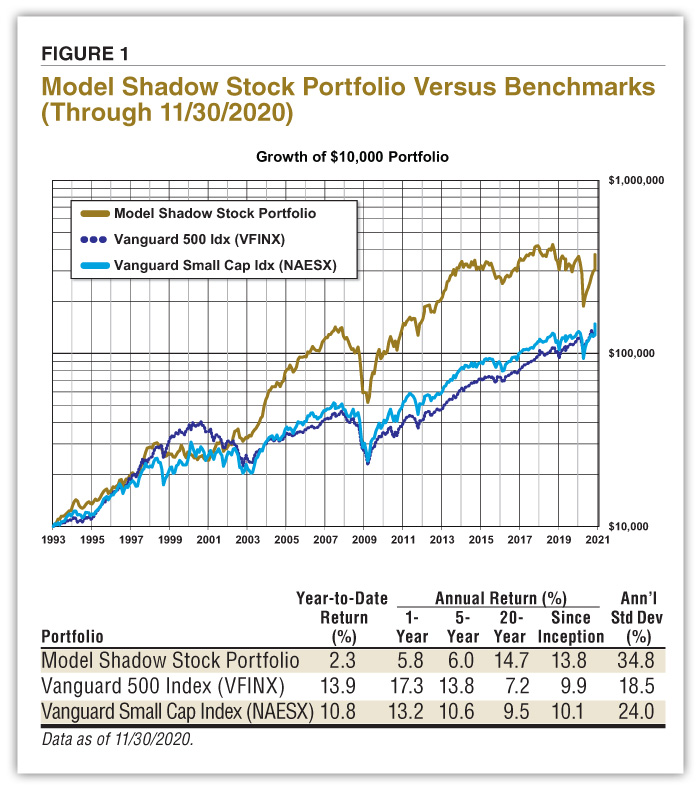
The Model Shadow Stock Portfolio gained 21.9% during November turning in its best single-month return since gaining 25.0% during April 2009. The Model Shadow Stock Portfolio is now up 98.5% since the end of March and is up 2.3% year to date.
The S&P 500 index as measured by the performance of the Vanguard S&P 500 Index fund  (VFINX) had a gain of 10.9% during November and is now up 13.9% during the first 11 months of the year. The Vanguard Small Cap Index fund (NAESX) is up 10.8% for the year after gaining 16.0% in November. The DFA U.S. Micro Cap fund (DFSCX) gained 16.4% during November but remains down 1.7% for the year.
Since its inception in 1993, the AAII Model Shadow Stock Portfolio has a compound annual average return of 13.8% versus the Vanguard 500 Index fund’s annual return of 9.9%. Over the same period, the Vanguard Small-Cap Index fund posted an average annual gain of 10.1%. Figure 1 summarizes the long-term performance.
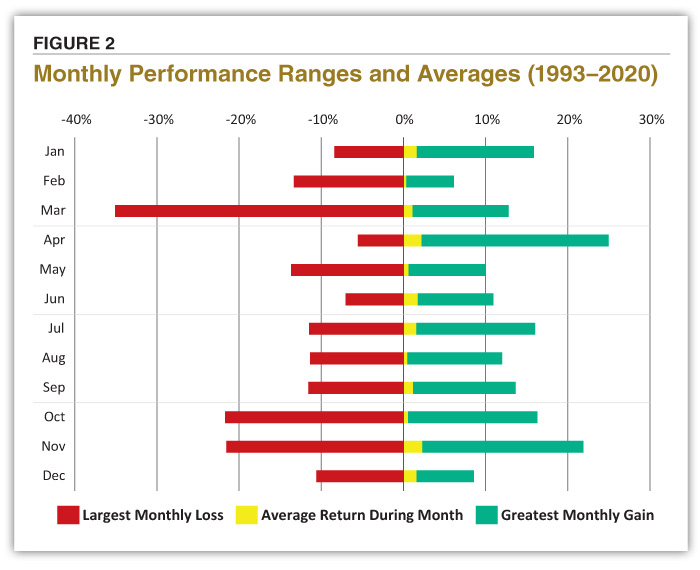
The 35.1% loss during March of this year and the 21.9% gain during November serves as a strong reminder of how quickly the market can move and the difficulties of trying to time movements into and out of the market. The impact of missing the single best month of the given year was discussed in the May 2018 AAII Journal (“Model Shadow Stock Portfolio: Staying Invested All 12 Months”).
Figure 2 presents the range of returns that the Model Shadow Stock Portfolio has observed each month over the 28-year history of the model portfolio, along with the average return each month. The portfolio has an average monthly return of 1.3% over its 28-year history. The month with the highest average return now is November (positive 2.3%), while the month with the lowest average return is February, at 0.4%.
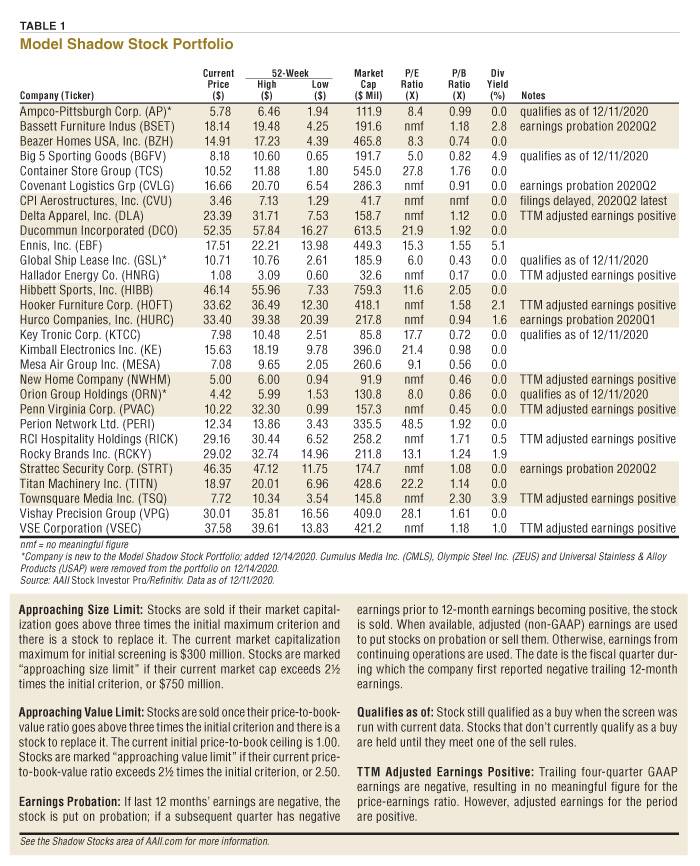
Table 1 shows the current holdings in the Model Shadow Stock Portfolio. The primary Model Shadow Stock Portfolio selection criteria target the intersection of the smallest 10% of domestic stocks as measured by market capitalization and the “cheapest” 10% of domestic stocks as measured by the price-to-book-value (P/B) ratio. These decile breakpoints are determined by examining domestic companies that are listed on the New York Stock Exchange (NYSE) and change over time. Given the dramatic market moves over the last year, it was not surprising to see the need for a slight adjustment to the Model Shadow Stock Portfolio rules.
The price-to-book-value ratio decile breakpoint of the NYSE stocks increased from 0.82 observed one year ago to the current level of 0.97, leading to an adjustment of the value used for the model portfolio from 0.90 to 1.00.
The NYSE market-cap cutoff for the lowest decile is currently $300 million, compared to $280 million one year ago, so the size cutoff was not adjusted for the Model Shadow Stock Portfolio during the quarterly review. A detailed analysis of the valuation and size breakpoints is available in the December 2020 Model Shadow Stock Portfolio Update on AAII.com.
The Model Shadow Stock Portfolio has company profitability rules in place when selecting candidates and pruning holdings; these act as a basic quality measure to filter out the many troubled companies found amid the pool of stocks trading with low price-to-book values. Notably, when adding stocks, positive quarterly and trailing 12-month
earnings from continuing operations are required and analysts must be providing positive earnings estimates for the current quarter and year.
Stocks are removed from the portfolio if they have values that exceed the initial market cap or price-to-book ratio by a factor of three during the quarterly portfolio review, or if earnings remain negative after a period of probation. The impact of the coronavirus pandemic on the economy has been dramatic and swift this year. Many of the Shadow Stock holdings have been placed on earnings probation. About half of the holdings had negative GAAP trailing earnings per share at the start of the quarterly review, with seven holdings on probation.
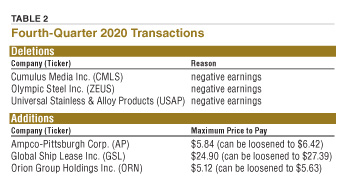 Three of the portfolio holdings reported negative adjusted quarterly earnings while on probation and were removed from the portfolio.
With the updated price-to-book maximum of 1.00, 14 stocks met the revised initial selection criteria for the Model Shadow Stock Portfolio. Two of the qualifying stocks were already held in the model portfolio, Big 5 Sporting Goods Corp. (BGFV) and Key Tronic Corp. (KTCC).
The remaining 12 stocks were examined to ensure adequate liquidity, timely financial filings and appropriate industry and foreign considerations. Three stocks were eliminated because their average daily trading volume was too low, and the resulting bid-ask spread was too wide for inclusion in the model portfolio.
We then used the weighted relative price strength ranking as a tiebreaker for the remaining candidates and three stocks were added.
(AP): Manufactures and sells specialty metal products and specialty industrial equipment to commercial and industrial users worldwide.(GSL): A containership owner, leasing ships to container shipping companies under industry-standard, fixed-rate time charters. The Model Shadow Stock Portfolio avoids pure leasing and rental companies that are primarily financial corporations; Global Ship Lease owns and charters its fleet of ships.(ORN): A heavy marine civil contractor that specializes in a full spectrum of marine, industrial and infrastructure construction services.The next quarterly review of the AAII Model Shadow Stock Portfolio will take place after the end of February. In the meantime, you can follow the portfolio in the Shadow Stocks area on AAII.com.
To receive monthly email updates along with alerts to any changes made to the portfolio, please sign up at www.aaii.com/email. ▪
AAII Model Portfolios

AAII Model Portfolios
AAII Model Portfolios

No comments have been added yet. Add your thoughts to the discussion!
You need to log in as a registered AAII user before commenting.
Log InCreate an account