

Related

Portfolio Strategies
The Mathematics of Retirement Portfolios

Financial Planning
One of the biggest retirement planning mistakes people make is not taking into account the taxes they will have to pay on their retirement income.
by AAII Staff | February 2021

One of the biggest retirement planning mistakes people make is not taking into account the taxes they will have to pay on their retirement income.
Researchers found that households that only take required minimum withdrawals (RMDs) plus interest and dividends from other accounts will pay 5.7% of their retirement income in taxes. Single taxpayers will pay 7.2%, while married couples will pay 5.5%.
It is important to note that the tax rate varies sharply by the Average Indexed Monthly Earnings (AIME) quintile for a household. (AIME is the basis used to determine Social Security benefits.) Tax liabilities are rarely greater than 2% of retirement income for retirees in the bottom four quartiles. However, those with retirement income that puts them in the top 5% and 1% of the highest AIME distribution will pay a larger share, especially those who are not married. For retirees in the top 20%, single individuals will pay 17.3% of retirement income in taxes and married couples will pay 10.7%. For those in the top 5% quartile, single retirees will pay 24.8% and married couples will pay 15.8%. Retirees in the top 1% will pay 22.7% of their retirement income in taxes.
The taxation rates are based on data from the Health and Retirement Study, which includes 1,907 households and 3,419 individuals who retired between 2010 and 2018 and didn’t receive disability benefits. Using the National Bureau of Economic Research’s TAXSIM 32 program, researchers estimated state and federal taxes on Social Security benefits, employer-sponsored plan distributions and other financial wealth.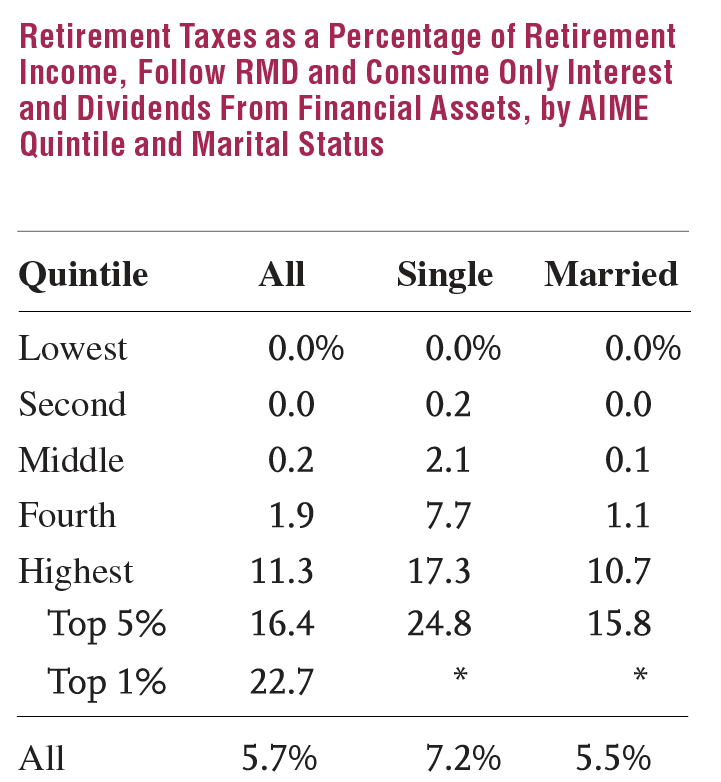
Assessing Social Security statements, defined-benefit pensions, defined-contribution balances and other financial assets can provide estimates of how much taxable income to expect. Retirees are taxed on pension payouts and withdrawals from any tax-deferred accounts, like traditional IRAs, 401(k)s, tax-deferred annuities and other similar retirement plans. RMDs now start at age 72. Those holding stocks, bonds or mutual funds outside of a retirement plan will typically be taxed on dividend and interest income; capital gains taxes will apply when an investment is sold at a profit.
Source: “How Much Taxes Will Retirees Owe on Their Retirement Income?” by Anqi Chen and Alicia H. Munnell; Center for Retirement Research at Boston College, December 2020.
Portfolio Strategies
Financial Planning

MARY M from CA posted over 5 years ago:
LARRY B from WV posted over 5 years ago:
STEPHEN P from GA posted over 5 years ago:
SCOTT O from FL posted over 5 years ago:
CHARLES R from IL posted over 5 years ago:
JAMES M from MT posted over 5 years ago:
LINDA P from MO posted over 5 years ago:
ROGER K from MA posted over 5 years ago:
RUSSELL C from OR posted over 5 years ago:
NORMAN B from SC posted over 5 years ago:
NORMAN B from SC posted over 5 years ago:
JAMES M from MT posted over 5 years ago:
You need to log in as a registered AAII user before commenting.
Log InCreate an account