


Specialized exchange-traded funds—ETFs targeting specific sectors or investing based on prevailing themes—charged higher fees and deliver poor risk-adjusted performance. The underperformance particularly occurs among newly launched specialized ETFs.
Researchers split the universe of equity ETFs into two categories: specialized and broad-based. Broad-based ETFs are defined by the study as ETFs that track broad market indexes. The original ETFs were broad-based but as more sponsors launched ETFs of their own, competition drove expense ratios lower. In response, ETF sponsors launched specialized funds for which they could charge higher fees.
Broad-based ETFs continue to dominate in terms of attracting investor dollars. They control about 80% of the assets under management (AUM) for the equity-focused ETFs analyzed. Despite controlling less than 20% of total AUM, specialized ETFs generate about 36% of the ETF industry’s revenues. The differential is because of the higher fees charged by specialized ETFs.
The investors who are drawn to specialized ETFs are described by researchers as those “who chase returns.” Specialized ETFs are launched to invest in securities presently attracting the attention of investors. Such stocks have often enjoyed strong price returns, are being discussed in the investment media and are forecast to grow earnings strongly.
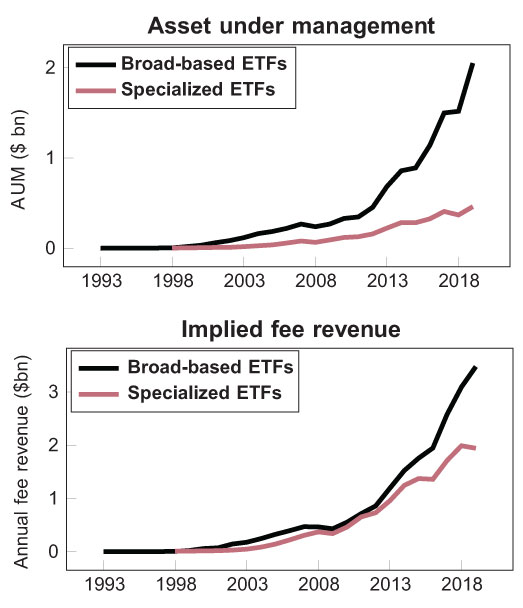
Despite being perceived as attractive investments, specialized ETFs disappoint. On a risk-adjusted basis, they lose about 3.1% per year. Put another way, these funds deliver negative alpha (outperformance). Worse yet, this underperformance is only partially attributable to the higher fees. A significant part of the underperformance is due to the tendency of such funds to be launched when interest is high and therefore so are the valuations of the stocks they invest in.
Nonetheless, these ETFs tend to be favored by so-called “sentiment-driven investors.” They also attract interest from unsophisticated investors seeking out investment ideas they perceive as having high future returns.
The findings are based on analysis of 554 broad-based ETFs and 526 specialized U.S. equity ETFs for the period of 1993 through 2020.
Source: “Competition for Attention in the ETF Space;” Itzhak Ben-David, Francesco Franzoni, Byungwook Kim, Rabih Moussawi; National Bureau of Economic Research, January 2021.

Related

First Cut ETFs
Emerging Markets ETF Winners
Related

Trading Strategies
Leveraged ETFs: Don’t Get Wiped Out by the Tail
Discussion
FREE REPORT

Get your free copy of our special
report analyzing the tech stocks
most likely to outperform the
market.
No comments have been added yet. Add your thoughts to the discussion!
You need to log in as a registered AAII user before commenting.
Log InCreate an account