


Related

First Cut Stocks
One factor that dividend investors often overlook is asset allocation, or the type of firms being invested in.
by Brian Haughey | March 2021

When a firm makes profits, it can choose to reinvest those earnings in the firm, pay them out to shareholders in the form of dividends, use them to repurchase its stock in a “stock buyback” or some combination of the three.
Rapidly growing firms tend to have volatile earnings. They prefer to retain earnings to fund organic growth and acquisitions. As firms mature and their growth slows, they often initiate dividend programs to return excess cash to shareholders.
Stock buyback programs tend to be intermittent and may not be executed in full. Such programs appeal to firms in sectors such as information technology, where it’s common to partly pay employees in stock and stock repurchases can prevent the number of shares outstanding from increasing. Stock buyback programs are also appealing to these firms because they increase the demand for shares, supporting a firm’s stock price.
On the other hand, dividends reduce stock prices because firms must use cash for the payments, reducing assets. A cynic might observe that this is one reason why many CEOs—who often own stock options—prefer to repurchase stock rather than pay dividends.
Income-oriented investors are attracted to stable sources of income, and firms that initiate dividend programs strive to continue them rather than interrupt the expected income stream. If a firm has insufficient earnings to pay dividends in a given year, it can tap its retained earnings, so that a short-term reduction in profits usually doesn’t lead to a suspension of dividends. If a firm does interrupt its dividends, the typical result is a sell-off in the stock, which firms don’t like because it increases their cost of capital. This reaction is not just because income investors move to sell the stock, but also because the broader market will likely view the firm’s cessation of dividends as being the result of financial distress.
Conversely, firms that increase their dividends tend to be rewarded by the market. First, an increase in dividends, particularly if it’s more than had been anticipated, is likely to increase the firm’s intrinsic value. Second, because companies are reluctant to reduce or eliminate a dividend, committing to an increased dividend sends a signal to shareholders that senior management are sanguine about the firm’s ability to continue paying the higher dividend in the future, and that the financial health of the firm, and its future prospects, are sound.
We think you’d like this related webinar! Seeking Dividend Safety and Aristocrats in a Volatile Market Video
According to S&P, dividends account for about one-third of equity total return since 1926. When those dividends are reinvested, their contribution to total return increases: A Hartford Funds analysis (cited by AAII Dividend Investing) shows that, since 1970, 78% of total returns from the S&P 500 index came from reinvesting dividends.
If dividends are important, we might conclude that a firm increasing its payments should outperform its peers that aren’t increasing their dividends. Some research bears this out, although others disagree. They list several reasons why receiving dividends can be a disadvantage. In particular, they point out that dividends are taxed as income, while firms that don’t pay dividends should experience capital gains, which are taxed more favorably. That argument is moot, though, if a firm is unable to deploy its retained earnings efficiently.
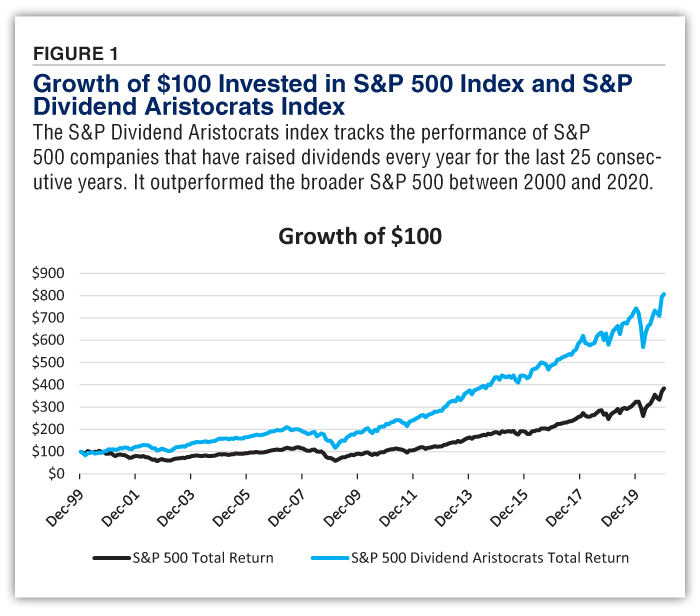
The S&P Dividend Aristocrats index focuses on dividend growers. It comprises the subset of S&P 500 stocks that have increased their dividends every year for at least 25 years. The index has performed impressively against the broader S&P 500 over the last 20 years, supporting the contention that dividend growers tend to outperform. As shown in Figure 1, the index returned 707% (10.45% annually), while the S&P 500 returned 284% (6.61% annually) through the period ending December 31, 2020.
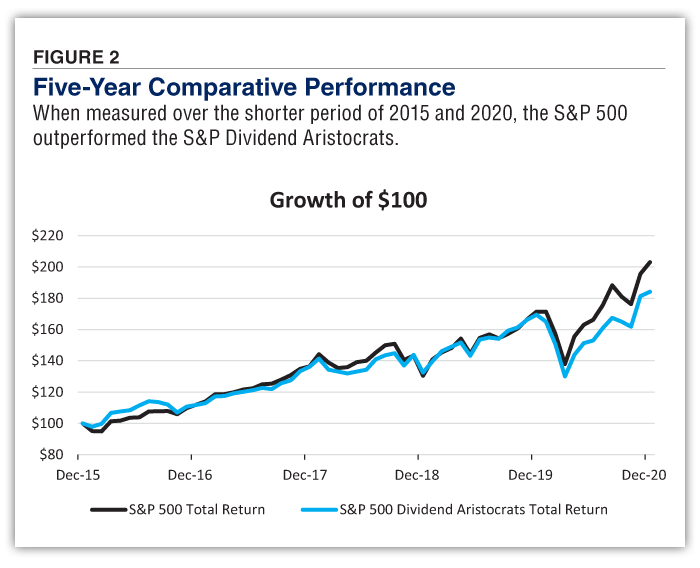
In recent years, the comparison has been less impressive. Between 2010 and 2020, for instance, the returns of both indexes were almost identical, with the Aristocrats’ return of 330% (14.18% annually) beating out the broad index by only 8%, or 20 basis points per annum. In the last five years, the S&P 500 returned 103% (15.2% annually), while the Aristocrats only managed 84% (12.97% annually), as shown in Figure 2.
What has led to the recent underperformance of the Aristocrats? Some researchers note that many firms wishing to return capital to shareholders have turned to share buybacks. They recommend that investors focus on firms with high shareholder yield, which combines buybacks with dividends.
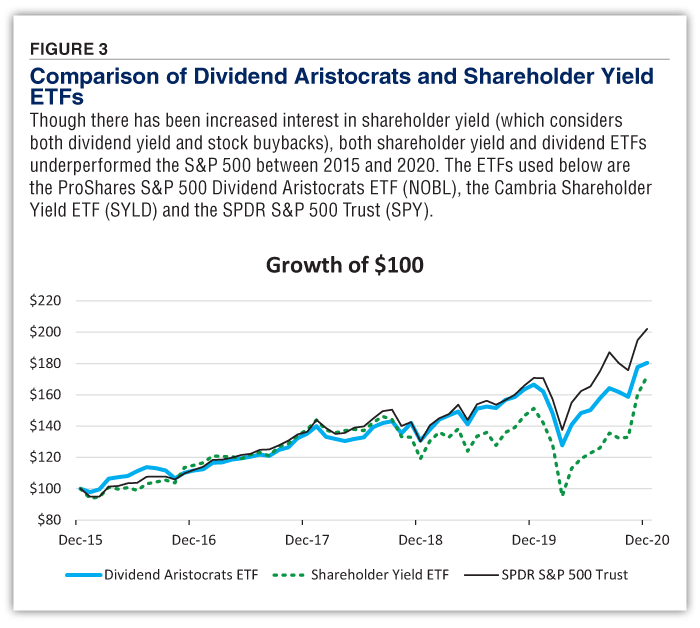
However, over the last five years, exchange-traded funds (ETFs) focused on shareholder yield have underperformed. Figure 3 on the next page compares the performance of the ProShares S&P 500 Dividend Aristocrats ETF  (NOBL) with that of the Cambria Shareholder Yield ETF (SYLD). After expenses, the Aristocrats ETF returned 12.51% annually, whereas the Shareholder Yield ETF returned 11.42%. Both funds underperformed the S&P 500 SPDR ETF Trust (SPY), which returned 15.09% annually after fees.
One factor that dividend investors often overlook is asset allocation, or the type of firms being invested in. As we shall see, the main reason for the underperformance of the Aristocrats ETF relative to the broad S&P 500 is its sector exposure, that is, the percentage of assets invested in each market sector.
The Pareto principle, sometimes referred to as the “80/20 Rule” suggests that 80% of consequences result from 20% of the causes. While examples of this rule can be found across nature, we can see from recent stock performance that the FAANG stocks [Facebook Inc. (FB), Amazon.com Inc. (AMZN), Apple Inc. (AAPL), Netflix Inc. (NFLX) and Alphabet Inc. (GOOGL)] have significantly outperformed the rest of the broad market. Any portfolio that doesn’t include those stocks is likely to underperform in the current environment, where growth stocks have been outperforming value.
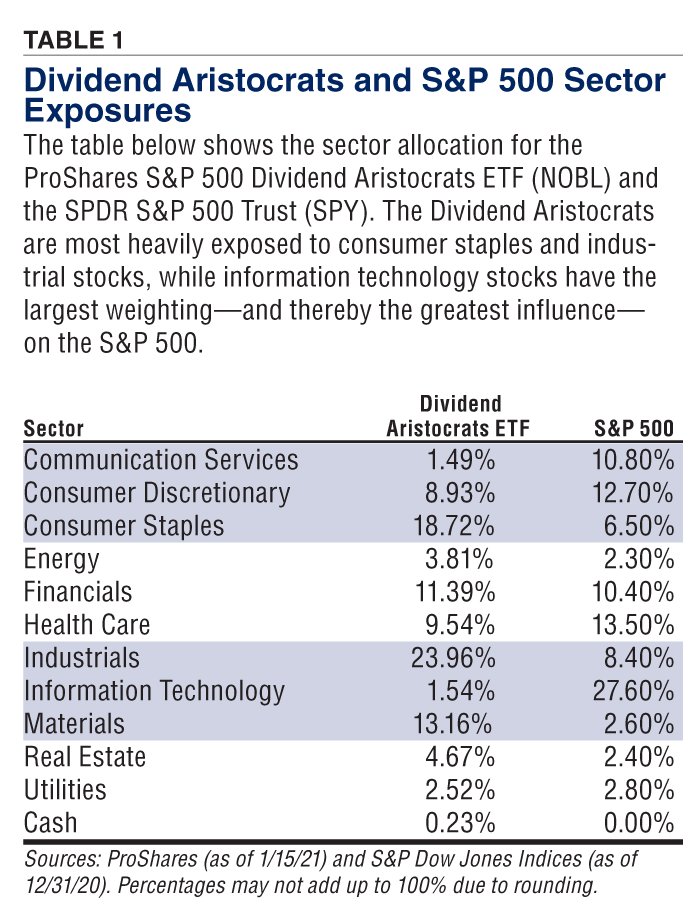
For instance, Table 1 shows that as of December 2020 stocks in the information technology sector accounted for 27.6% of the S&P 500, by market capitalization, whereas the corresponding exposure of the Dividend Aristocrats ETF was a mere 1.54%.
Since many of the recent best-performing companies in the information technology and communication services sectors are less than 25 years old, and because many don’t pay dividends, they don’t qualify for inclusion in the Dividend Aristocrats ETF. A consequence is that the ETF has much lower exposures than the S&P 500 to the information technology and communications services sectors and is more heavily weighted to the consumer staples, industrials and materials sectors.
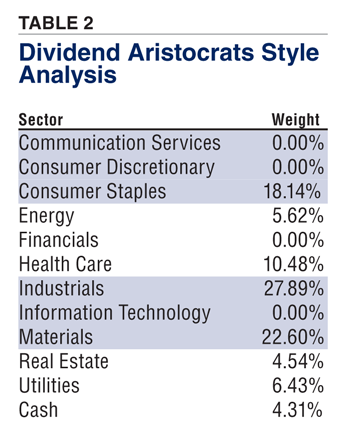
Furthermore, while the Aristocrats ETF has some exposure to the information technology and communications services sectors, the specific stocks in those sectors in the ETF may be more closely correlated to stocks in other sectors. An analysis of its performance over the last three years, using a technique known as returns-based style analysis, suggests that during this period the Aristocrats ETF has had average sector exposure that is more like that shown in Table 2.
Examining Tables 1 and 2, it becomes apparent that an investor in the Dividend Aristocrats ETF, intentionally or otherwise, is eschewing those sectors that have performed well in recent years and opting for a tilt toward value over growth. Since the ETF is precluded from holding many of the stocks that have performed well recently, such as the FAANG stocks, its performance will suffer relative to the S&P 500.
Understanding the allocations of any ETFs in which you invest is important, and you should be aware of any inadvertent sector bets that you may have made. Including dividend-paying stocks in general, and those in the Dividend Aristocrats ETF in particular, in your portfolio certainly has advantages. These well-managed firms have performed impressively over multiple decades, and offer a consistent, relatively low-risk income stream, but their lower risk may lead your portfolio to underperform a broad market index. Owning growth stocks, on the other hand, particularly those that don’t pay dividends, may lead to outperformance for some periods, but is likely to expose you to significantly more market risk, which may present a challenge if you rely on them for income. Investors who bought technology stocks during the dot-com bubble, for example, learned that painful lesson in the following decade.
While there is no sure-fire investing approach that is guaranteed to outperform the market consistently over time, having exposure to dividend-payers can offer relative peace of mind in an uncertain market.
First Cut Stocks

Exchange-Traded Funds

Investor Professor

No comments have been added yet. Add your thoughts to the discussion!
You need to log in as a registered AAII user before commenting.
Log InCreate an account