

Related

PRISM Wealth-Building Process
Investors need to learn how to minimize the risk that can be controlled and make sure that we are compensated for the risk that is unavoidable.
by John Bajkowski | March 2021

One difficulty with investing is not knowing what the future holds. How will stocks perform this year? How long will interest rates stay low? Where is the economy heading? When will inflation spike? When can we put the impact of the pandemic behind us? Risk is the four-letter word that describes these types of uncertainties that we deal with as investors.
Investors should not blush at the mention of risk, instead we should seek to understand risk. Investors need to learn how to minimize the risk that can be controlled and make sure that we are compensated for the risk that is unavoidable. At its most basic level, investing deals with the relations between risk and return.
Stocks, bonds, real estate, options and all other investments can be evaluated by examining measures of expected return and expected risk. It is normal to maximize return for a given level of risk or minimize risk for a given level of return. Investments need to be evaluated for their individual risk-reward potential and how they interact with the overall portfolio.
Understanding the basic determinants of risk and return is fundamental to the investment decision process. An analytical framework to compare investment alternatives with a consistent, critical risk and return framework should be used as an important step in the portfolio building and management process.
Before an investor starts to pick individual investments to construct a portfolio, they should assess a variety of considerations such as personal risk tolerance, liquidity needs, tax exposure, income needs and investment horizon. These factors are used to establish a strategic plan to guide the tactics used to implement your strategy.
“A Lifetime Strategy for Investing” is a guide AAII members can read online or download that provides an overview for formulating a strategy given your stage in life (www.aaii.com/lifetimeinvestmentstrategy). Sometimes individuals attempt to make decisions while pursuing vague objectives such as “to do well” or “to succeed.” However, such fuzzy objectives make it impossible for investors to successfully choose from the investment alternatives facing them. The focus of this special report is strategy—strategic allocation decisions made by the investor based on their life stage.
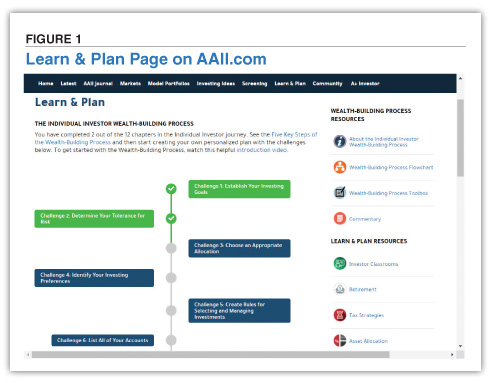
The Individual Investor Wealth-Building Process expands upon the concepts of the Lifetime Strategy for Investing and presents a five-step plan for defining your goals, picking an appropriate asset allocation, identifying your investing preferences, selecting your investments and monitoring your portfolio. The Wealth-Building Process at www.aaii.com/learnandplan includes a series of challenges that guide you through worksheets to establish your strategy, select an asset allocation and compose your portfolio (Figure 1).
Risk control is accomplished with a portfolio. You need a portfolio to diversify. A portfolio is represented by a collection of investments held together for a common goal. Investments have several major sources of risk that could produce unexpected returns.
Business and industry risk: The uncertainty of an investment’s ability to pay investors income, principal and any other returns due to a fall-off in business or even bankruptcy. A stock, for instance, may fall in value because a firm’s earnings have unexpectedly dropped due to bad management calls or an industry-wide slowdown.
Inflation risk: The uncertainty over future inflation rates, which results in uncertainty over the future real value of your investment. An investment that barely keeps pace with inflation will not be able to grow in real terms, leaving you with only as much purchasing power in the future as you have today.
Market risk: The risk that the general market or economic environment will cause the investment to lose value regardless of the particular security. A stock may drop in value simply because the overall stock market has fallen; this is referred to as stock market risk. A bond doesn’t face stock market risk, but it may drop in value due to a rise in interest rates; this is referred to as interest-rate risk.
Liquidity risk: The risk of not being able to get out of the investment conveniently at a reasonable price. This can occur for a number of reasons. If the market is volatile, you may be forced to sell at a significant loss if you must sell immediately. Another cause can be an inactive market. For instance, it may be difficult to sell a house simply because there are no buyers.
While potential returns should compensate you for risk, there are some risks that you will not be compensated for, and therefore they should be avoided. If you invest in a single security, your return will depend solely on that security. Individual firm risk accounts for up to 70% of the total risk that stock investors face. Yet, this risk can be almost eliminated by diversifying among different stocks—investing in, for instance, 15 different stocks rather than just one. Market risk, on the other hand, accounts for about 30% of total risk and cannot be avoided by diversification since all stocks are affected to some degree by the overall market.
The stock market provides higher returns for higher risks, but it only provides those higher returns for unavoidable risk. Firm risk is largely avoidable. No matter what investment objectives an investor may have, no matter what the intended holding period is, no matter what kind of stock analysis is performed, if you do not have a diversified portfolio, you are either throwing away return or assuming risk that could be avoided—or both.
Diversification substantially reduces your risk with little impact on potential returns. The key involves investing in categories or securities that are dissimilar. Diversification should occur at all levels of investing. Diversification among the major asset categories—stocks, fixed income and money market investments—can help reduce market risk, inflation risk and liquidity risk, since these categories are affected by different market and economic factors.
Diversification within the major asset categories—for instance, among the various kinds of stocks (international or domestic, for instance) or fixed-income products—can help further reduce market and inflation risk. And diversification among individual stocks helps reduce business risk.
There is one other type of diversification that is extremely important yet often overlooked—time diversification, remaining invested over different market cycles.
Time diversification helps to reduce the risk that you may enter or leave a particular investment or category at a bad time in the economic cycle. It has much more of an impact on investments that have a high degree of volatility, such as stocks, where prices can fluctuate over the short term. Longer time periods smooth those fluctuations. Conversely, if an investor cannot remain invested in a volatile investment over relatively long time periods, those investments should be avoided. Time diversification is less important for relatively stable investments, such as certificates of deposit, money market funds and short-term bonds.
Time diversification also comes into play when investing or withdrawing large sums of money. In general, it is better to do so gradually over time, rather than all at once, to reduce risk.
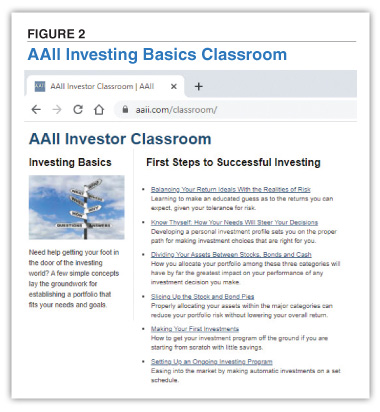
These are the important risk-reward concepts considered by the Individual Investor Wealth-Building Process. They are also explained and reinforced through the Investing Basics online classroom at www.aaii.com/classroom (Figure 2).
PRISM Wealth-Building Process

Value Investing

Portfolio Strategies

GEORGE C from CA posted over 5 years ago:
John D from OH posted over 4 years ago:
CHARLES R from IL posted over 4 years ago:
You need to log in as a registered AAII user before commenting.
Log InCreate an account