

Related

PRISM Wealth-Building Process
Get started building your portfolio with tips on asset allocation and how to decide whether to invest in stocks, funds or bonds.
by Anine Sus | January 2024

If you have been following along with me in this series as a beginning investor, you have your finances in order, you know how much money you have available to invest and you’ve opened a brokerage account—now what? It’s time to start being that investor and build your portfolio.
To have a successful investment portfolio, you must diversify what you hold. This doesn’t mean just owning stocks from various countries or splitting your money evenly between domestic and foreign investments. Its purpose is to strategically build a safety net for your portfolio to survive in all kinds of markets, much like getting your sweaters out of storage to protect yourself against the winter. But you don’t have just one sweater, you have a mock neck for the milder days and a nice fluffy knit for going out in the snow. By diversifying your portfolio, you reduce the risk of one bad investment losing value—or your only sweater unraveling—and tanking your returns.
Asset allocation is simply defined as how investors divide their portfolios between different types of investments. AAII’s Asset Allocation Models are a great place for beginners to start. They cover three general types of investors: aggressive, moderate and conservative. Each model is unique based on its allocation to stocks. Since the stock market is inherently more volatile, this allocation also equates to how much risk you want to take.
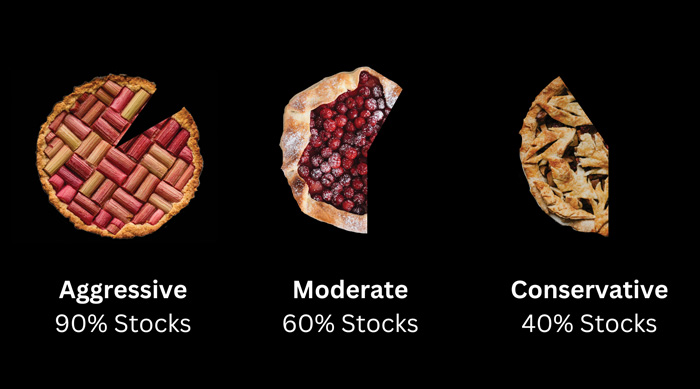
AAII’s My Portfolio tool has a diversification analyzer for A+ Investor and Platinum subscribers that will tell you exactly how much you deviate from whichever Asset Allocation Model you choose to follow. The diversification analyzer shows your portfolio’s allocation to domestic stocks, foreign stocks, bonds and cash. Since I am still a beginning investor with a long time horizon, my portfolio is practically all in stocks, with a little slice in cash. I can follow the aggressive model without allocating anything to bonds, since I’m choosing to only invest in things I can understand.
As a beginner, it’s crucial to understand what you’re investing in before you make a decision. Your hard-earned money is going into something that should make you more money in the long run, but only if you know its purpose and structure.
Stocks may be intimidating to the beginner, but they happen to be a great place to start for those who don’t have much money to spare. A stock is a piece of a publicly traded company that you can purchase on an exchange and add to your portfolio. As the company increases in value over time, so should your investment in the company’s stock.
You could start investing in stocks with as little as $5, especially with the growing availability of fractional share purchases. Fractional shares allow you to buy a portion of a share of stock based on the dollar amount rather than a whole share. This works well for investors who are regularly contributing small amounts to their savings but be sure to check which brokers allow fractional shares before opening your brokerage account. Note that fractional shares are not available for every stock, even if your broker offers them.
For those with more money to burn, you can start with a few hundred or a couple thousand dollars. You might choose a specific stock investing strategy to follow, which would narrow your investment universe so you can more easily choose stocks. For example, you can invest in value stocks (those undervalued by the market), growth stocks (those with significant price growth potential), dividend stocks (those that pay out a portion of earnings to investors on a quarterly basis) or stocks that grade well on environmental, social and governance (ESG) parameters.
You can also invest in stocks based on their size. Small-, mid- and large-cap stocks are named for the size of the company’s total equity value, called market capitalization. Small-cap stocks can be a good entry point for beginners since their share prices are usually lower.
A good way to ensure you are diversifying your portfolio is to hold at least 20 individual stocks. As we discussed with the sweaters, your stocks should not be overly concentrated in one industry or sector. This way, your portfolio can weather any storm.
Also suitable for the beginner are mutual funds and exchange-traded funds (ETFs). Funds are baskets of securities that investors can add to their portfolios for easy diversification. Funds primarily invest in stocks and bonds, so you could start your portfolio with just funds. Though mutual funds and ETFs both fall into the fund category, they have significant differences.
A mutual fund is a pooled collection of assets funded directly by investment dollars from many investors. Unlike stocks, mutual funds are traded once per day when the market closes at 4:00 p.m. Eastern Time. Many mutual funds require a minimum amount to invest, ranging from $500 to $5,000, so some mutual funds will be off-limits to beginners.
Mutual funds can also have higher taxes and fees. A mutual fund that is actively managed has a fund manager who makes buy and sell decisions. More transactions like these can lead to higher transaction fees and capital gains, meaning more taxes. Index mutual funds are passive and follow an index representing a specific area of the market. This means no extra costs for analyzing individual companies. Mutual funds can also have front- or back-end loads. A load is a sales charge or commission that is paid to the broker or adviser who sells you the mutual fund.
ETFs are a happy medium between stocks and mutual funds: They pool investors’ money like mutual funds but trade on exchanges like stocks. There is no minimum amount you must invest in an ETF and some brokers allow you to buy fractional shares—as you can with a mutual fund. ETFs can be actively managed, but the majority are passive index ETFs. ETFs also have lower tax-cost ratios because they issue and redeem shares with an intermediary known as an authorized participant. This gets a bit complicated, but it results in fewer capital gains distributions to pass along to shareholders.
To help you determine a good fund to invest in, you can compare their expense ratios. An expense ratio represents the cost of owning a mutual fund or ETF in your portfolio. A good cutoff for expense ratios is 0.75% for an actively managed fund. Anything above 1.50% is considered a very high expense ratio and will eat a large slice of your returns over the long run.
Though I don’t personally invest in bonds, I will do my best to explain how you can! A bond represents the debt of a company or government entity. A bond is considered a loan that you make to the issuer that will be paid back whenever it reaches its date of maturity.
Bonds with good credit ratings are low-risk investments that are held in your portfolio for anywhere between one and 30 years depending on the issuer. I think of bonds as the opposite of stocks in this regard: They are safe and will not appreciate in value nearly as much as stocks do over time. You will see less fluctuation in price and receive a lower, more fixed reward. However, if you are a moderate or conservative investor, you should include bonds in your portfolio. They will maintain the core of your portfolio’s value when the stock market is down. Since bonds are considered debt, companies are obligated to pay back bondholders before stockholders receive a penny.
Bonds increase in value based on yields or interest rates. These yields are likely better than what you can get from other savings vehicles. However, bond yields and inflation move inversely to each other, so when inflation is rising, bond yields will be lower. You can buy government bonds at TreasuryDirect.gov, though I have heard its interface is somewhat difficult to navigate.
Having a diversified portfolio of assets is key to long-term investing success. You can monitor your portfolio’s allocation and make changes based on what you want your portfolio to do for you. The last thing you want is one investment overtaking your portfolio with its high gains, or with its huge losses. You can check on a quarterly basis or less frequently if you find that not much is changing until six months or one year down the line. To get your allocation back to where you want it, you can sell all or part of your position in a security. If you want exposure to different industries, you can start by researching how those industries are doing and who the leaders are. Strategic asset allocation means you can have your pie and, eventually, eat it too!
PRISM Wealth-Building Process

PRISM Wealth-Building Process

PRISM Wealth-Building Process

JOHN L from NJ posted over 2 years ago:
ROBERT A from NC posted over 2 years ago:
ROBERT A from NC posted over 2 years ago:
DIETMAR K from AUT posted over 2 years ago:
THOMAS S from OR posted over 2 years ago:
PAUL S from OR posted over 2 years ago:
PAUL M from NY posted over 2 years ago:
KEVIN V from NC posted over 2 years ago:
MICHAEL B from WI posted over 2 years ago:
You need to log in as a registered AAII user before commenting.
Log InCreate an account