Contrary to expected behavior, retirees tend to reduce their spending for basic needs more than that for non-essentials.
In an effort to find what drives retiree spending, T. Rowe Price used data from 1,470 households interviewed between 2001 and 2015 from the Health and Retirement Study (HRS) and the Consumption and Activities Mail Survey (CAMS).
Author Sudipto Banerjee states, “Conventional thinking believes that nondiscretionary spending—basics like housing, food and utilities—is fixed and does not change over time. However, if we look closer, most of us do have some choice over how much we spend on these items. For example, one might move from New Jersey to Arizona to lower the housing costs or buy groceries in less expensive stores. While housing and food remain indispensable spending items, there are ways to live or shop more economically.”
In looking at retiree spending, Banerjee found that a decline in retiree spending was primarily driven by a decrease in nondiscretionary spending. In addition to housing, food and utilities, nondiscretionary spending includes insurance, property taxes, home repairs and maintenance, housekeeping supplies, auto payments and maintenance, clothing, medication, health care services and gasoline. The study defines discretionary spending as vacations, household furnishings and equipment, charitable and political contributions, cash or gifts to family and friends, personal care products and services, sporting and art events, gym memberships and dining out/takeout food.
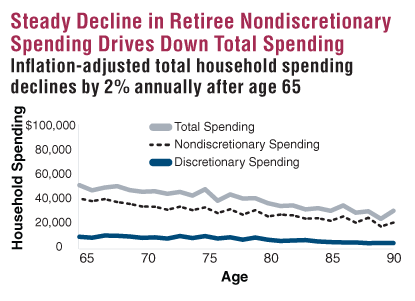 Banerjee discovered that following “a short adjustment period,” in an effort to preserve existing assets, “retirees set their nondiscretionary spending to match their guaranteed income, rather than choose their guaranteed income to match their nondiscretionary spending. This behavior suggests that retirees are reluctant to bridge any spending gap (between nondiscretionary spending and guaranteed income) by buying additional guaranteed income such as annuities.”
Banerjee suggests that if retirees don’t want to dip into their nest eggs, it would be helpful for their employer to know if they want an asset preservation or a spending preservation plan for retirement. Employers could then provide solutions and professional guidance, if necessary, so that retirees can properly plan for retirement instead focusing only on savings. The author also notes that if done correctly, offering in-plan solutions for retirees could reduce investing management costs.
Source: “Decoding Retiree Spending,” by Sudipto Banerjee; T. Rowe Price, March 2021.







No comments have been added yet. Add your thoughts to the discussion!
You need to log in as a registered AAII user before commenting.
Log InCreate an account